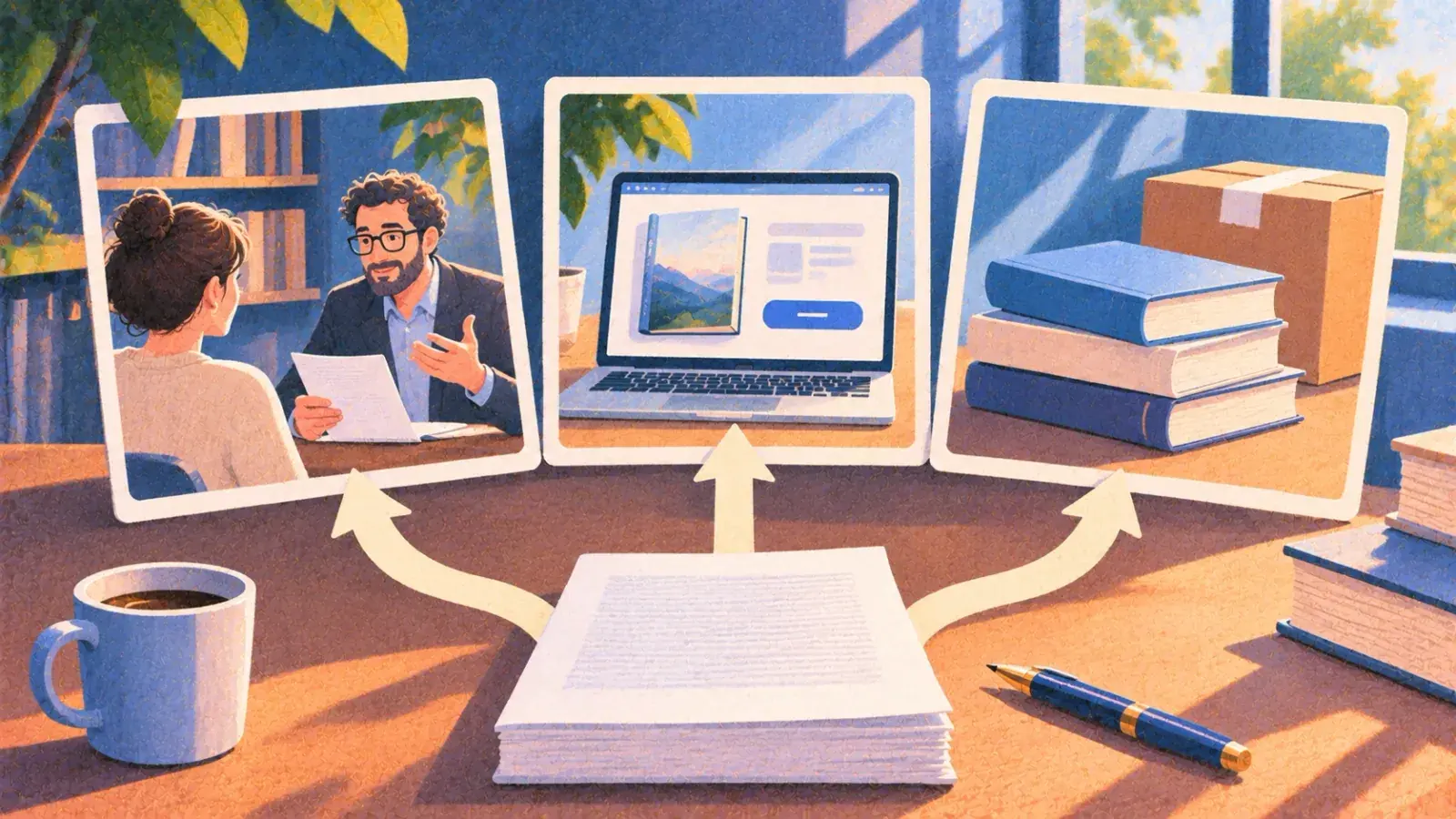
To publish a book, finish and edit the manuscript, then choose a route by three things: who controls the book, who pays up front and how it reaches readers. Traditional publishing costs you nothing up front and has the reach to get the book into bookstores, but an agent and a publisher make the decisions, and the publisher licenses your rights in return for an advance and royalties. Self-publishing on platforms such as Amazon KDP and IngramSpark leaves every decision and right with you, but you pay for editing and design and do the selling. Hybrid publishing sits between: a selective press edits and distributes the book under its imprint, and you pay part of the cost.
One rule is reliable: a reputable agent or traditional publisher doesn't charge you to read or sign your book. A company that takes your money and accepts every manuscript is a vanity press, whatever it calls itself.
Three ways to publish a book
| Traditional | Self-publishing | Hybrid | |
|---|---|---|---|
| Who pays to produce it | TraditionalThe publisher, which also pays you an advance | Self-publishingYou | HybridYou, for part or all of it |
| Who decides | TraditionalAn agent, then an editor and the publisher | Self-publishingYou | HybridThe press, which turns books down |
| How it reaches readers | TraditionalThe publisher's sales team and distributor, including bookstores | Self-publishingOnline retailers; stores can order print copies through IngramSpark | HybridThe press's distributor, which varies from press to press |
| What you earn | TraditionalRoyalties, once the advance has earned out | Self-publishingThe platform's royalty on each sale | HybridA higher royalty, usually no advance |
| Time to publication | TraditionalQuerying, then usually 12–18 months after the manuscript is accepted | Self-publishingDays to weeks once the files are ready | HybridSet by the contract |
| Rights | TraditionalLicensed to the publisher, often for the full term of copyright | Self-publishingYours | HybridSet by the contract |
Traditional royalties are a percentage of the list price or of the publisher's net receipts. The Authors Guild's Model Trade Book Contract, free to read with a commentary on every clause, pays 10% of list on the first 5,000 hardcovers, 12.5% on the next 5,000 and 15% after that, 7.5% of list on trade paperbacks, and 25% of net receipts on ebooks, which the Guild calls the current standard. The advance is paid against those royalties, so the book has to earn it back before any royalty check arrives.
How to choose your route
Traditional publishing suits you if
- You want an advance, a publisher's editing and design, and copies in bookstores.
- You can wait through months of querying and a year or more of production.
- You'd rather write than hire editors and buy ads.
- You can let the publisher have the final say on cover and price.
Self-publishing suits you if
- You already reach readers: a newsletter, a series following, a speaking calendar.
- You want to choose the cover, the price and the publication date.
- The audience is small and known, like a family history or a local guide.
- You can pay for editing and design up front and treat sales as a business.
A hybrid press sits between the two: it selects and distributes like a publisher but charges like a service, and the questions that tell a real one from a vanity press are in hybrid publishing. If you want a traditional deal for this book, query before you self-publish it. The self-publishing route stays open either way.
How to publish a book traditionally
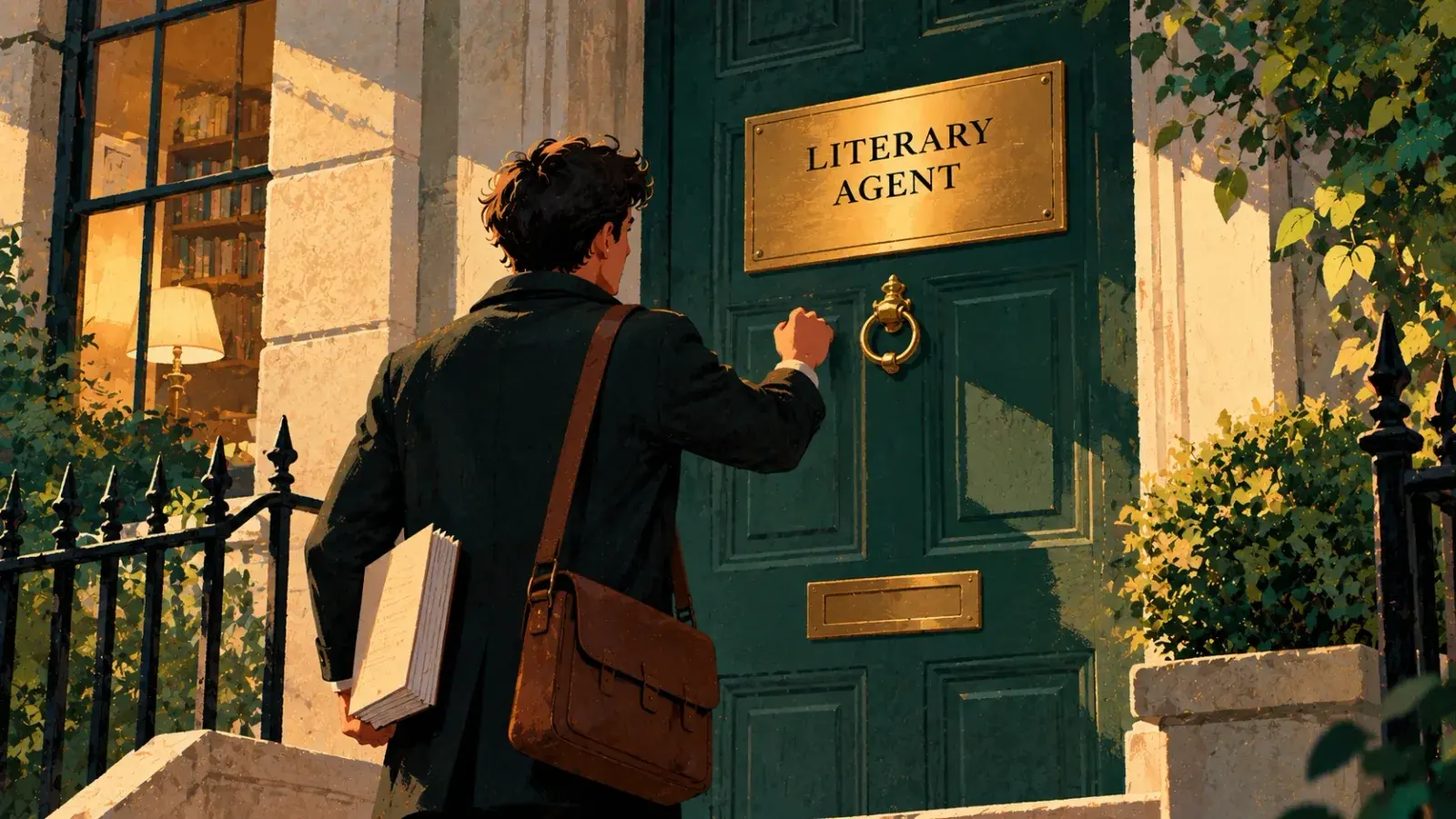
The Big Five houses and their imprints generally take only agented submissions. Small and independent presses work the same way, with no fee to you, though their advances are often small or absent, and some read manuscripts sent straight from authors.
- Finish and revise the manuscript
For a novel, agents expect the complete, revised manuscript, so revise with notes from a few beta readers first. Most nonfiction sells on a book proposal and sample chapters, though debut memoirists are often asked for the whole book.
- Write the submission package
A one-page query letter, a synopsis of one or two pages that gives away the ending, and the opening pages in standard manuscript format. Guidelines differ by agent, so check each package against the one you're sending to. If you draft in Strokes, attach the agent's guidelines to a chat with the Strokes Assistant and ask what your package is missing.
- Query agents in small batches
Find agents who represent your category and have recently sold books like yours, query five to ten at a time, and rework the letter if nobody asks for pages. Agents earn a commission on what the book makes. Members of the Association of American Literary Agents may not charge reading fees, and under the ethics code in force since September 2026, a member who sells editing to a writer who isn't a client must say in writing that paying doesn't mean representation. The full process is in how to get a literary agent.
- Go on submission
Your agent may ask for one more revision, then sends the manuscript to editors likely to want it. An editor who loves it makes an offer, and if several do, the agent can run an auction. Before the contract, publishers often send a deal memo listing the main terms.
- Read the contract before you sign
Your agent negotiates, but you sign. The advance comes in installments: the Authors Guild's model pays on signing, on acceptance of the manuscript and on publication, and the Guild notes that three, four or even five installments have become common. The rights section below lists the clauses to check.
- Edit, proof and launch with the publisher
How to self-publish a book
Self-publishing makes you the publisher: you hire the people a publisher would, approve every file and set the price.
- Pay for a real edit
Plan three passes: a developmental edit for structure, a copyedit for sentences and consistency, and a proofread of the formatted files. Book them in that order, because each pass changes what the next one sees.
- Commission the cover
An ebook needs only a front cover. A print book needs a full wrap, and the spine width depends on the page count, so the print cover is finished after the interior. Hire a designer whose portfolio is full of your genre.
- Decide on ISBNs
On KDP an ebook needs no ISBN, but each print format does, and KDP gives one free. A free KDP ISBN can only be used on KDP, and the imprint shows as “Independently published”. IngramSpark also offers a free ISBN, which it owns and which can't be transferred. To use your own imprint and one number everywhere, buy ISBNs from the national agency: in the US, Bowker sells one for $125 and ten for $295, as of November 2026.
- Format the files
Choose a trim size, then make a print-ready PDF and an EPUB from the same edited text. The manuscript formatting guide covers margins, type and front matter.
- Write the description and metadata
The retailer page does the selling: title, description (your blurb), categories, keywords and an author bio. KDP caps the description at 4,000 characters and won't accept reviews, quotes, web addresses or time-sensitive details in it.
- Choose where to sell
KDP sells ebooks and print-on-demand paperbacks and hardcovers on Amazon. IngramSpark prints on demand for other retailers and libraries, charges nothing to set up a title, lets you decide whether stores can return copies, and says a new title takes two to six weeks to appear. Since February 2026 it has taken a market access fee of 1.875% of the list price on each sale through its network. Draft2Digital distributes ebooks and paperbacks to the major online stores and library partners for a commission, and since April 2026 new accounts pay a one-time $20 activation fee. KDP Select, a 90-day program that renews unless you switch renewal off, requires the ebook to be sold only through KDP for each term; print can go anywhere.
- Set the price
On Amazon.com, KDP pays 70% on eligible ebooks listed at $2.99 to $12.99, after subtracting a delivery cost that averages $0.06 a copy, and 35% outside that band. The top of the band rose from $9.99 in July 2026, so check KDP's pricing page before you set a price. Paperbacks earn 60% of a list price of $9.99 and up (50% below), minus printing. KDP's own example: a 333-page black-ink paperback at $15 costs $5.00 to print and earns $4.00 a copy on Amazon, or $1.00 through Expanded Distribution, which pays 40%.
- Register the copyright
Registration is voluntary in the US, but you must register before you can sue over a US work, and registered works may be eligible for statutory damages and attorney's fees. The Copyright Office charges $45 online for a Single Application (one author, one work) and $65 for a Standard Application.
What publishing a book costs
Traditional publishing should cost you nothing up front. Self-publishing costs nothing to upload; the real costs are the people you hire.
| Cost | Traditional | Self-publishing |
|---|---|---|
| CostAgent | TraditionalA commission on earnings, not a reading fee | Self-publishingNone |
| CostDevelopmental edit, 80,000-word novel | TraditionalPaid by the publisher | Self-publishing$2,400–$2,800 |
| CostCopyedit, same novel | TraditionalPaid by the publisher | Self-publishing$1,600–$2,160 |
| CostProofread, same novel | TraditionalPaid by the publisher | Self-publishing$960–$1,600 |
| CostISBNs | TraditionalThe publisher's | Self-publishingFree from KDP for print (KDP only), or 10 for $295 from Bowker |
| CostUploading | TraditionalNot applicable | Self-publishingNo setup fee on KDP or IngramSpark |
| CostDistribution | TraditionalPaid by the publisher | Self-publishingIngramSpark keeps 1.875% of list price on network sales |
| CostPrinting | TraditionalPaid by the publisher | Self-publishingDeducted from each print-on-demand sale |
| CostCopyright registration | TraditionalCheck the contract | Self-publishing$45 or $65 online |
The EFA surveys its members' rates rather than setting them. Its 2026 rate chart, based on what members charged in 2025, gives fiction medians of 3.0–3.5¢ a word for a developmental edit, 2.0–2.7¢ for a copyedit and 1.2–2.0¢ for a proofread, and nonfiction runs higher. For the cover, get quotes from three designers who work in your genre.
Rights to read before signing
In the US your work is under copyright from the moment it is fixed in a tangible form. A standard trade contract leaves that copyright in your name and licenses the publisher specific rights: permission to publish the book in certain forms, places and languages for a set time. Two free references explain the terms before you meet them in a contract: the Authors Guild's model contract, with its clause-by-clause commentary, and the Copyright Office's copyright FAQ. These four clauses decide what you can do with the book for decades:
| Clause | What it decides | The Authors Guild's position |
|---|---|---|
| ClauseGrant of rights | What it decidesWhich formats, languages and countries the publisher may sell in, and for how long | The Authors Guild's positionIts model grants print, ebook and audio in English for the US, its territories and Canada, for the term of copyright. Keep audio rights to sell separately if you can. |
| ClauseSubsidiary rights | What it decidesWho may license translations, film and other uses, and how the money is split | The Authors Guild's positionForeign rights left unsold for two or three years should revert to you. |
| ClauseAdvance | What it decidesHow much, and when it's paid | The Authors Guild's positionTwo equal installments for advances of $40,000 or less. |
| ClauseReversion of rights | What it decidesWhen the rights come back to you | The Authors Guild's position“Out of print” should include an income test: under $250–350 to you over the prior two accounting periods, whether or not copies are on sale. |
The income test matters because a print-on-demand listing can keep a book available forever. Under the model clause you can ask for your rights back two years after publication, and if the publisher doesn't reissue the book within six months, they revert. Separately, Section 203 of US copyright law lets authors, or certain heirs, end a grant made in 1978 or later, generally 35 years after it was signed (for a publishing grant, 35 years after publication or 40 after signing, whichever comes first), by serving notice in advance. In self-publishing you keep everything: a platform's agreement lets it sell the book, and KDP Select's ebook exclusivity lasts as long as you keep renewing its 90-day term.
Three books, three routes
Priya Raman finishes an 82,000-word cozy mystery about a crossword constructor in Duluth. She queries 28 agents in four batches over five months and signs with the agent who asks the sharpest questions. After one more revision the book sells in a two-book deal, with the advance paid on signing, on acceptance and on publication, set for 18 months after acceptance. From first query to finished book: about three years.
The tradeoff Priya accepted: she paid nothing at any stage and got a publisher's editing and bookstore distribution, in exchange for about three years and the publisher's final say on cover, price and date.
Marcus Hale plans a four-book fantasy series. Book one runs 90,000 words, and a developmental edit, a copyedit and a proofread at the EFA medians come to $5,580–$7,380. He buys ten ISBNs for $295, so every print edition carries his own imprint, and registers the copyright for $45. The 333-page paperback at $15 earns $4.00 a copy on Amazon. The ebook at $4.99 earns 70%, about $3.45 after the average delivery charge.
The tradeoff Marcus accepted: before the cover and any ads he has spent $5,920–$7,720, roughly 1,500 to 2,250 sales to earn it back, and the selling is his job. In return he controls the cover, price and schedule, the book can be on Amazon within days of the files being ready, and each later book gives readers of the first one a next book to buy.
Dana Ortiz runs leadership workshops for hospital managers. A hybrid press accepts her manuscript, edits and designs it and distributes it under its imprint. Say the package costs $9,500 and she earns $3.00 on each copy sold through stores: 3,167 copies to earn back the fee. So before signing she asks, in writing, what she'll pay for the author copies she sells at workshops.
The tradeoff Dana is weighing: she pays for a press's editing, imprint and distribution instead of hiring each one herself. The test the hybrid publishing entry recommends is to divide what you will pay by what you earn per copy. If the answer is more copies than you can picture selling, treat it as a warning sign, unless, like Dana, you have another way to sell the book.
Publishing mistakes to avoid
- Paying a company that accepts everyone. Generic praise, a price after the congratulations and a deadline are the usual signs of a vanity press. Search the name on Writer Beware first.
- Taking the free KDP ISBN by accident. It works only on KDP. To sell the same print edition under one ISBN on KDP and IngramSpark, you need an ISBN you own.
- Enrolling in KDP Select while the ebook is elsewhere. Take it down from other stores first, and switch off renewal before the term ends if you plan to go wide.
- Pricing an ebook outside the 70% band. On Amazon.com a $14.99 ebook earns 35%, about $5.25 a copy. At $12.99, the top of the band, it earns about $9.05.
- Skimming the rights clauses. The grant of rights and the reversion clause outlast the advance by decades.
Frequently asked questions
Can I publish a book for free?
Yes. KDP and IngramSpark charge nothing to set up a title, KDP gives free ISBNs for print editions, and an ebook on KDP needs no ISBN. Printing costs, and IngramSpark's market access fee, come out of each sale. What a free book skips is editing and cover design, the two things a publisher would have paid for.
How long does it take to publish a book?
Self-publishing takes as long as editing and design. Once the files are ready, KDP says a book's page appears within 72 hours (up to five days for a first title), and IngramSpark says two to six weeks. Traditionally, querying can take months, and standard contracts set publication 12 to 18 months after the manuscript is accepted.
Do I need a literary agent to publish a book?
Only for the largest publishers: the Big Five and their imprints generally accept only agented submissions. Many small and independent presses read submissions from authors directly, and self-publishing needs no agent. Without one, have any contract reviewed by a publishing lawyer or an authors' organization before you sign.
Do I need to copyright my book before I publish it?
No. In the US a work is under copyright from the moment it is created and fixed in a tangible form, and registration is voluntary. Still, you must register before suing over a US work, and registered works may qualify for statutory damages and attorney's fees. Online registration costs $45 or $65 as of November 2026.