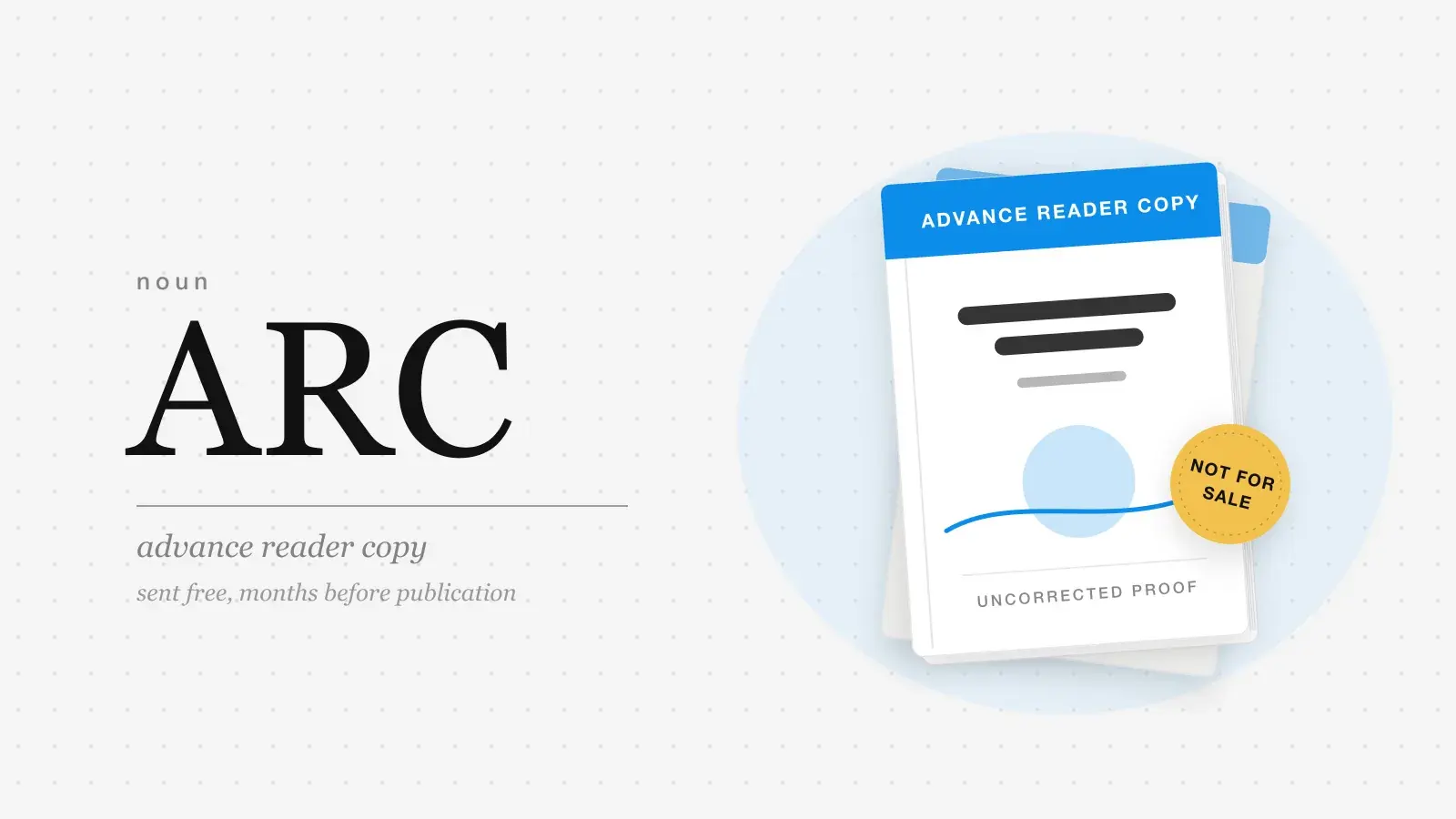
An ARC, or advance reader copy, is a free early edition of a book that a publisher or author sends to reviewers, booksellers, librarians and readers before publication, so they can review, stock or recommend it in time. Most are uncorrected and marked not for sale.
You'll also see advance review copy, advance reading copy, ARE (advance reader's edition) and galley. British publishers often say proofs. The digital version is an eARC, e-galley or DRC (digital review copy). The text isn't final: ARCs go out before the last proofread, which is why the cover says "uncorrected proof".
ARC examples
A finished book's back cover sells the story with its blurb. An ARC's back cover also carries the facts a reviewer or bookstore buyer plans around:
- The Orchard Accounts, a novel by Nell Varga
- On sale March 2, 2027 · Hardcover · 352 pages · $28.00
- 13-digit ISBN, publisher and imprint
- For readers of Marilynne Robinson's Gilead and Ann Patchett's The Dutch House
- Marketing: national review campaign, NetGalley, library conference galleys, author events in Chicago and Minneapolis
- Publicity contact: Dana Ortiz, dana@example.com
- Uncorrected proof. Please check all quotations against the finished book.
The "for readers of" line does the job of comp titles, though publishers often reach for bigger names than an author would risk in a query letter.
Before the first Harry Potter book came out in June 1997, Barry Cunningham, its editor at Bloomsbury, sent proof copies to a chosen group of authors, critics and booksellers to gather quotable praise ahead of the launch. The first hardback printing was 500 copies, 300 of them for libraries.
Sally Rooney's third novel came out on September 7, 2021. In the weeks before, advance copies circulated online, and one sold on eBay for more than $200. Selling an ARC is widely frowned on: the author earns nothing from the sale, and the buyer gets a text that may not match the book.
For Prince Harry's memoir, published January 10, 2023, Random House declined to offer electronic ARCs, which are easier to copy and forward than printed ones. The text got out anyway: the Spanish edition went on sale by mistake in some bookstores in Spain five days early and was pulled, and newspapers reported its contents before release day.
Who gets ARCs, and when
At a traditional publisher, ARCs usually go out four to six months before publication. The trade magazines whose reviews bookstores and libraries use when ordering set that schedule. Publishers Weekly wants adult titles at least three months, preferably four, before the first day of the publication month, and Kirkus Reviews asks for four to five months. Newspaper critics and online reviewers come later.
| Who | Why they want it early | How it usually arrives |
|---|---|---|
| WhoTrade reviewers: Publishers Weekly, Kirkus, Booklist, Library Journal | Why they want it earlyPrepublication reviews that guide store and library orders | How it usually arrivesDigital galley, three to five months ahead |
| WhoBooksellers | Why they want it earlyDeciding what to stock and recommend | How it usually arrivesSales reps, Edelweiss, NetGalley |
| WhoLibrarians | Why they want it earlyOrdering for the collection | How it usually arrivesNetGalley, Edelweiss, library conferences |
| WhoNewspaper and magazine critics | Why they want it earlyA review that runs near publication day | How it usually arrivesPrinted ARC with a press letter |
| WhoBloggers, BookTok and Bookstagram | Why they want it earlyPosts in launch week | How it usually arrivesPublisher invitations, NetGalley |
| WhoAn indie author's ARC team | Why they want it earlyReader reviews from launch day | How it usually arrivesEmail, BookFunnel, BookSirens |
Most digital ARCs go out through NetGalley and Edelweiss. Both are free for readers. Publishers decide who gets each title, and a member who posts reviews of what they get is approved more often. Publishers pay to list their books, and NetGalley sells listings to self-published authors too. Pricing changes, so check the current terms. Outside those sites, indie authors build ARC teams from their own readers.
Making ARCs of your own book
With a traditional publisher, the ARC is made for you from the typeset pages, usually while proofreading is still under way. Your part is a list for your editor or publicist: authors who might blurb the book, the bookseller who hosted your last event, the podcast host who loves your genre. Fixes you make in the proofs go into the finished book, not into ARCs already printed, so don't panic when an early reviewer quotes a typo.
If you're self-publishing, you make the ARC, and the order matters more than the tools.
- Finish the copyedit first. A file full of typos earns reviews that mention typos, and those reviews stay up after you fix the book.
- Mark it. Put "Advance reader copy. Uncorrected proof. Not for sale." on the title page and in the file name, so a forwarded copy says what it is.
- Export the formats people read: EPUB for e-readers and phones, PDF for laptops. If you write in Strokes, both come from the same document, and a version saved the day the ARC goes out records what early readers saw.
- Pick a delivery route. Email works for a small team. BookFunnel can give each reader their own download link and show who downloaded, and BookSirens and NetGalley's indie listings find reviewers you don't know yet.
- Time it. Early enough that readers can finish before launch, late enough that they still remember to post.
How you ask matters. The FTC's endorsement guidance says you can't make a free copy conditional on a positive review, and it expects reviewers who got the book free to say so. Retailers and review sites have their own rules too. This isn't legal advice, so read the current policies before you send the first copy.
Ask like this
- Would you like a free advance copy? No strings attached.
- If you review it, an honest review is welcome, whatever you thought.
- Please mention that you got a free advance copy.
Not like this
- Free copy in exchange for a five-star review.
- Only post if you loved it; email me if you didn't.
- No need to mention it was free.
ARC vs. galley, proof and finished copy
People in publishing use ARC and galley interchangeably, sometimes on the same cover. When they do separate them, the difference is what the copy is for.
| Name | What it is | Who it's for | Text |
|---|---|---|---|
| NameGalley proof | What it isTypeset pages sent to be checked | Who it's forAuthor, editor, proofreader | TextBeing corrected |
| NameARC | What it isA bound or digital reading copy made from those pages | Who it's forReviewers, booksellers, librarians | TextNearly final, uncorrected |
| NameFinished copy | What it isThe published book, sent free | Who it's forCritics and media | TextFinal |
| NameBeta copy | What it isA draft manuscript file | Who it's forBeta readers | TextStill open to big changes |
The galley name comes from metal type. Compositors set lines in trays called galleys and pulled proofs from them to check. Some publishers also bound uncorrected proofs and mailed them to reviewers, not for correction but to get reviews in on time, and the name stuck. Picture books often go out as F&Gs, folded and gathered sheets, rather than bound copies.
An ARC is also not a beta copy. A beta reader sees a draft while you can still change the story. An ARC reader sees the book once the story is settled and only small corrections remain, and their job is to talk about it.
If you get an ARC
- Read it before publication day if you can, so your review appears when people can buy the book.
- Review it honestly, and say it was free. One line does it: "I received a free advance copy from the publisher."
- Check quotations against the finished book, and don't sell the copy or forward the file.
An ARC is one stop in a longer chain: the manuscript is typeset into galleys, the galleys are bound as ARCs for early readers, and the corrected pages become the book. For the feedback round that comes well before, see how to find beta readers.