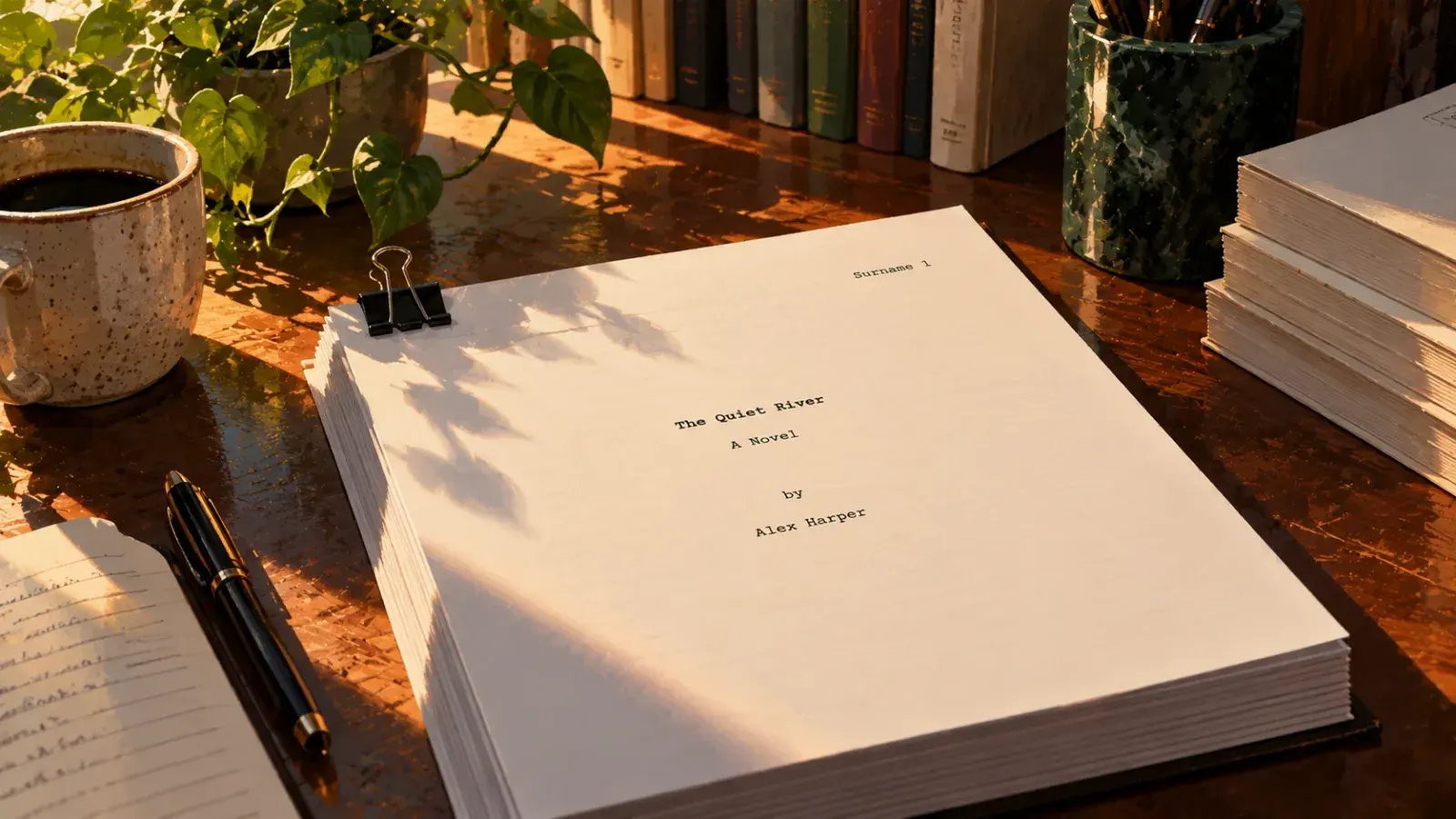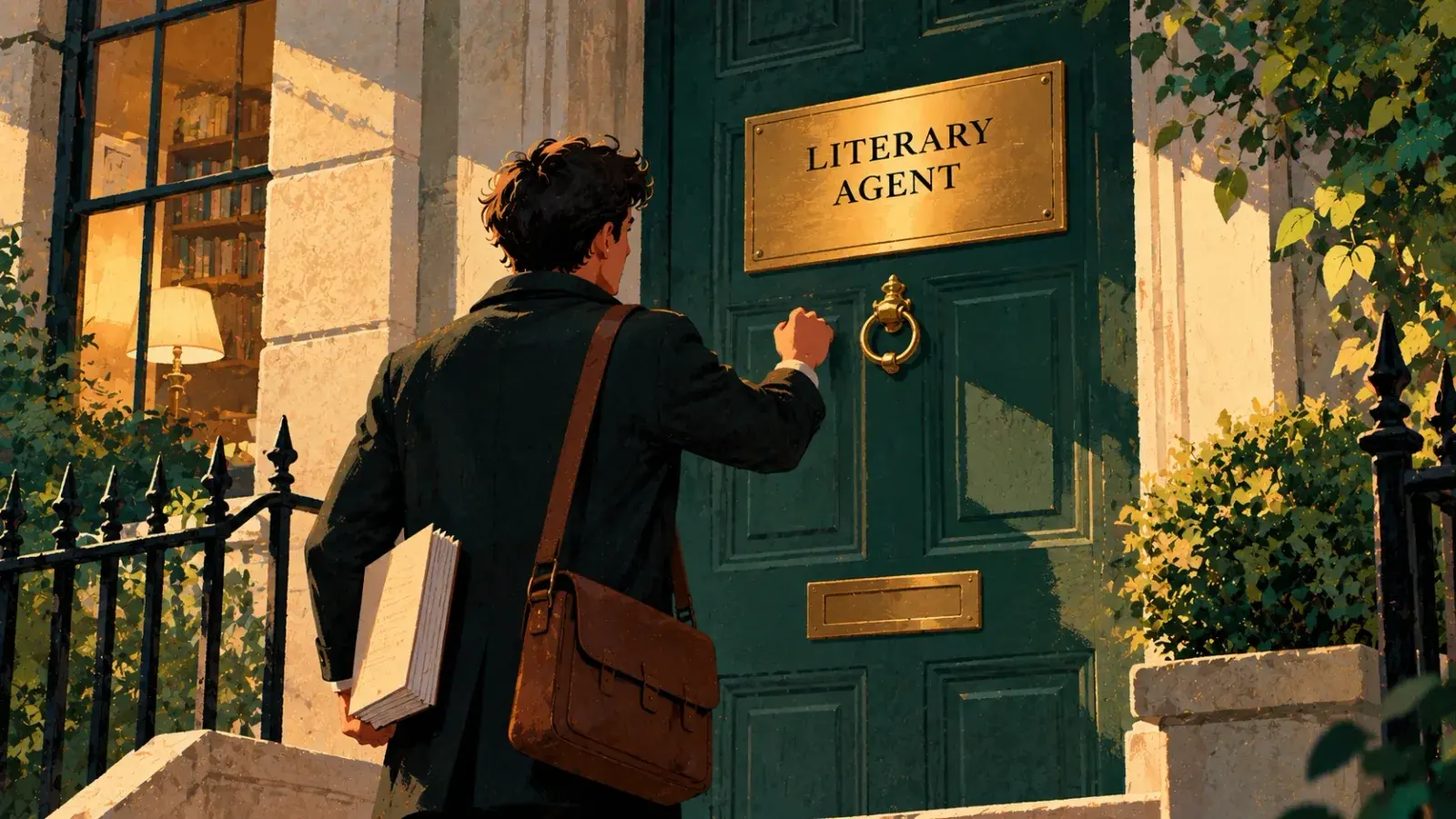
A manuscript is an author's text before it is published: the document a writer revises, sends to agents and editors, and hands to a publisher to be edited and typeset. When the text is printed and bound, it becomes a book.
The word comes from the Latin manu scriptus, "written by hand," and entered English in the 1590s, more than a century after printing reached Europe. The abbreviation is MS, plural MSS. Almost nobody submits handwritten pages anymore, but the word stayed: the Word file you send an agent is a manuscript.
Manuscript examples from literary history
Surviving manuscripts show what a printed book hides, from single crossed-out words to whole endings that never reached print.
Dickens wrote the 66-page manuscript in about six weeks in the autumn of 1843, and it is thick with deletions and insertions. None of that shows in print, where Scrooge's answer to Marley's ghost reads as if it came out whole:
You may be an undigested bit of beef, a blot of mustard, a crumb of cheese, a fragment of an underdone potato.
Two canceled chapters of Persuasion, dated July 1816, are the only pages in Austen's hand that survive from any novel she finished for publication. They hold her first ending, in which Anne and Wentworth reach an understanding in an awkward meeting at the Crofts' lodgings. She rejected most of it within weeks and wrote the ending readers know, built around Wentworth's letter: "You pierce my soul. I am half agony, half hope."
Mary Shelley drafted the novel in notebooks in 1816 and 1817, and Percy Bysshe Shelley read them and wrote changes and additions as they went. The Bodleian's pages, online through the Shelley-Godwin Archive, show both hands on the same leaves, his corrections and additions squeezed between her lines and into the margins.
Twain later claimed he was "the first person in the world to apply the type-machine to literature," and thought the book was Tom Sawyer. The evidence points to Life on the Mississippi instead, generally named as the first book manuscript submitted to a publisher in typescript. He didn't do the typing himself.
In April 1951 Kerouac typed a draft in three weeks, single-spaced with no paragraph breaks, on long sheets of tracing paper he taped into a scroll about 120 feet long. It used his friends' real names. Viking published the novel in 1957, after several more drafts, shorter and with the names changed. The legend is the three weeks. Getting from scroll to book took six more years.
When your draft becomes a manuscript
Writers use the word loosely, but in publishing it usually means a complete, revised text that is ready for someone else to read. While you are still writing, it is a draft or your WIP. A novelist sends a query letter only once the manuscript is finished, because an agent who likes the opening will ask for the rest. Nonfiction usually sells on a proposal with sample chapters, though debut memoirists are often asked for the full manuscript.
The words you'll meet along the way: a partial is a request for part of the manuscript, often the opening chapters. A full is a request for all of it. An unsolicited manuscript is one nobody asked for. Those land in the slush pile. Most large publishers stopped reading them long ago and now take new fiction only through agents.
Thanks for sending THE WINTER LEDGER. I'd love to read the full manuscript. Please attach it as a Word document and paste your query into the email.
What to send back:
- One file for the whole book, not one per chapter, named so it can't be mistaken:
Okafor_Ledger_full.docx - A title page with your contact details and a rounded word count, such as "about 92,000 words"
- Every chapter in standard manuscript format, each starting on a new page
- The latest revision, with your beta readers' fixes in it, not the version from last spring
Two mistakes come up often. One is formatting the manuscript like a book, with justified text, a decorative font or a cover image. Agents and editors want plain, double-spaced pages they can mark up, and standard manuscript format is a handful of settings you make once. The other is sending the wrong version. A date or draft number in every file name prevents it.
The costliest mistake is keeping one copy. In December 1922 Hadley Richardson packed Ernest Hemingway's manuscripts, carbon copies included, into a suitcase to bring them to him in Lausanne. It disappeared at the Gare de Lyon in Paris, and nearly all of his fiction to that point went with it. Copies in the same suitcase count as one copy. Version history, which Strokes keeps for every document, protects you from your own bad edits, not from a lost laptop, so keep a copy somewhere else too.
Manuscript vs. draft, proof and book
| Stage | What it is | Who reads it |
|---|---|---|
| StageDraft | What it isUnfinished text, still changing | Who reads itYou, perhaps a critique partner |
| StageManuscript | What it isComplete, revised, in standard format | Who reads itBeta readers, agents, editors |
| StageEdited manuscript | What it isThe same file with an editor's changes and queries | Who reads itYou and your editors |
| StageProofs (galleys, page proofs) | What it isThe typeset text, checked before printing | Who reads itProofreaders and you |
| StageAdvance reader copy | What it isBound copies printed before publication | Who reads itReviewers and booksellers |
| StageBook | What it isThe published edition | Who reads itReaders |
The line between manuscript and book is typesetting. Until then the text is formatted for working on: 12-point type, double spacing, one-inch margins, room for an editor's marks. A standard manuscript page holds about 250 words, so an 80,000-word novel runs to about 320 manuscript pages and usually fewer printed ones. After typesetting, corrections happen on proofs, and nobody calls it a manuscript again. A typescript, a word archives and rare-book dealers still use, is simply a manuscript that was typed.
Other meanings of manuscript
- Historical manuscripts. Handwritten books and documents in libraries and archives, from medieval codices to letters and diaries. Beowulf survives in a single manuscript, the Nowell Codex in the British Library, its edges scorched in a 1731 fire.
- Academic publishing. The paper you submit to a journal is a manuscript. After peer review, the version the journal accepts is the author accepted manuscript, or postprint. The typeset, published version is the version of record.
- Scripts. Screenplays and stage plays are manuscripts too, with formats of their own.
- Music. Manuscript paper is blank staff paper for writing music by hand.
- Handwriting. In American schools, manuscript is also the name for print handwriting, the separate letters children learn before cursive.
Related terms: copy editing, galley proof. Before you send your manuscript anywhere, check its length against typical word counts by genre, then read how to get a literary agent for what happens after a full request.