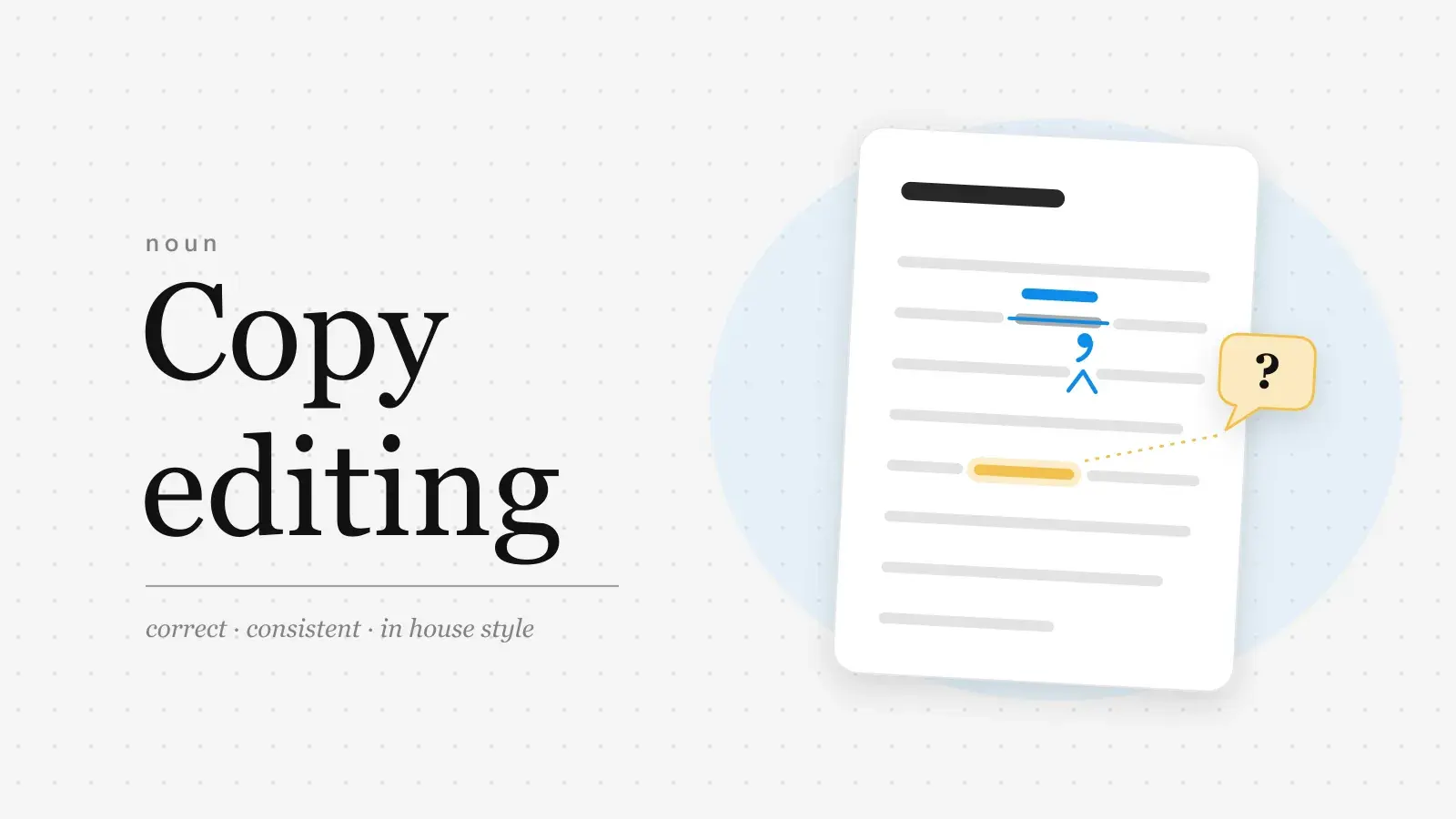
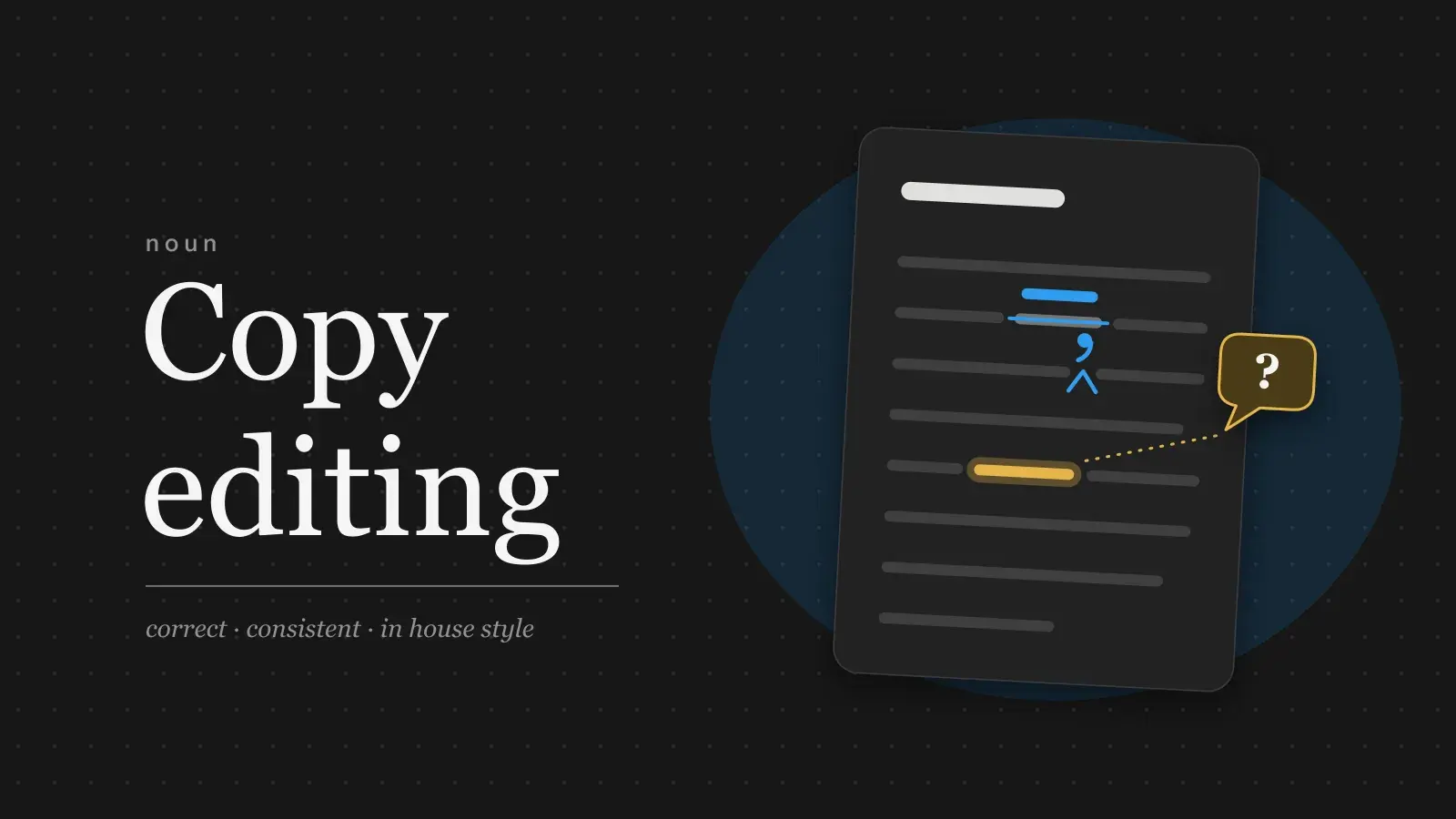
Copy editing is the edit that makes a finished draft correct and consistent: grammar, spelling, punctuation, word usage and house style, plus the small contradictions a reader trips over, such as a name spelled two ways. It comes after the structural and line edits and before proofreading.
In printing, copy is any text headed for the press. The job's name is spelled three ways: Merriam-Webster has copy editor and the verb copyedit, the University of Chicago Press titled Amy J. Schneider's 2023 handbook The Chicago Guide to Copyediting Fiction, and copy-editing turns up too. Pick one and stick to it, which is the job in miniature.
What a copy editor checks
On a book, the copy editor usually works in Word with Track Changes on and sends back three things: the edited manuscript, queries in the margin for anything they can't settle alone, and a style sheet. The checks fall into six groups.
| Check | What it covers | A typical fix |
|---|---|---|
| CheckMechanics | What it coversSpelling, grammar, punctuation | A typical fixA comma splice split into two sentences |
| CheckUsage | What it coversWrong or confused words | A typical fix"Poured over the map" becomes "pored over the map" |
| CheckHouse style | What it coversNumbers, capitals, hyphens, the serial comma | A typical fixAn age is "twenty-one" in Chicago style, "21" in AP |
| CheckConsistency | What it coversNames, terms and spellings across the book | A typical fix"Rhys" in chapter 2, "Reece" in chapter 9 |
| CheckContinuity | What it coversTimeline, ages, who knows what and when | A typical fixMonday's funeral is "last Tuesday" two chapters later |
| CheckFacts on the page | What it coversDates, places and quotations that look wrong | A typical fixA query, not a rewrite: "Bridge opened in 1937?" |
Editors also sell copy edits by depth: a light edit fixes errors and inconsistencies, a heavy one rewrites freely and shades into line editing. Ask for a sample edit of a few pages before you agree on a level and a price.
The style sheet is the part writers hear least about and use longest. It records every decision made for this one book: that the village is Long Ashby with no hyphen, that the narrator's sister turns thirty-four in chapter 6, that characters say "OK" rather than "okay." You'll need it again when the sequel uses the same names. A style guide such as Chicago or AP sets the general rules. The style sheet records how they were applied here.
Copy editing examples
Three slips that reached print. Holmes fans have argued about the first two for decades.
In the first Holmes novel, Watson recalls being struck on the shoulder by a Jezail bullet. Three years later, in The Sign of the Four, he sits nursing his wounded leg: "I had a Jezail bullet through it some time before."
A style sheet carried over from the first book would have caught it, and the second mention would have come back with a query: Shoulder in Study in Scarlet. Change to match, or is this a second wound?
A Study in Scarlet opens as "a reprint from the Reminiscences of John H. Watson, M.D." In this story his wife offers to send James off to bed. Dorothy L. Sayers later argued, in her essay "Dr Watson's Christian Name," that the H stood for Hamish, the Scots form of James.
Maine exempted from overtime the "canning, processing, preserving, freezing, drying, marketing, storing, packing for shipment or distribution" of certain foods. Delivery drivers for Oakhurst Dairy argued that, with no comma before "or distribution," the law covered packing for distribution, not distribution itself. The court found the sentence ambiguous and ruled for the drivers, and the dairy settled for $5 million in 2018.
A copy editor wouldn't have quietly added the comma. Only the drafters knew which meaning they intended, so the right move was a query.
Copy editing vs. line editing
Line editing asks whether each sentence works: its rhythm, clarity, word choice and voice. Copy editing asks whether it is correct and consistent. A line editor might cut half your adverbs. A copy editor leaves them alone, because they aren't errors, and fixes the one you misspelled.
Draft: Marion walked slowly into the kitchen, she had driven six hours from Albany and was really very tired, and she poured over the map again looking for Milbrook.
Copy edit: Marion walked slowly into the kitchen. She had driven six hours from Albany and was really very tired, and she pored over the map again looking for Millbrook.
Line edit: Marion dragged herself into the kitchen. Six hours from Albany, and Millbrook still wasn't on the map.
The copy editor split the comma splice, fixed pored and matched the town to its spelling in chapter 1. Whether "really very tired" is good writing is the line editor's call.
| Edit | Asks | Works on | Per word, fiction |
|---|---|---|---|
| EditDevelopmental | AsksDoes the book work? | Works onPlot, structure, pacing, character | Per word, fiction3.0–3.5¢ |
| EditLine | AsksDoes each sentence work? | Works onRhythm, clarity, voice, word choice | Per word, fiction2.7–3.5¢ |
| EditCopy | AsksIs it correct and consistent? | Works onGrammar, usage, style, continuity | Per word, fiction2.0–2.7¢ |
| EditProofreading | AsksDid anything slip through? | Works onTypeset pages: typos and layout | Per word, fiction1.2–2.0¢ |
Copy editing vs. proofreading
Copy editing waits until after developmental editing and the line edit, because there's no point fixing commas in a chapter that may be cut. Proofreading is the step people confuse it with. A proofreader works on the typeset pages and checks what the copy editor missed or the layout broke: typos, bad line and page breaks, running heads, page numbers that match the contents. Proofreaders work from the copy editor's style sheet and don't reopen its decisions. It's also too late to rewrite: a changed sentence can push text onto the next page, and every fix costs more.
In your manuscript
A traditional publisher pays for the copy edit on a book it buys, so a writer querying agents needs a clean draft, not a paid edit. If you're self-publishing, you hire the copy editor yourself. At the fiction rates in the table above, 2.0 to 2.7 cents a word, a 90,000-word novel costs $1,800 to $2,430. The same figures put the pace at six to ten 250-word pages an hour: 36 to 60 hours of careful reading.
The edit comes back with every change tracked. Accept or reject each one and answer every query, even if the answer is "fine as is." To keep your original wording, write stet, Latin for "let it stand."
Ch. 3: Nell is thirty-four here, but in ch. 11 she "turned thirty last spring." Which is right?
Ch. 12: Sunrise at 5:10 a.m. in Vermont in December is about two hours early. Change to 7:15, or keep?
AI models handle the mechanical layer well enough now: a comma splice, poured for pored, a doubled word. Review each change, because they will also "fix" a choice you made on purpose. In Strokes you can select a passage and press ⌘K to fix it in place, or add your style sheet to an AI Assistant chat as context.
The typeset pages a proofreader marks are the galley proofs, and the symbols used on them are collected in Proofreading marks and editing symbols. To get the file ready for an editor in the first place, read How to format a manuscript.