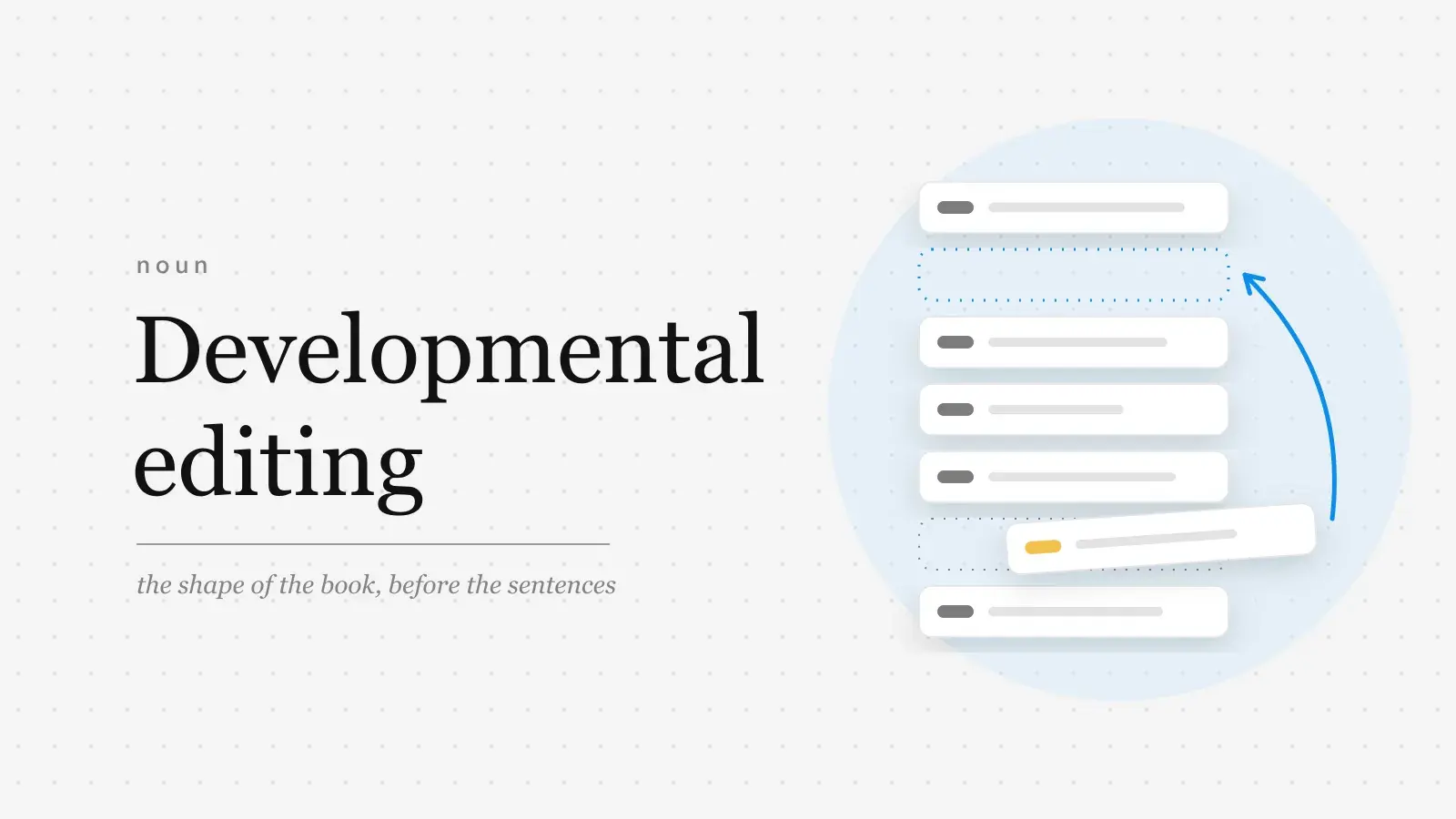
Developmental editing is the big-picture edit of a draft. The editor reads the whole manuscript and works on what it is built from: premise, structure, plot, character, pacing and point of view, or in nonfiction, the argument and the order it unfolds in. It comes before anyone works on sentences.
The Editorial Freelancers Association notes that developmental editors also go by substantive, structural or content editors, and that they may deliver a manuscript evaluation or an editorial letter setting out the main problems and possible fixes. Editors Canada puts structural editing first of four stages, ahead of stylistic editing, copy editing and proofreading. What comes back is usually a letter that diagnoses the book as a whole, plus comments in the margins showing where each problem turns up. You rarely get rewritten sentences. The rewriting is yours.
What a developmental editor looks at
A developmental editor reads the way a reader does, then rereads the way a mechanic does. Most notes land in one of these areas.
| Area | The editor asks | A typical note |
|---|---|---|
| AreaPremise and stakes | The editor asksWhat does the protagonist want, and what happens if they fail? | A typical note"The stakes are stated in chapter 2 but not felt until chapter 19." |
| AreaStructure | The editor asksDo the big turns land where the book needs them? | A typical note"The inciting incident arrives a third of the way in. Bring it into the first fifty pages." |
| AreaCharacter | The editor asksDoes each character change, or at least have a job? | A typical note"Two friends give Nell the same advice. Merge them." |
| AreaPoint of view | The editor asksIs this the right narrator, used consistently? | A typical note"Ana's chapters are the strongest. Consider her as the only narrator." |
| AreaPacing | The editor asksWhere does tension sag, and where does it rush? | A typical note"The middle third has six scenes of planning and none of doing." |
| AreaOpenings and endings | The editor asksDoes the book start late enough and end on its own question? | A typical note"The story starts on page 31. Cut or fold in what comes before." |
| AreaArgument (nonfiction) | The editor asksDoes each chapter earn its place in this order? | A typical note"Chapter 7 is your thesis. Put a version of it in the introduction." |
| AreaGenre and audience | The editor asksDoes it meet the expectations of its shelf? | A typical note"Romance readers expect a happy ending. This one ends apart." |
What a developmental editor doesn't do is fix commas. Sentence work belongs to line editing and correctness to copy editing, which come later. An editor who spends a structural edit on typos has sold you the wrong service.
Developmental editing examples
The best-documented developmental edits are the ones where both versions survive, or where letters record the advice. None of them is about a sentence.
In the ending Dickens first wrote, Pip, still unmarried, meets Estella briefly in London years later. She has been widowed and has remarried, and they part. The novelist Edward Bulwer-Lytton read the proofs, found the ending too sad and pressed for a change. Dickens wrote a new close in which the two meet in the ruins of Satis House, and the serial ended with it in August 1861. He told Forster, "I have put in as pretty a little piece of writing as I could."
The note was about the shape of the whole story, not a line in it. Readers still argue over which ending is right.
In November 1924 Maxwell Perkins, Fitzgerald's editor at Scribner's, wrote that Gatsby was too vague as a character and that his wealth needed a convincing explanation. Fitzgerald revised through the winter in Rome, reworking the sixth and eighth chapters heavily, and the book came out in April 1925. In the published novel, chapter 6 opens with Gatsby's real history as James Gatz, which Nick says he heard "very much later" and sets down early to clear away the rumors.
That is a developmental fix in two parts: what the reader needs to know about a character, and where in the book they learn it. The earlier draft was published decades later as Trimalchio.
Before the novel came out in 1926, F. Scott Fitzgerald read it and told Hemingway the opening ran long. He urged cuts of at least 2,500 words and advised letting the action play out among the characters. Hemingway had Scribner's drop the first 30 pages outright. The book now begins: "Robert Cohn was once middleweight boxing champion of Princeton."
It is still one of the commonest notes on a first chapter. The story starts later than the draft does.
In 1957 Harper Lee sold J. B. Lippincott a manuscript about the adult Jean Louise Finch coming home to Maycomb, Alabama. Her editor, Tay Hohoff, found it more a string of anecdotes than a finished novel, but saw that the flashbacks to Jean Louise's childhood as Scout were its strongest part. Lee later said Hohoff persuaded her to write the novel from the point of view of the young Scout. Over the next couple of years Hohoff took her from draft to draft, and the result was To Kill a Mockingbird. The original manuscript was published in 2015 as Go Set a Watchman.
In your manuscript
Get a developmental edit, or give yourself one, when you have a complete draft that you have already revised at least once. Earlier, the editor is reading a book you haven't finished deciding on. Later, after a line edit, you pay twice for every paragraph the structural changes remove. Many writers put beta readers between their own revision and a paid edit. Readers tell you where they got bored or lost. An editor tells you why, and what to do about it.
To give your own draft a developmental pass:
- Write a reverse outline: one line per scene saying what happens and what changes. A scene where nothing changes is a candidate to cut or merge.
- Note the page where the central conflict starts. Everything before it has to hold a reader without it.
- Give every character a one-line job. Two characters with the same job are a merge waiting to happen.
- Read the whole draft in as few sittings as you can, with no pen. Pacing problems only show at reading speed.
- Write yourself the editorial letter before you change anything, biggest problem first.
If your chapters are separate documents in a Strokes project, you can add them to a chat with the AI Assistant and ask for a scene-by-scene outline, or for the point where the stakes stop rising. Treat the answer as one more reader's notes. Check each claim against the text and keep the structural decisions for yourself.
Dear Maya,
The engine of The Salt Year is strong. Nell has one season to decide whether to sell her father's oyster lease, and every chapter set on the water works. My main concern is the first 80 pages. Nell doesn't reach Harbor Point until chapter 5. Before that we get her divorce, her job in Boston and two flashbacks to her mother, so a reader doesn't learn what the book is about until page 81.
My suggestions, biggest first:
- Open on the drive north. Give the divorce two or three lines in chapter 1 and let the rest come out in her arguments with Theo.
- The buyer's offer arrives at the midpoint, in chapter 14. Move it to the end of chapter 3 so the clock starts early, and let the midpoint turn on something new: what Nell finds in her father's ledgers.
- Theo and Dana do the same job. Both tell Nell to stay. Merge them, or give Dana a reason to want her gone.
I've flagged the scenes I'd cut in the margin notes. These are suggestions, not instructions. It's your book.
Look at what the letter does. Each note names a problem, points to the evidence by chapter and page, offers one way out and leaves the decision with the author. The order is by impact, so if Maya only manages the first two, the book still gets better. And not one sentence is touched.
Developmental edits go wrong when the editor starts writing a different book: a quiet literary novel pushed toward a thriller, a memoir rearranged into self-help. The other failure is the vague letter, all "the middle drags" and no page numbers. Even famous edits get argued over. About 60,000 words came out of Thomas Wolfe's first novel, working with Maxwell Perkins, before it appeared as Look Homeward, Angel in 1929. When the uncut version came out in 2000 as O Lost, the scholar Matthew Bruccoli, who reconstructed it with Arlyn Bruccoli, called it the restoration of a masterpiece. Whoever is right, the test for a note is the same: does it make your book more like itself?
Developmental editing vs. line editing
| Manuscript assessment | Developmental edit | Line edit | |
|---|---|---|---|
| Asks | Manuscript assessmentWhat are the book's biggest problems? | Developmental editWhat should the book become, scene by scene? | Line editDoes each sentence work? |
| You get | Manuscript assessmentA letter | Developmental editA letter plus margin comments | Line editTracked changes and comments |
| Changes | Manuscript assessmentNothing on the page | Developmental editNothing on the page, usually | Line editWords, rhythm, clarity |
| Best for | Manuscript assessmentDeciding what kind of help you need | Developmental editA draft that needs rebuilding | Line editA draft whose structure holds |
A manuscript assessment, also sold as a critique or evaluation, is the cheaper diagnosis: a full read and a letter, without the margin notes. If you aren't sure your draft needs structural work, start there. Line editing and copy editing follow the developmental edit, in that order. There's no point polishing a chapter the structural edit may cut.
What developmental editing costs
Freelance developmental editors usually quote by the word or by the project. The Editorial Freelancers Association's 2026 rate chart, built from what more than 1,100 members reported charging for work in 2025, gives these median ranges.
| Service | Per word | A 90,000-word book |
|---|---|---|
| ServiceManuscript assessment | Per word1.5–1.8¢ | A 90,000-word book$1,350–$1,620 |
| ServiceDevelopmental edit, fiction | Per word3.0–3.5¢ | A 90,000-word book$2,700–$3,150 |
| ServiceDevelopmental edit, nonfiction | Per word4.0–5.0¢ | A 90,000-word book$3,600–$4,500 |
| ServiceLine edit, fiction | Per word2.7–3.5¢ | A 90,000-word book$2,430–$3,150 |
| ServiceCopy edit, fiction | Per word2.0–2.7¢ | A 90,000-word book$1,800–$2,430 |
The price is mostly time. The chart's pace for a fiction developmental edit is 5.5 to 10 pages of 250 words an hour, so a 90,000-word novel, 360 such pages, comes to roughly 36 to 65 hours of reading, rereading and writing. Nonfiction goes slower, at 4 to 8 pages an hour.
Before you pay, ask to see an editorial letter from a past project (shared with the client's permission) or book a short call about your synopsis and opening chapters. A ten-page sample edit shows how someone handles sentences, not structure. Agree in writing on what you will receive, the deadline and whether a follow-up call is included. If you plan to query agents, a paid developmental edit is optional, because publishers edit the books they buy. If you're self-publishing, nobody else will do this edit, so it is the one to budget for first.
Related terms: manuscript, inciting incident and info dump, the backstory block that developmental letters so often ask you to break up. When the letter arrives, a novel outline template doubles as a reverse outline for planning the revision.