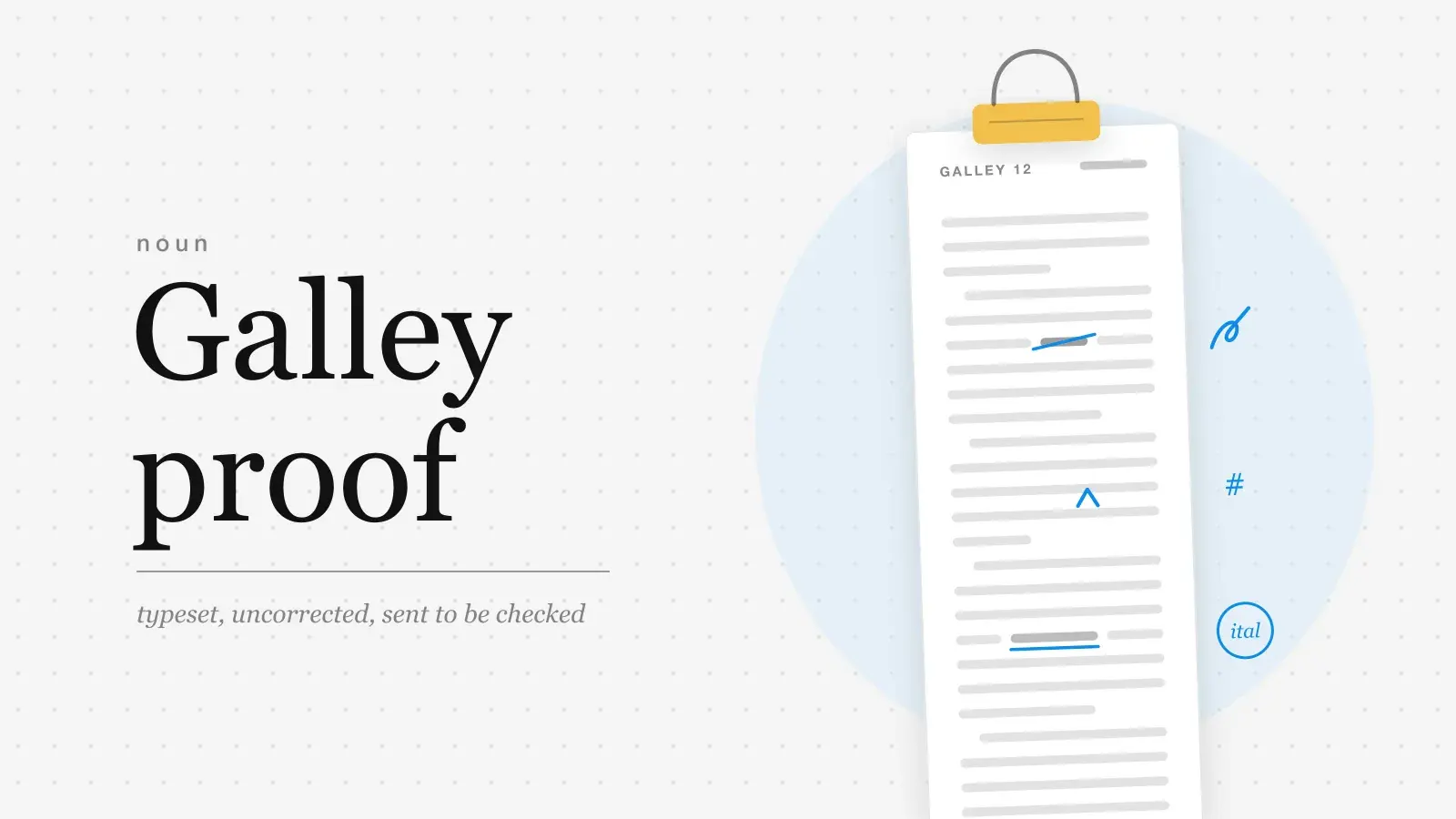
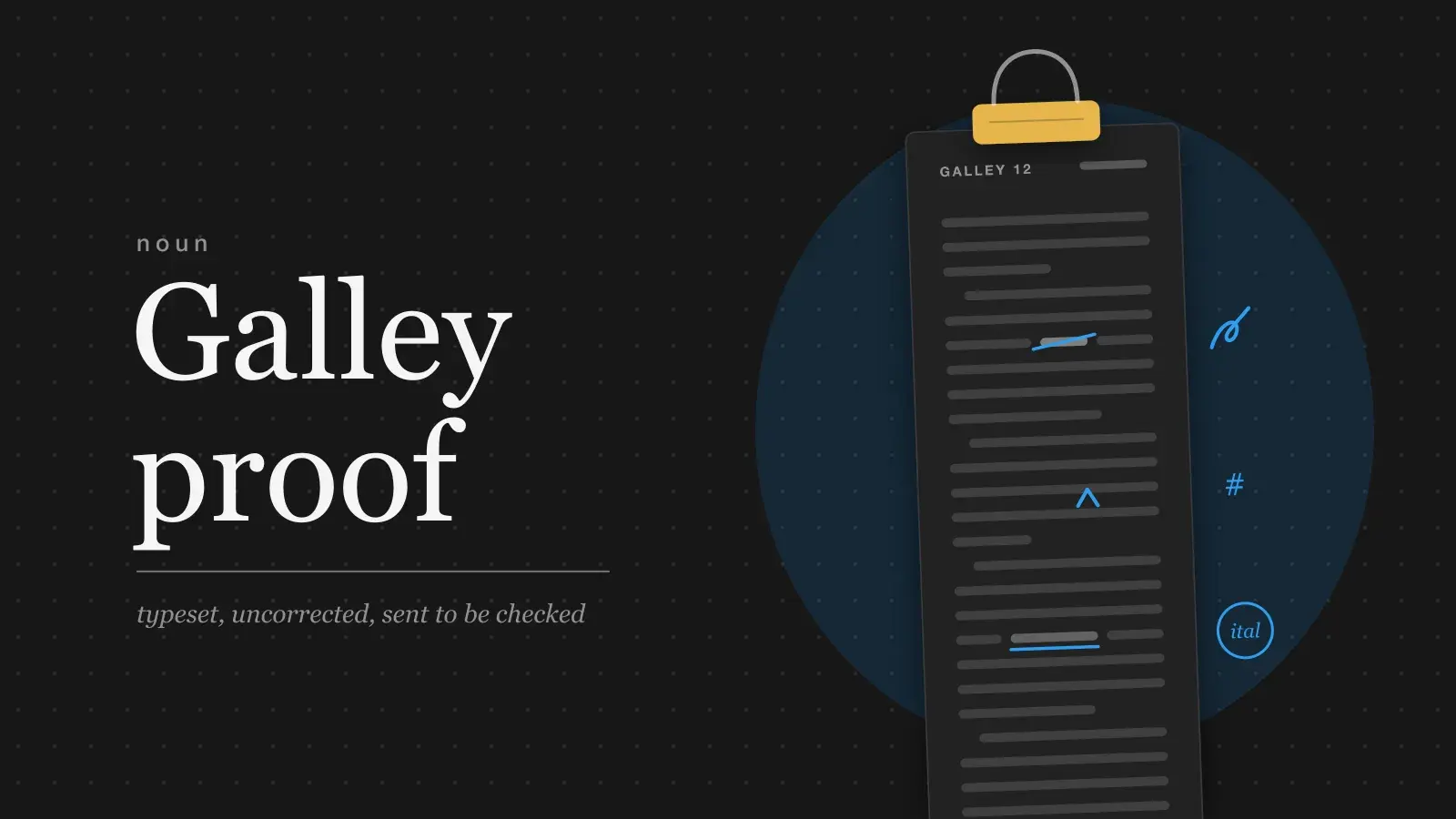
A galley proof, or galley, is a copy of a book's typeset text, printed or sent as a PDF, that the author, editor and proofreader check for errors before the book goes to press. Strictly, it is the text set in long columns before it has been divided into pages.
The name comes from metal type. From the 1650s, printers set lines of type into an oblong tray called a galley and pulled cheap trial prints from it on a small proof press: long strips with no page breaks, used to catch the compositor's mistakes and damaged letters before the type was made up into pages. Type is digital now, so most people say proofs or uncorrected proof, but in US publishing "galleys" still means almost any prepublication copy, including the bound ones sent to reviewers.
Examples
Printers pulled proofs long before anyone called them galleys. The famous cases are mostly about what got through.
In Exodus 20:14 the word not dropped out, so the commandment read "Thou shalt commit adultery." The same edition turned greatness into great-asse in Deuteronomy 5:24. The king's printers were fined £300 and lost their license (the fine was later quashed), and most copies were destroyed. A dropped word is the hardest error to see on a proof, because the sentence that remains is still grammatical.
Balzac treated proofs as another draft. He covered them with changes and additions, every one of which had to be reset by hand, and sometimes went through the cycle more than once for a single book, at real cost to himself and his publishers. That is the bill the clause on author's alterations in a modern publishing contract is written to cap.
Sylvia Beach had a printer in Dijon set 1,000 numbered copies of a long English novel full of invented words. The Joyce scholar Jack Dalton counted more than 2,000 errors in that first edition. When the London edition came out later in 1922 from the same printer and plates, it carried a loose seven-page errata list with 201 corrections. An errata slip is what a book gets when the corrections arrive after the plates are made.
After a last look at the proofs, Fitzgerald asked his editor, Maxwell Perkins, whether the novel could be retitled Trimalchio or Gold-Hatted Gatsby. Perkins advised against it. On March 19, 1925, Fitzgerald was keen on Under the Red, White, and Blue, but by then it was too late to change. The book came out on April 10 as The Great Gatsby. Proofs fix errors. They are a poor time to reopen decisions the rest of the house has already acted on.
In early October 2010 it emerged that the British edition of Franzen's novel had been printed from an earlier draft, missing more than 200 changes he had made. HarperCollins offered readers an exchange, but thousands of copies were already out. The last check on any proof is not of the text but of the file: that the corrected version is the one going to print.
Galley proof vs. page proof
In the strict sense, galleys come first. They show the text in continuous columns, without page numbers or running heads, so that errors can be fixed before the text is made up into pages. Page proofs show the book as it will print: pages with numbers, running heads, notes and images in place. Once the text is in pages, a change that adds or removes a line moves every line after it, which can shift page breaks, the contents page and the index.
Most books are now typeset straight into pages, so the first proofs an author sees are usually page proofs, and many editors still call them galleys. If it matters, ask which proof you have and what you're allowed to change on it.
| Proof | What it shows | Who reads it | What can change |
|---|---|---|---|
| ProofGalley proof (strict sense) | What it showsText in long columns, no page breaks | Who reads itAuthor, editor, proofreader | What can changeErrors, plus small rewrites |
| ProofFirst page proofs | What it showsFinished pages: numbers, running heads, images | Who reads itAuthor, proofreader | What can changeErrors, ideally without changing the line count |
| ProofUncorrected proof (ARC) | What it showsA bound or digital copy of those pages | Who reads itReviewers, booksellers, librarians | What can changeNothing. Fixes go into the finished book |
| ProofSecond proofs | What it showsThe same pages with corrections made | Who reads itEditor, proofreader | What can changeOnly corrections that went in wrong |
| ProofFinal proofs | What it showsThe printer's pages, imposed for press | Who reads itPublisher | What can changeSerious faults only, at a cost per page |
The bound copy in the third row is an ARC (advance reader copy). It is made from the same uncorrected pages, but it goes to reviewers rather than proofreaders, and nobody expects corrections back.
In your manuscript
With a traditional publisher, proofs usually arrive as a PDF with a deadline, often about two weeks for a book. Journal proofs can allow as little as 48 hours. By now your manuscript has been through copy editing, so the proof is for errors, not for the sentence you've since thought of a better way to write. Your contract probably puts a price on the second kind.
Publishing contracts have long let authors change proofs free up to a limit, often 10 or 15 percent of the original cost of typesetting, not counting the typesetter's own errors, and charge anything beyond it to the author, often against royalties. Macmillan's 1909 contract with Jane Addams set the line at 10 percent, and SFWA's 1989 model hardcover contract at 15. Check the clause in yours.
Read with the style sheet from the copy edit open beside you.
Mark corrections the way the publisher asks: comments in the PDF, or a list by page and line number. When you must change wording, replace it with something the same length, so nothing after it moves.
Proof as set: She had kept the letter for eleven years, unopened, in the drawer under the good tablecloth.
Correction that fits: She had kept the letter for twelve years, unopened, in the drawer under the lace tablecloth.
Correction that reflows: She had kept the letter for twelve years, unopened and never once mentioned to Tom, in the drawer under the lace tablecloth.
Twelve fixes the timeline from chapter 2, and lace replaces a vague word. Both have as many letters as the words they replace, so the typesetter can fix them without touching the next line. The added clause is a rewrite: it pushes the paragraph onto another line, and possibly the chapter's last line onto a new page.
If you self-publish, you are the publisher, so you make the proofs. Export a PDF of the interior for your proofreader, then order a printed proof copy from your printer and read that too. Margins, the gutter and how your trim size feels in the hand are easiest to judge on paper. Keep the file you proofed. If you lay the book out in Strokes, page view shows real pages with margins and page numbers, PDF export gives you the proof, and saving a version the day it goes out records exactly what your proofreader saw.
The symbols that go in a proof's margins are collected in Proofreading marks and editing symbols, and if checking other people's galleys sounds like a job, read How to become a proofreader.