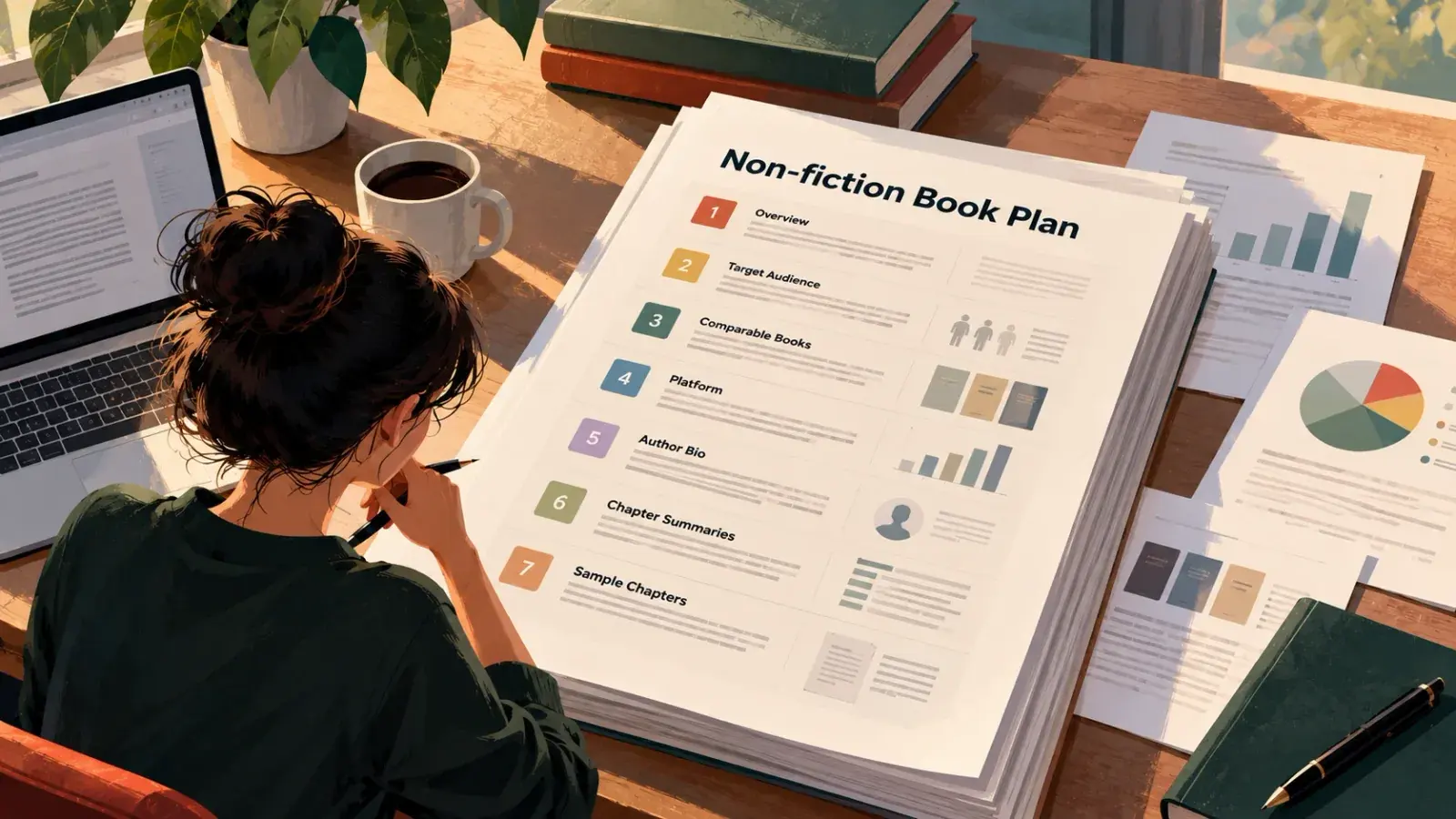
A book proposal is the document that sells a nonfiction book before it is written. It usually runs 10 to 25 double-spaced pages plus one or two sample chapters, in seven main parts: an overview, the target audience, comparable titles, your marketing and platform, an author bio, a chapter-by-chapter outline and the sample chapters. Research the comps and outline the chapters first, and write the overview last. Every page should help an editor answer four questions: what is this book, who will buy it, why are you the one to write it, and can you write it.
What a book proposal is for
Publishers buy most nonfiction on the strength of a plan: an idea, an author and a market, argued on paper. An agent reads the proposal to decide whether the book can sell. An editor who wants it then has to persuade colleagues, and at a larger house that usually means an acquisitions meeting where sales and marketing staff weigh in and someone drafts a profit-and-loss estimate from what you said about readers and reach.
So write for people who may never get to your sample chapter. They skim the overview, study the comps and the platform, and ask whether enough readers will pay for this. The writing still matters, since the samples prove you can deliver. But the proposal's first job is the business case, which is why it reads more like a short business plan than a long query letter.
Who needs one
| Kind of book | What agents usually want |
|---|---|
| Kind of bookPrescriptive nonfiction (how-to, business, health) | What agents usually wantA query and a proposal with one or two sample chapters |
| Kind of bookNarrative nonfiction (history, science, reportage) | What agents usually wantA proposal, sometimes with longer samples or a full draft |
| Kind of bookMemoir | What agents usually wantA proposal, and debut memoirists are often asked for the full manuscript too |
| Kind of bookNovel | What agents usually wantNo proposal: a query, a synopsis and the finished manuscript |
| Kind of bookAcademic book | What agents usually wantThe press's own proposal form, a CV and a sample chapter or two |
When the categories blur, the agency's page settles it. Dystel, Goderich & Bourret, a New York agency, puts it plainly: nonfiction can be queried with a proposal, but it does not accept partial manuscripts for novels. University presses run their own process. UC Press, for example, asks for a CV, a sample chapter or two and five to ten suggested peer reviewers, and asks authors not to send a fully drafted manuscript. If your book is a memoir, the guide to writing a memoir covers when to finish the draft before you pitch.
Book proposal format and length
Jane Friedman, who writes about the publishing business, puts most proposals at 10 to 25 double-spaced pages, not counting the sample chapters. Complex projects can pass 50 pages once the samples are in. The format is plain manuscript style: 12-point Times New Roman, double-spaced, one-inch margins, a title page, a contents page, and a header with your last name, a short title and the page number. Those specifics come from Debra Eckerling's formatting guide for Writer's Digest, and an agent's own rules override them. Send a PDF or a Word file, whichever the guidelines ask for.
The usual order is below. If an agent lists a different one, use theirs.
| Section | Typical length | What it proves |
|---|---|---|
| SectionTitle page | Typical lengthOne page | What it provesTitle, author, contact |
| SectionOverview | Typical lengthOne to three pages | What it provesThe idea is clear, timely and big enough for a book |
| SectionTarget audience | Typical lengthOne or two pages | What it provesA specific reader exists and can be reached |
| SectionComparable titles | Typical length5–10 books, 100–200 words each | What it provesReaders already buy books like this |
| SectionMarketing and platform | Typical lengthOne or two pages | What it provesYou can reach readers yourself |
| SectionAbout the author | Typical lengthHalf a page to a page | What it provesYou are the right person for this book |
| SectionChapter outline | Typical lengthA paragraph or two per chapter | What it provesThe whole book is planned |
| SectionSample chapters | Typical lengthOne or two chapters | What it provesYou can deliver the pages |
How to write each section
The examples below follow one invented book through its proposal, so you can see how the sections support each other. Before It Leaks: Caring for an Older House in Your First Five Years is a repair guide by Dana Ortiz, a contractor who teaches home repair at a community college. The book, the author and the comp are fictional.
Overview
The overview opens the proposal and is the page everyone reads, which is why it is written last. In one to three pages it needs a hook (a scene, fact or problem that earns the next paragraph), the book in a paragraph (the idea, how it is organized, what the reader can do at the end), why now, and why you. Close with the specs: estimated word count, number of chapters, any illustrations, and how many months after contract you can deliver the manuscript.
Give the title and subtitle the same care. In nonfiction the subtitle does the explaining. It tells a buyer what they get, which leaves the title free to be short.
Mara Keller found the problem three weeks after closing, when the kitchen floor of her 1928 house gave a little under the dishwasher. The inspection report had called the plumbing "serviceable." The joist under it had been wet for a decade.
Before It Leaks is a repair and upkeep guide for the first five years in an older house, the stretch when new owners know the least about the building and small problems are still cheap. Each of its twelve chapters takes one system (water, roof, wiring, heat, windows, foundation) and teaches the reader to inspect it, fix what a careful beginner can fix, and recognize when to call a professional. The book runs about 70,000 words with 60 line drawings. The complete manuscript can be delivered twelve months after contract.
Notice what it leaves out. It does not promise to be comprehensive, and it does not say the book is for every homeowner. Friedman lists the "comprehensive treatment" pitch among the usual proposal mistakes: editors buy a new angle, not more coverage.
Target audience
Name a reader specific enough to find. "Homeowners" is a census category. "People who bought a house built before 1960 in the last few years and have never held a pipe wrench" is a reader, and you can say where they gather. Add a secondary audience if one has its own reason to buy. Evidence beats size: Friedman advises against padding this section with census figures or search-result counts. Better proof is a community you can point to, reviewers complaining that existing books miss something, or recent press coverage of the problem your book solves.
Primary reader: first-time owners of houses built before 1960, in their first five years in the house, who want to handle routine repairs themselves and need to know where the line is. Secondary reader: people deciding whether to buy an older house, who want a realistic picture of the upkeep. Where they are: old-house forums and local preservation societies, community-college repair classes, and regional home shows, where the author speaks four times a year.
Comparable titles
Comparable titles, or comps, show that readers already buy books like yours and that yours adds something. Friedman suggests five to ten. A niche subject may have only a few, which is fine. Keep them recent: UC Press asks for books from the past three to five years, and most trade proposal guides suggest about the same. Pick books from established publishers that sold steadily, not the category's runaway hit or a classic. Neither tells an editor what to expect from a new title.
For each comp, give the title and subtitle, author, publisher, year, page count, format and price, then 100 to 200 words on what it does, who reads it and what yours does that it doesn't. Never claim your book has no competition, and never trash the books you list. Advice differs on sales data: Friedman says to leave out Amazon rankings, star ratings and review counts, while some proposal consultants include them. If you add them, date them.
The Weekend Fixer: Home Repair Without Panic by Lena Brooks (Harbor Lane Books, 2023; 256 pages; trade paperback, $22.99). A friendly room-by-room guide to small repairs, popular with first-time buyers of newer houses. It assumes drywall, plastic supply lines and a modern breaker panel, so it says little about plaster, galvanized pipe or knob-and-tube wiring. Before It Leaks starts where older houses differ, and adds a year-by-year maintenance calendar that The Weekend Fixer doesn't attempt.
Marketing and platform
Platform is the reach you have now: people who know your work and would hear about the book from you. This is the section where proposals drift into hype, and the fix is always the same. Replace adjectives with numbers you can stand behind, and verbs of hope with verbs of commitment. "I will" with a number is a plan. "I hope to" and "I'm willing to" are wishes.
Split the section in two. The platform part lists what exists today: newsletter subscribers, followers on the one or two channels that matter, talks per year and typical audience, classes you teach, outlets you have written for. The marketing plan lists what you will do around publication, each item with an audience and a date.
Platform
- YouTube channel on old-house repair: 52,000 subscribers
- Weekly newsletter: 7,400 subscribers
- Two community-college repair courses: about 60 students a year
- Four regional home shows a year, 150 to 300 people per talk
Marketing plan
- Launch week: a five-part video series on the channel, each episode built on one chapter
- A free printable five-year maintenance calendar on the author's site, linked from the newsletter
- Talks at all four home shows in the publication year, with books for sale at the booth
- The book as the course text for both community-college classes
If your numbers are small, don't inflate them. Friedman notes that commercial publishers usually look for visibility to tens of thousands of people. Below that, lean on borrowed reach (an employer, a professional association, a podcast host who has already agreed to have you on), on expertise the press already quotes, and on smaller presses, which can work with a narrower market than a big house.
About the author
Half a page to a page, in the third person, about this book. Lead with the experience that makes you the one to write it, then credentials and publications, then the platform in a sentence, since the details live in the section before. Cut whatever doesn't bear on the book. If your expertise is thin, show credibility another way: the experts you have interviewed, the community you run. The author bio examples show the long and short versions side by side.
Dana Ortiz has repaired older houses for nineteen years, first as a carpenter and since 2014 as the owner of a two-person restoration firm. She teaches two home-repair courses at her local community college and runs a YouTube channel on old-house repair with 52,000 subscribers. Her articles on plaster and window restoration have appeared in regional home magazines. She lives in a 1924 house that she is, in her words, still getting to know.
Chapter outline
The outline proves the whole book exists in your head. Give each chapter a title, an estimated length and a paragraph or two in the present tense: its point, the stories or evidence that carry it, and what the reader can do at the end. A summary that lists topics ("This chapter discusses roofs") is the most common weakness. A good one makes a claim. Friedman suggests keeping the whole outline under about 3,000 words unless an agent asks for more. If the order is still moving, settle it first with a nonfiction book outline.
Chapter 3: Water You Can't See (about 6,500 words). Many of the costliest repairs in an older house begin as a slow leak nobody noticed. This chapter follows water through a 1920s house, from the supply line at the street to the drain under the basement floor, and shows the reader six places to check every spring: under the sinks, around the toilet base, at the water heater, along exposed galvanized pipe, where the sewer line leaves the foundation, and on the ceiling below each bathroom. It opens with Mara Keller's kitchen floor and ends with a one-page spring water check to tape inside a cabinet door.
Make the numbers agree. The chapter lengths should add up to the word count in your overview, and the platform figures in the bio should match the marketing section. Editors notice.
Sample chapters
Send one or two finished chapters, set as standard manuscript pages (the manuscript formatting guide has the details). Which chapters depends on the book. For memoir and narrative nonfiction, send the opening, because the story has to work from page one. For a prescriptive book, send the strongest, most useful chapter and not the introduction: an introduction mostly promises, and the sample is there to deliver. This is where an editor judges your sentences, so revise it harder than anything else in the package.
Writing a book proposal, step by step
The sections appear in one order and are best written in another. This sequence keeps each part built on the one before.
- Pin the idea down in two sentences
Write what the book is and what the reader gets from it, in two sentences. If you can't, the proposal will wander. Keep those lines at the top of your draft and test every section against them.
- Research the comps
Find and read five to ten recent books your reader already buys. Note what each does well and what it leaves out. The gaps are your angle, and the readers of those books are your audience.
- Define the reader and gather evidence
Describe the primary reader in a sentence and list where they gather. Collect the evidence: communities, membership counts, press coverage, the complaints in reviews of your comps.
- Outline every chapter
Give each chapter a title, a length and a summary that makes a point. This is where weak structure shows up, and it is far cheaper to fix in an outline than in a draft.
- Write the sample chapters
This is the longest step. Draft, revise, and get a reader you trust to go through it before an agent does.
- Document platform, plan and bio
Pull current numbers for every channel and date them. Write the marketing plan as commitments, then the bio, keeping only what bears on this book.
- Write the overview last
Now you know the book's angle, reader, structure and author, so the overview is a summary of things already decided. Spend most of your revision time on its first page.
- Fit it to each agent and send
Check each agent's guidelines for order, length and file format, and pair the proposal with a query letter that leads with the hook and your platform. The guide to getting a literary agent covers building the list and tracking replies.
Common book proposal mistakes
| Mistake | Fix |
|---|---|
| Mistake"There is no other book like this." | FixList recent comps and say what yours adds |
| Mistake"My audience is anyone who…" | FixName one primary reader and where to find them |
| Mistake"I hope to appear on major podcasts." | FixSay what you will do, for whom, with a number |
| MistakeChapter summaries that list topics | FixGive each chapter a point and its evidence |
| MistakeThe introduction as the sample | FixSend the opening or the strongest chapter |
| MistakePitching a comprehensive treatment | FixPitch what is new: the angle, the method, your access |
| MistakeNumbers that don't agree | FixMake chapter lengths add up to the stated word count |
| MistakeOne proposal for every agent | FixFollow each agent's order, length and file format |
Keeping the proposal in Strokes
A proposal is several documents that change together: the overview, the outline, two sample chapters and a pile of research. In Strokes they can sit in one project folder as ordinary files on your machine. Write the samples in page view so they look like manuscript pages, and export the finished proposal as a Word file or a PDF, whichever the agent wants. Version history saves as you work. Save a version yourself before each submission so you know exactly what each agent read.
The AI Assistant makes a demanding first reader. Add the outline and a sample chapter to a chat and ask whether each summary makes a point, whether the overview promises anything the outline never delivers, or whether the bio buries the one credential that matters. Don't ask it for comps. Language models can produce plausible titles that don't exist, a failure known as hallucination, so every title, publisher and year in your proposal should come from a catalog you checked yourself. For a ready-made structure, start from the book proposal template.
Frequently asked questions
How long is a book proposal?
Usually 10 to 25 double-spaced pages before the sample chapters, and 50 or more once they are attached. Narrative books with long samples run longer. Completeness matters more than length: every section present, none padded.
Do I have to finish the book before writing a proposal?
Not for most nonfiction. A proposal with one or two sample chapters is normally enough, and you write the rest after the contract. Memoir is the exception: debut memoirists are often asked for the complete manuscript as well.
Do novels need a book proposal?
No. Agents sign debut novels on a finished, revised manuscript and ask for a query letter, a synopsis and sample pages. Novelists with a publishing track record sometimes sell a new book on a synopsis and sample chapters, but that comes later.
Should I send the proposal with my query?
Follow each agent's guidelines. Many agencies ask nonfiction writers to query with the proposal attached, while others want a query first and request the proposal if they are interested. Either way, have it finished before you query.
Can I get a nonfiction book deal without a big platform?
Yes, though it is harder for prescriptive books, where platform carries the most weight. In memoir and narrative nonfiction the story and the writing count for more. Smaller presses and university presses can also take on books with narrower markets.