Plot is the sequence of events that make up a story, connected by cause and effect: what happens, and why each event leads to the next. A plot usually follows one central conflict from an inciting incident through rising action to a climax and a resolution. What separates a plot from a list of events is the “because” between them.
The most useful thing here is a test you can run on any outline: read the events with “because” between them, and wherever only “and then” fits, a link is missing. To compare the diagrams themselves, Freytag's pyramid, three acts and the rest, see the guide to plot structure and the plot diagram.
Plot vs. story
The best-known definition comes from E. M. Forster's lectures, published as Aspects of the Novel in 1927. He defined a story as events arranged in time order, and a plot as events arranged with the emphasis on causality, then made the difference in two short sentences.
“The king died and then the queen died” is a story. “The king died, and then the queen died of grief” is a plot.
He went one step further: “The queen died, no one knew why, until it was discovered that it was through grief at the death of the king.” That, he said, is a plot with a mystery in it, “a form capable of high development.” The events are the same in all three versions. What changes is how they are connected and when the reader learns the connection.
Critics have other names for the same split. The Russian Formalists of the 1920s called the events in their real order the fabula and the order and manner in which a work presents them the syuzhet. A murder mystery shows the gap most clearly. The story begins with the murder, or long before it; the plot begins when the detective arrives and hands the reader the facts one at a time. Emily Brontë's Wuthering Heights (1847) works the same way on a larger scale: a visitor arrives in 1801 and hears the thirty years before it from the housekeeper, inside a frame story.
For a writer, the practical point is that you choose the plot. The events can stay fixed while you decide which comes first, which the reader sees and which they only hear about, and where the causes are revealed.
A plot, step by step: “The Monkey's Paw”
W. W. Jacobs published “The Monkey's Paw” in 1902, in his collection The Lady of the Barge. It is short enough to read in fifteen minutes, and every event in it is caused by the one before, which makes it an unusually clean example of plot. The labels are the five stages of the usual classroom model, set out after the story.
Exposition. On a wet night the Whites, an old couple and their grown son Herbert, entertain Sergeant-Major Morris, back from India. He tells them about a mummified paw on which a holy man put a spell: three men can each have three wishes from it. The fakir, Morris says, wanted to show “that fate ruled people's lives, and that those who interfered with it did so to their sorrow.”
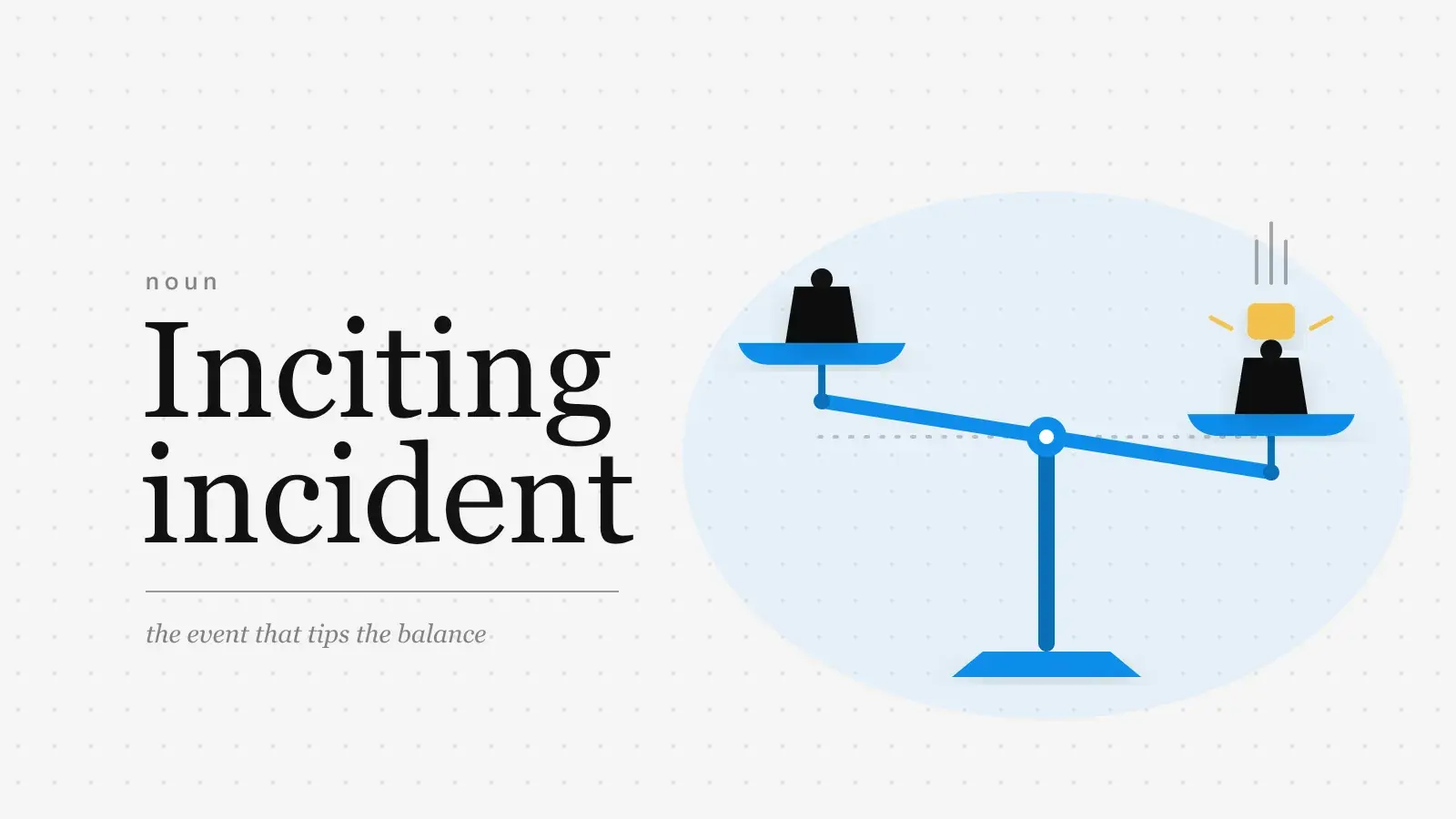
Inciting incident. Morris throws the paw on the fire. Mr. White snatches it out and keeps it, against his guest's advice.
Rising action. Half joking, Mr. White wishes for two hundred pounds to pay off the house. The next day Herbert is caught in the machinery at the factory where he works, and the firm offers compensation: two hundred pounds. About a week after the funeral, Mrs. White wakes her husband and makes him use the second wish: “I wish my son alive again.”
Climax. In the night, a knock at the front door. Mrs. White runs to draw the bolt. Mr. White, who saw what the machinery did to Herbert, finds the paw in the dark and makes the third wish.
Falling action and resolution. The knocking stops. His wife gets the door open, and the story ends: “The street lamp flickering opposite shone on a quiet and deserted road.”
Look at the joints. The paw is kept because Morris tries to destroy it. The money comes because of the wish, and the death because of the money. The second wish comes because of the death, and the third because of what the second might bring to the door. Each event is the answer to the one before, which is Forster's “of grief” on a larger scale. Jacobs also never shows the thing at the door. The climax is a decision, made in the dark, and the reader supplies the horror.
The order matters as much as the links. Jacobs tells the events as they happen, so the reader hears the fakir's warning before Mr. White makes his first wish, and the half-joking wish for two hundred pounds already carries dread. Open the story instead on the knocking at the door, with the warning, the money and the funeral coming out afterward, and the same events become Forster's plot with a mystery in it: the reader would spend the story asking what is outside and why, instead of fearing what each wish will cost.
The five elements of plot
The labels above come from the model most classrooms teach, which divides a plot into five stages, set off by an event that disturbs the opening situation. It is one model among several: three acts and Freytag's pyramid cut the same movement in different places, and the plot diagram guide compares them.
| Element | What it does | In “The Monkey's Paw” |
|---|---|---|
| ElementExposition | What it doesIntroduces the characters, the setting and the normal state of things | In “The Monkey's Paw”The Whites play chess on a stormy night and welcome an old soldier |
| ElementInciting incident | What it doesDisturbs the normal state and starts the central conflict | In “The Monkey's Paw”Mr. White pulls the cursed paw out of the fire to keep it |
| ElementRising action | What it doesComplications that raise the stakes and the tension | In “The Monkey's Paw”The first wish is granted through their son's death |
| ElementClimax | What it doesThe turning point where the conflict is decided | In “The Monkey's Paw”Knocking at the door after the second wish, and the third wish |
| ElementFalling action | What it doesThe immediate consequences of the climax | In “The Monkey's Paw”The knocking stops and the door swings open |
| ElementResolution or denouement | What it doesThe new normal once the conflict is over | In “The Monkey's Paw”An empty road under a flickering street lamp |
Exposition doesn't have to come first or all at once. Many writers start with the inciting incident or in medias res and feed the background in later; what goes wrong is the info dump. Rising action is usually the longest part, a series of attempts and setbacks that each make things harder. The climax is where the protagonist faces the central conflict head-on and something is decided that cannot be undone. Falling action shows what that decision cost, and the resolution settles the new state of things. In a short story the last two can share a paragraph. In a novel the falling action can run for several chapters.
Plot and subplot
A subplot is a secondary storyline that runs alongside the main plot, usually with minor characters or a side of the protagonist's life the main plot doesn't cover. A good one does at least one job for the main plot:
- Mirrors it. In King Lear (c. 1606), the Earl of Gloucester believes his scheming son over his loyal one, just as Lear believes his flattering daughters over Cordelia. Two fathers, the same mistake, two kinds of blindness.
- Complicates it. In Pride and Prejudice (1813), Lydia Bennet's elopement with Wickham looks like the end of Elizabeth's hopes and becomes the reason she learns what Darcy is really like.
- Contrasts with it. In Much Ado About Nothing (c. 1598–99), Claudio and Hero fall in love at first sight and nearly fall apart at the first lie, while Beatrice and Benedick argue their way into something sturdier.
- Changes the pace. A lighter storyline gives the reader somewhere to breathe between the main plot's big scenes, which matters most in a long book.
Subplots most often go wrong when they never touch the main plot. A common rule of thumb: each subplot crosses the main line at least once, ideally near a turning point, and is resolved before or alongside the main climax so it doesn't trail after the ending. A storyline that rarely meets the main one can still earn its place through contrast or theme, as long as the reader can see what it adds. A novel outline with a column per storyline shows at a glance when one has gone quiet for ten chapters.
Plot-driven vs. character-driven
Every story has both plot and character, but most lean one way. The difference is what pushes the story forward: events that happen to people, or changes that happen inside them.
| Plot-driven | Character-driven | |
|---|---|---|
| What moves the story | Plot-drivenExternal events, goals and obstacles | Character-drivenInner change, relationships, choices |
| The reader keeps asking | Plot-drivenWhat happens next? | Character-drivenWho will this person become? |
| Often found in | Plot-drivenThrillers, mysteries, adventure, much fantasy | Character-drivenLiterary fiction, coming-of-age novels, much romance |
| Classic example | Plot-drivenAround the World in Eighty Days, Jules Verne (1872) | Character-drivenMrs Dalloway, Virginia Woolf (1925) |
| Typical weakness | Plot-drivenCharacters who only react | Character-drivenA middle where nothing happens |
Many of the strongest plots are both at once: the events test the character, and the character's choices cause the next events. Elizabeth Bennet's prejudice is what makes her reject Darcy the first time. A character's flaw is often the engine, which is why a list of character flaws is as much a plotting tool as a character one.
Types of plot
Writers and critics have tried many times to sort all plots into a few kinds. None of the lists is complete, but each gives you a lens for seeing what your own story is closest to.
| Type | The shape | Classic example |
|---|---|---|
| TypeOvercoming the monster | The shapeA hero defeats a threat to a community | Classic exampleBeowulf; Dracula (1897) |
| TypeRags to riches | The shapeSomeone lowly rises, loses it, and wins it back for real | Classic example“Cinderella”; Jane Eyre (1847) |
| TypeThe quest | The shapeA journey toward a distant goal, with trials on the way | Classic exampleKing Solomon's Mines (1885) |
| TypeVoyage and return | The shapeA trip into a strange world and back, changed | Classic exampleAlice's Adventures in Wonderland (1865) |
| TypeComedy | The shapeConfusion keeps people apart until it is cleared up | Classic exampleA Midsummer Night's Dream (c. 1595) |
| TypeTragedy | The shapeA flaw or a mistake leads to destruction | Classic exampleMacbeth (c. 1606) |
| TypeRebirth | The shapeA dark force holds someone until they are freed or transformed | Classic exampleA Christmas Carol (1843) |
Older and more granular is Georges Polti's The Thirty-Six Dramatic Situations (1895, translated into English in 1916), which lists situations rather than whole plots: supplication, deliverance, crime pursued by vengeance, pursuit, revolt, daring enterprise, abduction and 29 more. Polti credited the number 36 to the eighteenth-century playwright Carlo Gozzi. At the other extreme, Kurt Vonnegut drew stories as lines on a graph of good and bad fortune and gave the shapes names such as “Man in Hole”, in which someone falls into trouble and climbs out better off. He wrote in Palm Sunday that his master's thesis on the idea had been rejected by the University of Chicago.
Use these as diagnostics, not recipes. If your story is a quest, ask what the goal really is; if it is a rebirth, ask what holds the character down. The answer often points to your theme, the subject of the guide to themes in literature.
Plot devices
A plot device is any technique that moves the plot along or shapes how the reader experiences it. The ones writers use most:
| Device | What it does |
|---|---|
| DeviceChekhov's gun | What it doesA detail shown with care pays off later, so nothing important is wasted. |
| DeviceForeshadowing | What it doesHints of what is coming build dread or anticipation. |
| DeviceRed herring | What it doesA false clue leads the reader, and often the detective, the wrong way. |
| DeviceMacGuffin | What it doesAn object everyone chases that matters for the chase, not for itself. |
| DeviceIn medias res | What it doesThe story opens in the middle of the action and fills in the past later. |
| DeviceFlashback | What it doesA scene from earlier in time interrupts the present to explain it. |
| DeviceCliffhanger | What it doesA chapter or episode ends at the point of greatest suspense. |
| DeviceTicking clock | What it doesA deadline forces the characters to act and speeds up the pace. |
| DevicePlot twist | What it doesA revelation changes the meaning of what came before. |
| DeviceDeus ex machina | What it doesAn outside force solves the problem: usually a flaw, because the hero didn't. |
Devices work when they serve the chain of cause and effect rather than replace it. A twist lands when it was possible all along, and a ticking clock matters when missing the deadline costs something the reader cares about.
How to test your own plot
This check takes half an hour and works on an outline or on a finished draft. It uses Forster's idea directly: a plot is events joined by cause.
- List the main events
One line each, in the order the reader meets them. Fifteen to thirty lines for a novel, five to ten for a short story.
- Join them with “because”
Read the list aloud with “because” or “so” between each pair. Wherever only “and then” fits, the link is missing: something happens without being caused, or causes nothing.
- Check who causes the climax
In most plots the protagonist decides the climax through a choice, as Mr. White does in the dark. If luck, a rescue or another character settles it instead, check that the story set it up; otherwise it is likely to read as a deus ex machina, however well disguised.
- Find the question the inciting incident asks
Write it down: will the Whites escape the paw's price? Then check that the climax answers that question, not a different one.
- Cross the subplots
Mark where each subplot touches the main line. For a storyline that never touches it, ask what it contributes through events, character, theme or contrast before you decide to cut it.
If the event list lives as a table in your outline, you can attach the chapters and ask the Strokes Assistant to point out events that nothing causes, or that cause nothing.
Frequently asked questions
What is the difference between plot and story?
In E. M. Forster's definition, a story is events in time order, while a plot connects them by cause. The king died and then the queen died is a story; the king died, and then the queen died of grief is a plot. Critics also use story for the events themselves and plot for the order in which the work reveals them.
What is the difference between plot and theme?
Plot is what happens; theme is what it means. The plot of Macbeth is a general who murders a king, takes the crown and is destroyed. One theme is that ambition overriding conscience destroys the peace it was meant to win. The plot is the evidence for the theme, and the climax is usually where the theme is decided.
Can a story have no plot?
Some experimental and literary fiction keeps plot to a minimum, focusing on a mood, a consciousness or a single moment, as many vignettes and prose poems do. Even then, readers usually look for change of some kind. Many stories that seem plotless have a quiet plot: an inner shift rather than a chain of outward events.
What is a plot hole?
A plot hole is a gap or contradiction in the chain of events: a character knowing something they couldn't, a problem solved by a method that should have worked earlier, or an event with no cause. Listing the main events and joining them with because is a quick way to find them before a reader does.