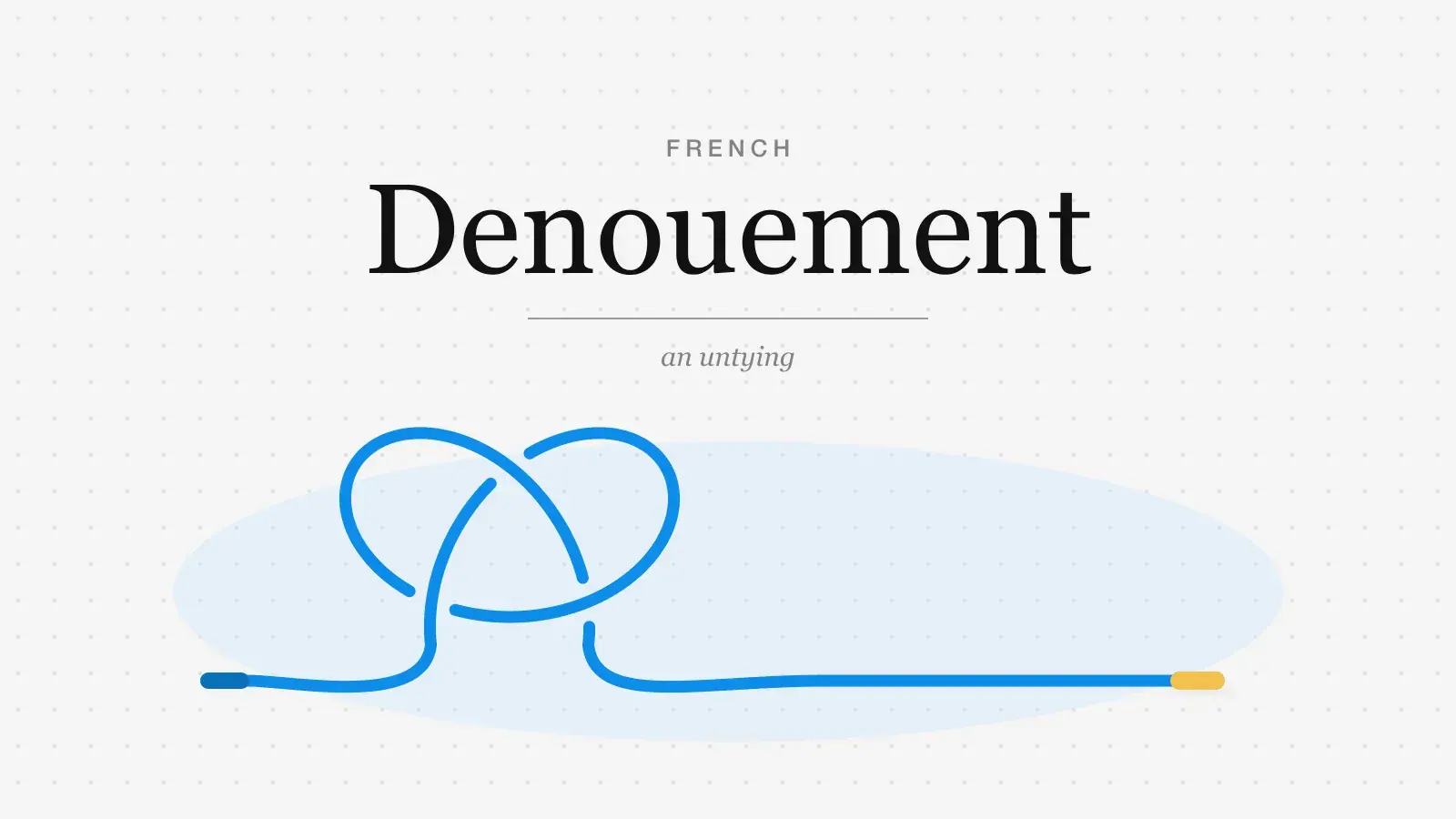
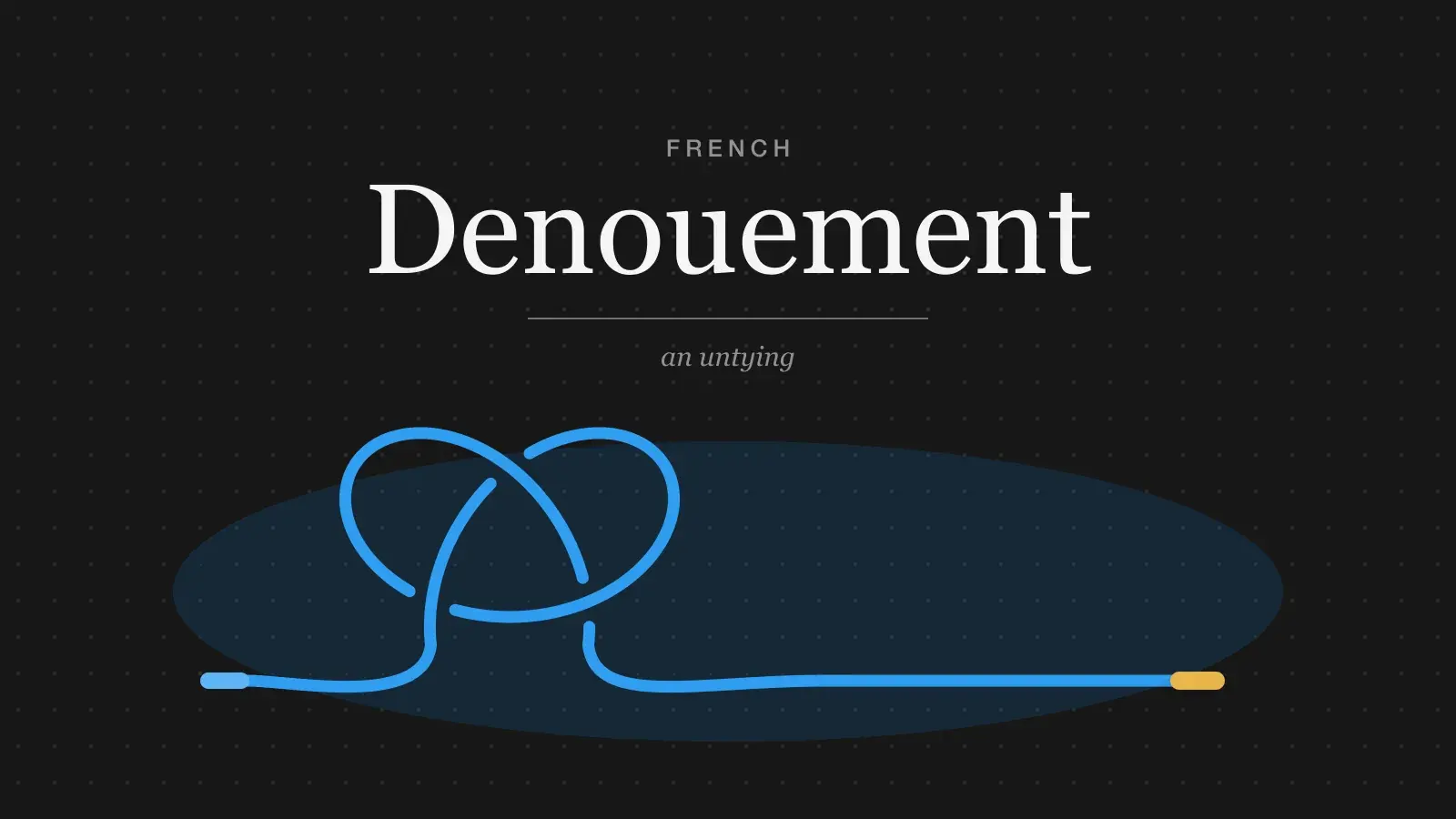
The denouement (pronounced day-noo-MAHN) is the final part of a plot, after the climax. The main conflict is over, and the denouement shows what it left behind: loose threads tied off, remaining questions answered, the characters settled into a new normal.
The word is French for "an untying," from dénouer, to untie, which goes back to the Latin nodus, a knot. English borrowed it in the 1750s, and you will still see it spelled with the accent. The idea is far older. Aristotle's Poetics splits every tragedy into two parts, which S. H. Butcher's translation calls "Complication and Unravelling or Denouement." Everything up to the turning point ties the knot. Everything after it unties it.
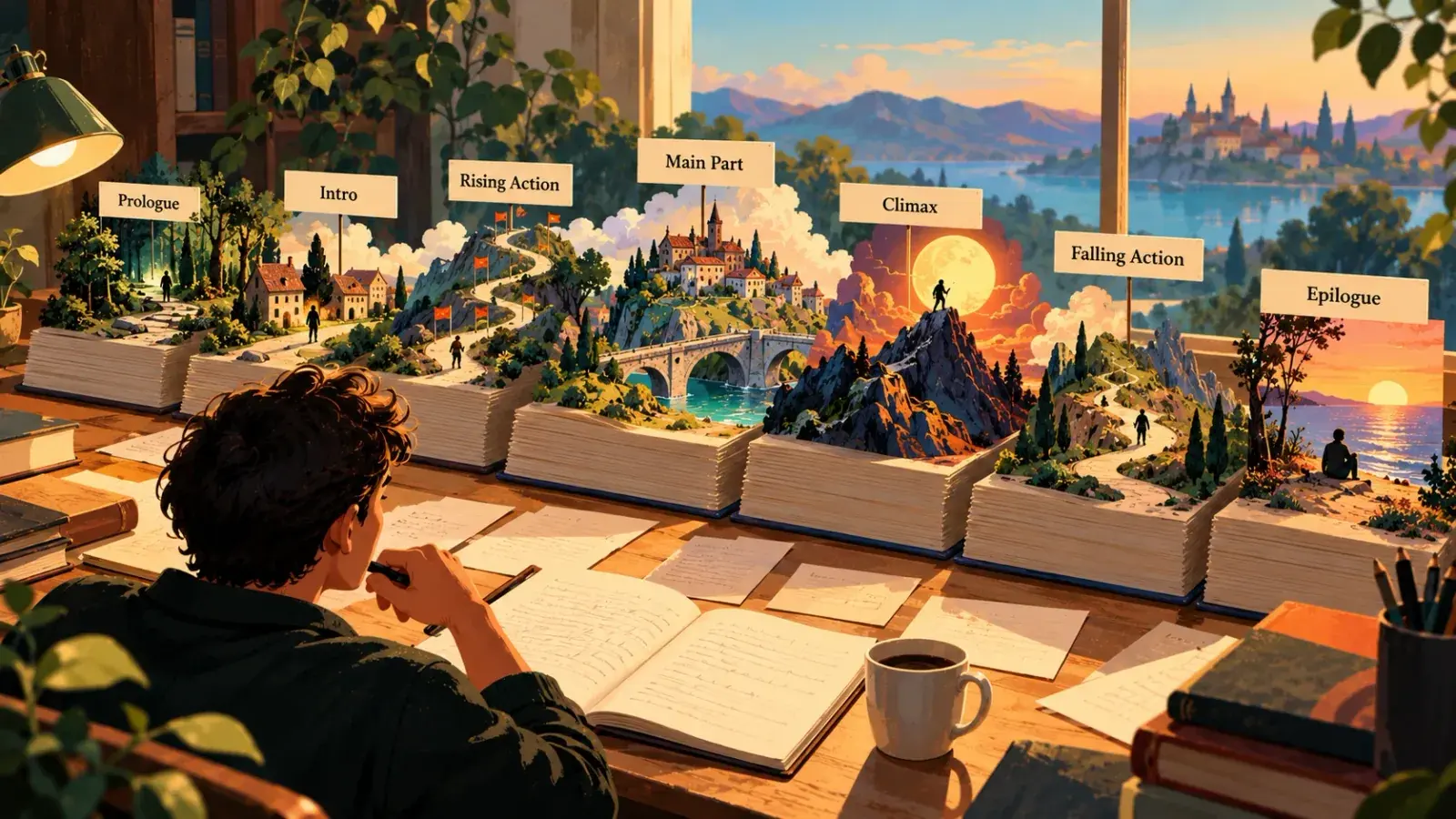
Gustav Freytag's 1863 study of drama, in Elias MacEwan's English translation, divides a play into five parts: introduction, rise, climax, return or fall, and catastrophe. Classroom versions of his pyramid usually rename the last part the resolution or the denouement.
Denouement examples
Let four captains
Bear Hamlet like a soldier to the stage
The climax kills Gertrude, Laertes, Claudius and Hamlet in a single scene. What follows is short and public. Horatio, kept alive to tell the story, promises to explain to "th' yet unknowing world" how it happened. Fortinbras, a foreign prince, claims the crown and orders a soldier's funeral. Tragedies often end this way: a witness to set the record straight, someone new in charge, the bodies carried off.
Happy for all her maternal feelings was the day on which Mrs. Bennet got rid of her two most deserving daughters.
Elizabeth accepts Darcy in Chapter 58, and Austen keeps going for three more chapters. Jane hears the news. Mr. Bennet gives his consent. Mrs. Bennet discovers she likes Darcy after all, mostly for his income. The last chapter then runs forward in time to settle every character, down to Lydia's letters asking for money. Comedy can afford a long denouement because the pleasure is in watching everyone react.
…and to Tiny Tim, who did NOT die, he was a second father.
The climax comes at the end of Stave Four, with Scrooge at his own gravestone begging for a chance to change. Stave Five shows the change at work: a prize turkey sent anonymously to the Cratchits, a donation whispered to the charity collector he turned away in Stave One, dinner at his nephew's, a raise for Bob Cratchit. Until the denouement, Scrooge's reform is a promise. Stave Five shows him keeping it.
In Dickens's first ending, Pip runs into Estella in London years later. She has remarried, they talk briefly, and they part. Edward Bulwer-Lytton read the proofs and urged a happier close, so Dickens rewrote it: the two meet in the ruins of Satis House, and in the wording Dickens settled on for later editions the book ends, I saw no shadow of another parting from her. Nothing before the last chapter changed. Only the denouement did, and with it what the novel seems to say about Pip's hopes. Readers still argue over whether that last line promises a marriage.
So we beat on, boats against the current, borne back ceaselessly into the past.
Gatsby is shot at the end of Chapter VIII, and the last chapter is all denouement: a funeral almost nobody attends, a goodbye to Jordan Baker, a reluctant handshake with Tom on Fifth Avenue, and Nick's decision to go back home to the Midwest. Every question of plot is answered. The larger one, what Gatsby's hope was worth, is left with the reader.
In the book, destroying the Ring is not the end. The hobbits get home to find the Shire taken over and have to free it themselves in "The Scouring of the Shire," a chapter Tolkien said he had foreseen from the outset. Only then does Frodo, unable to settle, sail from the Grey Havens. Jackson's film drops the Scouring, and plenty of reviewers still felt its run of farewells went on too long. A long denouement has to keep earning its pages.
How to write a denouement
Write it once you know your climax, and with a list of what the reader is still waiting for. When the main question is answered, tension drops, and readers stay only as long as something they care about is unsettled.
- Answer what's still open, biggest first. List every question the book raised that the climax didn't answer: the subplot romance, the estranged brother, the family business. Each one gets a scene, a line or a silence you chose on purpose.
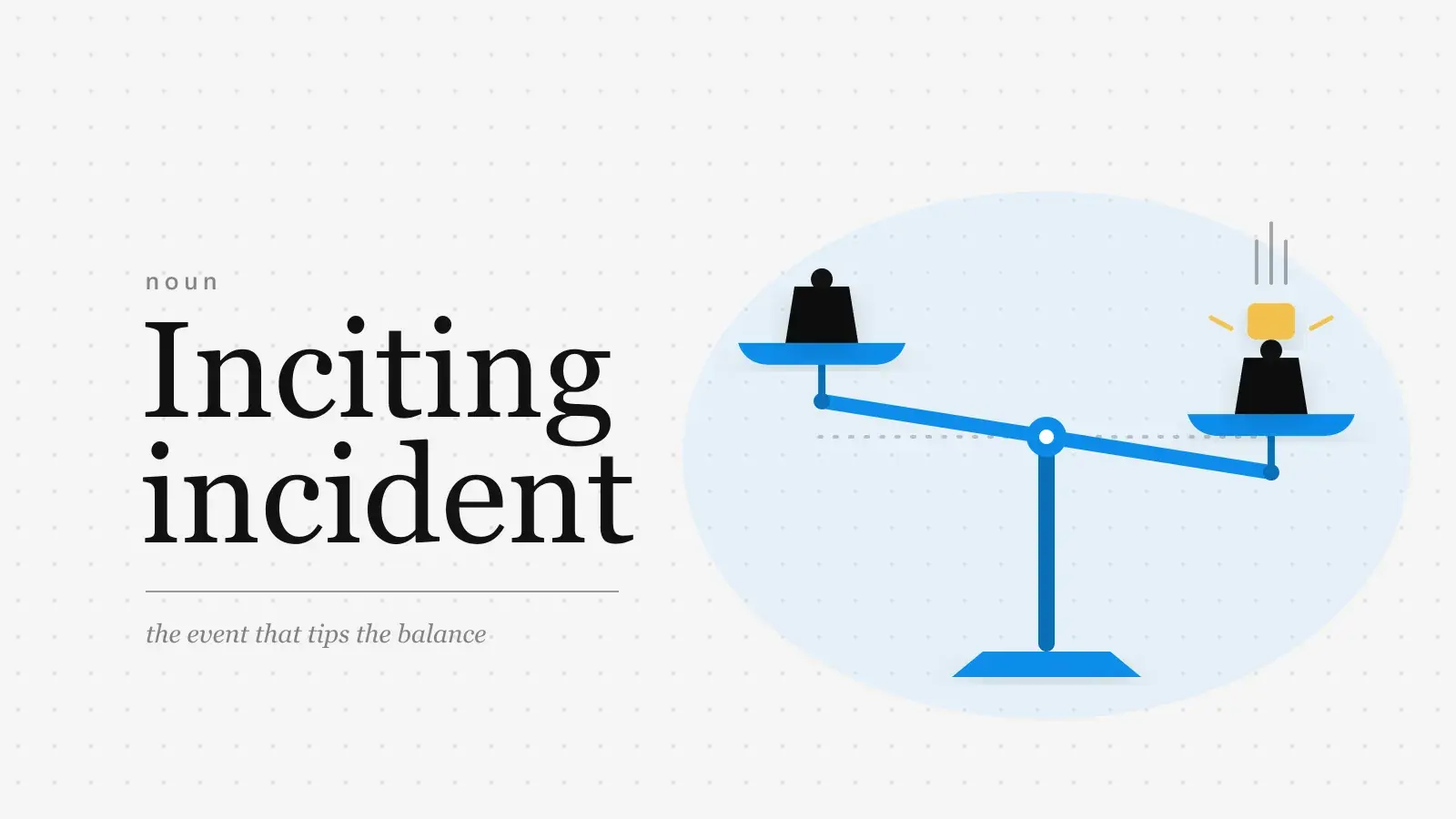
- Show the change in action. The inciting incident knocked the protagonist's life off balance. The denouement shows the new balance. Scrooge doesn't announce that he has changed. He buys the turkey.
- Echo the opening. A last image that mirrors the first lets the reader measure how far the story has come. Blake Snyder's Save the Cat! beat sheet makes this its final beat, the Final Image. A returning motif does the same job.
- Stop sooner than feels safe. Every extra scene after the climax reads as another ending. If you have three candidates for the last scene, pick one and fold the others into it.
- Don't start a new conflict. A series can close on a hook for the next book. In a standalone, a fresh problem on the last pages tells the reader the story isn't over.
Length follows genre. Tragedies and thrillers clear the stage in a few pages. Mysteries need room for the explanation. Comedies and romances linger, and romance readers expect the ending to confirm the couple's future as an HEA or HFN. Literary novels may give the whole last chapter to aftermath, as Gatsby does.
You also choose how closed to make it. Austen ties every thread. Fitzgerald settles the plot and leaves the meaning open. Frank Darabont planned to end The Shawshank Redemption (1994) with Red on a bus toward the Mexican border, his future uncertain. Producer Liz Glotzer pushed for a reunion on the beach, which by her account Darabont thought sappy. It became test audiences' favorite scene, and it stayed. Same story, two different last notes.
Two failures turn up in drafts again and again. One stops on the climax's last blow, before the reader sees what it cost. The other reports everyone's future in a list.
Draft: The last chapter opens a year after the night Lena and June finally fought it out in their late mother's house. It reports on everyone in turn. June finished nursing school. Lena moved to Portland and started dating again. The house sold for more than they expected. Their aunt apologized at Thanksgiving. The dog lived to fifteen.
Revised: Three weeks later, on the morning the buyers get the keys, the sisters repaint the kitchen doorframe where their mother penciled their heights every birthday. June rolls white over her own marks without slowing down. Lena can't start on hers. June takes the roller from her, leaves one line showing, and paints carefully around it.
The draft says how everything turned out. The revision shows the one outcome the book was about, two sisters who can now work side by side, and lets the sale and the move happen offstage. The aunt and the dog get one line each, or none.
Denouement vs. falling action, resolution and epilogue
| Term | What it covers | Where it falls |
|---|---|---|
| TermClimax | What it coversThe decisive confrontation that answers the story's main question | Where it fallsThe last big scene |
| TermFalling action | What it coversWhat follows straight from the climax: escapes, deaths, confessions | Where it fallsRight after the climax, often only pages |
| TermResolution | What it coversThe outcome of the conflict, often used as a plain synonym for denouement | Where it fallsAt or just after the climax |
| TermDenouement | What it coversThe settling: threads tied off, the new normal shown | Where it fallsThe final scenes or chapter |
| TermEpilogue | What it coversA separate section set after the story, often after a gap in time | Where it fallsAfter the last chapter, if at all |
In a novel, falling action and denouement often share the same pages. A workable rule: falling action is still about the conflict (the villain's escape, the bomb that might still go off), and the denouement starts once the outcome is no longer in doubt.
An epilogue sits outside that stretch. The denouement belongs to the story's last chapters. An epilogue is a separate section that steps past them, usually after a jump in time, as the "Nineteen Years Later" epilogue of Harry Potter and the Deathly Hallows does. Almost every novel has a denouement, even if it lasts a page. An epilogue is optional.
Detective fiction uses the word in a narrower sense: the scene where the detective explains how the crime was done. At the end of "The Red-Headed League" (1891), Holmes walks Watson through his reasoning over whisky and soda in Baker Street, and Watson answers, You reasoned it out beautifully. In a mystery, the explanation is the payoff the reader has waited for, so the reveal and the denouement often share a chapter.
Related terms: in medias res, a choice about where a story begins, and frame story, where the denouement often returns to the outer tale. To place the ending among the other turning points, fill in the three-act structure template or the Save the Cat beat sheet, which gives the Final Image a row of its own.