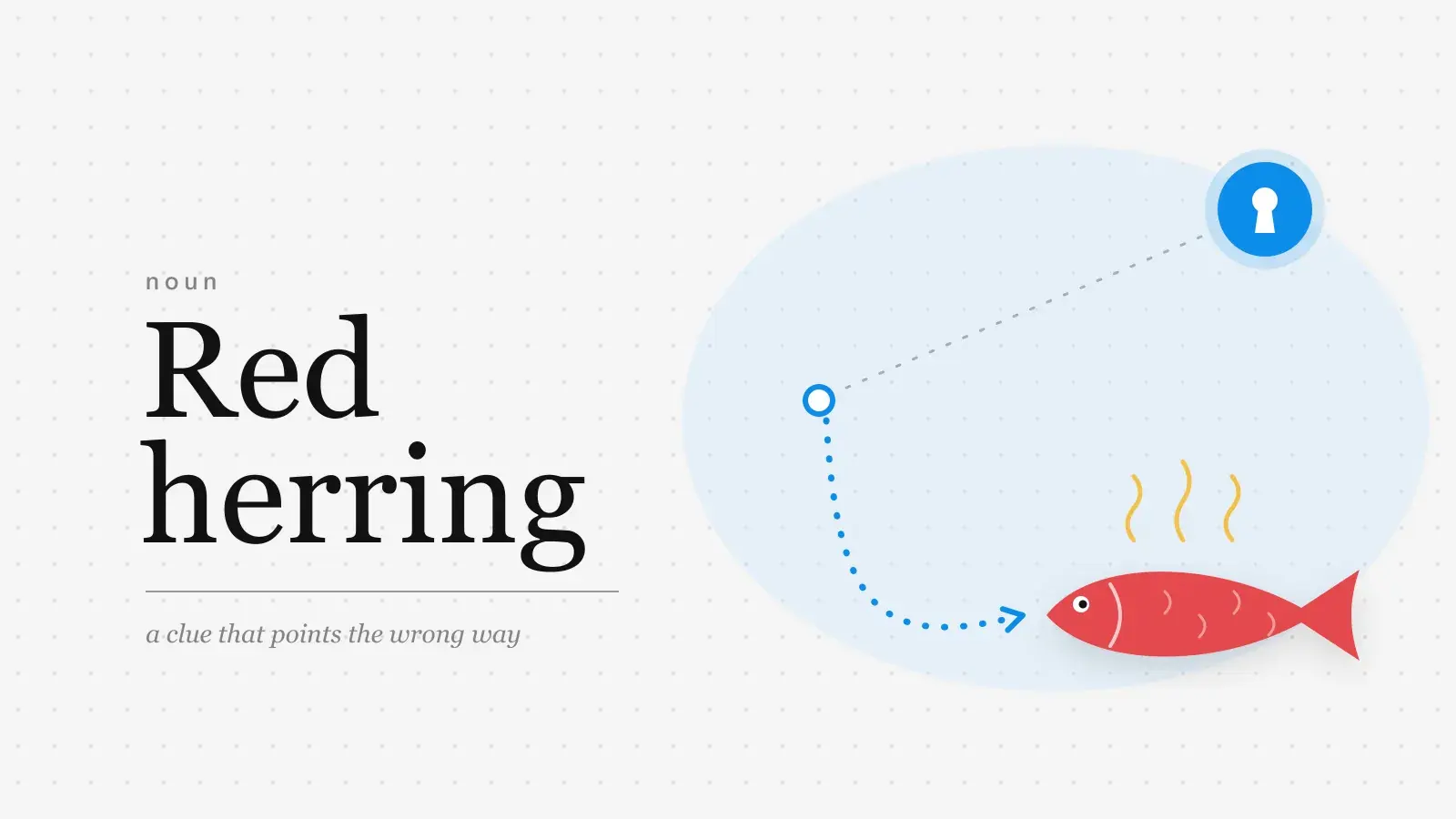
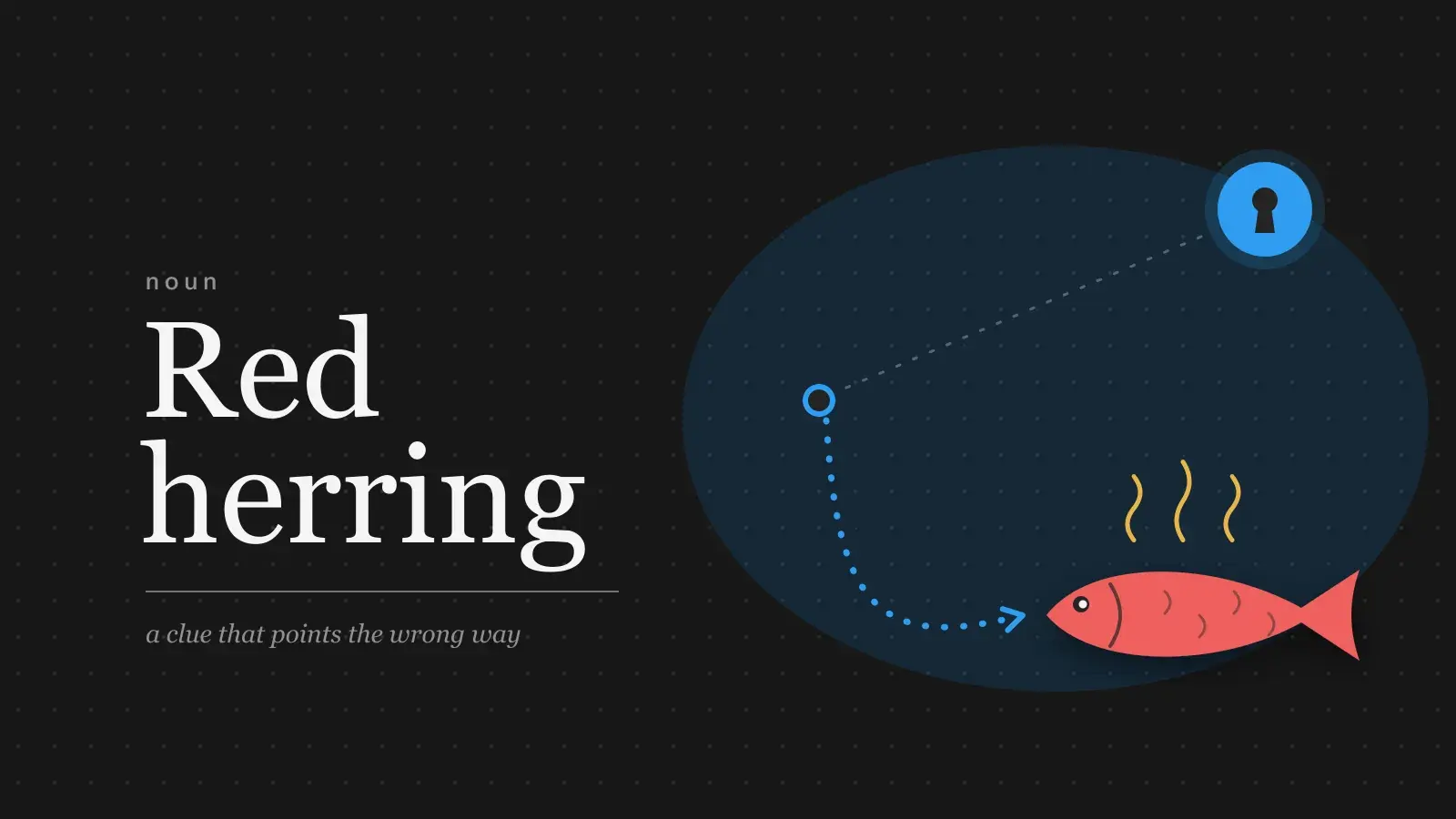
A red herring is a misleading clue: a suspect, object or detail planted to pull the reader toward the wrong conclusion. Mysteries and thrillers rely on it most. It draws attention away from the real answer, which sits in plain sight until the reveal.
The name comes from smoked herring, which cures to a reddish brown and smells strong. The figurative sense is usually traced to William Cobbett, who wrote in his Political Register on February 14, 1807, that as a boy he had dragged a red herring across a trail to pull hounds off a hare. He used the story to mock newspapers fooled by a false report of Napoleon's defeat. Etymologists now doubt that hunters ever did this, but a hound pulled off the scent is still the best picture of the device.
Red herring examples in literature
I had come to an entirely erroneous conclusion which shows, my dear Watson, how dangerous it always is to reason from insufficient data.
Julia Stoner dies gasping about "the speckled band," and travelers in spotted headscarves are camped on the family estate. Holmes connects the two, and so does the reader. The band is a swamp adder that her stepfather, Dr. Grimesby Roylott, sends through a ventilator into her room.
…he conceived the exceedingly clever idea of preparing a lot of manufactured evidence against himself.
Emily Inglethorp is poisoned, and her much younger husband is everyone's first suspect. Poirot goes out of his way to stop the police arresting him, and readers take that as a verdict. He did it. He wanted to be arrested and then cleared by an alibi, because a man once acquitted could not be tried again.
A diamond vanishes from a country house. Sergeant Cuff suspects the housemaid Rosanna Spearman, who is sewing something in secret, and Rachel Verinder, who won't let her wardrobe be searched. Both are hiding something, but not a theft. Each is shielding Franklin Blake, who took the stone in a laudanum haze and remembers nothing. Give a false suspect a true secret, and their guilty behavior survives a second reading.
Miss Havisham was going to make my fortune on a grand scale.
Pip's anonymous fortune arrives through Jaggers, who is also Miss Havisham's lawyer, and Pip draws the obvious conclusion. So does the reader. The money is from Magwitch, the convict Pip fed on the marshes as a boy. This time the misreading is Pip's own, and the novel makes him pay for the snobbery he builds on it.
Harry is sure that Snape, who openly despises him, is after the Stone. When Harry's broom bucks in the middle of a Quidditch match, Snape is in the stands muttering without blinking. The culprit is Quirrell, the timid teacher with the stammer. Snape was saying a counter-curse.
How to write a red herring
Readers enjoy being fooled and resent being lied to. A fair red herring is a real clue with a second, innocent explanation. S. S. Van Dine's 1928 "Twenty Rules for Writing Detective Stories" allowed no tricks on the reader "other than those played legitimately by the criminal on the detective himself."
- Explain it later. Every herring needs a payoff of its own: the suspect's actual secret, the stain's actual cause. One left dangling reads as a plot hole.
- Point it at someone. A clue that means nothing is padding. The strongest herrings misread a true clue, as the speckled band does.
- Hide the real clue next to it. Put the true detail in the same scene, mid-list or mid-action, while the reader watches the loud one.
- Clear it at a turn. Ruling out a suspect is a scene in itself and makes a natural midpoint reversal.
Two failures are common. One is the herring that shouts: a suspect who glowers and lurks, whom experienced readers rule out on sight. The other is cheating in the narration. Ronald Knox's 1929 rules for detective fiction barred a culprit whose thoughts the reader has been allowed to follow. A point-of-view character who thinks innocent thoughts and turns out guilty has lied to you. Christie's The Murder of Roger Ackroyd (1926) broke the rule three years before Knox wrote it down, and it still divides readers. An unreliable narrator gets more room, but only if the book signals it.
Too loud: The gardener glared at Inspector Hale. There was fresh mud on his boots and a spade in his hand, and he said nothing at all when asked where he had been on Tuesday night.
Fair: The gardener said he'd spent Tuesday night at his sister's in Lydford and named the bus he caught home, the 11:20. It was a good answer. It was also the bus that stopped at the end of the Mardens' lane. Behind him the kitchen clock said ten past nine. Hale's watch said five to nine.
The fair version gives the reader something to check, keeps an innocent explanation in reserve (he was meeting the Mardens' daughter), and slips the real clue, a clock running fast, into the same paragraph.
A quick test once the draft exists: give an AI model the chapters before your reveal and ask who did it. If it names the real culprit and cites the clues you meant to bury, they are too loud. In Strokes you can add those chapters to an AI Assistant chat as context.
The red herring fallacy
In argument, a red herring is an irrelevant point raised to change the subject. Asked why the project is over budget, a manager talks about the team's late nights. Unlike a straw man, it doesn't distort the other side's claim. It walks away from it. A debater asked about crime figures who answers with the opponent's voting record on schools is doing the same thing. If it happens to you, name the switch and ask the question again. In fiction the detour has to pay off later. In an argument it is only a dodge.
Red herring vs. Chekhov's gun
| Device | What it promises | What happens |
|---|---|---|
| DeviceRed herring | What it promisesThis matters, and it points here | What happensIt matters, but it points elsewhere |
| DeviceChekhov's gun | What it promisesThis will matter later | What happensIt does, as promised |
| DeviceMacGuffin | What it promisesEveryone wants this | What happensThe chase matters more than the thing |
| DeviceForeshadowing | What it promisesSomething is coming | What happensIt comes, often in a new light |
Chekhov's gun says a detail shown with care must pay off. A red herring seems to break that rule and doesn't: it pays off too, just not the way the reader expected. A MacGuffin is the thing characters chase, and nobody is fooled about it. Hitchcock's Psycho blurs the line between the two. Marion Crane's stolen $40,000 drives the first act and then sinks with her car, and Hitchcock told François Truffaut that the first part of the story was a red herring.
Related terms: Chekhov's gun, MacGuffin, unreliable narrator and midpoint. To see false clues beside true ones, read Foreshadowing examples from literature. To plan where each clue lands, start with How to outline a novel.