When to use it
- Planning a novel from premise to chapter list before the first draft
- Turning a beat sheet, a snowflake summary or a pile of index cards into one working document
- Tracking subplots and themes across a long book, so no thread goes quiet for too long
- Getting a stalled draft back on course by checking it against the beats
- Briefing an editor, critique partner or co-writer on the whole book in a few pages
How to use this template
- Write the logline and the ending first
A logline names the protagonist, the event that starts the story, the goal, what stands in the way and what is at stake, in a sentence or two. If it will not come, the story is not clear to you yet, and it is better to find that out now than in chapter twelve. Write the ending as a best guess too. Knowing where the book lands tells you what the first act has to set up, even if the ending changes in the draft.
- Make the characters' wants collide
Give each main character one row. Put something a camera could film in the Wants column: win the custody case, get the ship off the moon. Needs or flaw is the inner change the story forces on them. Give the antagonist a goal of their own, because a villain who exists only to get in the way is hard to write and easy to predict. When one row is not enough, move the character to a character profile.
- Pin the beats before the chapters
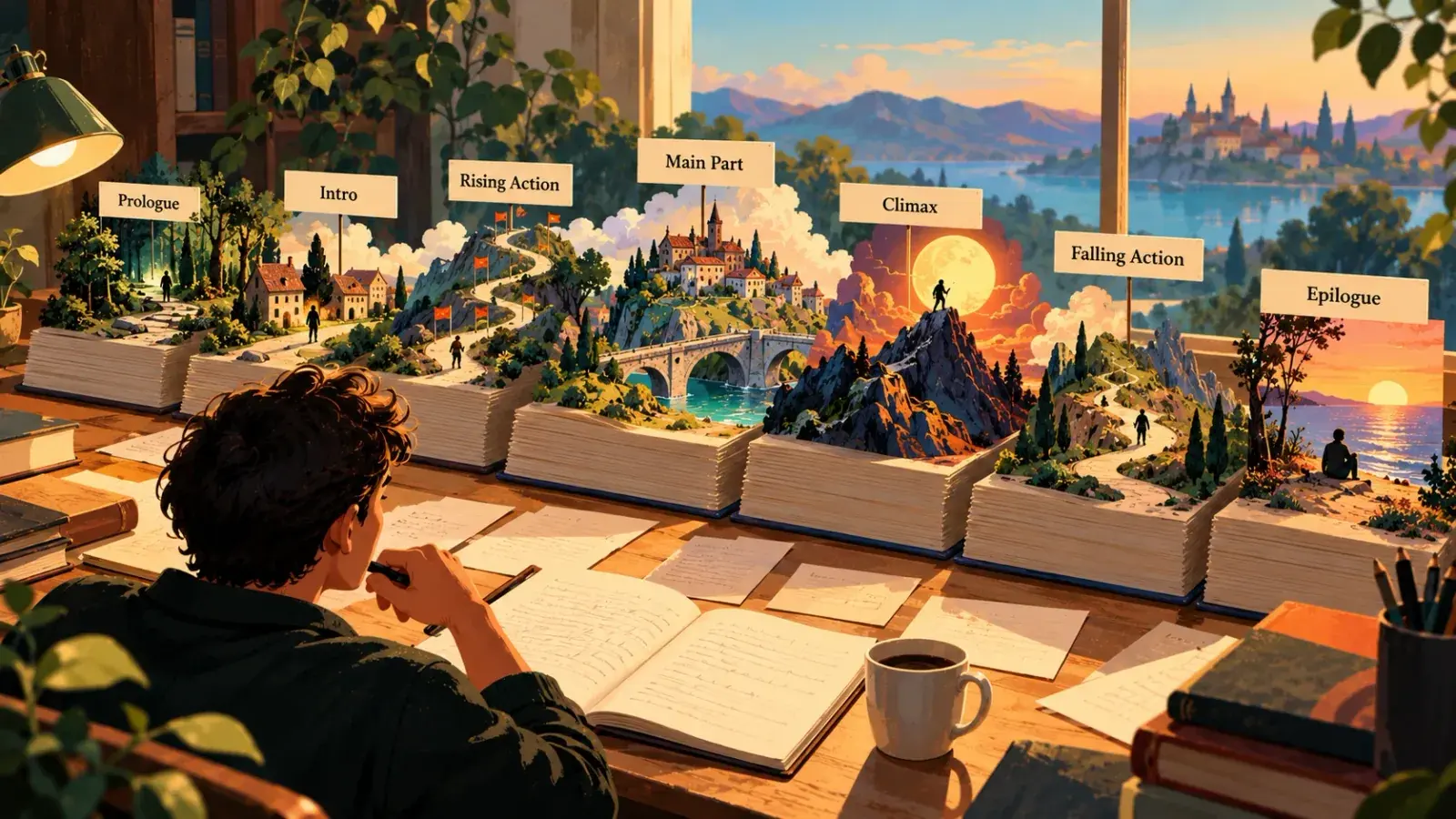
Fill in the three acts, a sentence or two per beat: the inciting incident, the end of act one, a pinch point in each half of the middle, the midpoint, the low point and the climax. These are the posts. The chapters are the fence between them. Turn the percentages into chapter numbers. In a 90,000-word novel of 30 chapters at 3,000 words each, the inciting incident lands around chapter 3, the midpoint around chapter 15 and the low point around chapter 23.
- Fill the chapter table, then the threads
One row per chapter. The summary says what happens, and the purpose says why the book needs it. Purpose is the test. If the only answer is "introduces the sister" or "more investigating", the chapter probably belongs inside a neighbor. Leave subplots and themes for last. They are easier to see once the spine is in place, and you can mark the chapter where each thread opens, turns and closes.
A filled-in novel outline example
Here is the outline for an invented science fiction novel, cut down to its first lines in each section. The entries are short on purpose. An outline you can read in five minutes is one you will actually reread before each writing session.
Story at a glance: Science fiction, about 90,000 words in 30 chapters. An ice-mining station on a frozen moon, over six days. Close third person, past tense, one narrator.
Logline: When the evacuation shuttle she is to fly off a failing mining moon has seats for only three of her four crew, pilot Ada Reyes has six days to find room for the fourth, but the station director will not leave behind the ore cargo that fills the missing seat.
Ending: All four get home, on Mags's plan rather than Ada's. Dumping the ore costs Ada her pilot's license, and she takes the blame without arguing.
- Ada Reyes, protagonist. Wants all four of her crew on the shuttle. Needs to let them choose for themselves. Arc: decides for everyone → asks.
- Hollis Grange, station director. Wants to launch on schedule with every ton of ore, the cargo that keeps the company alive. Blind spot: he counts people the way he counts cargo.
- Mags Dunn, the crew's mechanic and Ada's former partner. Wants to be asked, not assigned.
Beats: The manifest posts three seats for four (ch. 3). Ada refuses Grange's lottery and pulls a scrapped tug out of the hangar to rebuild as a second way up (ch. 7). Grange cuts the hangar's power (ch. 11). The tug flies but cannot reach orbit, so the only way to free a seat is to get the ore off the shuttle (ch. 15). The launch moves up a day (ch. 19). The crew votes without her, and Mags volunteers to stay (ch. 23).
Subplot: Ada and Mags. Opens ch. 2, turns ch. 15, closes ch. 28. It mirrors the main plot: Ada decides for Mags the way Grange decides for her crew.
Theme question: Is deciding for the people you love a kind of love?
Motif: The crew roster on the back of Ada's hand, four names in ch. 1, three in ch. 23.
| Ch | POV | Summary | Purpose |
|---|---|---|---|
| Ch1 | POVAda | SummaryA routine ore run. Ada counts her crew by name over the radio, as she does every shift, while a reactor alarm nobody answers anymore keeps sounding. | PurposeSets up the crew, Ada's habit of counting them and the failing station |
| Ch2 | POVAda | SummaryDinner in the mess. Mags sits at the other table. | PurposeOpens the Ada and Mags subplot |
| Ch3 | POVAda | SummaryThe evacuation order. The manifest lists three seats for Ada's crew of four. (Inciting incident) | PurposeStarts the story and the six-day clock |
| Ch4 | POVAda | SummaryGrange explains the ore weight and offers a fair lottery. | PurposeIntroduces the antagonist's goal and his logic |
Use it with any outlining method
The template uses three acts as its frame because the other common methods fit inside it. If you already work with one, here is where its output goes. The guide to how to outline a novel compares the methods themselves.
| Method | Where it goes in the template |
|---|---|
| MethodThree-act structure | Where it goes in the templateThe three acts, as they are |
| MethodSave the Cat beat sheet | Where it goes in the templateCatalyst (10%) as the inciting incident, Break into Two (20%) as the end of act one, All Is Lost (75%) as the low point, the Finale as the climax. The B story becomes a subplot. |
| MethodSnowflake method | Where it goes in the templateThe one-sentence summary becomes the logline. The five-sentence paragraph (setup, three disasters, ending) fills the acts. The character summaries fill the characters table, and the scene spreadsheet becomes the chapter table. |
| MethodHero's journey (Vogler's 12 stages) | Where it goes in the templateThe stages from the ordinary world to crossing the threshold fill act one. The ordeal sits near the midpoint. The road back, resurrection and return with the elixir make act three. |
| MethodDiscovery writing | Where it goes in the templateFill in the story at a glance, the logline and two or three beats. Write the chapter table after the draft, from the pages. |
For a beat-by-beat version of the middle rows, start from the three-act structure template or a Save the Cat beat sheet, then copy the beats in here. If you are a pantser, the last row is yours: a light outline gives the draft a direction, and the chapter table written afterward shows you the book you actually wrote.
Keep it loose while you draft
An outline is a forecast. Keep the beats firm and let the chapters between them move. Plan only the next few chapters in detail. The rows for chapter 20 onward can stay one line each until you get there, because writing chapter 10 will change them.
When the draft parts from the plan, decide which one is right, then update the outline the same day. Use the Notes section as a holding pen: open questions get answered by drafting, and a good idea that belongs in act three can wait there instead of derailing act one. When one chapter needs more planning than a row can hold, give it a chapter outline of its own.
Subplots are the threads most likely to vanish in a long draft. Two famous outlines show one way to catch it. Joseph Heller plotted Catch-22 on a handwritten grid, with the months of 1944 running down the side and the major characters across the top. J.K. Rowling's hand-drawn grid for Harry Potter and the Order of the Phoenix gave its first columns to chapter, month, title and plot, then gave each subplot a column of its own. Add a column per subplot to your chapter table, and an empty stretch shows a thread that has gone quiet. The same trick works for a motif: if it appears in chapters 1 and 29 and nowhere between, the reader will not feel it land.
Frequently asked questions
What should a novel outline include?
The premise and a logline, the main characters with what each one wants, the turning points of the plot (inciting incident, end of act one, midpoint, low point, climax), a chapter list with what each chapter does, the subplots, and the themes. Notes for open questions and research round it out.
How detailed should a novel outline be?
Detailed enough that you can start the next chapter with confidence. A light outline is the top of this template: the story at a glance, the logline, the ending and the beats, which fits on a page or two. A full outline adds a row for every chapter, the subplots and the motifs. You can mix the two: full rows for the act you are about to draft, single lines for the rest.
Can I use this template if I don't like to plan?
Yes. Fill in only the logline, the ending you are aiming for and two or three beats, then draft. After the draft, fill in the chapter table from what you actually wrote. That reverse outline is where structural problems show up before revision.
Can I open the template in Word or Google Docs?
Yes. The .docx file opens in Microsoft Word, and in Google Docs if you upload it to Google Drive and open it there. The .md file opens in any plain-text editor and in Markdown apps such as Obsidian.