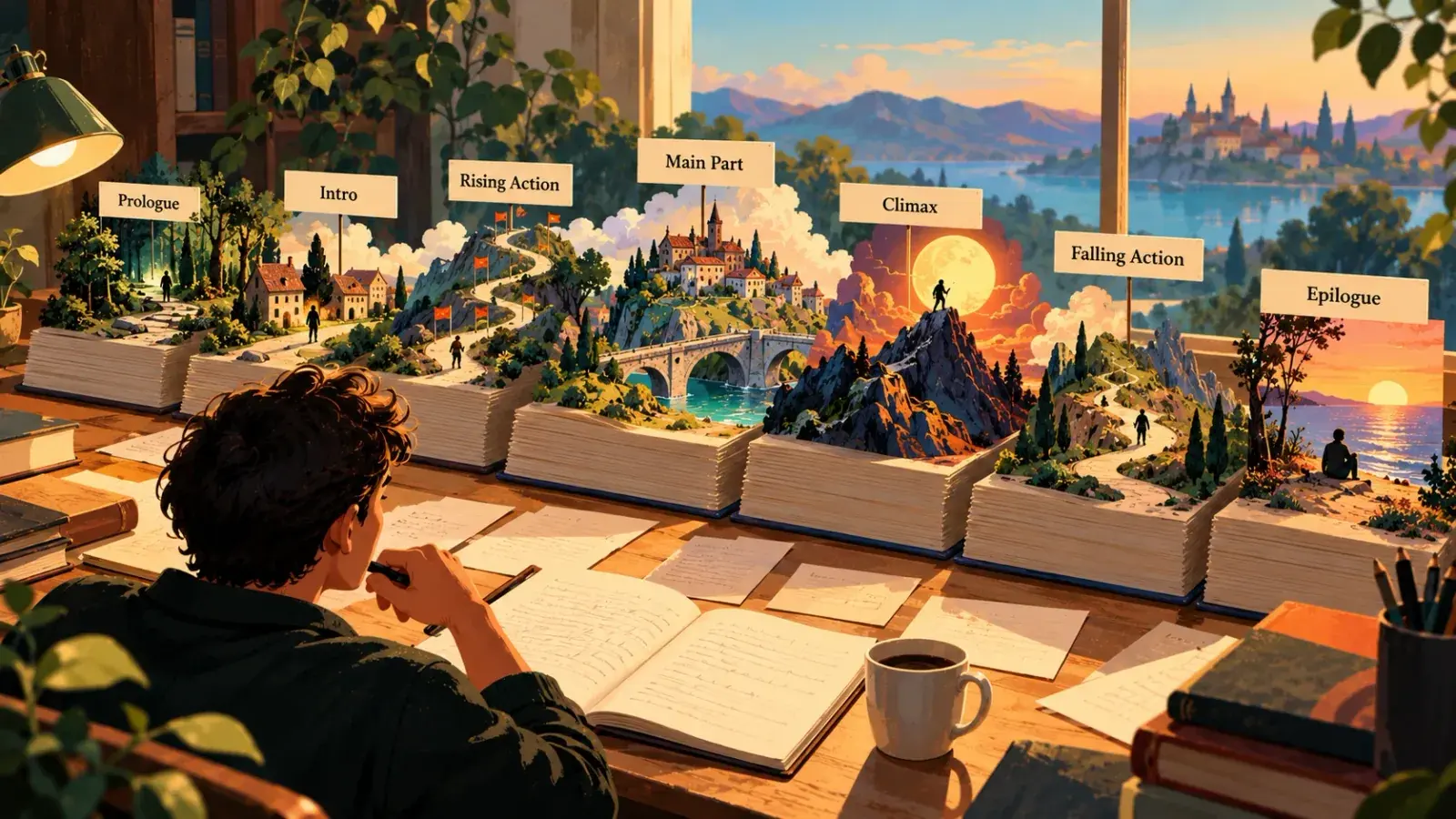
A plot diagram is a picture of a story's structure: a line that rises from the exposition through the rising action to the climax, then falls through the falling action to the resolution. The version taught in schools descends from Gustav Freytag's pyramid of 1863. Plot structure is the wider name for the pattern a story's events follow, and the pyramid is only one of several maps writers use.
A diagram pictures one plot so you can see its shape; it is not a template every story has to fit. Below: the parts of a plot diagram, Freytag's pyramid with his reading of Romeo and Juliet and a fairy tale mapped three ways, seven plot structures side by side, and a method for diagramming your own manuscript. What plot is in the first place, and how it differs from story, is covered in what is plot.
The parts of a plot diagram
Plot diagram
                               CLIMAX
                                 /\
                                /  \
                               /    \  falling
               rising action  /      \  action
                             /        \
                            /          \
   EXPOSITION _____________/            \__________ RESOLUTION
                           ^
inciting incident| Part | What happens | Where it usually sits |
|---|---|---|
| PartExposition | What happensThe characters, the setting and the normal state of things | Where it usually sitsThe opening pages, though much of it can be fed in later |
| PartInciting incident | What happensAn event disturbs the normal state and starts the central conflict | Where it usually sitsEarly: in the first 10 to 15 percent of a novel |
| PartRising action | What happensAttempts, setbacks and complications raise the stakes | Where it usually sitsMost of the story, with a midpoint and a low point inside it |
| PartClimax | What happensThe protagonist faces the conflict head-on and something is decided for good | Where it usually sitsLate: usually in the last fifth of a novel or film |
| PartFalling action | What happensThe immediate consequences of the climax play out | Where it usually sitsRight after the climax; a paragraph or several chapters |
| PartResolution or denouement | What happensLoose ends are tied off and a new normal is shown | Where it usually sitsThe last pages |
Two things trip students and writers up. First, the climax is not simply the most exciting scene; it is the scene where the main conflict is decided, which is usually also the most exciting one. Second, the drawing makes the climax look like the middle of the story. In a five-act play it nearly is. In a novel or a film, the rising action takes most of the length, the climax comes near the end, and the line drops quickly afterward.
Freytag's pyramid
The German novelist and critic Gustav Freytag described the pyramid in Die Technik des Dramas (1863), translated into English by Elias J. MacEwan as Technique of the Drama. He was writing about five-act tragedy, Shakespeare and Sophocles above all, and he gave the drama what he called a pyramidal structure: five parts, with three crises between them.
| Freytag's part | What it means | Its usual classroom name |
|---|---|---|
| Freytag's partIntroduction | What it meansThe situation and the people before the action starts | Its usual classroom nameExposition |
| Freytag's partRise | What it meansThe action builds through complications | Its usual classroom nameRising action |
| Freytag's partClimax | What it meansThe high point, where the hero's fortunes turn | Its usual classroom nameClimax |
| Freytag's partReturn or fall | What it meansThe hero's fortunes decline as the opposing forces gain ground | Its usual classroom nameFalling action |
| Freytag's partCatastrophe | What it meansThe final outcome, in tragedy the hero's destruction | Its usual classroom nameResolution or denouement |
The three crises are moments rather than stretches. The exciting force moves the play from the introduction into the rise, and Freytag thought every play needed one; it is the ancestor of the inciting incident. The tragic force comes just after the climax and starts the fall. The force of the last suspense is a late moment where escape seems possible again, just before the catastrophe. He treated the last two as useful rather than required.
Two cautions if you use the pyramid for fiction. Freytag's climax sits in the middle because in a five-act tragedy the third act is the turn and the last two acts are the fall. And his “catastrophe” means the final outcome, not a disaster. In a comedy it is the wedding.
Romeo and Juliet on the pyramid
Freytag used Romeo and Juliet (c. 1595) as one of his examples, and his reading differs in an interesting way from the version most classrooms teach. Here is the play mapped onto the pyramid, with both readings where they part.
| Part | Act and scene | What happens |
|---|---|---|
| PartExposition | Act and scenePrologue, 1.1–1.4 | What happensThe feud, a street brawl, the Prince's warning that the next fight will cost lives, Romeo moping over Rosaline |
| PartExciting force | Act and scene1.2 and 1.5 | What happensRomeo agrees to go to the Capulets' feast (Freytag's choice) and meets Juliet there (the classroom's usual choice) |
| PartRise | Act and scene2.1–3.1 | What happensThe balcony scene, the secret marriage, and the duel in which Tybalt kills Mercutio and Romeo kills Tybalt |
| PartClimax | Act and scene3.1, or 3.2–3.5 | What happensClassroom: Romeo kills Tybalt and is banished. Freytag: the run of scenes from Juliet waiting for her wedding night to Romeo's farewell at dawn |
| PartReturn or fall | Act and scene3.5–5.2 | What happensJuliet is ordered to marry Paris, takes the Friar's potion and is mourned as dead; Romeo hears she is dead and buys poison; the Friar's letter never reaches him |
| PartCatastrophe | Act and scene5.3 | What happensRomeo kills Paris at the tomb and drinks the poison, Juliet wakes and stabs herself, and the families make peace |
Freytag called Tybalt's death “the strong break which separates the aggregate rise from the climax.” For him the peak is the lovers' one night together, the height of their fortune, and the duel is what makes it a peak with a cliff behind it. He named the duel and banishment, Juliet's betrothal to Paris, and the death of Paris as tragic forces that push the play down. The undelivered letter is the kind of moment he meant by the force of the last suspense: for a scene, it still seems the plan could work.
Neither reading is wrong. The classroom version puts the climax at the irreversible act, which is often the more useful idea for a writer: find the moment after which the ending can't be avoided.
One story, three maps
The two readings of Romeo and Juliet, Freytag's and the classroom's, already show two maps disagreeing. A fairy tale shows three at once: the classroom plot diagram, Freytag's pyramid, and three acts (a setup, a long confrontation and a resolution, compared in the next section). Here is Charles Perrault's “Cinderella” (1697), the version with the pumpkin coach and the glass slipper.
| Event | Plot diagram | Freytag | Three acts |
|---|---|---|---|
| EventCinderella cooks and cleans for her stepmother and stepsisters and sits among the cinders | Plot diagramExposition | FreytagIntroduction | Three actsAct 1: setup |
| EventThe king's son gives a ball; the sisters go and Cinderella is left in tears | Plot diagramInciting incident | FreytagExciting force | Three actsAct 1: catalyst |
| EventHer fairy godmother turns a pumpkin into a coach and warns her to leave by midnight | Plot diagramRising action | FreytagRise | Three actsEnd of Act 1: she goes |
| EventFirst night: the prince dances only with her, and she leaves at a quarter to twelve | Plot diagramRising action | FreytagRise | Three actsAct 2: midpoint, a false victory |
| EventSecond night: the clock strikes twelve, she flees in rags and loses a glass slipper | Plot diagramRising action, the low point | FreytagClimax and tragic force | Three actsEnd of Act 2: all seems lost |
| EventThe prince's search: every lady tries the slipper, the sisters included | Plot diagramRising action | FreytagReturn, force of the last suspense | Three actsAct 3 |
| EventThe slipper fits, she produces its pair, and the godmother restores her gown | Plot diagramClimax | FreytagCatastrophe, a happy one | Three actsAct 3: climax |
| EventShe marries the prince and finds husbands for her sisters | Plot diagramFalling action and resolution | Freytag | Three actsResolution |
Each map highlights something different. The plot diagram looks for the scene where the conflict is decided, so its climax is the slipper. Freytag's pyramid tracks the heroine's fortune, so its peak is the second night at the ball, the height of her luck just before the clock strikes. Three acts track proportion and the turns between acts, so the escape at midnight becomes the low point that ends act two, and the last act climbs from there. Where two maps put the climax in different places, the disagreement tells you which question each one is asking.
Seven plot structures compared
Six of the structures below draw the same basic movement, trouble rising to a decisive moment, in different ways; kishōtenketsu builds to a turn that needn't come from conflict at all. Each suits different stories.
| Structure | Shape | Key parts | Suits |
|---|---|---|---|
| StructureFreytag's pyramid | ShapeA symmetrical peak | Key partsIntroduction, rise, climax, return, catastrophe | SuitsTragedy, five-act drama, literary analysis |
| StructureThree-act structure | ShapeA long middle between two turns | Key partsSetup, confrontation, resolution; two plot points and a midpoint | SuitsAlmost any novel or film |
| StructureThe hero's journey | ShapeA circle out and back | Key partsDeparture, initiation, return | SuitsQuests, fantasy, adventure |
| StructureSave the Cat | ShapeFifteen beats on a timeline | Key partsCatalyst, midpoint, All Is Lost, finale | SuitsCommercial fiction and screenplays |
| StructureFichtean curve | ShapeA jagged climb of crises | Key partsRising crises, climax, short fall | SuitsThrillers, mysteries, fast openings |
| StructureKishōtenketsu | ShapeFour panels with a turn | Key partsIntroduction, development, twist, conclusion | SuitsQuiet stories, short fiction, comics |
| StructureSeven-point structure | ShapeTwo halves around a midpoint | Key partsHook, plot turns, pinches, midpoint, resolution | SuitsPlanning a character's change |
Three-act structure
Act one sets up the story, act two confronts the protagonist with rising obstacles, act three resolves it. Syd Field made it the working model for screenwriters in Screenplay (1979), with a plot point turning the story at each act break. For a novel, read it as rough proportions, a quarter, a half and a quarter, and hold the long middle up with a midpoint and two pinch points. The three-act structure template has the beats and percentages as a fill-in document.
The hero's journey
Joseph Campbell's The Hero with a Thousand Faces (1949) traced one pattern through world myth in 17 stages, grouped into departure, initiation and return. Christopher Vogler's The Writer's Journey condensed it to 12 stages for screenwriters. It is usually drawn as a circle, because the hero ends where they began, changed. The full list of stages is in the guide to outlining a novel.
Save the Cat
Blake Snyder's Save the Cat! (2005) split a screenplay into 15 beats, and Jessica Brody's 2018 adaptation placed them in novels by rough percentage: a Catalyst near 10 percent, a midpoint at the halfway mark, All Is Lost near 75 percent. It is three-act structure with more signposts. The Save the Cat beat sheet template lays out all fifteen.
The Fichtean curve
John Gardner described the Fichtean curve in The Art of Fiction (1983): a story built as a series of crises, each raising the tension, with little exposition at the start. The line on the diagram is jagged rather than smooth, climbing in steps to a climax roughly two thirds of the way through or later, then falling briefly. Backstory arrives through the crises instead of before them, which is why the shape suits thrillers and mysteries that open with trouble.
Kishōtenketsu
Kishōtenketsu comes from the four-part structure of classical Chinese poetry, qǐ chéng zhuǎn hé, and is widely used in Japanese and Korean storytelling, including four-panel comics. Its parts are ki, an introduction; shō, development; ten, a twist or turn; and ketsu, a conclusion that reconciles them. The turn need not come from conflict. Often it brings in something unexpected that changes how the first two parts read. A four-line example:
Kishōtenketsu, original example
Ki: Every morning an old man feeds the pigeons in the square.
Shō: He knows them by sight and names the boldest one Captain.
Ten: Across town, a girl in a hospital bed watches the same flock land on her windowsill every afternoon.
Ketsu: On the day she goes home, she walks to the square, and the old man introduces her to Captain.
Seven-point structure
Seven-point structure runs hook, first plot turn, first pinch, midpoint, second pinch, second plot turn and resolution. The novelist Dan Wells adapted it from a role-playing game manual and popularized it in talks and on the Writing Excuses podcast. Its strength is the symmetry: the hook shows the protagonist in the opposite state from the resolution, so many writers plan it from the ends inward, resolution first, then the hook, then the midpoint where the character moves from reacting to acting.
How to diagram your own story
Drawing your own plot is the fastest way to see a sagging middle or a climax that arrives too soon. It works on an outline and on a finished draft.
- List the chapters
One line per chapter or scene: what happens, and whose scene it is. Number them, so you can see where each falls as a share of the book.
- Mark the turning points
Find the inciting incident, the end of the setup, the midpoint, the low point and the climax. If you can't find one, write “missing” rather than forcing a candidate.
- Rate the tension
Give each chapter a number from 1 to 5: how much is at stake and how uncertain the outcome feels. Rate fast and honestly; you are looking for the shape, not precision.
- Read the shape
Three or more chapters in a row at the same number are worth a second look: a stall, unless the stretch is a deliberate breather. A 5 well before the last quarter may mean the climax came early, or that the real climax is still to be written.
- Compare, then fix
Hold the shape against one structure, three acts is the simplest, to see what is missing, then fix the story, not the chart: raise the stakes in the flat stretch, move a revelation, or cut. The guide to pacing has the tools for each.
| Chapters | What happens | Tension |
|---|---|---|
| Chapters1–2 | What happensA ferry pilot finds a stowaway child on the last crossing of the season | Tension2 |
| Chapters3 | What happensInciting incident: a storm closes the harbor and nobody claims the child | Tension3 |
| Chapters4–9 | What happensShe searches for the child's family; each lead goes nowhere | Tension3, 3, 3, 3, 3, 3 |
| Chapters10 | What happensMidpoint: the child's mother is found, and she doesn't want him back | Tension4 |
| Chapters11–14 | What happensThe pilot decides to keep him while the authorities close in | Tension4, 4, 5, 5 |
| Chapters15–16 | What happensClimax: she sails him across the strait in the season's last storm | Tension5 |
In the example, the fix is not to add a chase to chapter 6 but to make each failed lead cost something: a lie told, a job lost, the child attaching to her a little more. The flat line becomes a climb without a single new event.
Once the table exists, you can attach the chapters and ask the Strokes Assistant where the draft's rising action stalls or the climax arrives earlier than the table says.
Frequently asked questions
What is the difference between plot structure and a plot diagram?
Plot structure is the pattern a story's events follow, such as three acts, the hero's journey or Freytag's pyramid. A plot diagram is a drawing of one of those patterns, usually the rise to a climax and the fall after it, used to label where each event of a particular story falls. It describes one story; it doesn't prescribe what every story must do.
Where does the climax go in a plot diagram?
At the peak. On Freytag's symmetrical pyramid that is the middle, because he was describing five-act tragedy. In most novels and films the climax comes much later, usually in the last fifth, so a realistic diagram of a novel is a long climb and a short fall rather than an even triangle.
What is the most common plot structure?
Three-act structure is the one most writing guides start from: a setup, a long confrontation and a resolution, divided by two turning points with a midpoint in between. Save the Cat and seven-point structure are both detailed versions of it. The hero's journey is common in fantasy and adventure.
Is the inciting incident part of the plot diagram?
Yes, although some school diagrams leave it out. It sits at the point where the exposition ends and the rising action begins, the event that disturbs the normal state and starts the central conflict. Freytag's name for the same moment was the exciting force.