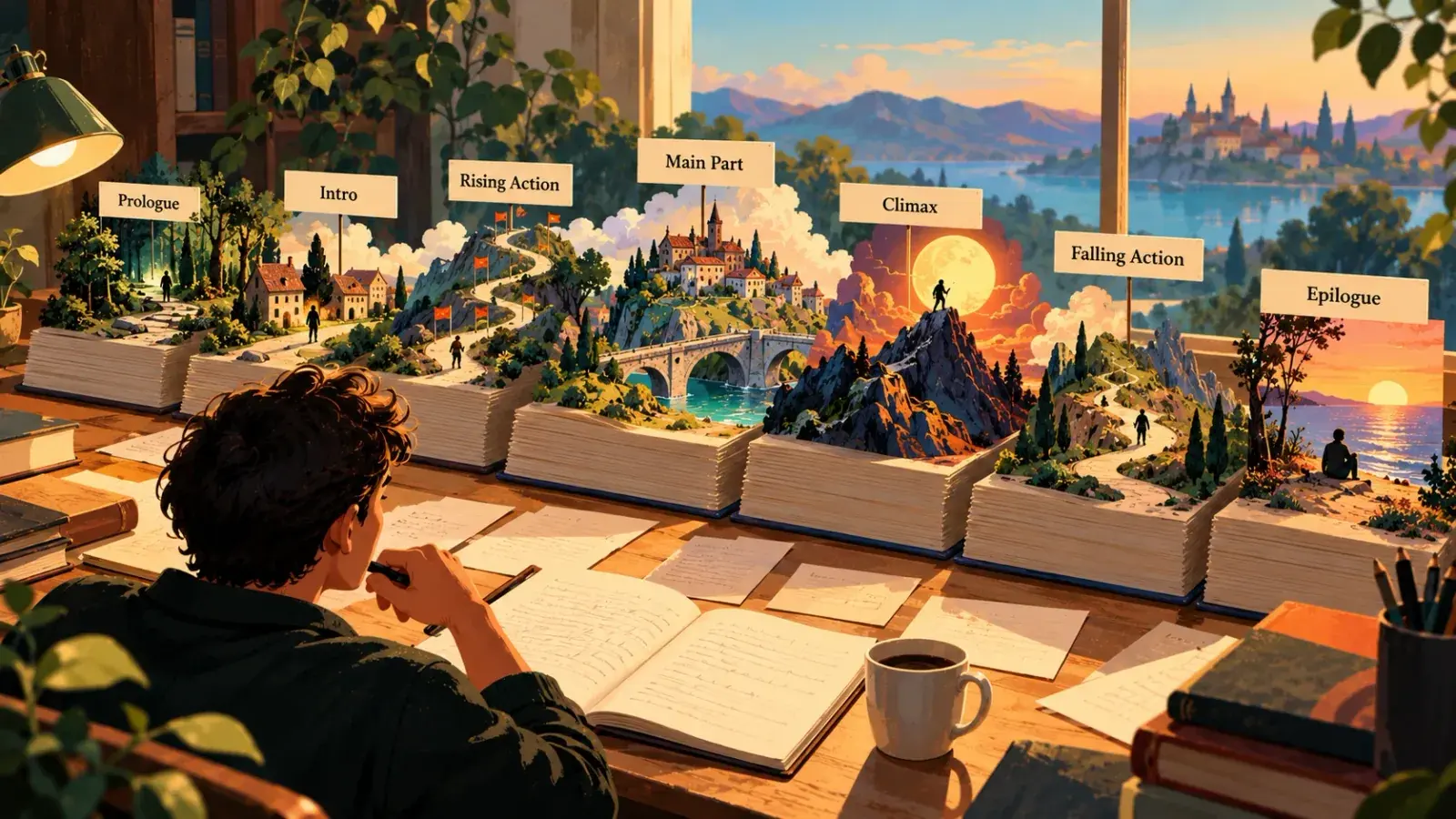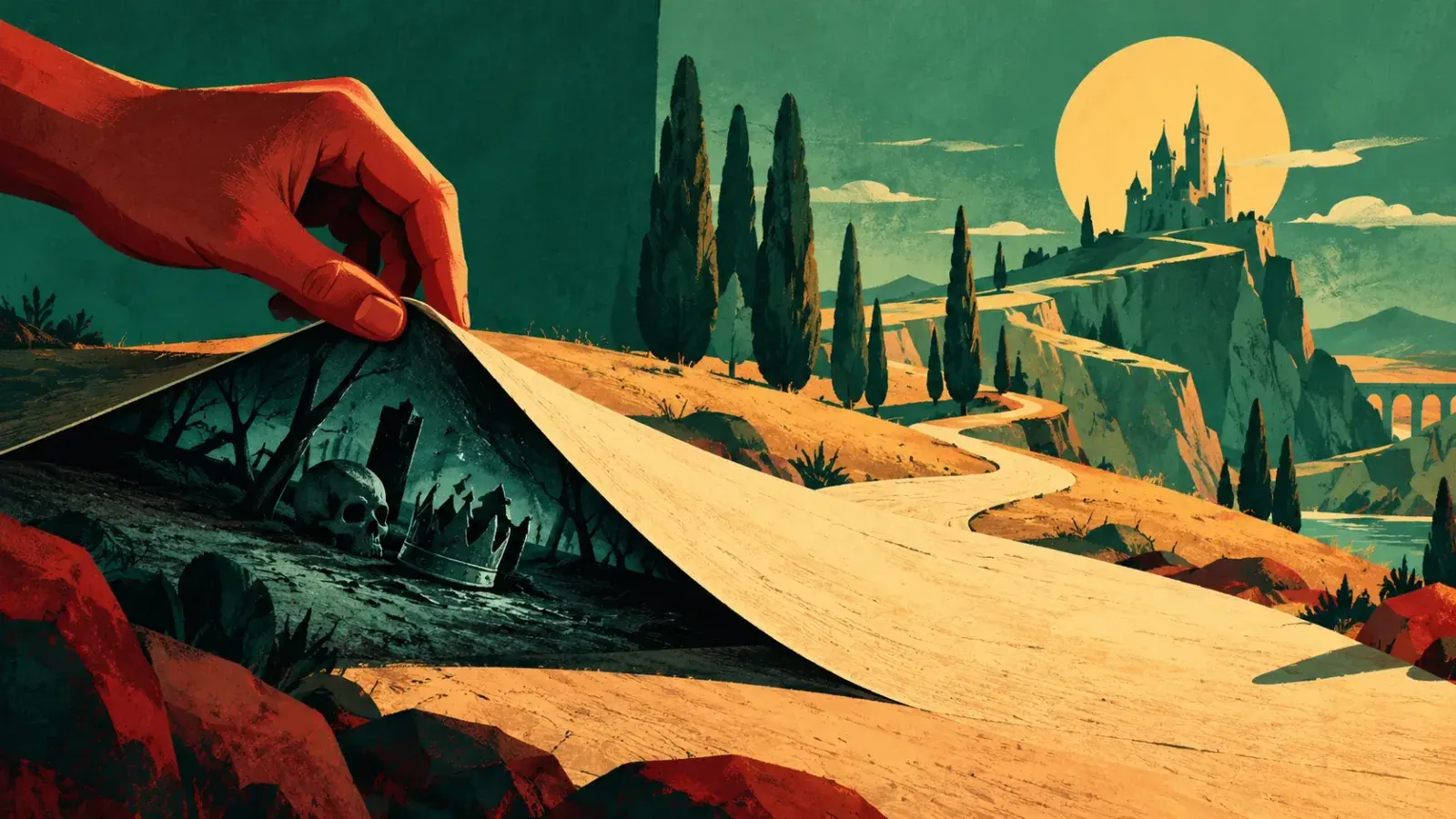
Foreshadowing is a hint, early in a story, of something that happens later. It can be stated outright, by a narrator or a prophecy, or slipped in through an object, a line of dialogue or a setting that the reader only understands looking back.
Below are 16 examples from public-domain classics, grouped by technique, each with a note on what it sets up. Then a method for planting your own, how much is too much, and how to fix it in revision.
Types of foreshadowing
Every hint is either direct or indirect. Direct foreshadowing says something is coming. Indirect foreshadowing hides the hint in ordinary detail that reads as a clue only the second time. The other types describe what carries the hint.
| Type | How it works | Example below |
|---|---|---|
| TypeDirect | How it worksA narrator or prologue says what will happen | Example belowRomeo and Juliet, the prologue |
| TypeProphecy and omen | How it worksA prediction, dream or sign in the story | Example belowMacbeth, the witches |
| TypeDialogue | How it worksA line means more than the speaker knows | Example belowThe Cask of Amontillado |
| TypeSetting and weather | How it worksThe place or the sky mirrors what is coming | Example belowThe Fall of the House of Usher |
| TypeSymbol and motif | How it worksA recurring image gathers weight | Example belowMacbeth, blood and water |
| TypeChekhov's gun | How it worksAn object shown early matters later | Example belowThe Gift of the Magi |
| TypeRed herring | How it worksA hint that points the wrong way | Example belowJane Eyre, Grace Poole |
Direct foreshadowing and prophecy
Direct foreshadowing gives away an outcome to buy a different kind of suspense: once the reader knows what happens, they read for how.
From forth the fatal loins of these two foes
A pair of star-cross'd lovers take their life;
The sixth line of the play gives away the ending, with a pun: "take their life" means both are born and kill themselves. Every hopeful scene after it plays as a countdown.
That was a memorable day to me, for it made great changes in me.
An older Pip narrates, so he can flag his first visit to Miss Havisham as a turning point without saying how. A narrator looking back is the natural home of direct foreshadowing, and memoirists use the same move.
THIRD WITCH. All hail, Macbeth! that shalt be king hereafter!
…
THIRD APPARITION. Macbeth shall never vanquish'd be, until
Great Birnam wood to high Dunsinane hill
Shall come against him.
The first prophecy pushes Macbeth toward murder. The later ones sound like guarantees and turn out to be riddles: soldiers carry boughs from Birnam Wood, and Macduff, not "of woman born" in the usual way, kills him.
SOOTHSAYER. Beware the Ides of March.
…
CAESAR. The Ides of March are come.
SOOTHSAYER. Ay, Caesar; but not gone.
The warning is spoken twice, then backed by omens and by Calpurnia's dream of Caesar's statue running with blood. Each time Caesar waves it off, the dread grows, so the assassination lands as fulfillment rather than surprise.
Foreshadowing in dialogue
The examples from here on are indirect foreshadowing: the hint hides in ordinary detail. A line foreshadows when the speaker means one thing and the story means another. The reader feels that gap before they can name it.
DUNCAN. There's no art
To find the mind's construction in the face:
He was a gentleman on whom I built
An absolute trust.
[Enter Macbeth, Banquo, Ross and Angus.]
Duncan is speaking of the traitor whose title he has just given to Macbeth, and Macbeth walks in on the next line. The audience has already heard Macbeth's first thought of murder.
Go ask his name. If he be married,
My grave is like to be my wedding bed.
Juliet is being dramatic about a boy at a party. By Act 5 her wedding bed and her grave are the same tomb. The line works because it is natural in the moment.
"…it will not kill me. I shall not die of a cough."
"True—true," I replied…
Montresor, leading Fortunato to the niche where he will wall him up, agrees and means something else. He toasts Fortunato's "long life", and when asked for a sign that he is a mason, produces a trowel.
Foreshadowing through setting and symbols
Places, weather and repeated images foreshadow without a word of plot. A motif builds its expectation by returning.
Perhaps the eye of a scrutinizing observer might have discovered a barely perceptible fissure, which, extending from the roof of the building in front, made its way down the wall in a zigzag direction, until it became lost in the sullen waters of the tarn.
In the last paragraph the same fissure widens, the walls rush apart and the tarn closes over the ruins. The house and the family share a name, and a fate.
…the great horse-chestnut at the bottom of the orchard had been struck by lightning in the night, and half of it split away.
Rochester proposes under that tree, and the storm splits it the same night. Later Jane finds the halves still joined at the root, and at the end Rochester calls himself the lightning-struck chestnut. The weather foreshadows the separation, and the roots foreshadow the reunion.
LADY MACBETH. A little water clears us of this deed:
…
What, will these hands ne'er be clean?
After the murder Macbeth fears the oceans could not wash his hand clean. His wife says a little water will do. The play keeps returning to bloody hands until she sleepwalks, scrubbing at a spot no one else can see.
Chekhov's gun and red herrings
Chekhov's gun is the promise side of foreshadowing: what a story shows with care should matter later. Chekhov made the point in an 1889 letter about a loaded rifle on stage. A red herring is a hint planted to point the wrong way.
Objects that pay off
Now, there were two possessions of the James Dillingham Youngs in which they both took a mighty pride. One was Jim's gold watch that had been his father's and his grandfather's. The other was Della's hair.
Della sells her hair to buy a chain for the watch, and Jim sells the watch to buy combs for her hair. O. Henry names both objects side by side, disguised as comic exaggeration.
And he stirred it and he tasted it; not with a spoon that was brought to him, but with a file.
It is the file Pip stole for the convict on the marshes. The stranger leaves Pip two one-pound notes, which return in Chapter 39, when the convict reveals he is Pip's benefactor. The book's secret sits in a pub scene a child only half understands.
Treplev shoots a seagull and lays it at Nina's feet. Trigorin, a visiting writer, sketches a story from it: a girl by a lake, free as a gull, ruined by a man with nothing better to do. He then does that to Nina.
In Act 4 the gull returns, stuffed, a shot sounds offstage, and the play ends on the news that Treplev has shot himself. The man the principle is named for put a gun and a bird on stage, and paid off both.
Hints that mislead
It was a curious laugh; distinct, formal, mirthless. …
"Some of the servants, very likely," she answered: "perhaps Grace Poole."
The laugh is a true plant: it comes from Rochester's hidden wife. Grace Poole is the cover story, and it holds because it explains the clue instead of competing with it.
At that instant I was aware of a bushy black beard and a pair of piercing eyes turned upon us through the side window of the cab.
A bearded spy follows Sir Henry in London, and the butler at Baskerville Hall has a full black beard. Suspicion lands on him. The spy was Stapleton in a false one. The clue was real. Only the inference was wrong.
"It is well. I go; but remember, I shall be with you on your wedding-night."
Victor takes it as a threat to his own life and spends the wedding night armed, searching the inn, while the creature goes to Elizabeth. The hint is honest. The narrator's misreading is the misdirection.
Foreshadowing in modern books and film
The same techniques in copyrighted works, described rather than quoted. Spoilers for all three.
- Of Mice and Men (John Steinbeck, 1937). Carlson shoots Candy's old dog with his Luger, and Candy regrets not doing it himself. At the end George takes that Luger to Lennie. The earlier scene rehearses the ending.
- Harry Potter and the Philosopher's Stone (J.K. Rowling, 1997; Sorcerer's Stone in the US). In chapter one Hagrid mentions borrowing a motorbike from "young Sirius Black", a name that means nothing until the third book.
- The Sixth Sense (M. Night Shyamalan, 1999). Only the boy really talks to the psychologist, his wife never answers him, and the boy says the dead he sees don't know they are dead. A second viewing finds every clue in plain sight.
How to plant foreshadowing in your draft
Foreshadowing is easiest to write backward. You cannot hint at an ending you have not chosen, so many writers plant hints in revision. If you plan first, an outline can carry them from the start (see how to outline a novel).
- Name the payoff in one sentence
The death, the betrayal, the twist, the skill that saves the day. A vague payoff produces vague hints.
- List what the reader must already know
Which facts make the payoff feel earned? That the ice was never tested. That the butler has a beard. Each fact becomes a plant.
- Plant it in a scene busy with something else
Hints hide best in an argument, a joke or a list. Readers watch the opening chapters around the inciting incident closely, so bury plants there more deeply.
- Echo it once, changed
Bring the detail back midway in a new light: the object moved, the line repeated with a new meaning. The echo keeps the plant alive without pointing at it.
- Give a twist a cover story
Offer an innocent explanation for the clue, as Grace Poole explains the laugh. That is what makes a payoff surprising and fair.
- Pay off the exact detail
Same object, same words, same place. A reader who flips back should find it where you left it.
Here is one plant written three ways. The payoff, much later: a boy falls through the ice of a reservoir.
Too loud. Mara watched her brother lace his skates by the reservoir. She had no idea the ice would nearly kill him before the winter was out.
Direct, on purpose. Years later, when people asked why she had stopped skating, Mara said she had grown out of it. It was the first lie she told about that winter.
Buried. Dad's rule was that nobody went on the reservoir until he had drilled a test hole, and Dad had been gone since October. Theo was already lacing his skates, insisting it was his turn to keep the puck, and Mara was arguing back, so neither of them mentioned the drill.
The first spends the payoff and adds nothing. The second promises a reckoning without revealing its shape. The third plants the one fact the payoff needs inside a scene about something else.
To keep track across a long draft, give each payoff a row. An empty cell is a missing plant. A story bible is a good home for the table.
| Payoff | Plant | Echo | Cover story |
|---|---|---|---|
| PayoffCh. 21: Theo falls through the ice | PlantCh. 2: Dad's test-hole rule | EchoCh. 9: the drill, still in its case | Cover storyTheo says a neighbor tested the ice |
| PayoffCh. 30: Dad never left town | PlantCh. 4: his truck at the gas station | EchoCh. 17: a local motel receipt | Cover storyMara thinks a coworker borrowed it |
How much foreshadowing is too much
Weight the hints to the payoff. A character who turns out to swim well needs one plant. A twist that rewrites the book needs several, each fair on a second reading, and at least one with a cover story. Tragedy and horror can foreshadow openly, because dread is the point. A mystery must hide its plants among false ones.
Signs it is too loud
- Early readers name the twist before the midpoint.
- The narrator winks: little did she know.
- The plant gets more description than anything around it.
- Every hint points the same way.
Signs it is too quiet
- Readers call the ending a cheat.
- The payoff depends on a fact first mentioned at the climax.
- The only plant sits in a passage most readers skim.
- The object vanishes so long that readers forget it.
Fixing it in revision
Hints are easier to judge in a finished draft. One focused pass catches most problems:
- List every payoff, then search the manuscript for the object, name or place it relies on. The hits are your plants. If the first hit is the payoff itself, add one earlier.
- Cut or pay off orphans. A detail described with care that never matters is a broken promise.
- Reread the opening last. Once you know the ending cold, sharpen, soften or move the early hints.
In Strokes, each chapter can be its own document in a project folder. Save a version before you seed or strip out hints. Version history lets you preview any earlier version with the changes marked and restore it in one click. For a quick loudness check, add the opening chapters to a chat with the AI Assistant and ask what it expects to happen, and why. If it names your twist from chapter three, a careful reader may too.
Frequently asked questions
What is the difference between direct and indirect foreshadowing?
Direct foreshadowing says something is coming, through a prologue, a prophecy or a narrator looking back, as the Romeo and Juliet prologue does. Indirect foreshadowing hides the hint in an ordinary detail that reads as a clue only in hindsight, like the crack in the House of Usher.
Is Chekhov's gun the same as foreshadowing?
They overlap. Chekhov's gun is a rule of economy: anything shown with care should matter later. Foreshadowing is the broader craft of hinting at what is coming, through dialogue, setting, prophecy and motifs as well as objects.
How is foreshadowing different from a flash-forward?
A flash-forward shows a later scene outright, then returns. Foreshadowing only hints. A narrator saying a day would change everything is foreshadowing. Cutting from chapter three to the funeral a year later, then back, is a flash-forward.
Can you use foreshadowing in memoir?
Yes. A memoirist knows how things turned out, so the narrating voice can look ahead, as Pip does in Great Expectations. Use it at chapter ends or turning points, so the reader keeps reading for how it happened.