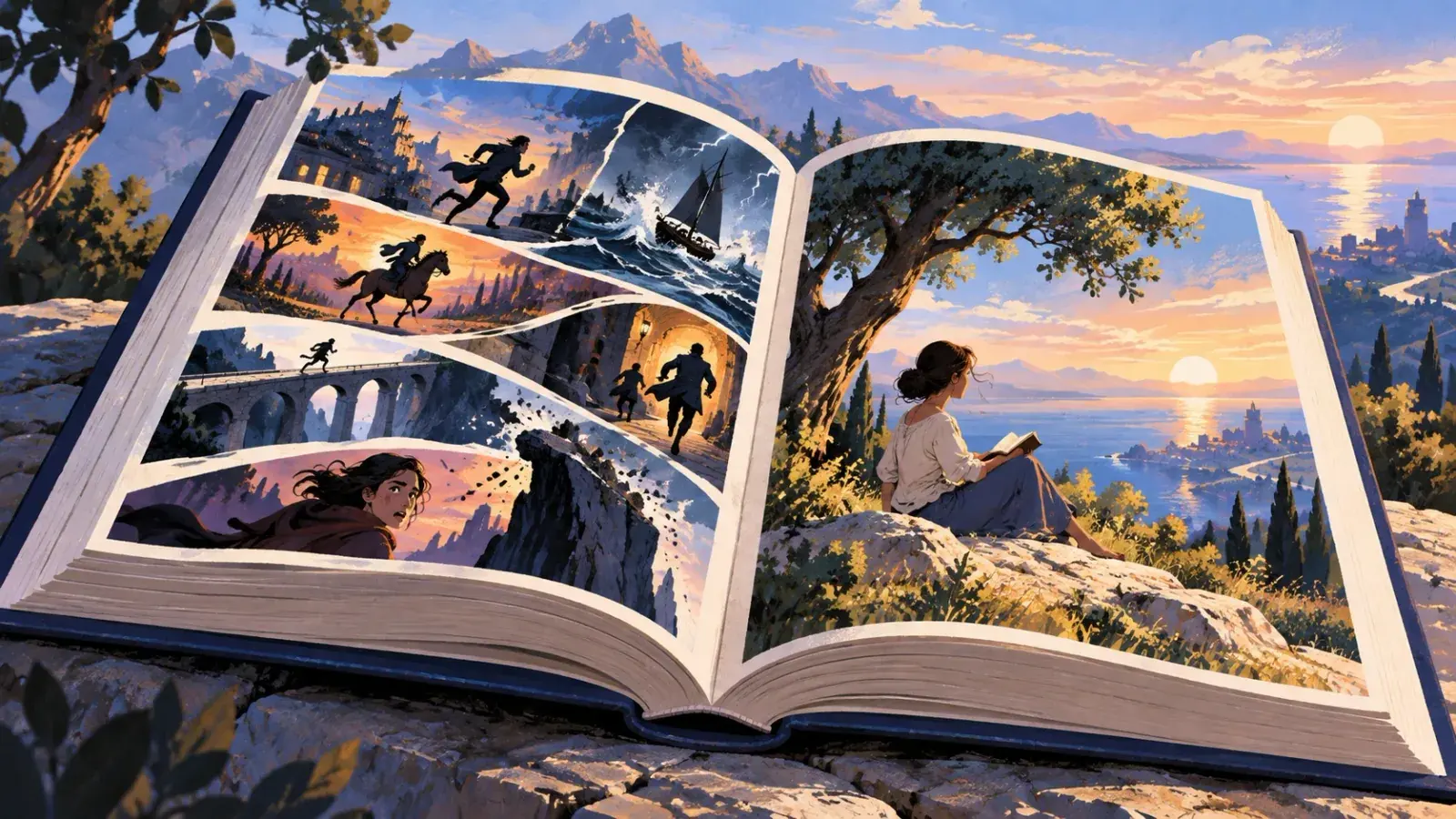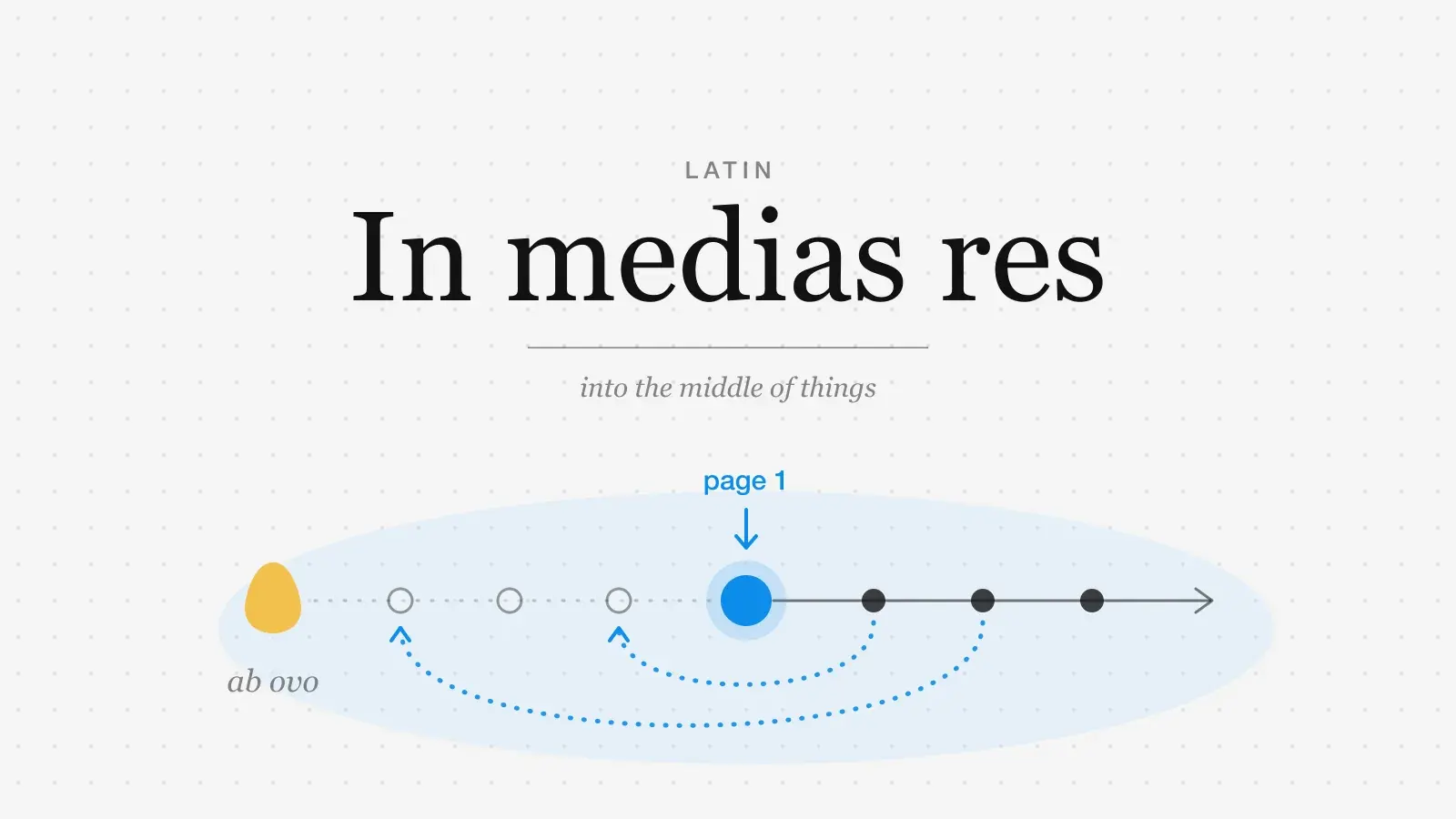
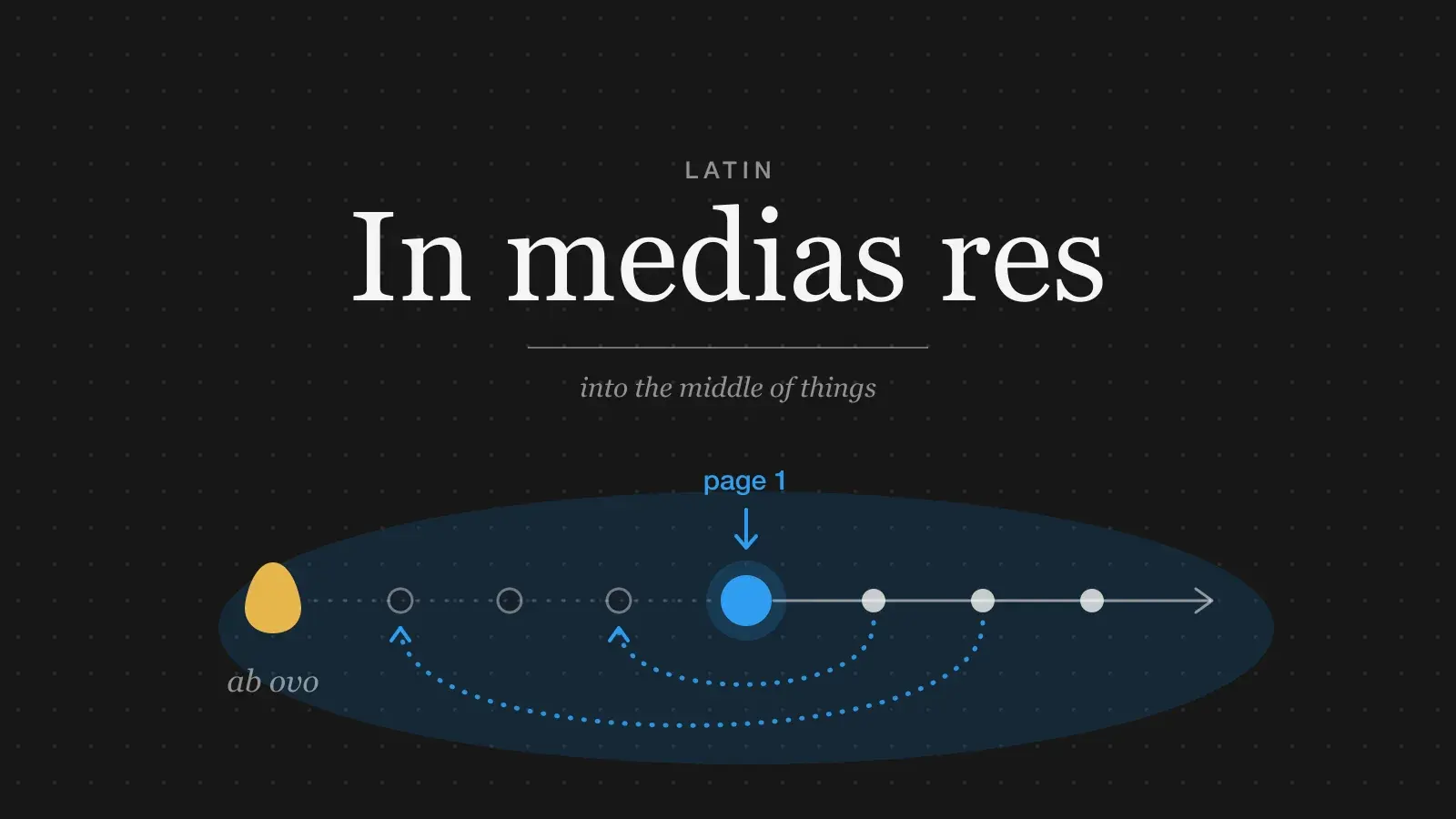
In medias res (Latin for "into the middle of things") means opening a story partway through its events, after the trouble has started. The reader arrives mid-situation and learns what came before later, through dialogue, memory or flashback.
The phrase comes from Horace's Ars Poetica, a verse letter on writing from the late first century BCE. Praising Homer, he says the good epic poet doesn't begin the Trojan War from the twin egg, the one Helen hatched from, but rushes the listener into the middle of things. The egg gave us the opposite term, ab ovo: starting at the very beginning. Merriam-Webster dates the phrase in English to 1786. It is medias, not media, because the Latin adjective agrees with res. Dictionaries list more than one pronunciation, including in MAY-dee-us RAYS and in MEE-dee-us RAYZ.
Examples of in medias res
So now all who escaped death in battle or by shipwreck had got safely home except Ulysses…
Troy fell nearly ten years before the poem opens. Odysseus is stuck on Calypso's island, his son is losing the house to suitors, and the hero doesn't appear in person until Book 5. The famous adventures (the Cyclops, Circe, the visit to the dead) arrive in Books 9 to 12, as a story Odysseus tells the Phaeacians over dinner. The past comes back as a performance by the man who lived it, at the point where the reader most wants to hear it.
Who's there?
A jumpy sentry challenges the dark at midnight. The old king is already dead, his brother already crowned and married to the widow. The guards' talk and Claudius's first speech in Scene 2 supply the facts, and the one piece of backstory that matters, that the king was murdered, is held back for the Ghost in Scene 5. When it arrives it isn't exposition. It sets the whole play moving.
TRUE!—nervous—very, very dreadfully nervous I had been and am; but why will you say that I am mad?
The first sentence answers an accusation the reader never hears. The old man is already dead, someone is already listening, and we walk in mid-conversation. Before you learn anything about the crime, you know not to trust the person describing it.
The novel opens with a boy picking his way through jungle toward a lagoon. The plane crash that put him there is never shown. Readers piece it together from the burned scar the wreck cut through the trees and from his first, half-informed conversation with Piggy. Golding skips the most dramatic event in his timeline because the book is about what happens once the adults are gone.
A man in a gas mask and his underwear crashes an RV in the desert, records a goodbye to his family and stands in the road with a pistol, waiting for the sirens. Then the episode jumps back three weeks to his fiftieth birthday and spends the rest of its hour catching up. This is the flash-forward form of the device. You watch a chemistry teacher's dull week differently because you know where it ends.
Epic poets copied Homer so closely that starting in the middle became one of the conventions of the form. Virgil's Aeneid opens with Aeneas's fleet in a storm off Carthage, and Aeneas tells Dido about the fall of Troy in Books 2 and 3. Milton's Paradise Lost begins with Satan already thrown into Hell; the angel Raphael narrates the war in Heaven in Books 5 and 6.
In your manuscript
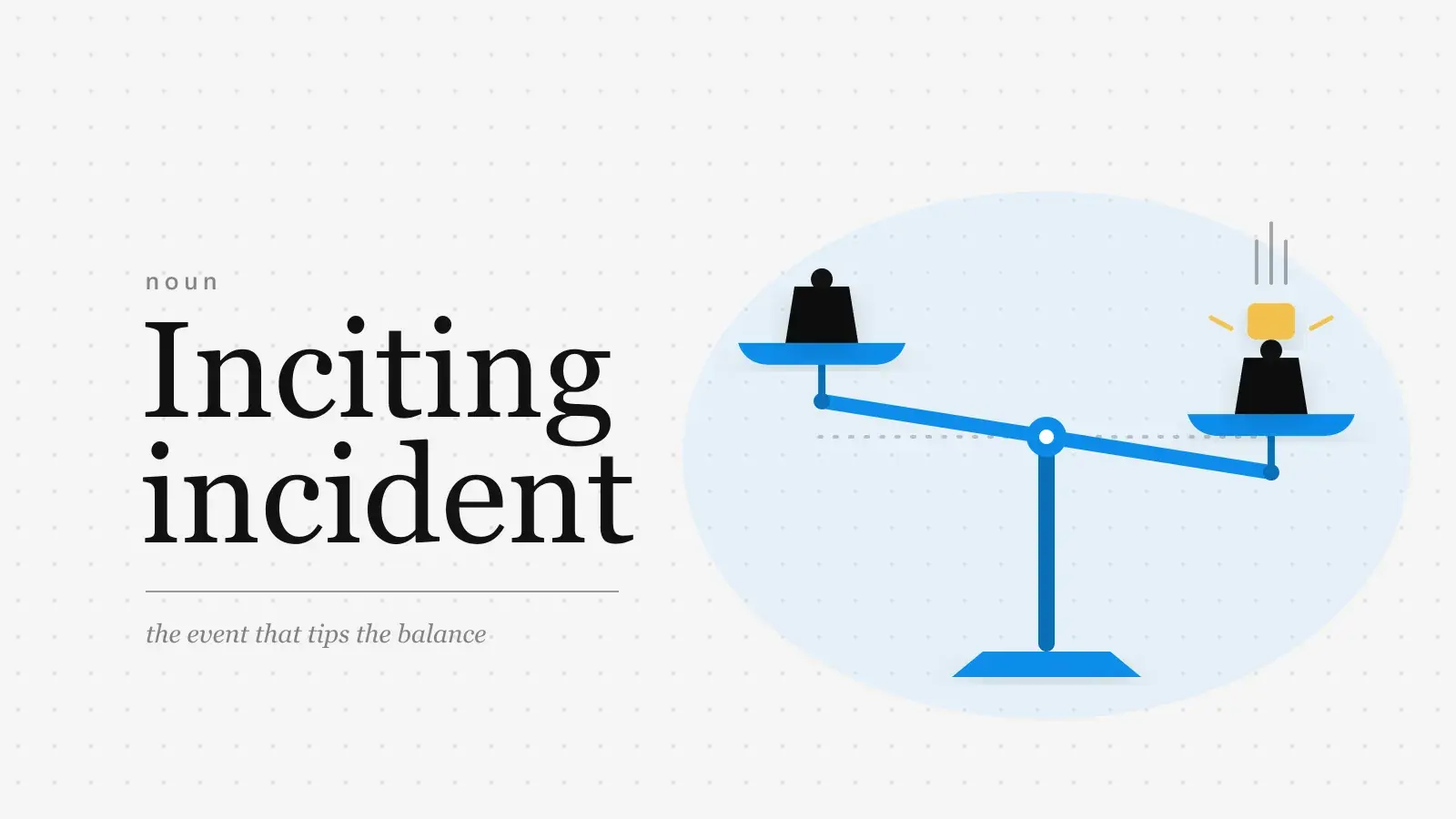
Starting in the middle doesn't mean starting with an explosion. It means starting after something has been set in motion, at a moment with its own small tension. An ab ovo opening begins with the hero's childhood or an ordinary week. Many novels begin at the inciting incident, the event that knocks the hero's life sideways. A working test: if that event happened before page one, you are in medias res.
- Ground the reader before you intrigue them. Within a page, readers need to know whose head they are in, roughly where, and what that person wants right now. The history can wait. The present can't be vague.
- Let the character know what they know. A narrator who spends three chapters alluding to "what happened in Leeds" isn't building mystery, just stalling. Name the event plainly and hold back its cause or its cost instead.
- Pay the past back in installments. Each piece of backstory should arrive when a scene makes the reader want it. A second chapter that stops to explain everything the first one skipped is an info dump with a better opening.
- Skip fights between strangers. A chase on page one only works if the reader cares who wins. A small moment with a clear want beats a big one with no stakes.
If you open with a flash-forward, the chapters between the jump back and the scene you showed first have to hold up on their own. When they exist only to get back to the exciting part, readers notice.
From the egg: Nell Varga took over the ferry between Marrow Point and the mainland the year her brother left the island. Her father had run it before her, and his father before him. In the nineteen years since, she had spoken to her brother twice. Then, one Tuesday in March, he called to say he was coming home.
In the middle: The ferry was halfway across when Nell saw her brother on the mainland dock, standing where he had stood the day he left, a green duffel at his feet. Nineteen years, and he hadn't bought a new bag. She eased the throttle back. The crossing took eleven minutes. She could make it last twenty.
The second version drops the family history and the phone call, which can come back later in a line each. It keeps the facts that matter, turns them into things Nell sees, and gives her something to do about them. Why she's stalling is what pulls the reader on.
One test for any draft: hand your first page to someone who knows nothing about the book and ask what they know and what they want to know. If the first list has no person and no want in it, they aren't intrigued. They're lost.
In medias res vs. flashback and prologue
| Technique | What it is | Relation to in medias res |
|---|---|---|
| TechniqueAb ovo | What it isStarting at the very beginning, in order | Relation to in medias resThe opposite |
| TechniqueFlash-forward opening | What it isA later scene first, then a jump back to catch up | Relation to in medias resA variant, often counted as one |
| TechniqueFlashback | What it isA past scene played in full inside the present story | Relation to in medias resThe usual way to pay back the past |
| TechniquePrologue | What it isA separate section before chapter one, often in another time | Relation to in medias resCan open in the middle, or stand in for it |
| TechniqueFrame story | What it isAn outer story in which someone tells the main one | Relation to in medias resOdysseus's tale to the Phaeacians works like one |
Strictly, in medias res means a story that starts late and keeps moving forward, as the Odyssey does. In everyday use the term also covers the flash-forward, as in Breaking Bad or a novel that opens at a funeral and goes back a year. The difference matters when you plan. A true in medias res opening makes the reader ask what is going on. A flash-forward makes them ask how it came to this, and promises you'll return to that scene. The guide to foreshadowing examples covers how that promise differs from a hint.
Related terms: frame story, prologue and point of view, which decides whose memory the past comes back through. To choose where your first chapter cuts in, put the turning points in story order first; How to outline a novel walks through that step.