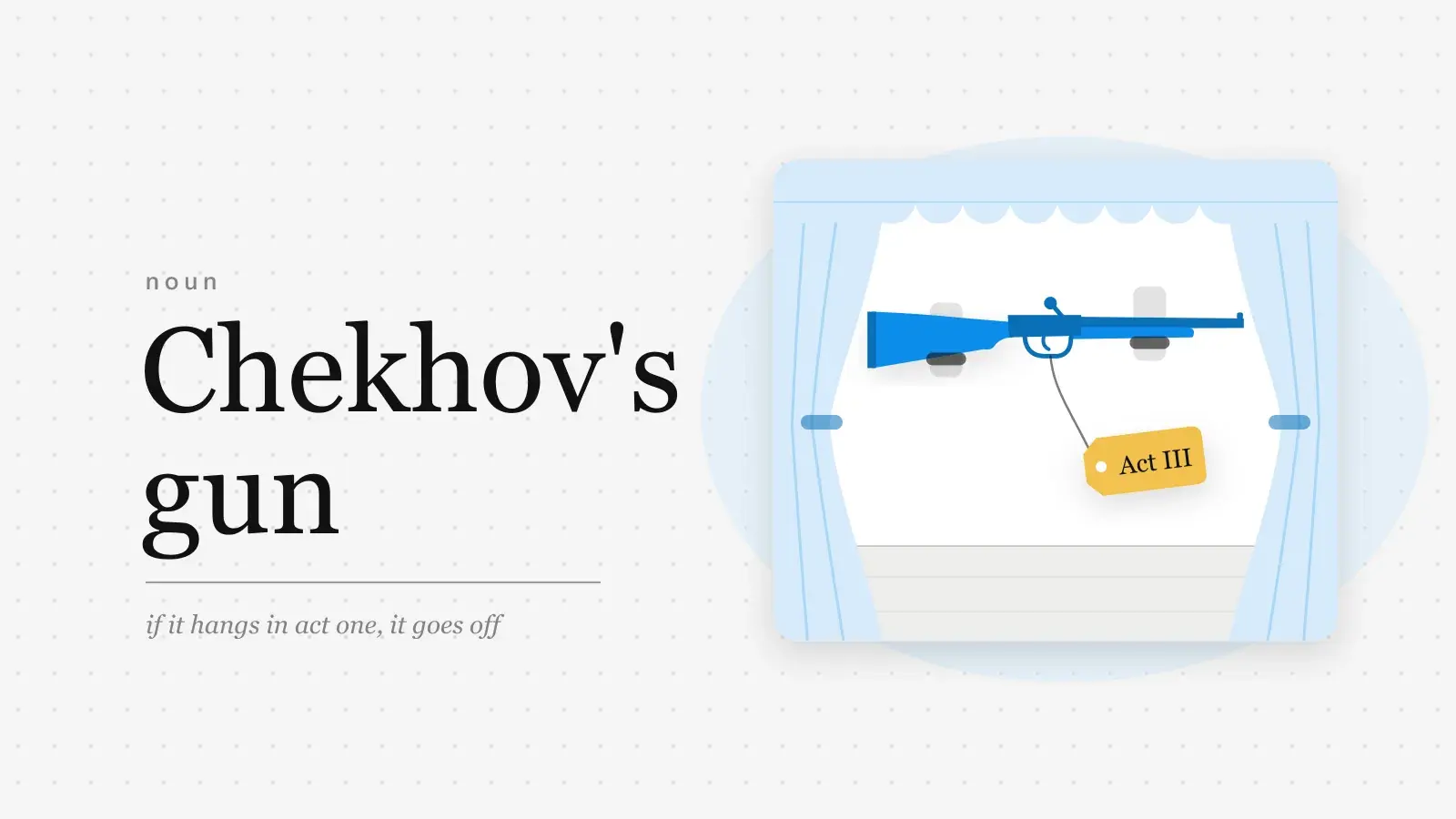
Chekhov's gun is the principle that every detail a story singles out has to earn its place. If a loaded gun hangs on the wall in the first act, it should go off before the curtain falls. If it is never going to, take it off the wall.
Anton Chekhov gave this advice more than once, and each witness remembered it a little differently. In a letter of November 1, 1889, to Aleksandr Lazarev, who wrote as A. S. Gruzinsky, it is a loaded rifle nobody means to fire, and the lesson is not to make promises you don't intend to keep. Ilia Gurliand's memoir of 1904 has a pistol on the wall in the first act. Sergei Shchukin's, from 1911, begins with an order to remove everything that has no bearing on the story.
Every version makes the same point: if it won't be fired, don't hang it. Chekhov was telling writers to cut. Today the phrase is often used the other way round, as advice to plant: show the gun early so the climax doesn't come from nowhere. The two go together, since a payoff only feels earned in a story without props that go nowhere.
Chekhov's gun examples
…Constantine has shot himself.
In Act II, Konstantin Treplev walks on with a gun and a dead seagull and lays the bird at Nina's feet. By Act III he has shot himself, offstage between the acts, and survived with a bandaged head. Act IV brings everything back: the gull, stuffed, ordered by a man who no longer remembers asking for it, and then a shot offstage. The doctor tells the room a bottle of ether has burst and takes Trigorin aside to tell him the truth.
General Gabler's pistols.
Hedda names them at the end of Act I as the one thing she has left to kill time with. Act II opens with her firing one at Judge Brack as he comes up the garden. In Act III she gives one to Eilert Løvborg and asks him to use it beautifully. He is found shot in the bowels, and Brack, who recognizes the pistol, now has a hold over her. She uses the other to end the play, and Brack gets the last line: "people don't do such things."
…a convict's leg-iron which had been filed asunder.
Pip steals a file from Joe's tools for the escaped convict and hears him working at his leg iron in the mist. It reads as atmosphere. In Chapter 10 a stranger at the pub stirs his rum with Joe's file so only Pip can see. In Chapter 16 Mrs. Joe is struck down in her kitchen, and beside her lies a leg iron, filed through some time before. In Chapter 53 Orlick boasts that he picked it up on the marshes and kept it. Dickens fires the same gun twice: once as a mystery, once as a confession.
In his first years at Shawshank, where he arrives in 1947, Andy Dufresne gets two things through Red: a rock hammer and a poster of Rita Hayworth. Both have a cover story: Andy shapes stones as a hobby, and every cell has a pin-up. Nineteen years later the warden throws a stone at the poster on Andy's wall, Raquel Welch by then, and it goes straight through into the tunnel the hammer dug.
How to plant one in your manuscript
A planted detail has to survive two readings. The first time, it should seem to belong to its scene for reasons of its own. The second time, it should look inevitable.
- Give the gun a day job. Hedda's pistols show her boredom, and Andy's hammer shows his hobby. A detail that exists only for the payoff stands out, because nothing else in the scene needs it.
- Spend attention in proportion. Half a page of loving description promises something big. A clause promises something small, or a surprise.
- Remind once. Dickens brings the file back in Chapter 10, so the iron in Chapter 16 has somewhere to land. One quiet return keeps a detail alive without spotlighting it.
- Fire it at something new. The leg iron Pip's convict filed off his ankle comes back as the weapon that fells Mrs. Joe. A payoff that turns the object to an unexpected use beats the one the reader predicted in act one.
It goes wrong in three ways. The gun never fires: a locked drawer described at length in Chapter 3 and never opened. The gun smokes from the start, so the twist shows a hundred pages early. Or the gun appears only when needed, a skill or ally the story never showed. The fix for that one is in an earlier chapter, not the climax.
Unplanted, Chapter 19: Cornered on the roof, Mara remembered the fire ladder on the north side and ran for it.
Planted, Chapter 2: The landlord had painted the fire ladder the same green as the gutters, as if he hoped the inspector would miss it. Mara didn't. She also noticed that the bottom rung had rusted through.
Paid off, Chapter 19: She went over the north parapet onto the green ladder, counted rungs in the dark, and dropped the last six feet rather than trust the bottom one.
The plant also tells you about the landlord, and about Mara, who notices things. That is what hides it.
In revision, keep a ledger of every object, skill and minor character the draft lingers on. It is usually part of a developmental edit, done on a whole draft rather than a chapter at a time.
| Detail | Planted | Reminded | Pays off |
|---|---|---|---|
| DetailGreen fire ladder, rusted bottom rung | PlantedCh. 2 | RemindedCh. 11 | Pays offCh. 19 |
| DetailFather's pocketknife | PlantedCh. 4 | RemindedNone | Pays offNowhere yet: give it a job or cut it |
| DetailNeighbor's dog that barks at strangers | PlantedCh. 6 | RemindedCh. 9 | Pays offCh. 17, when it stays quiet |
An AI model can make a first pass: give it your opening chapters and ask for every detail the text dwells on. If it lists something you never meant to plant, a reader may snag on it too. In Strokes you can add chapter documents to an AI Assistant chat as context.
Chekhov's gun vs. foreshadowing
| Device | What it is | Example |
|---|---|---|
| DeviceChekhov's gun | What it isA specific thing given weight early and used later | ExampleHedda's pistols |
| DeviceForeshadowing | What it isA hint of what is coming: an omen, a mood, a line | ExampleThe witches' prophecies in Macbeth |
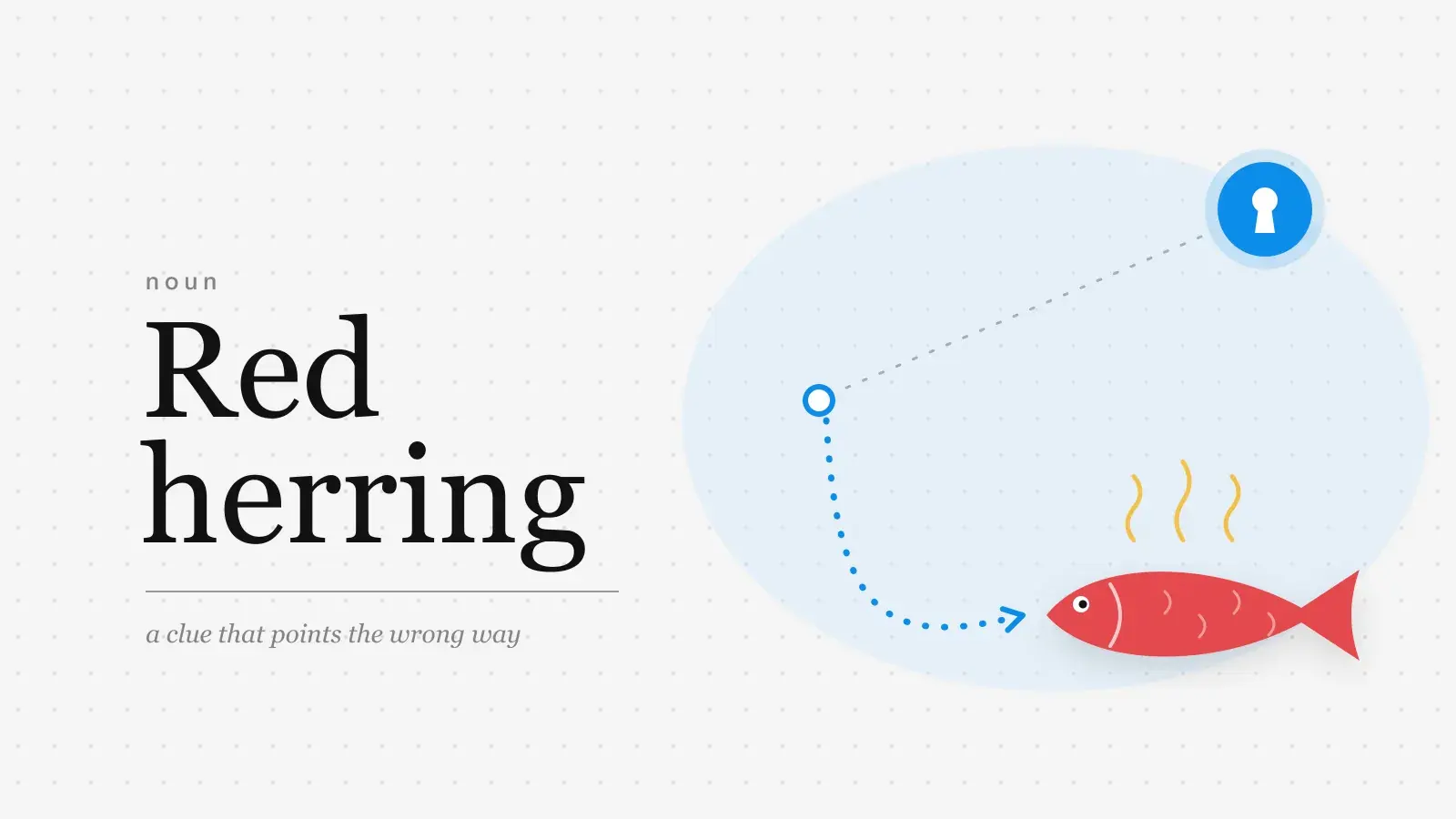
| DeviceRed herring | What it isA planted clue that points the wrong way | ExampleThe spotted handkerchiefs in The Speckled Band |
| DeviceMacGuffin | What it isThe thing everyone chases, whatever it turns out to be | ExampleThe statuette in The Maltese Falcon |
| DeviceDeus ex machina | What it isA rescue nobody planted | ExampleThe god lowered onto the stage in Greek tragedy |
Foreshadowing is about what the reader expects. Chekhov's gun is about what the story uses. A gun can foreshadow, as Hedda's pistols do, or be hidden so well that it foreshadows nothing, like the rock hammer. Most good mystery solutions are guns the reader looked straight at and didn't count.
Writers have stretched the name. A Chekhov's gunman is a minor character met early who comes back to decide the plot. A Chekhov's skill is an ability shown early that saves the day, like Ripley working the power loader in Aliens (1986) well before she fights the queen in it.
When the gun stays on the wall
Chekhov didn't always follow his own rule. In Act II of The Cherry Orchard (1904), the governess Charlotta opens the act with a rifle she has just unslung from her shoulder, and the clerk Epikhodov mentions the revolver he always carries, in case he decides to shoot himself. Neither is fired. The Chekhov scholar Donald Rayfield reads the silent guns as part of what the play is about: people who never quite act.
Realist fiction is full of things that never go off. In a 1968 essay, Roland Barthes singled out a barometer in Flaubert's story "A Simple Heart" (1877) that does nothing for the plot or the characters. Its job, he argued, is to tell you the room is real. He called this the reality effect.
So the working rule is narrower than "everything must fire." Every detail needs a job, and paying off later is only one of them. Trouble starts when a texture detail gets a gun's emphasis: a close-up, a repetition, a character's long look. Emphasis is the promise. Keep the promises you make with it, and let the barometers be barometers.
Related terms: red herring, MacGuffin, motif (a detail that returns for meaning rather than plot) and denouement, where loose ends get settled after the climax. For plants and payoffs from the classics, read Foreshadowing examples from literature. To track setups chapter by chapter, start from the novel outline template.