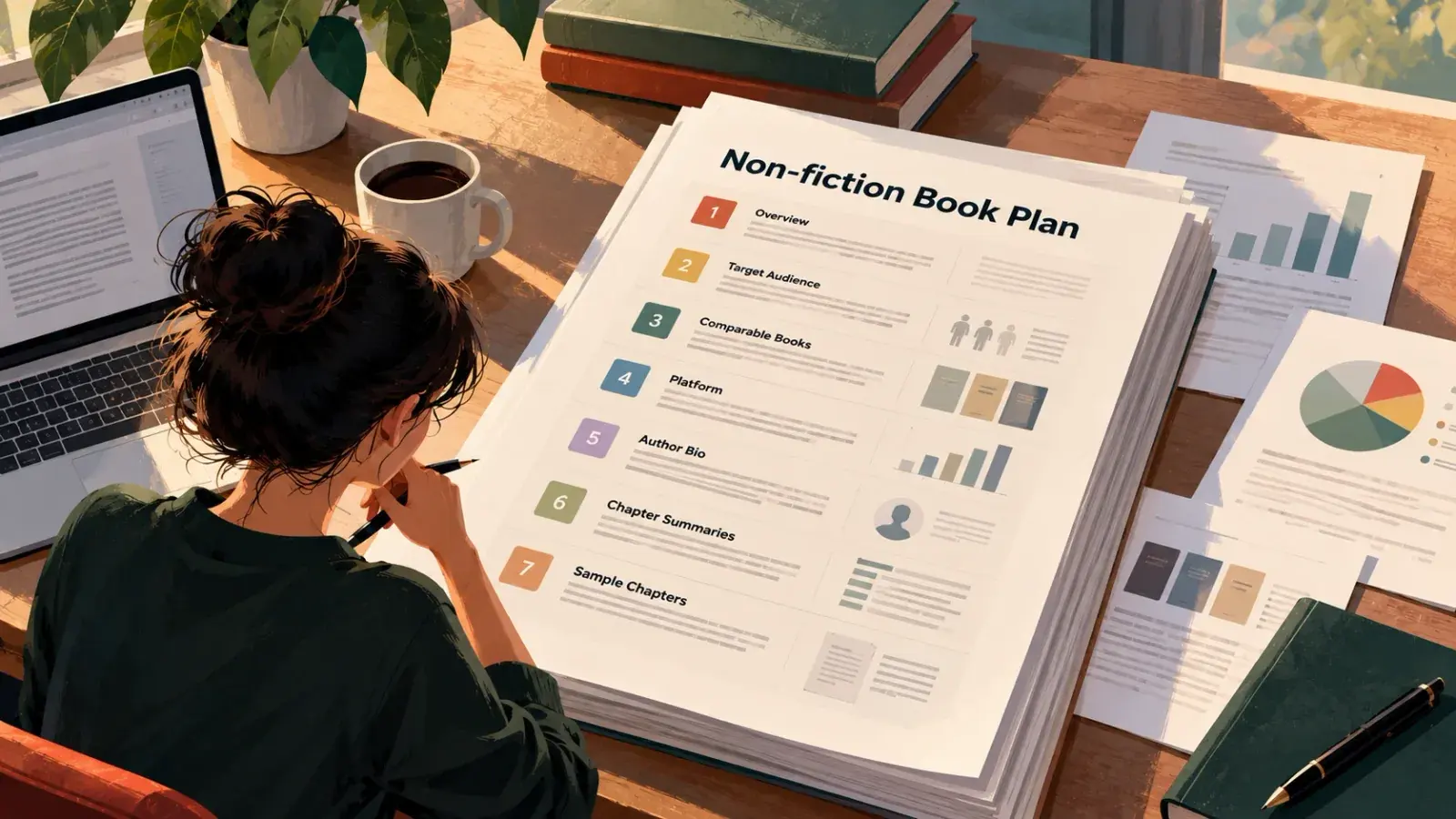
To start writing a book, give the first 30 days five jobs, in this order: choose one idea, turn it into a premise you can say in one sentence, make a plan just detailed enough to begin, set up a routine you can keep in a bad week, and write the first pages without polishing them. The order is the same for a novel and for nonfiction. What changes is the premise: a novel needs a character with a goal and something to lose, and a nonfiction book needs a reader with a problem and a promise.
One invented novel and one invented how-to book run through the plan. The days are a suggested pace, not a deadline: stretch any stage your weeks can't hold, and keep the order. If the plan runs to schedule, day 30 leaves you with a premise, a working title, a plan, a tested routine and 3,000 to 5,000 rough words. What comes after is in the guide to how to write a novel.
The 30-day plan at a glance
| Days | The job | Fiction | Nonfiction | You finish with |
|---|---|---|---|---|
| Days1–5 | The jobChoose one idea | FictionA story you'd still want to tell in a year | NonfictionA reader you know and their problem | You finish withOne line on what the book is, and an ideas file for the rest |
| Days6–10 | The jobWrite the premise | FictionCharacter, goal, opposition, cost | NonfictionReader, problem, promise | You finish withA premise in one sentence and one paragraph, and a working title |
| Days11–17 | The jobMake a starting plan | FictionAn ending, the big turns, three chapters in detail | NonfictionA table of contents, one promise per chapter | You finish withA one-page plan and a folder ready for the draft |
| Days18–21 | The jobBuild the routine | FictionA fixed slot, a target, three trial sessions | NonfictionThe same | You finish withA log of three sessions and a target you can keep |
| Days22–30 | The jobWrite the first pages | FictionA rough chapter one | NonfictionThe chapter you know best, rough | You finish withOne rough chapter and the start of the next |
Days 1–5: choose one idea
On day 1, before anything else, put a writing slot in your calendar for all 30 days. Then choose: a dozen ideas, or one idea carried for years, tend to stall in the same place, because nothing has been chosen.
- Day 1: list every idea
Give it 20 minutes: every book you have thought of writing, one line each, unranked. If the list is short, the story ideas page has 120 premises by genre.
- Days 2–3: test the strongest three
Ask of each: Would you still want it a year from now? Can you see the middle, not just the opening? Who reads it? Do you know enough, or can you find out? What can you bring that others can't?
- Day 4: read the shelf
Find three to five recent books closest to each finalist and read their openings in a library or a store preview. Note what yours would do differently. That list is the start of your comp titles.
- Day 5: commit
Choose one and write a line at the top of a new document: what the book is and why you are the one to write it. Other ideas, old and new, go in an ideas file.
| Question | Heist novel | Caregiving memoir | Window repair guide |
|---|---|---|---|
| QuestionCan you see the middle? | Heist novelOnly the robbery | Caregiving memoirYes: the hospital months | Window repair guideEvery chapter |
| QuestionDo you know enough? | Heist novelNo: it needs research on 1970s Detroit | Caregiving memoirYes: I lived it | Window repair guideYes: twenty years of jobs |
| QuestionWhat only you bring | Heist novelAn uncle's stories from the assembly line | Caregiving memoirThe year itself | Window repair guideA repair method that saves the old glass |
The rest of this page follows the novel and the guide, one step at a time.
Days 6–10: write the premise
An idea is a subject. A premise gives it a shape. Write the book down to one sentence, then out to a paragraph, and rewrite both until a stranger could tell what kind of book it is.
A novel: character, goal, opposition, cost
Name a particular person, a goal specific enough to fail at, opposition that can push back for a whole book, and a cost. The sentence is your logline, and the paragraph is an early draft of the back-cover blurb.
One sentence. In December 1973, a payroll clerk at a Detroit car plant has eleven days to steal the last cash payroll before the company shuts the gates without paying the severance it owes, and the man guarding the cash is her brother-in-law.
One paragraph. Dee Kaminski has run the payroll at the Beaumont Avenue plant for nineteen years, so she is the first to see that the severance fund is gone. She has never stolen a paper clip. Now she needs a driver she can trust, a way past the guard station, and eleven days in which Walt, head of plant security, doesn't notice her asking questions.
The sentence holds all four parts. The paragraph adds why she is the one who sees it, and a plan that is bound to go wrong.
Nonfiction: reader, problem, promise
Name the reader, the problem that sends them looking, what will be different after the last page, and why you are the one to write it. For memoir, the promise is a question about your life, and the memoir guide shows how to find it.
One sentence. A step-by-step guide for owners of houses built before 1940 who have been told their wooden windows must go, showing how to repair, reglaze and weatherproof them one at a time.
One paragraph. Owners of old houses hear the same thing at every estimate: the windows have to go. This book is for the ones who would rather keep them. A restorer with twenty years of work in Providence, Rhode Island, shows how to do each job with hand tools, how long it takes, and when a window really is past saving.
The sentence names the reader and the problem before the subject. Give the book a working title the same week, even a plain one: how to write a book title covers the long version. For a novel, check the length your shelf expects in novel word counts by genre.
Days 11–17: make a starting plan
Know roughly where the book ends and exactly what the first chapters contain. Plotters and pantsers differ mostly in how far ahead that runs. Plan the opening in detail and the rest in a line each; how to outline a novel compares fuller methods.
- Day 11: write the ending you're aiming at
One paragraph: what the character has done or lost, or what the reader can now do. It can change later, but it keeps the early chapters pointed one way.
- Days 12–14: list the big moves
For a novel, the handful of turns that change the story's direction, a line each. For nonfiction, a table of contents with one line per chapter on what the reader can do by its end.
- Days 15–16: plan the first three chapters
Scene by scene for a novel, section by section for nonfiction. The novel outline, book outline and memoir outline templates give you the document.
- Day 17: set up the files
One folder with notes and draft side by side, a document per chapter, and a list of research questions, each tagged with the chapter that needs the answer.
In Strokes, you can ask agent mode to build it: a Notes folder with documents for ideas, premise, plan, research and log, and a Draft folder with a document per planned chapter.
Ending to aim at. The money reaches the union hall on Christmas Eve. Walt lets Dee walk away and loses his job for it.
Big moves. Dee finds the severance fund empty. She recruits Ray, a laid-off driver. The armored-car schedule changes. Walt finds the copied key. The robbery, on the last payday.
Chapter 1. Monday's payroll run and the ledger that won't balance. Lunch with Walt and her sister, who already knows the plant is closing. That night Dee copies the ledger page by hand.
Days 18–21: build the routine
You need a time, a place, a session target and three trial sessions before day 22. Arnold Bennett's advice to readers short of time is still the plainest:
Rise an hour, an hour and a half, or even two hours earlier; and—if you must—retire earlier when you can.
…I do suggest that you might, for a commencement, employ an hour and a half every other evening in some important and consecutive cultivation of the mind.
Bennett, who first wrote the book as articles for the London Evening News in 1907, meant study, but the arithmetic fits a book: an early hour on weekdays, or ninety minutes three evenings a week.
- One slot, every time. Starting out, a regular slot usually matters more than a long one.
- A target sized for your worst week, such as 500 words or 45 minutes.
- A log of date, minutes and words. It shows your real pace, and how long it takes to write a novel turns that into a schedule.
- A note to tomorrow at the end of each session: where you stopped and what happens next.
Use the trial sessions for real book words, such as a scene from the middle you can already see. You are testing the slot and the target, not the prose.
| Session target | 3 sessions a week | 5 a week | Every day |
|---|---|---|---|
| Session target300 words | 3 sessions a weekAbout 1,700 | 5 a weekAbout 2,800 | Every dayAbout 3,900 |
| Session target500 words | 3 sessions a weekAbout 2,800 | 5 a weekAbout 4,600 | Every dayAbout 6,500 |
| Session target750 words | 3 sessions a weekAbout 4,200 | 5 a weekAbout 7,000 | Every dayAbout 9,800 |
Days 22–30: write the first pages
Now draft one complete rough chapter and the start of the next. Chapter one will probably be rewritten once you know the book better, so for now it only has to exist.
A novel: start where something changes
Open on the day the ordinary breaks, not on the alarm clock or the family history. The guide to how to start a story collects opening techniques. Hold off on a prologue until the draft shows it needs one.
First try. Dolores Kaminski woke at 5:40, as she had every weekday for nineteen years, and lay listening to the radiator knock while she thought about her life.
After. The ledger was off by eleven hundred dollars, and the ledger had never been off, not once in nineteen years, not even the week of the riots.
The second version opens on the first thing that is different, in Dee's own voice, and hands the reader a question: where did the money go?
Nonfiction: start with the chapter you know best
Leave the introduction for last: it promises what the book delivers, and you won't know that until the chapters exist. Draft the chapter you could talk about for an hour, and open it on a case, not a definition.
The window in Mrs. Arruda's back bedroom had been painted shut since 1958, and she wanted to know whether it could be opened without breaking the glass. It could. It took forty minutes, a putty knife and a block of scrap pine, and the method I used that afternoon is the one this chapter teaches.
In both kinds of book, reread only the last paragraph before a session, mark gaps in square brackets, such as [when did the armored car arrive?], instead of stopping to research, and don't revise chapter one until chapter three exists.
Day 31: what comes next
Spend the first session of month two on a review, not new pages. Reread the premise and the plan against the draft. If the draft has pulled away from the plan, change the plan. Lower the target if you missed more sessions than you made, then set a goal for the next 30 days: the first big turn of a novel, or three chapters of nonfiction. If you stall for more than a week, the writer's block guide sorts out the likely causes.
Mistakes that stall a new book
- Research with no end date. Research only what the next chapter needs.
- Planning instead of writing. A forty-page world history and no scenes. Give the plan seven days, then draft.
- Polishing chapter one. It will probably change once you know the ending, so an hour spent perfecting it now may have to be spent again.
- A target built on your best day. One bad week and the whole plan feels lost.
- The shiny new idea. Around week three another book will look easier. Put it in the ideas file and go back to your WIP.
Frequently asked questions
Should I outline before I start writing a book?
Outline enough to start: an ending to aim at, the main turns and the first three chapters scene by scene. If you prefer to discover the story on the page, skip the detail, but know roughly where you are heading. Nonfiction needs more planning up front, because the table of contents carries the book's argument.
Do I need to finish a nonfiction book before pitching it?
Usually not for prescriptive nonfiction, which typically sells on a proposal with one or two sample chapters. A debut memoir is more often expected to be finished, with a proposal alongside. Agents generally expect a debut novel to be complete and revised before you query. Requirements vary, so check each agent's guidelines.
Should I start writing a book at the beginning?
For a novel, start with chapter one but keep it rough until later chapters exist. For nonfiction, start with the chapter you know best and write the introduction last, because it promises what the finished book delivers. For memoir, start with a scene you remember vividly rather than with your birth.