When to use it
- Pitching a nonfiction book to literary agents before the manuscript is finished
- Sending a proposal straight to a press that accepts them, such as a university press
- Memoir, when an agent asks for a proposal alongside the manuscript
- Testing a book idea on paper before you commit a year to drafting it
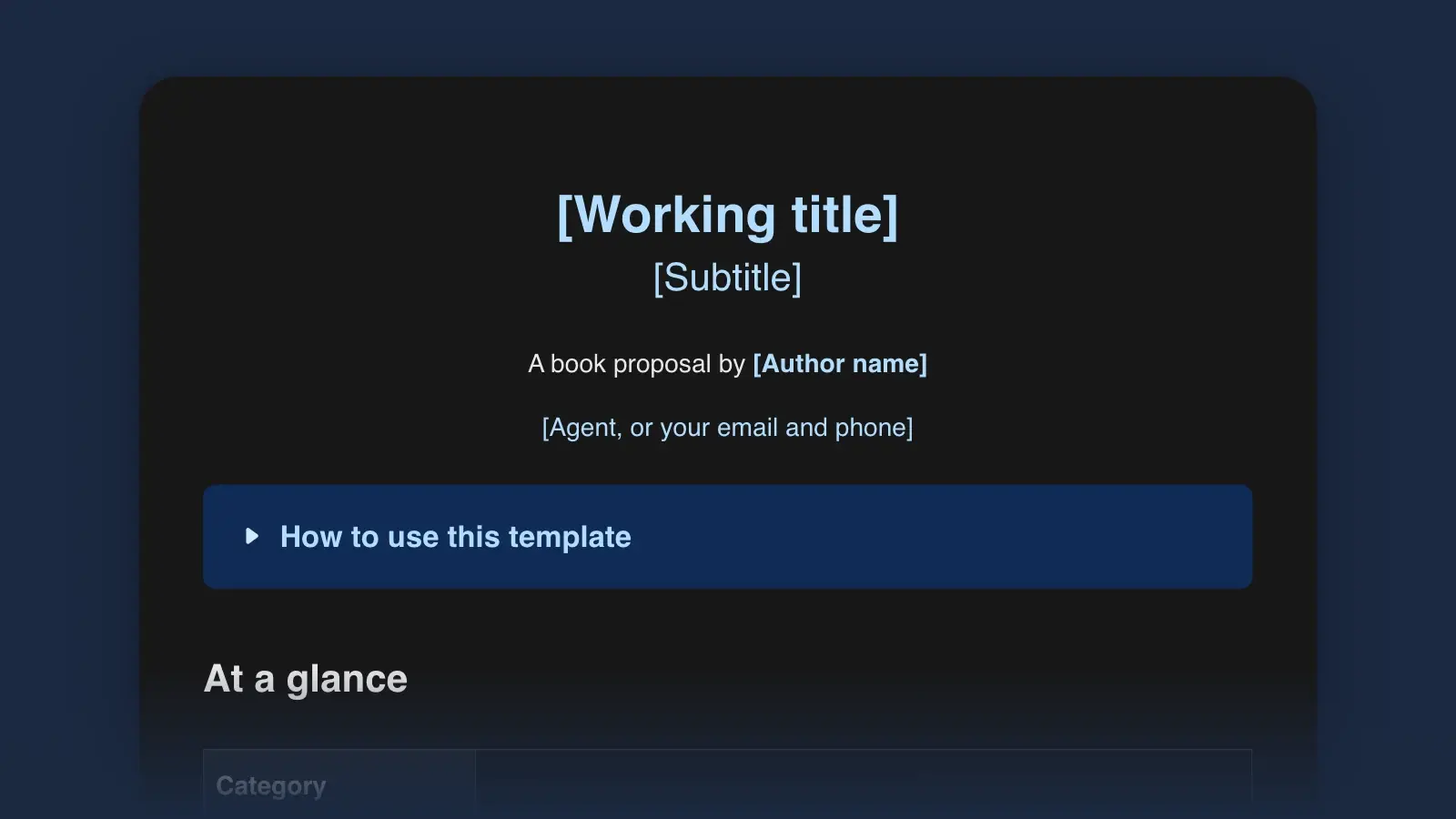
How to use this template
- Research the comps first, write the overview last
The overview opens the proposal, but it is the hardest page to write before you know where the book sits. Start with the comp titles instead: find the recent books your reader already buys, read them, and note what each does and what yours adds. That list tells you who the audience is and what the overview has to claim.
- Put numbers in the market sections
Audience, platform and marketing are where an editor decides whether the book can sell. Replace adjectives with figures you can stand behind: subscribers, talks a year, the membership of an association you belong to. "I will" with a number reads as a commitment. "I hope to" reads as a wish.
- Summarize every chapter, then write the samples
Give each chapter a working title, an estimated length and one paragraph on its point, its main story or evidence, and what the reader takes away. If the order is still moving, settle it first with the book outline template. Then write one or two sample chapters as finished manuscript pages.
- Fit it to the agent, then send
Agents and presses set their own order and format, so read the submission guidelines before you export. Expect to send a Word file or a PDF, double-spaced unless they say otherwise. In Strokes, keep the proposal in the book's project folder beside the chapters, export from there, and save a version before each send so you know exactly what each agent read.
Book proposal format: order and length
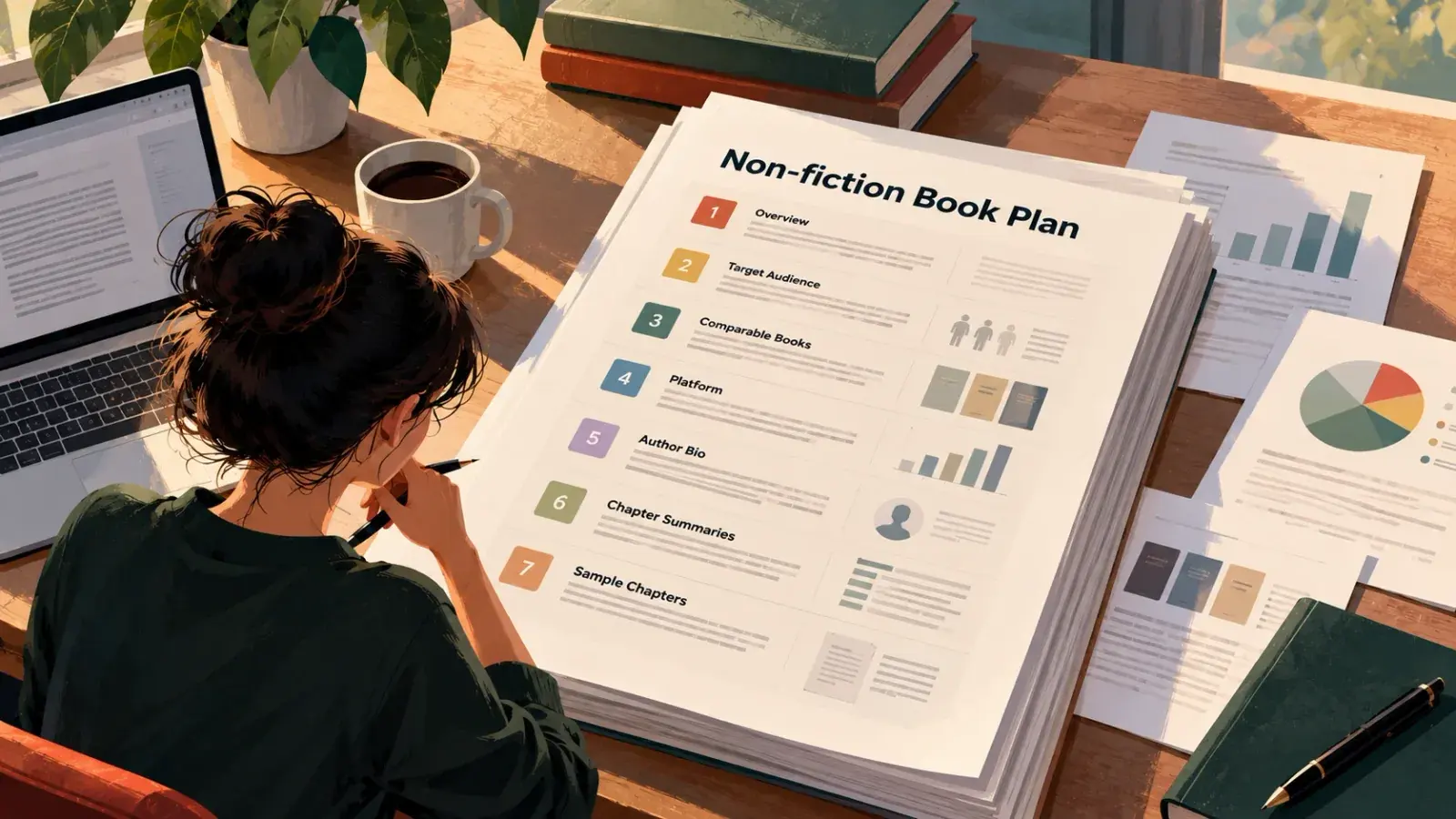
Most proposals run 10 to 25 double-spaced pages before the sample chapters, according to Jane Friedman, who writes about the publishing business, and complex projects can pass 50 once the samples are attached. The order below is the common one. Where an agent lists their own, use theirs.
| Section | Typical length | What it has to show |
|---|---|---|
| SectionTitle page | Typical lengthOne page | What it has to showTitle, author, length, status |
| SectionOverview | Typical lengthOne to three pages | What it has to showThe hook, the big idea, why now |
| SectionTarget audience | Typical lengthA page or less | What it has to showA reader you can name and count |
| SectionComparable titles | Typical length4–10 books, a paragraph each | What it has to showA shelf exists, with a gap on it |
| SectionMarketing and platform | Typical lengthOne to two pages | What it has to showReach you already have |
| SectionAbout the author | Typical lengthHalf a page to a page | What it has to showWhy you, for this book |
| SectionChapter outline | Typical lengthA paragraph or two per chapter | What it has to showThe book is planned end to end |
| SectionSample chapters | Typical lengthOne or two chapters | What it has to showYou can write it |
Two exceptions. Debut novels are not sold on a proposal: agents want a query letter, a synopsis and the finished book. Memoir sits in between, and a debut memoirist may be asked for the proposal and the complete manuscript. The full guide to writing a book proposal takes each section in depth.
What a strong proposal looks like
Comps carry the most weight for the least space. Choose recent books from your own shelf that sold steadily without being the category's runaway hit. Give the title and subtitle, author, publisher and year. Jane Friedman's guide adds page count, price and first format, and says you don't need Amazon rankings, star ratings or sales figures, which the agent can look up. Then give each book a short paragraph (Friedman suggests 100 to 200 words) on what it does well, who reads it, and what yours does that it doesn't. The table in the template is the summary, and the paragraphs go under it.
Chapter summaries are the easiest part to write vaguely. Each one should state a point and name the material that carries it. Here is one for an invented book about running a very small bookshop.
Chapter 4: The Front Table (about 5,000 words). The front table is the one display every customer sees, and in a 400-square-foot shop it has to earn its space every week. This chapter follows a month at the author's shop, from the Monday the table is reset to the Saturday the featured title sells out, and lays out how she chooses what goes on it: a new hardcover, a paperback staff pick, a local author, and nothing that is already stacked by the door of the chain store across the street. It closes with a weekly planning sheet readers can copy for their own shop.
The marketing section works the same way. An editor reads it as a list of promises, so make each one specific enough to check.
Commitments
- A launch-week issue to my 6,200 newsletter subscribers, with a live Q&A
- Talks at the four regional bookseller conferences I already speak at each year
- A free shelf-planning worksheet on my site that points to the book
Wishes
- Promote the book on social media
- Seek appearances on major podcasts
- Reach every book lover in America
Frequently asked questions
How long should a book proposal be?
Most run 10 to 25 double-spaced pages before the sample chapters, and a complex project can reach 50 or more once the samples are attached. Completeness matters more than length: an agent would rather read 15 tight pages than 40 padded ones.
Do I need to finish the book before writing a proposal?
Not for most nonfiction. It usually sells on a proposal and one or two sample chapters, and you write the rest after the contract. A debut memoirist may be asked for the complete manuscript as well, and a debut novelist needs a finished book.
How many comp titles should a proposal include?
Four to ten is the usual range, published in the last three to five years (the window the University of California Press asks for). A niche subject may have only two or three honest comps, which is fine. A classic or a runaway bestseller tells an agent less than a recent book that sold steadily.
Is a book proposal the same as a query letter?
No. A query letter is a one-page pitch. The proposal is the full document that sells the book. For nonfiction you usually query first and send the proposal when an agent asks for it or when their guidelines say to include it.