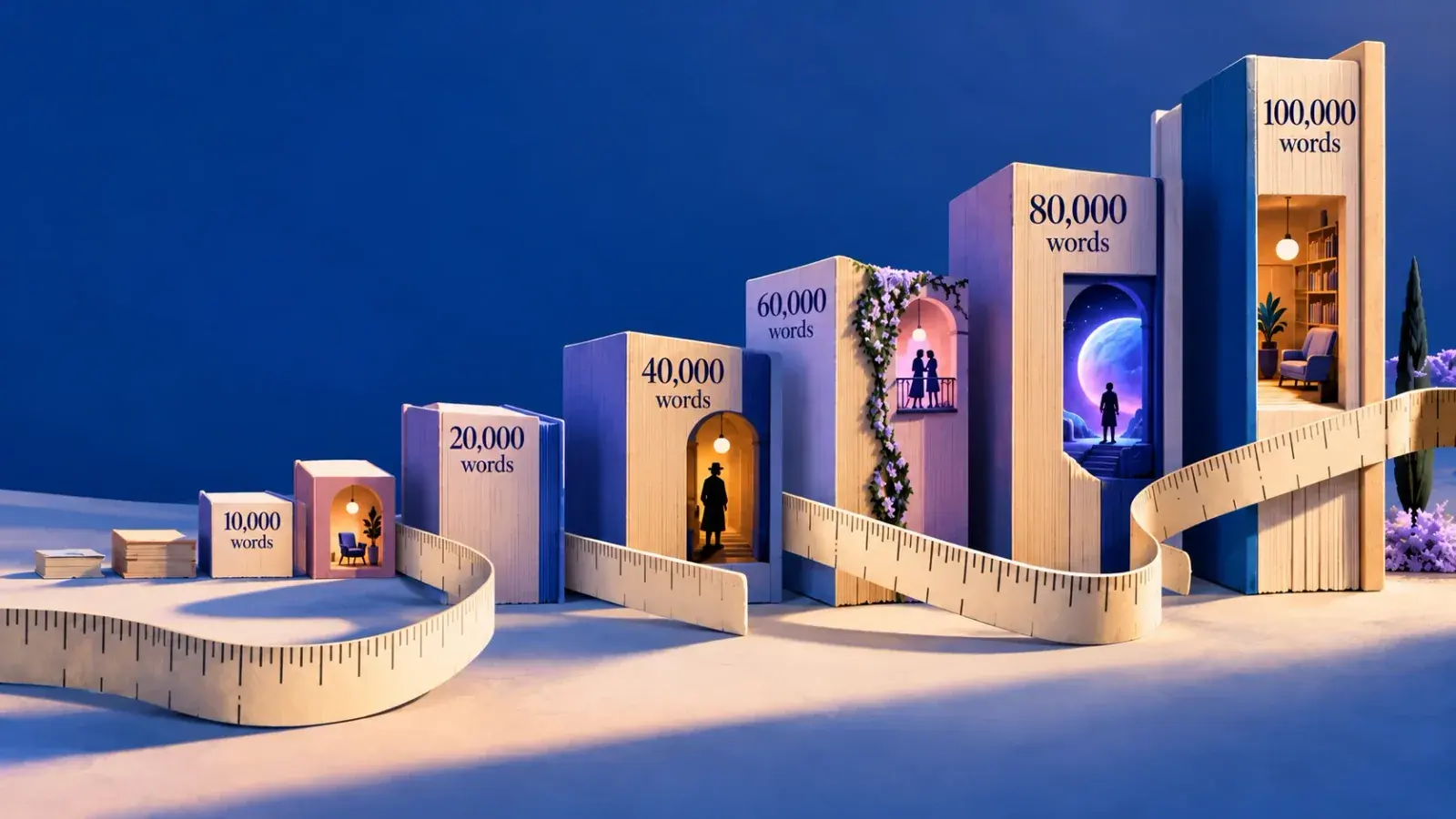
Most agents and publishers expect an adult novel to run between 70,000 and 100,000 words, and 80,000 to 90,000 is the safest target for a debut. Science fiction and fantasy run longer, up to about 120,000. Young adult runs about 55,000 to 80,000 and middle grade 20,000 to 55,000. Anything from 40,000 words up counts as a novel by the definition the big science fiction awards use, and 80,000 words fills about 320 manuscript pages, or roughly 230 to 320 printed ones.
Novel word counts by genre
These are the ranges agents and industry guides most often cite for a first novel. Agent Rachelle Gardner, for one, calls 80,000 to 100,000 words ideal for adult fiction and will look at 70,000 to 120,000. Other agencies post their own ranges, and they broadly agree. Read them as the expected size of a book on that shelf, not as a pass mark: a manuscript a few thousand words outside the range is fine, one 30,000 outside it needs a reason.
| Genre | Typical range | Notes |
|---|---|---|
| GenreLiterary fiction | Typical range80,000–100,000 | NotesSome run as short as 60,000 |
| GenreCommercial and upmarket | Typical range80,000–100,000 | NotesIncludes women's and book club fiction |
| GenreMystery and thriller | Typical range70,000–100,000 | NotesCozies sit at the shorter end |
| GenreRomance (single title) | Typical range70,000–100,000 | NotesTrade-published contemporary and historical |
| GenreCategory romance | Typical range50,000–75,000 | NotesSet by each publisher's line |
| GenreFantasy | Typical range90,000–120,000 | NotesAbove 120,000 is a hard sell for a debut |
| GenreScience fiction | Typical range90,000–120,000 | NotesSome guides narrow it to 100,000–115,000 |
| GenreHorror | Typical range70,000–100,000 | NotesTension favors the lower half |
| GenreHistorical fiction | Typical range80,000–100,000 | NotesSetting earns room, not research |
| GenreYoung adult | Typical range55,000–80,000 | NotesYA fantasy can run to about 100,000 |
| GenreMiddle grade | Typical range20,000–55,000 | NotesUpper middle grade 40,000–55,000 |
| GenreMemoir | Typical range80,000–90,000 | NotesAgents may ask for the full draft |
Category romance is set by the line
Series romance publishers state a length for each line, and they mean it. Harlequin's submission pages list 50,000 words for Harlequin Presents, 55,000 to 60,000 for Intrigue and 70,000 for Special Edition. Lines revise these targets, so check the current guidelines before you write to one.
Nonfiction and memoir
Most nonfiction works differently. It is usually signed on a book proposal and a sample chapter or two, before the book is finished, so the length is settled with the publisher. As a rough guide, Gardner puts most nonfiction at about 50,000 to 70,000 words. Memoir is the exception. An agent may ask a first-time memoirist for the complete manuscript as well as a proposal, which is why memoir has a row in the table.
Novella and short story word counts
The most widely quoted bands come from science fiction's two main awards. The Nebula Awards (run by SFWA) and the Hugo Awards use the same cutoffs, and writers in other genres often borrow them, though magazines and contests set their own limits. A novella sits between 17,500 and 40,000 words. Flash fiction has no award category, and its ceiling depends on the market.
| Form | Word count |
|---|---|
| FormFlash fiction | Word countUnder 1,000 (some markets allow 1,500) |
| FormShort story | Word countUnder 7,500 |
| FormNovelette | Word count7,500 to 17,499 |
| FormNovella | Word count17,500 to 39,999 |
| FormNovel | Word count40,000 and up |
A 45,000-word book is a novel by definition and still a short one by the market's standards. Agent guidelines list novel ranges, not novella ranges, so a 30,000-word story usually finds its home with magazines, contests and small presses that ask for that length.
How many pages is 80,000 words?
It depends which pages. A manuscript page in standard format (12-point type, double-spaced, one-inch margins) holds about 250 words. The figure comes from how editors once estimated length: about 10 words a line and 25 lines a page in a monospaced font such as Courier. A printed paperback page holds more, roughly 250 to 350 words depending on trim size, font and line spacing. The table shows both, before front matter and chapter openings add their pages.
| Words | Manuscript pages | Printed pages |
|---|---|---|
| Words50,000 | Manuscript pages200 | Printed pages145–200 |
| Words60,000 | Manuscript pages240 | Printed pages170–240 |
| Words70,000 | Manuscript pages280 | Printed pages200–280 |
| Words80,000 | Manuscript pages320 | Printed pages230–320 |
| Words90,000 | Manuscript pages360 | Printed pages255–360 |
| Words100,000 | Manuscript pages400 | Printed pages285–400 |
| Words120,000 | Manuscript pages480 | Printed pages345–480 |
When you submit, give agents words, not pages. Page counts change with formatting. Word counts do not. Use your word processor's count and round it to the nearest thousand: "complete at 87,000 words." The guide to formatting a manuscript covers the rest of the page.
Why agents care about length
A query letter states the word count beside the title and genre, and a number far outside the range gives a busy agent an easy reason to pass. Three things sit behind the habit.
- Cost. A longer book costs more to print and ship, so either the price rises or the margin shrinks. Print-on-demand services such as Amazon KDP price a paperback as a fixed charge plus a charge per page, which makes the trade easy to see.
- Reader expectations. Thriller readers expect a fast book and fantasy readers a big one. Agents check your comp titles against your length. A book twice as long as its comps is a different product.
- Editing. A debut at 150,000 words often reads as a draft that has not been cut, or as two books in one. Agents would rather see you do that work before they do.
Why debuts face tighter length limits
The ranges bind hardest on first books. An author with a readership has a record that pays for the extra paper, which is why so many famously long novels came after their writers were known. Comparing your debut to the fifth book in a bestselling series tells you little about what an agent will take on now.
Self-publishing removes the agent but not the reader. Genre readers still notice a book far shorter or longer than its neighbors, and print costs still rise with every page.
If your draft is too long or too short
Measure the gap first. A few thousand words over is a line-editing job. Twenty thousand over is structural: you will not find it by trimming adverbs.
Too long
- Start later. Many drafts open a chapter or two before the story does.
- Merge scenes that do the same job, such as two arguments that end in the same place.
- Cut subplots and viewpoint characters that do not change the ending.
- Shrink backstory delivered in blocks to the two lines the reader needs.
- If the draft holds two complete arcs, consider whether it is two books.
Target: 110,000 words, inside the 90,000–120,000 range for a debut fantasy and clear of the 120,000 line. Needed: 18,000 words out.
- −3,100. Cut the prologue's history of the empire. Two lines of it move into chapter 1.
- −4,200. Merge the council scenes in chapters 4 and 9, which end with the same vote.
- −7,800. Drop the smuggler's point of view. Her two essential scenes go to the protagonist.
- −3,000. Trim about 50 words from the opening and 50 from the close of 30 chapters.
Total: 18,100 words out, leaving 109,900.
Too short
- Check the form. Under 40,000 words, the story may simply be a novella, and that may be its right length.
- Look for summary where a scene belongs: the confrontation reported in a paragraph instead of played out.
- Give a secondary character a subplot that puts pressure on the main plot.
- Let the middle escalate: a second attempt that fails in a new way.
Do not pad. Extra description and recap add words and lose readers. The same logic applies to chapters: see how long a chapter should be.
Cutting a draft in Strokes
The fear in a big cut is losing a scene you will want back. In Strokes, keep the book as a project with one document per chapter and save a version before each cutting pass. Version history keeps versions automatically and on demand, marks what changed when you preview an older one, and restores it in one click. For the judgment calls, open the AI Assistant beside a chapter and ask which scenes repeat what the reader already knows, or add two chapters to the chat and ask whether they do the same job. When the draft fits, export it to Word or PDF for submission.
Frequently asked questions
Is 50,000 words long enough for a novel?
By the SFWA and Hugo definitions, yes: a novel starts at 40,000 words. For an adult debut sent to agents it is short, since most genres expect 70,000 or more. It suits category romance and middle grade, and it is the classic 50,000-word goal of a November drafting month, which makes it a strong first draft.
What is the average length of a novel?
There is no reliable count across all published novels, and length swings by genre. What agents publish are expected ranges: 70,000 to 100,000 words for most adult fiction, more for science fiction and fantasy, less for young adult and middle grade. If you need one number for an adult novel, 80,000 to 90,000 is the range agents most often call safe.
How many pages is 100,000 words?
About 400 manuscript pages at the standard 250 words per page, and roughly 285 to 400 pages in a printed paperback, depending on trim size, font and spacing. Front matter and chapter openings add a few more.
Should I give an exact word count in a query letter?
No. Use your word processor's count rounded to the nearest thousand, such as 87,000 words, and state it with the title and genre. Agents ask for words rather than pages because page counts depend on formatting.
Do word counts matter if I self-publish?
Less, because no agent screens the book, but readers of a genre still expect a familiar length, and print costs rise with page count because print-on-demand services charge per page.