To write a memoir, choose one stretch or thread of your life instead of all of it, and name the question that stretch answers. Pick a structure that serves the question, write the turning points as scenes, and let your present-day self reflect on what they meant. Finish a full draft before you polish anything, then revise in passes with a careful eye on the real people in the book.
Memoir vs autobiography
Both are true stories told in the first person by the person who lived them. An autobiography covers a whole life, usually from the beginning. A memoir covers a slice: a period, a relationship, a single thread. The word comes from the French mémoire, memory.
| Memoir | Autobiography | |
|---|---|---|
| Scope | MemoirOne period, relationship or theme | AutobiographyThe whole life to date |
| Order | MemoirWhatever serves the story | AutobiographyUsually chronological |
| Who writes it | MemoirAnyone with a story and a question | AutobiographyUsually someone already known |
| What it delivers | MemoirMeaning: what the experience revealed | AutobiographyRecord: what happened, and when |
If you are not already famous, you are writing a memoir. Few readers want a stranger's whole life in order. Plenty will follow one through a hard year if the writing earns it.
Find your memoir's focus and question
Most memoirs that stall are trying to hold everything. The fix is to choose a slice, then find the question that slice answers. Vivian Gornick draws this line in The Situation and the Story (2001): the situation is what happened to you; the story is what you came to understand through it. Readers come for the situation and stay for the story.
| The life | The slice | The question it answers |
|---|---|---|
| The lifeThirty years as a nurse | The sliceThe first year in a pediatric ICU | The question it answersHow do you stay tender in a job that rewards going numb? |
| The lifeGrowing up between two countries | The sliceThe summer you were sent to your grandmother's village at 14 | The question it answersWhich place was home, and who got to decide? |
| The lifeFour generations on a family farm | The sliceThe year you sold it | The question it answersWhat do you owe the people who built something you don't want? |
Write your question in one sentence and keep it where you can see it. It does three jobs. It tells you where the book starts: close to the moment the question became unavoidable, not at your birth. It tells you where it ends: when the question is answered, or changed. And it tells you what to cut: a chapter that does not bear on the question probably belongs to a different book, however good it is.
Then read three or four recent memoirs that circle a similar question. They show you what has been done, and they become your comp titles when you pitch.
Choose a memoir structure
Take one example through four shapes. You and your brother spend a summer clearing out your late father's house, and the question is who he really was, and how much of him you carry.
Chronological
Begin with the phone call, end with the sale of the house. Time supplies the momentum, and readers always know where they are. The risk is "and then" sameness, so it suits slices with a strong arc of their own.
Thematic
Organize chapters by subject instead of date: the garage, the letters, the gun cabinet, the garden. Each chapter can range across forty years. Books built from short vignettes often take this shape. It needs a strong through-line, or it reads as a collection of essays.
Braided
Alternate two or three strands: the summer in the house, your childhood in it, and what you learn researching the steel mill where he worked for thirty years. The strands start far apart and meet near the end. Braiding is also a way to approach painful material from the side.
Frame
An outer story in the present holds the past. In a frame story, the last night in the empty house could open the book, every few chapters could return to it, and the book could end at morning. A frame gives you a clock and a natural place for reflection.
Shapes combine: a frame around a chronological middle is common. Choose the one that puts your question under the most pressure, then sketch the chapters in a memoir outline.
Scene, summary and reflection
A scene puts the reader in a moment: a place, a time, people talking, something changing. Summary covers ground fast: "For three years we barely spoke." Use scenes for the turning points and summary for the stretches between. First drafts lean on summary, which is where the advice to show, don't tell earns its keep. "My father was a hard man" is a verdict. Readers need the evening that taught you so, and they will reach the verdict themselves.
Every memoir also has two narrators. The experiencing self lived the events and did not know how they would end. The narrating self is writing now and does. Sue William Silverman, in Fearless Confessions (2009), calls them the voice of innocence and the voice of experience. Scenes belong mostly to the first, reflection to the second. With only the experiencing self, a memoir is a string of events. With only the narrating self, it is a lecture. The meaning lives in the gap between them.
The kitchen smelled of bleach and old coffee. My brother held up a shoebox. "Receipts," he said. "Nineteen eighty-one." He shook it once and dropped it in the trash bag. I took it back out.
I told him we might need it for the estate. Nobody's estate needs a receipt from 1981. What I wanted, I can see now, was evidence. A man who kept forty years of receipts had not lost our letters. He had thrown them away.
The first paragraph is the experiencing self: present, physical, no hindsight. "I can see now" hands the page to the narrating self, who says what the scene meant. Make that move at the turning points, not after every scene.
Memory, truth and real people
Memory is reconstruction, and readers know it. Nobody expects a conversation from 1994 word for word, only dialogue true to what was said and how people talked. What breaks the contract is invention: events that did not happen, presented as if they did. In January 2006, The Smoking Gun reported that James Frey had fabricated or exaggerated parts of A Million Little Pieces, and later printings carried a note from the author admitting it.
Check what you can against letters, journals, photographs, old emails and other people's memories. When accounts differ, say so on the page ("my sister remembers it as March"). Admitted uncertainty makes readers trust the rest. Then say in an author's note what you changed: names, identifying details, compressed time, composite characters, reconstructed dialogue.
The harder part is care. The people in your book did not choose to be in it. Ask of every unflattering detail whether the story needs it or only your score does. Write about your experience of people, not a verdict on them, and turn the same scrutiny on yourself. Readers side against a narrator who is always right. Many memoirists show the relevant pages to the people in them before publication, not to ask permission but so nobody is ambushed.
How to write a memoir, step by step
- Make a memory inventory
List 50 to 100 moments, one line each, with a place and who was there. List scenes, not themes: "Dad teaching me to back up the trailer, the church lot, 1989", not "my relationship with my father". Firsts, lasts, arguments and objects you still own are good prompts. Do not judge yet.
- Write the question in one sentence
Look for the question that keeps surfacing in the inventory and circle the moments that bear on it. Those are your book.
- Choose where it starts and ends
Open on, or just before, the moment the question opens: the phone call, the diagnosis, the move. End where it is answered or transformed. Weave backstory in later, a paragraph at a time.
- Pick a structure and outline loosely
Write one line per chapter and treat the outline as a hypothesis the draft will test.
- Draft the scenes you see most clearly
Write in any order: the scenes you can already see first, the bridges between them later. Momentum matters more than sequence.
- Keep a routine you can sustain
A fixed time slot several days a week beats occasional marathons. Stop mid-scene so the next session starts easily, and do not reread the whole draft each time. That is how chapter one gets polished forever.
- Finish, then rest the draft
Get to the end, rough parts and all. Then leave it for a few weeks so you can read it as a stranger would.
- Revise in passes
One job per pass. Structure: does every chapter bear on the question? Scene and summary: are the turning points dramatized? Reflection: does the narrating self speak at the moments that matter? People: list everyone real in the book and ask whether each hard detail is necessary and fair. Line editing comes last, once nothing big will move.
- Get outside readers
Give the revised draft to three to five beta readers, ideally people who read memoir and are not in the book. Ask specific questions: where did you lose interest, whom did you not believe, what did you want more of? The guide to finding beta readers covers how to brief them and sort their notes.
Where Strokes fits
In Strokes you can keep the book as a project: one document per chapter, beside the memory inventory, the question and the list of real people. Version history saves versions as you go, so you can cut a scene hard, preview the earlier version with the changes marked and restore it in one click if the chapter worked better before. When a chapter is done, ask the AI Assistant where it summarizes what should be a scene, or where reflection is missing. Keep the memories and the sentences your own.
Getting a memoir published
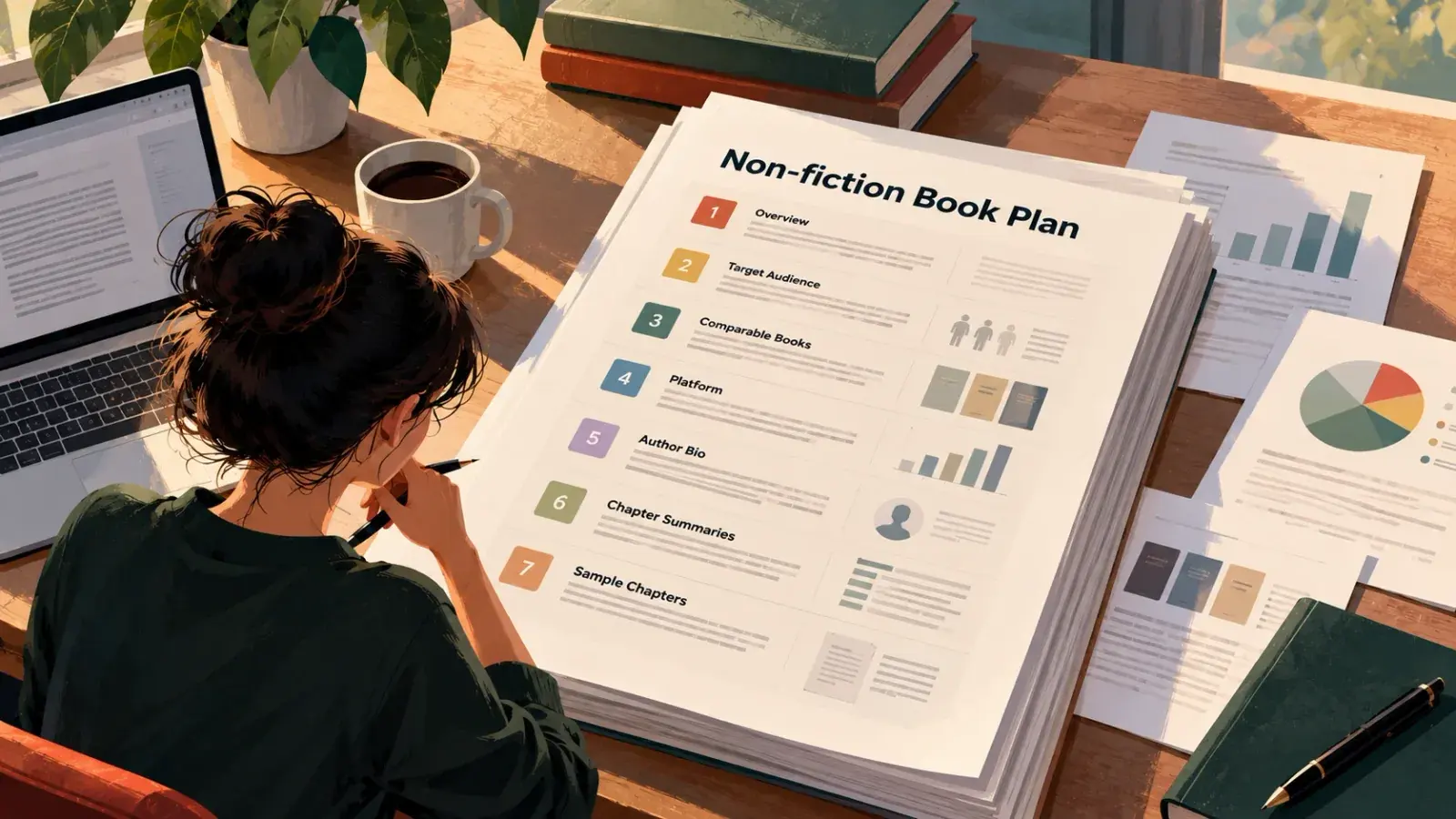
For a debut memoir, most agents want the manuscript finished and polished before you query, and many also ask for a book proposal: an overview, chapter summaries, comp titles, your platform and sample chapters. Writers with an established platform or earlier books sometimes sell memoir on a proposal alone. Requirements vary, so read each agent's submission guidelines. Our guides on finding a literary agent, the query letter and the book proposal cover each step.
Some independent and university presses read unagented memoir, often in set reading periods, so check each press's current guidelines. Self-publishing gives you control of timing and rights and leaves editing and design to you. A memoir printed for your family is a finished book too. Know which one you are writing by the time you revise: a family edition will be read by the people in it, a trade book by strangers, and that changes how you handle both.
Common memoir mistakes
- Including everything that happened. Real life has no editor. Cut what fails the question, however true or vivid.
- Summarizing the turning points. If a moment changed you, the reader needs to be in the room for it.
- Writing the first draft for the people in it. Imagining your mother reading every line freezes the draft. Write for a stranger first and make the decisions about family in revision.
Frequently asked questions
How long should a memoir be?
There is no fixed rule. A range of roughly 70,000 to 90,000 words is often cited for a debut memoir, and published memoirs run well under and over it. Check each agent's guidelines and let the story set the length: a tight memoir beats a padded one.
How do I start a memoir?
Find the question your memories share, then open near the moment it became unavoidable: the phone call, the move, the diagnosis. Not at your birth. Weave family history in later.
Can I change names and details in a memoir?
Yes, if you say so in an author's note. Changed names and identifying details, compressed time, reconstructed dialogue and, used sparingly, composite characters are accepted practice. Inventing events and presenting them as true is not.
Do I need permission to write about my family?
Not as a rule, but the legal risks in the US are defamation and invasion of privacy, and written consent reduces both. If the book shows living people in a damaging light, consult a media lawyer. Many memoirists also show family the relevant pages before publication. This is not legal advice.
Should a memoir be in past or present tense?
Both work. Past tense is the common choice because it leaves room for the narrating self to reflect. Present tense gives immediacy but makes reflection harder to fit in.