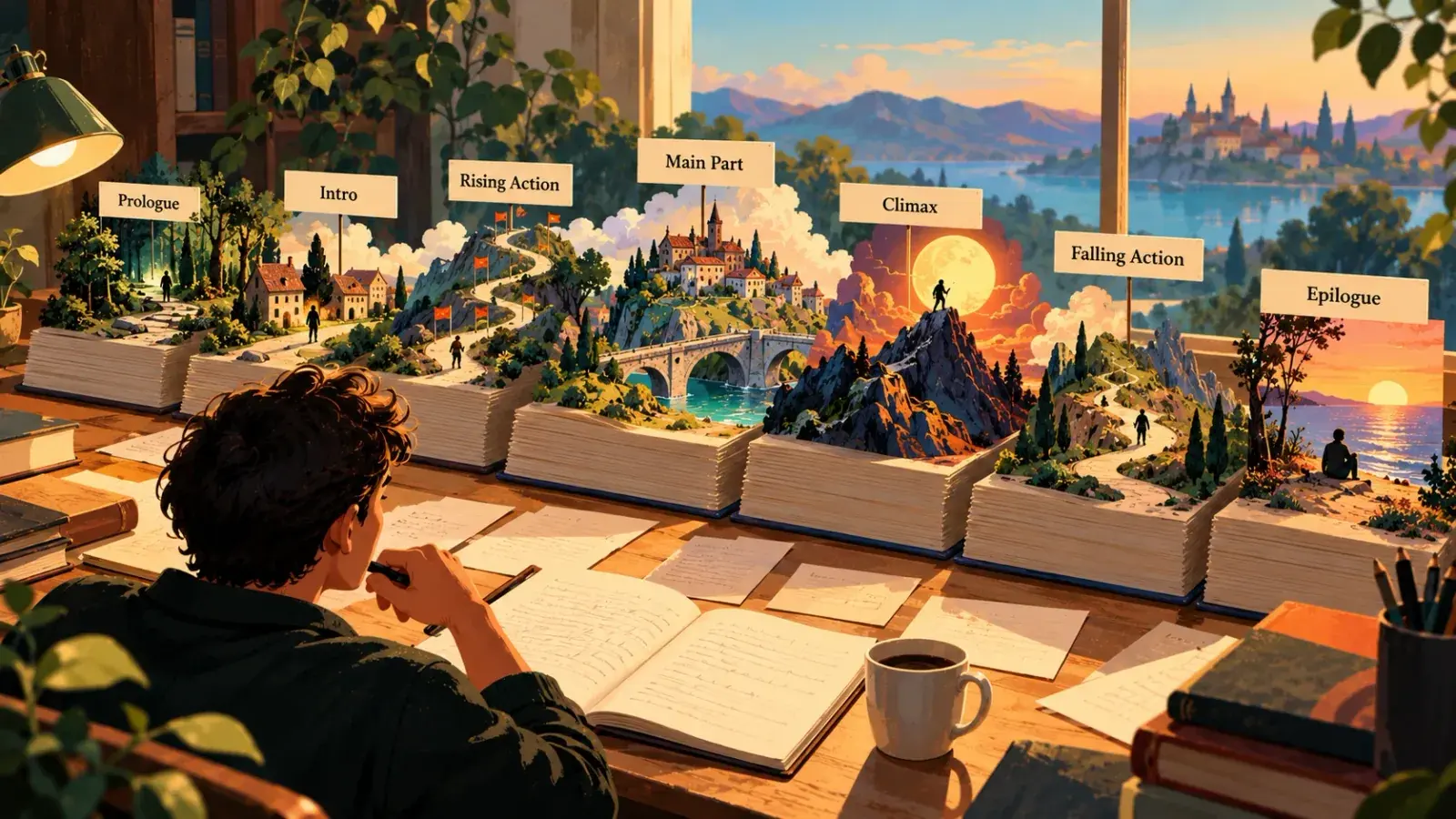
To outline a novel, work from the smallest summary outward: a one-line logline, the main characters and what each one wants, the half-dozen turning points that shape the plot, a chapter list, then a card for each scene. A plotter may go all the way to scene cards. A pantser may stop at the turning points. Five methods give the work a frame: three-act structure, the Save the Cat beat sheet, the snowflake method, the hero's journey, and scene cards with a reverse outline. Whichever you choose, the outline is a plan you will change.
Why outline a novel at all
A novel is too long to hold in your head. A plot outline lets you find a structural problem on one page instead of 300: a middle where nothing changes, a villain who disappears for a hundred pages, a climax the hero watches instead of decides. Fixing those in a plan takes an afternoon. Fixing them in a finished draft takes a rewrite.
Writers sort themselves loosely into plotters and pantsers. Plotters outline before drafting. Pantsers write by the seat of their pants and find the story on the page. Many writers sit somewhere between. The useful question is how much you need to know before you start. A pantser who knows the ending and two turning points still has somewhere to steer. A plotter who outlines every scene still meets surprises in the draft.
| Outline depth | What it contains | Suits |
|---|---|---|
| Outline depthLight (one page) | What it containsLogline, ending, four to six turning points | SuitsPantsers, short novels |
| Outline depthMedium (a few pages) | What it containsAbove, plus a one-line plan per chapter | SuitsMost first novels |
| Outline depthFull (scene by scene) | What it containsAbove, plus a card per scene and character sheets | SuitsPlotters, mysteries, multiple POVs |
Five ways to outline a novel
These methods overlap. They describe the same rise and fall at different levels of detail, and many writers mix them: three acts for the big shape, beats for the middle, cards for the scenes.
| Method | You end up with | Best for | Watch out for |
|---|---|---|---|
| MethodThree-act structure | You end up withSetup, confrontation, resolution, with turning points between | Best forFirst novels, any genre | Watch out forA vague, sagging middle act |
| MethodSave the Cat beat sheet | You end up with15 beats placed by rough percentage | Best forCommercial fiction with a clear goal | Watch out forA formula feel if followed beat by beat |
| MethodSnowflake method | You end up withA synopsis, character sheets and a scene list, built in ten steps | Best forPlotters who like detail | Watch out forWeeks of planning before a page of draft |
| MethodHero's journey | You end up with12 stages from ordinary world to return | Best forFantasy, adventure, quests | Watch out forForcing a mentor and a quest on a quiet story |
| MethodScene cards and reverse outline | You end up withOne card per scene, rearranged freely | Best forVisual thinkers, revising a draft | Watch out forLosing the big shape in the detail |
Three-act structure
The oldest frame is Aristotle's point that a whole story has a beginning, a middle and an end. Syd Field turned it into a working template for screenwriters in Screenplay (1979): act one sets up the story, act two (about half the length) confronts the hero with obstacles, act three resolves it, and a plot point turns the story at each break. For a novel, read it as proportions: roughly a quarter, a half, a quarter. Its weak spot is the long second act, which is why Field himself later added a midpoint and two pinch points to hold it up. Our three-act structure template lays the acts out as a fill-in document.
The Save the Cat beat sheet
Blake Snyder's screenwriting book Save the Cat! (2005) breaks a story into 15 beats, and Jessica Brody's Save the Cat! Writes a Novel (2018) adapts them for fiction with a rough position for each. The beats that carry the weight: the Catalyst, a life-changing event around 10%; the hero's choice to enter a new world around 20%; a midpoint that raises the stakes; All Is Lost, the low point, around 75%; and a new insight around 80% that launches the finale. Between them sit a stretch of doubt, a second storyline (often a relationship) that carries the theme, and mounting pressure. The book opens and closes on mirrored images of the hero's life. Treat the percentages as rough positions.
The snowflake method
Randy Ingermanson's snowflake method grows a novel from one sentence by adding detail in rounds. Its ten steps start with a one-sentence summary (he suggests under 15 words), then a five-sentence paragraph covering the setup, three disasters and the ending. Character summaries, a one-page and then a four-page synopsis, full character charts and a spreadsheet with one line per scene follow. Only then does the draft begin. You will know your book well before you write it, which some writers love and others find drains the fun.
The hero's journey
Joseph Campbell's The Hero with a Thousand Faces (1949) traced one pattern through myths worldwide in 17 stages. Christopher Vogler's The Writer's Journey condensed it to 12 stages: the ordinary world; the call to adventure; refusal of the call; meeting the mentor; crossing the first threshold; tests, allies and enemies; the approach to the inmost cave; the ordeal; the reward; the road back; the resurrection; and the return with the elixir. The ordeal often sits near the midpoint. Read the stages as functions, not props: the mentor can be a diary, the threshold a divorce.
Scene cards and the reverse outline
Write each scene on an index card, or as one line in a document: whose scene it is, what they want, what goes wrong. Snyder lays his cards out in four rows, one per quarter of the story, so holes and sags show at a glance. The reverse outline runs the same idea backward. After drafting, you list what each scene actually does and compare it with the plan. It suits pantsers best, because it outlines the book you wrote rather than the one you imagined. The scene outline template gives each card the same fields.
How to outline a novel, step by step
This plan works with any of the methods above. Each step adds a layer. Stop whenever you know enough to write the next chapter with confidence.
- Write the premise and a logline
Start with a what-if question, then turn it into one or two sentences that name the protagonist, the event that starts the story, their goal, what stands in the way and what they stand to lose. If you cannot write it yet, the story is not clear yet, which is worth knowing before chapter one.
- List the characters and what they want
For each main character, write the want (a concrete goal), the need or flaw (what has to change in them) and what blocks them. Conflict comes from wants that collide, so give the antagonist a goal too. A character profile holds the longer version.
- Place the major turning points
Decide the inciting incident, the end of act one, the midpoint, the low point, the climax and the denouement, a sentence or two each. Add a pinch point in each half of the middle, where the opposition shows its strength. These are the load-bearing walls. Build the chapters around them.
- Join them into a one-page summary
Write the story in prose, a paragraph per act. The South Park creators Trey Parker and Matt Stone test their story beats by the words between them: "but" and "therefore" are good, "and then" means the events are not connected. The same test exposes gaps in a novel's summary.
- Break the summary into chapters
Give each chapter one line: what happens and what it does for the story. Use the turning points as fixed posts and fill between them. The count follows from length: a 90,000-word novel with 3,000-word chapters has 30. The guide to how long a chapter should be has the usual ranges.
- Write a card for each scene
Note the viewpoint character, their goal in the scene, the conflict and the outcome. That goal, conflict and disaster pattern comes from Dwight Swain's Techniques of the Selling Writer (1965). Add one line on what has changed by the end. A scene where nothing changes is a candidate for cutting.
- Stop and start drafting
You are done when you can see the next few chapters clearly. Set a limit before you begin, because outlining feels like progress long after it has stopped being useful. Start from the novel outline template if you want the structure ready-made.
A worked example: one novel, outlined
Here is the plan applied to an invented literary mystery, working title The Lake Keeps, from logline to a single scene card.
Premise. What if a woman learned that her brother's drowning had been staged, and that the person who staged it was the one she trusts most?
Logline. When a piano tuner finds a letter hidden in an old upright suggesting her brother did not drown fifteen years ago, she has until the lake freezes and the island ferry stops running to learn who lied about that night, even if the answer is her mother.
- Mara Quill, 34, piano tuner. Wants the truth about Eli. Needs to stop keeping the peace at any cost. Blocked by a town that closed the case and her own habit of not asking.
- Ruth Quill, her mother. Wants the past left shut. Hides that she helped Eli leave.
- Tom Hale, the ferryman who reported the drowning. Wants to sell the ferry and leave before anyone looks closely.
| Turning point | Roughly | In The Lake Keeps |
|---|---|---|
| Turning pointInciting incident | Roughly10% | In The Lake KeepsTuning the church hall upright, Mara finds an unsigned letter to Eli, dated a month after he drowned. |
| Turning pointEnd of act one | Roughly20–25% | In The Lake KeepsThe sheriff won't reopen the case. Mara takes the ferry to the island where Eli was last seen. |
| Turning pointFirst pinch point | RoughlyAbout 37% | In The Lake KeepsHer workshop is broken into. The letter is gone. Only her photo of it is left. |
| Turning pointMidpoint | Roughly50% | In The Lake KeepsMara finds the cut log pages in Hale's boathouse. Eli signed for a crossing a week after he drowned. |
| Turning pointSecond pinch point | RoughlyAbout 62% | In The Lake KeepsThe council approves Hale's sale. The last crossing is set. |
| Turning pointLow point | Roughly75% | In The Lake KeepsIn Ruth's desk Mara finds a draft of the letter. Her mother wrote it. |
| Turning pointClimax | Roughly80–95% | In The Lake KeepsOn the last crossing, Mara makes Ruth and Hale tell the whole story. |
| Turning pointDenouement | RoughlyLast pages | In The Lake KeepsSpring. Mara mails a letter of her own to an address two states away. |
- Mara at work as the lake starts to ice. Talk in town of the ferry sale.
- Dinner with Ruth on the anniversary. Eli's room, kept as it was.
- The church hall upright. The letter. (Inciting incident.)
- Ruth reads it and calls it a cruel joke. Too quickly.
- Mara asks Hale about that night. His story matches the report word for word.
- The sheriff closes the door on the case.
- Mara buys a ferry ticket and crosses to the island. (End of act one.)
POV: Mara.
Goal: copy the ferry logbook for that October before Hale locks up.
Conflict: Hale's daughter is working the counter, and she remembers Eli.
Outcome: Mara gets the book, but the October pages are gone.
What changes: she stops believing the case was a mistake and starts believing it was covered up.
Plant: the stubs are cut clean, not torn.
Keep the outline flexible
While you draft
Treat the outline as your current best guess. When the draft finds something better, follow it, then update the outline the same day so it stays a true map. Keep the turning points firm and the scenes between them loose, and plan in detail only a few chapters ahead: chapter 25 will look different once you have written chapter 10. Park ideas that belong later in a list at the bottom of the outline.
After the first draft
Reverse-outline the draft before you revise. Write one line per scene: what happens, whose viewpoint, what changes. Then look for scenes where nothing changes, threads that vanish, characters absent for long stretches and a midpoint that has drifted to the two-thirds mark. Rewrite the outline to fix them, and revise from the new plan. The same one-line summaries are a head start when you write a synopsis for agents.
Common outlining mistakes
- Outlining instead of writing. A plan can grow forever. Set a deadline for it.
- Events without causes. A chain of "and then" reads as a list. Each scene should follow from the last or complicate it.
- A hero who only reacts. After the midpoint the protagonist should be making the plans, not answering them.
- An empty middle. Without pinch points, the antagonist vanishes between act one and the climax.
- A climax someone else wins. The ending should turn on the protagonist's choice.
Outlining a novel in Strokes
If you outline in documents rather than on cards, keep the outline beside the manuscript. In Strokes, a project is a folder tree of files on your machine: one project per novel, the outline at the top, and a document for each part or chapter beneath it, so each chapter stays its own file on disk. Before a big restructure, such as cutting a subplot or moving the midpoint, save a version. Version history lets you preview any earlier version with the changes marked and restore it in one click.
The AI Assistant can take the outline as context: ask where the midpoint falls, which characters vanish for long stretches, or which scene cards lack a goal or a conflict. In Agent mode it can read each chapter and write a one-line summary per scene into your outline document, a quick first reverse outline, with every step shown for you to review.
Frequently asked questions
How long should a novel outline be?
Long enough that you can start writing with confidence. A light outline fits on one page: logline, ending and the main turning points. A full outline runs to many pages, with a line or card for every scene and a sheet for each main character.
Should a pantser outline at all?
A light outline helps most pantsers: the logline, the ending you are aiming for and two or three turning points. Many discovery writers outline afterward instead, with a reverse outline of the first draft, which shows the structure of the book they actually wrote.
Which outlining method is best for a first novel?
Three-act structure with a midpoint is the simplest to hold in your head. Add the Save the Cat beats if you write commercial genre fiction, or try the snowflake method if you like working from summary down to detail.
Can I outline a novel I have already started?
Yes. Reverse-outline what you have, one line per scene, then outline forward from where you stopped. A stalled middle is a common reason to stop and plan, and the turning points you have not reached yet are the place to start.
What is the difference between an outline and a synopsis?
An outline is a working plan for you, as detailed as you like, often scene by scene. A synopsis is a short prose summary of the whole plot, ending included, written for an agent or editor to read.