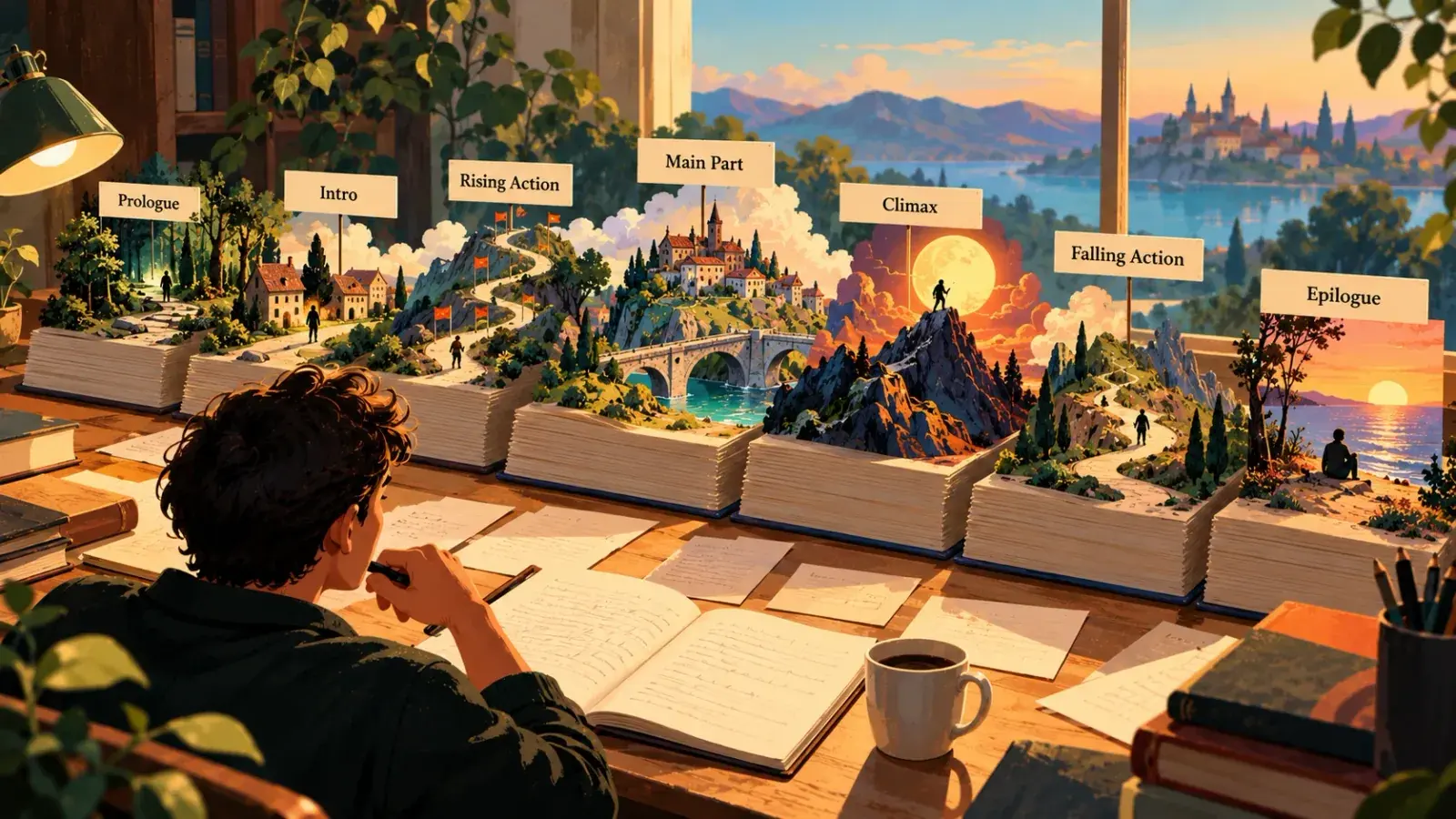
To write a novel, take one idea through seven stages. Shape it into a premise you can say in a sentence, plan the plot as far as you need to start, get to know the people who drive it, and write a complete first draft without stopping to polish. Then revise from the big problems down to the small ones, test the book on readers, and choose how to publish. Most adult novels run 70,000 to 100,000 words. At 500 words a day, an 80,000-word draft takes about five months.
This page is the map. Each stage has a detailed guide, linked under "Go deeper" below, and one invented novel runs through every section so you can see each stage applied to the same book.
| Stage | You finish with | Go deeper |
|---|---|---|
| Stage1. Premise | You finish withA one-sentence logline and a shelf the book belongs on | Go deeperWord counts by genre |
| Stage2. Plot | You finish withFive turning points and a chapter plan | Go deeperHow to outline a novel |
| Stage3. Characters | You finish withA want, a need and a flaw for each lead | Go deeperCharacter development |
| Stage4. First draft | You finish withA complete, rough manuscript | Go deeperHow long it takes |
| Stage5. Revision | You finish withA draft that holds together | Go deeperPacing |
| Stage6. Feedback | You finish withNotes from readers who aren't you | Go deeperFinding beta readers |
| Stage7. Publishing | You finish withA query package or a finished book file | Go deeperGetting an agent |
Turn an idea into a premise
Most ideas are situations, not stories. "A lighthouse keeper's daughter" is a situation. So is "a city where it never stops raining." A novel needs someone who wants something, something in the way, and a reason it matters now. E. M. Forster drew the line in a 1927 lecture series that became Aspects of the Novel:
"The king died and then the queen died," is a story. "The king died, and then the queen died of grief" is a plot. … If it is in a story we say "and then?" If it is in a plot we ask "why?"
That "why" is what carries a reader through 300 pages. Push your idea forward in three passes: a question, a premise with a person and a cost, then a logline short enough to say across a table. Here is one idea taken through all three. We will follow this book through the rest of the guide.
What if: a translator found her own childhood in a book she was translating?
Premise: Nora Vance, a court interpreter in Baltimore, takes a side job translating the memoir of a Portuguese novelist who died last spring. Chapter nine describes her childhood: the yellow house, the dog that drowned, the fire she has never talked about. To find out how he knew, she has to go back to the coastal town her mother left when Nora was seven and has refused to discuss since, and she has six weeks before the English edition goes to print.
Logline: A court interpreter translating a dead novelist's memoir finds her own childhood in chapter nine, and has six weeks before publication to learn whether he stole her past or was part of it.
Test it before you spend a year on it
- Is the goal specific? "Find the truth" is a mood. "Learn how he knew before the book is printed" is a goal.
- Can the opposition push back for a whole book? Nora's mother wants the past closed, the publisher wants the book on time, and the town has its own version of the fire.
- Does trying cost something? She can lose her mother, the job, or the story she tells herself about her life.
- Do you know what failure looks like? You don't need the ending yet. You need to know what is at stake if she gets it wrong.
Then decide which shelf the book goes on. Genre sets the length readers and agents expect (see novel word counts by genre) and the promises you have to keep: a romance needs its happy ending, a mystery needs fair clues. Read five or ten recent novels in your category. The closest of them become your comp titles when you pitch. Still looking for the idea itself? Try the fantasy writing prompts or their romance and horror counterparts.
Plan the plot to the depth you need
Writers split loosely into plotters and pantsers: plotters outline before they draft, pantsers find the story on the page. Few writers are pure either way, and the useful question is how much you need to know before you start. For a first novel, know at least the five turning points. They are the load-bearing walls, and everything between them can move.
| Turning point | Rough position | In the example |
|---|---|---|
| Turning pointInciting incident | Rough positionAbout 10% | In the exampleNora reads chapter nine |
| Turning pointFirst commitment | Rough positionAbout 25% | In the exampleShe flies to Portugal without telling her mother |
| Turning pointMidpoint | Rough positionAbout 50% | In the exampleHer mother's letters turn up in the novelist's archive |
| Turning pointLow point | Rough positionAbout 75% | In the exampleHer mother cuts contact and the publisher threatens to replace her |
| Turning pointClimax | Rough positionAbout 90% | In the exampleShe delivers the translation with chapter nine intact and a translator's note in her own voice |
The inciting incident breaks the status quo. The first commitment has to be a choice: Nora could send the publisher a polite email and stay home. The midpoint changes what the story is about (the novelist didn't steal her past: he was in it), and the climax makes her decide something only she can decide.
With those five fixed, list the chapters between them, a line each. How to outline a novel compares five methods, from three-act structure to the snowflake method, and the novel outline template gives you the document to fill in. If you think in beats, start from the Save the Cat beat sheet.
Choose point of view and tense early
Changing point of view after 40,000 words means rewriting nearly every sentence, so decide before you draft. First person makes Nora's investigation intimate, but she has to be present for every discovery. Third person limited gives a little distance and lets you add a second viewpoint later, perhaps the novelist in his own chapters. Past tense is the default most readers never notice. Present tense adds immediacy, and some readers dislike it. The point of view guide walks through the options with examples.
Research what the plot needs, then stop
Research is the most respectable way to avoid writing. Before the draft, learn only what the plot depends on: how translation contracts work, what a Portuguese fishing town looks like in February. In the draft, mark gaps with a placeholder such as [TK: tide times] (TK is editors' shorthand for "to come") and keep going. If you are inventing a world, a worldbuilding template and a story bible keep the rules in one place so book two doesn't contradict book one.
Build characters who want things
Plot is what happens. Character is why it happens this way and not another. For each lead, write down four things before you draft: what they want (a goal you could photograph), what they need (what they must learn or give up, often without knowing it), the flaw that keeps them from it, and what they do under pressure. The gap between want and need is where the character arc lives.
Wants: to deliver the translation on time and keep her quiet life.
Needs: to stop rendering other people's accounts of her life and give her own.
Flaw: she is a professional neutral. She says exactly what others said and never what she thinks.
Under pressure: she gets formal and precise, and lies by leaving things out.
Opposition does not have to be a villain. Here it is a mother protecting a secret and a publisher protecting a schedule, each with a reasonable case. If your book does have a villain, give them a goal as clear as the hero's (see how to write a villain). Secondary characters work best when each wants something different from the lead, which gives every scene they share a little friction.
To find a character's voice, write a page that will never go in the book, such as a letter they would not send. The character profile template holds the facts, and the guides to character archetypes and dialogue go further.
Write the first draft to the end
The first draft has one job: to exist. A common way for a first novel to die is chapter one rewritten ten times and a middle that never reaches an ending. Write forward, badly if necessary, and fix it later.
Set a pace you can keep
Pick a daily or weekly word target you can hit on a bad day, not a good one. The arithmetic is simple and a little startling:
| Words a day | Writing daily | Five days a week |
|---|---|---|
| Words a day250 | Writing dailyAbout 10½ months | Five days a weekAbout 15 months |
| Words a day500 | Writing dailyAbout 5 months | Five days a weekAbout 7½ months |
| Words a day1,000 | Writing dailyAbout 11 weeks | Five days a weekAbout 4 months |
| Words a day1,667 | Writing dailyAbout 7 weeks | Five days a weekAbout 10 weeks |
| Words a day2,000 | Writing dailyAbout 6 weeks | Five days a weekAbout 8 weeks |
The 1,667 row is the pace of NaNoWriMo, the November challenge to write 50,000 words in a month. The nonprofit behind it closed in 2025, but writers still run the challenge on their own. Stephen King, in On Writing, argues for finishing a first draft within about a season so the story doesn't start to feel foreign to you. The aim is to reach the end while the beginning is still fresh in your head. For the whole timeline, from resting the draft to querying and publication, see how long it takes to write a novel.
The oldest version of this advice still works. Anthony Trollope wrote dozens of novels, many of them while working full time for the Post Office, and described his method plainly:
It had at this time become my custom,—and it still is my custom, though of late I have become a little lenient to myself,—to write with my watch before me, and to require from myself 250 words every quarter of an hour. … I always began my task by reading the work of the day before, an operation which would take me half an hour, and which consisted chiefly in weighing with my ear the sound of the words and phrases.
Take two things from it: a target per session rather than per mood, and a short reread of yesterday's last pages to pick up the voice. Hemingway added a third, in a 1935 Esquire piece addressed to a young writer: stop for the day while it is still going well and you know what happens next, so tomorrow starts with something to write.
Keep moving through the middle
- Leave notes, not fixes. When you realize in chapter 14 that the fire happened in winter, not summer, write
[From here: fire in winter, fix ch. 1–13]and carry on as if the early chapters already said so. - Skip what won't come. Write the next scene you can see and leave a one-line placeholder for the one you can't.
- Write scenes, not chapters. In each scene someone wants something, meets resistance and leaves changed. A scene outline helps when one won't start, and chapter length can wait for revision.
- Stuck for a week? Check the plan. A long stall often means the next turning point no longer makes sense. If fixing the outline doesn't help, the writer's block guide has more.
Keep the files tidy
One file per chapter makes chapters easy to move, count and send. Keep notes beside the draft, not inside it, and never delete a cut scene: move it to a separate file, because you will want a line from it later.
A novel project
the-translator/
  notes/
    premise.md
    outline.md
    characters.md
    research.md
  draft/
    01-the-job.md
    02-chapter-nine.md
    03-the-yellow-house.md
  cut/
    cut-scenes.md
  submission/
    query-letter.md
    synopsis.md
Revise from the top down
When the draft is done, put it away. King suggests at least six weeks. The point is to forget enough that you read it as a stranger would. Then read it straight through in a few sittings, making notes, not edits. As you go, write a reverse outline: one line per scene, saying what happens and what changes. Scenes where nothing changes are the first candidates to cut.
Revise in order of scale, so you never polish something you later throw away:
- Structure
Do the turning points land? Does the ending answer the question the opening asked? Cut, merge and move scenes. This is the pass where whole chapters go.
- Character and continuity
Check that every lead wants something in every scene they are in, that the arc moves in steps rather than one jump, and that the timeline, names and ages agree from start to finish.
- Scenes and pacing
Start scenes later and leave them earlier. Look for beats that repeat and stretches of backstory the reader doesn't need yet. The pacing guide and foreshadowing examples help here.
- Lines
Now the sentences: dialogue that sounds like people, filler words, telling where a moment should be shown. Read the hardest chapters aloud.
- Copy and proof
Last, spelling, grammar and consistency. Keep a short list of your choices (serial comma or not, "OK" or "okay") so they stay the same on every page.
Your notes from the read-through will mostly be structural. Write them as instructions to yourself, specific enough to act on:
Ch. 9–14: Nora learns the same thing three times (he knew the house). Merge into one scene at the archive and move the letters up to the midpoint. Her mother exists only in phone calls until ch. 22; put her on the page by ch. 6, or the low point won't hurt.
Save a version before each big cut so a bad decision is never final. A first novel often needs more than one structural pass. That is normal, not a sign the book is failing.
Get feedback from readers
You cannot read your own book for the first time. Feedback comes in layers, and each fits a different stage:
- Alpha readers and critique partners see rough chapters as you go. Critique partners are fellow writers who comment on craft, usually as a swap.
- Beta readers read a complete, revised draft as readers do. Three to five is a common recommendation: enough to see patterns, few enough to manage. Mix people who read your genre with one who doesn't.
- Professional editors work at three levels: developmental (structure and story), line (sentences and voice) and copy (correctness). If you self-publish, budget at least for a copy edit and a proofread. If you query agents, a paid edit is optional.
Ask beta readers questions about their experience, not your craft. "Was the pacing right?" gets a polite yes. These get answers you can use:
- Where did you put the book down, and where couldn't you?
- Who did you care about? Who did you mix up?
- What did you expect to happen that didn't?
- Was anything confusing in the first three chapters?
- Did the ending feel earned, or did it come from nowhere?
One reader's comment may be taste. When three readers lose interest in the same chapter, the chapter has a problem. Fix the problem readers point to, but trust yourself on the solution: they are usually right that something is wrong and often wrong about what to do. For where to find readers and how to brief them, see how to find beta readers.
Choose a publishing path
There are three main routes, and you can choose differently for different books. Decide before the final polish, because each needs different files.
| Path | Who pays | What you need | Time to readers |
|---|---|---|---|
| PathTraditional (agent, then publisher) | Who paysThe publisher pays you an advance and royalties. The agent takes a commission, typically 15% of your US advance and royalties | What you needA finished manuscript, query letter and synopsis | Time to readersMonths of querying, then often 18–24 months from deal to shelf |
| PathSelf-publishing | Who paysYou pay for editing, cover and marketing, and keep the rights | What you needAn edited manuscript, a cover, EPUB and print files | Time to readersWeeks, once the files are ready |
| PathSmall press or hybrid | Who paysSmall presses pay you. Hybrid publishers charge you part of the costs for higher royalties | What you needThe press's own submission package | Time to readersVaries by press |
The traditional route
For a debut novel, agents expect the whole book finished and revised before you query. The package is a query letter of about 250 to 350 words, a synopsis of one or two pages that gives away the ending, and your opening pages in standard manuscript format. The heart of the query is a short pitch paragraph:
Nora Vance has spent fifteen years saying other people's words in Baltimore courtrooms, and she is good at not having opinions. Then a publisher hires her to translate the last memoir of a celebrated Portuguese novelist, dead six months, and chapter nine describes her childhood down to the dog's name. With six weeks until the English edition goes to print, Nora goes back to the fishing town her mother fled, where everyone remembers the fire and no two people tell it the same way. To finish the translation honestly, she will have to decide whose version of her life goes on the page, and for once speak in her own voice.
Our guides to writing a query letter, writing a synopsis and getting a literary agent cover each step, and the query letter template gives you the letter's shape.
Self-publishing
Self-publishing makes you the publisher. You hire the editor and the cover designer, prepare an EPUB and a print-ready PDF, set the price and do the marketing. Common distributors include Amazon KDP, IngramSpark (which reaches bookstores and libraries) and Draft2Digital (which sends ebooks to many stores at once). Amazon's KDP Select program asks for the ebook to be exclusive to Amazon, so read the current terms before you enroll.
Writing a novel in Strokes
Strokes is a desktop editor for macOS and Windows that keeps your work as files on your own machine, so the layout above maps onto it directly: one project per novel, a document per chapter, and your notes in the same folder tree. Version history saves versions automatically and on demand, so you can strip a chapter down in a structural pass, preview the earlier version with the changes marked, and restore it in one click if the cut was wrong.
The AI Assistant is useful as a reader, not a ghostwriter. Add the relevant chapters to the chat and ask specific questions: where the tension drops in chapter 12, or whether Nora's reaction there fits what she said in chapter 2. When the book is done, export it to Word for agents, or to EPUB and PDF if you are publishing it yourself.
Frequently asked questions
How long does it take to write a novel?
It depends on your pace and your time. At 500 words a day, an 80,000-word first draft takes about five months. At 1,000 words a day, it takes under three. Resting the draft, revising it and getting feedback add several months more, so a first novel often takes a year or longer from first page to a manuscript ready to send out.
How many words should my first novel be?
Most agents expect an adult novel of 70,000 to 100,000 words, with 80,000 to 90,000 the safest target for a debut. Science fiction and fantasy can run to about 120,000, young adult usually runs 55,000 to 80,000 and middle grade 20,000 to 55,000.
Do I need an outline to write a novel?
No, but you need a direction. Many writers draft without a full outline and still know the main turning points and roughly how the book ends. If you prefer to discover the story as you write, plan to make a reverse outline of the first draft before you revise.
Do I need to finish my novel before contacting agents?
Yes, for a debut novel. Agents sign first-time novelists on a complete, revised manuscript, and one who likes your opening pages will ask for the whole book. Nonfiction is different: it usually sells on a proposal and sample chapters.