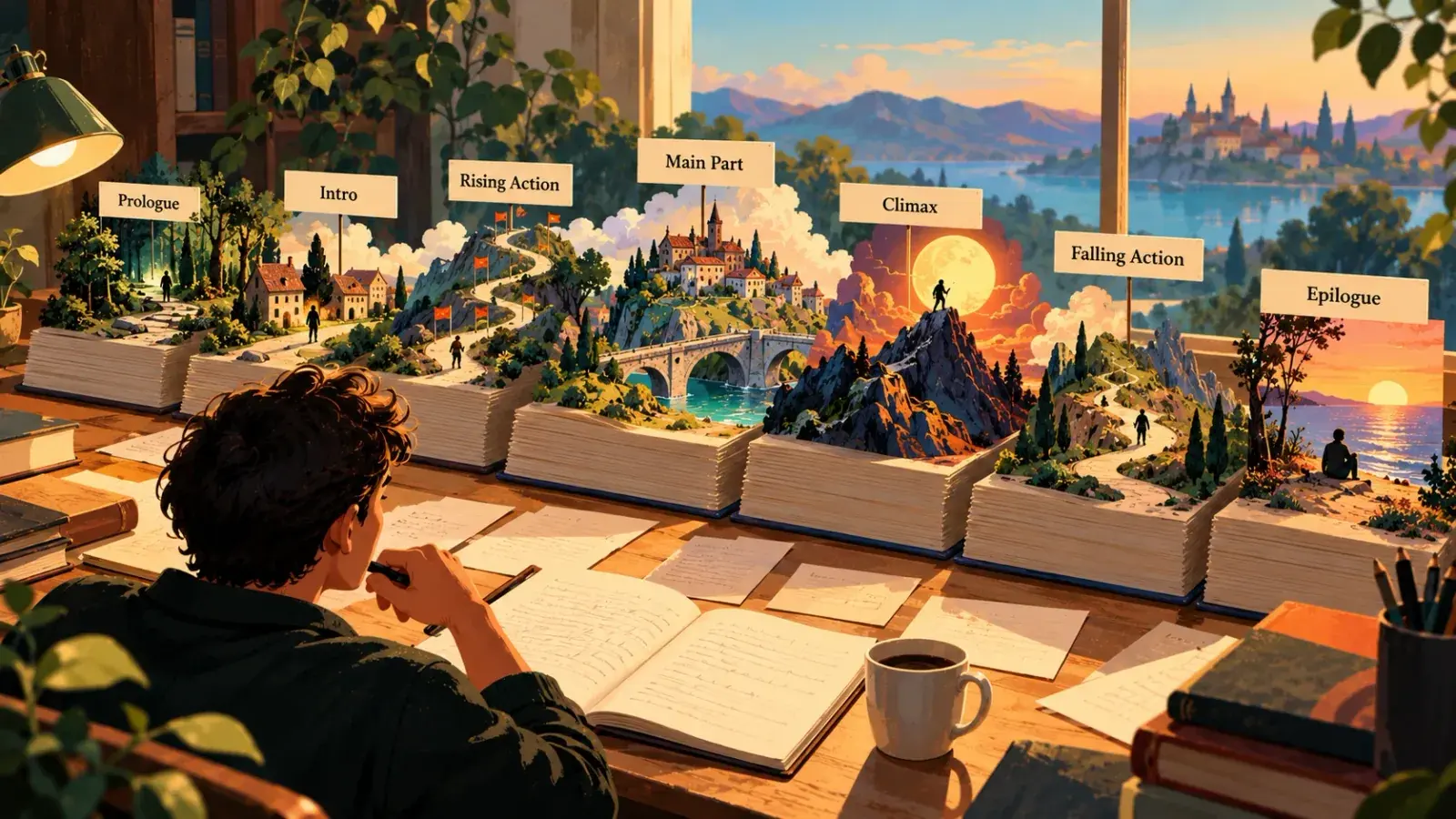
A story idea worth writing has three parts: a specific character, a situation they can't walk away from and a complication that forces a choice. The 120 story ideas below are original and grouped by genre, and every one has all three parts, in that order. Pick one that makes you ask what happens next, change any detail that isn't yours and write the scene where the complication lands.
This is the broad list: ten genres, ten to fourteen premises in each, and most of them could be a short story or a novel. When you want to go deeper in one genre, the fantasy, horror and romance writing prompts have 100 each. After the list: one idea taken to both sizes, six steps from premise to first scene, where writers have found their ideas for two centuries, and why promising ones stall.
| Genre | Every idea in it has | Ideas |
|---|---|---|
| GenreLiterary and contemporary | Every idea in it hasA private pressure: a secret, a debt, a loyalty | Ideas1–14 |
| GenreMystery and crime | Every idea in it hasA question with a findable answer | Ideas15–28 |
| GenreThriller and suspense | Every idea in it hasA clock and a threat | Ideas29–40 |
| GenreScience fiction | Every idea in it hasOne changed rule of the world | Ideas41–54 |
| GenreFantasy and magical realism | Every idea in it hasOne impossible thing in ordinary life | Ideas55–64 |
| GenreHorror and the uncanny | Every idea in it hasOne wrong detail and no easy exit | Ideas65–74 |
| GenreRomance and love stories | Every idea in it hasTwo people and a reason not to | Ideas75–84 |
| GenreHistorical fiction | Every idea in it hasA real event and a private problem | Ideas85–96 |
| GenreFamily and coming of age | Every idea in it hasLoyalty pulling against honesty | Ideas97–108 |
| GenreComedy and satire | Every idea in it hasA ridiculous rule, taken seriously | Ideas109–120 |
Literary and contemporary story ideas
These ideas turn on a private pressure: a secret, a debt, a loyalty that has gone on too long. The complication is usually a person, not an event.
- A court stenographer is hired by a convicted man's mother to read her the trial transcript aloud, one evening a week. In week six, the stenographer finds an error in her own record that may have helped convict him.
- A restaurant critic loses her sense of smell after a long illness and keeps reviewing, relying on her husband's descriptions. Her best review in years is of a restaurant he turns out to part-own.
- Twin brothers, 61, have run a hardware store in Duluth since their father died. One has bought a one-way ticket to Lisbon and has three weeks to tell the other, who has just signed a ten-year lease.
- A hospice chaplain who lost her faith a decade ago, and kept the job, is asked by a dying atheist to teach him to pray before his daughter flies in on Sunday.
- A widow is invited to her late husband's fortieth high-school reunion by classmates who don't know he has died. She goes, and lets them believe he is parking the car.
- Two sisters who haven't spoken in nine years clear out their mother's apartment on alternate weekends. The labels on the boxes are their only conversation, until one box says “You know why.”
- A man spends his inheritance buying back, from strangers, the furniture his mother sold during the divorce. The last piece, the dining table, belongs to the woman his father left her for.
- A school-bus driver in rural Nebraska notices that one third-grader has stopped bringing lunch and started arriving early. The boy's father is her landlord, and her lease is up in May.
- A cellist quits a famous string quartet at fifty and drives a city bus in her hometown. The quartet's second violinist, who never forgave her, starts riding her route every morning.
- A sixteen-year-old in Glasgow is paid by her grandfather to read him the newspaper over breakfast. One morning it prints his obituary by mistake, and he asks her to help him live up to it.
- For twenty years a stand-in has doubled for a famous actor: same height, same walk. When the actor's father dies, the actor pays him to go to the funeral in his place, and nobody tells the mother.
- A Mumbai tax accountant learns that his late father kept a second household across the city for thirty years and declared every rupee of it. The second family wants the ashes, and so does his mother.
- A woman inherits her uncle's taxidermy shop in Wisconsin and gives herself a month to close it. On the first morning, the town's oldest customer arrives with his dead dog and a cash deposit.
- A woman has never told her husband she was on the ferry the night it sank. Their daughter has just taken a summer job on the replacement ferry and wants her mother aboard for the first crossing.
Mystery and crime story ideas
A mystery needs a question with a findable answer and someone with a reason to find it. Most of these detectives are amateurs whose day job happens to fit the crime. For clues, suspects and fair play, see the guide to writing a mystery novel.
- A crossword setter notices that a rival's daily puzzles have spelled out the initials of a missing woman for a week. The police call it coincidence, and tomorrow's puzzle is hers to set.
- A small-town vet realizes that the poisoned dogs on her table all belong to people who sat on the same jury twelve years ago.
- A hotel housekeeper finds a guest dead in room 412 and runs for the manager. When they come back, the bed is made and the guest is in the lobby, checking out.
- A locksmith is called to open a widow's safe and finds it empty, except for a key to his own front door.
- A retired detective in a care home is sure a resident was murdered. The only person who believes her is the night cleaner, who has her own reasons to stay away from the police.
- A podcaster whose series helped convict a man gets a letter from him listing three details only the killer could know. Two of them were cut from her episodes before they aired.
- An auctioneer cataloguing a dead collector's estate finds that every painting has been swapped for a forgery, and her own catalog photographs, taken a month ago, already show the fakes.
- A nine-year-old who logs every car on her street sees a neighbor's car come home at 3 a.m. with different license plates. The neighbor is a police officer, and he has noticed her notebook.
- A county archivist digitizing the local paper finds that one issue from 1987 was reprinted with a single paragraph removed. She is holding the original, and one of the people named in it is now the sheriff.
- A forensic accountant hired to find where a dead man's savings went learns he gave them away, a thousand dollars at a time, to strangers he met on buses. Someone is still cashing his checks.
- A wedding videographer spots the same guest in his footage from four weddings in four states, and a stolen envelope of cash at each. At the fifth wedding, she asks him to dance.
- A sign-language interpreter at a televised press conference sees the police chief's deaf daughter in the front row sign a message meant only for her: “He's lying about the car.”
- A village cricket club's elderly scorer notices that one page of the 1998 scorebook is in two different hands. It covers the match played the afternoon a teammate disappeared.
- A Rome taxi driver was the last person to see an American student before she vanished. He is also the only one who knows she got out at a church and came back wearing different shoes.
Thriller and suspense story ideas
A thriller needs a clock and a threat aimed at the protagonist or someone they love. In most of these, the hero's own skill is what puts them in the way.
- A bridge engineer gets an anonymous message saying a bridge she signed off on will fail at 5:40 tonight, at rush hour. Attached are her own calculations, with one number circled.
- A home nurse caring for a retired intelligence officer realizes his dementia is a performance. The relatives who visit every Thursday are there to find out how much he remembers.
- A mountain rescue volunteer reaches two climbers alive after a storm. Each of them, out of the other's hearing, asks her not to let the other get down the mountain.
- A hospital's night interpreter is called to translate for a patient who says, in a language nobody else in the building speaks, that the man who brought him in is going to kill the surgeon.
- A woman sells her house in one afternoon to a cash buyer. That night she learns the same buyer has bought every house on her street the same way, the same week.
- A ghostwriter finishing a tech founder's memoir after his death finds his notes for the last chapter: a confession that names the board members now paying her fee.
- A ferry crew of four on a winter crossing find a stowaway with a bag of cash and a gunshot wound. Ten minutes later, the coast guard radios to ask whether they've seen anyone.
- A hostage negotiator is asked for by name. The man holding the bank has no demands, only questions about the last negotiation she lost, and he knows things that never went in the report.
- A retired air traffic controller, flying as a passenger, hears the captain's welcome over the speakers and recognizes the voice from a near miss she covered up twenty years ago.
- A teenage lifeguard at a Florida resort watches a man go under in the deep end while his companions do nothing. By morning, the hotel insists he was never a guest.
- A night-bus driver on a mountain route realizes one passenger has a gun and another is an off-duty officer who hasn't noticed. The next stop is ninety minutes away.
- A family in witness protection learns that their teenage son posted a photo online, and that the window behind him reflects their street sign.
Science fiction story ideas
Each of these changes one rule of the world and follows it to an ordinary person's door. In most, the rule changes in the first sentence and someone knocks in the second.
- Memory editing is legal and cheap. A divorce mediator's job is to get both partners to agree on what each will forget, and her own ex-husband has just booked a session.
- In a city where cheap glasses show the wearer when someone is lying, a professional eulogist, paid to exaggerate kindly, has to speak at the funeral of a man nobody liked.
- Two hundred years into the voyage, a generation ship's historian finds that the destination was reached forty years ago and the council voted not to land.
- The first child born on Mars turns eighteen and is legally free to move to Earth. Her body can't survive Earth's gravity, and the colony has never told her.
- A climate engineer who runs a coastal city's flood barriers is ordered to let one district flood to save the rest. Her mother lives there and won't leave.
- Each citizen gets one vote a decade, and it counts ten thousand times. A shy librarian's number comes up three weeks before the most bitter election in living memory.
- Teleportation scans you, builds a copy and destroys the original. A courier who has made the trip eight hundred times meets a man who says he is her original: the machine failed to destroy him on her first trip.
- A colony on a tidally locked planet lives on the thin ring between permanent day and permanent night. A surveyor finds the ring is drifting, and the town will be in darkness within eleven years.
- A linguist on a first-contact team realizes the visitors' language has no future tense, and that the treaty she has just translated only works if it does.
- Every child inherits one memory from each parent, chosen by the parent. At sixteen, a girl realizes the memory her mother picked for her is of a crime.
- A hospital installs a system that predicts each patient's death to the week. A night nurse notices that its forecasts for her ward change every time one particular doctor is on duty.
- A woman receives a refund for eight hours of her life that she sold at nineteen and doesn't remember selling. The receipt lists where she was.
- An elderly couple are paid to live as the “human baseline” in a test town run entirely by machines. Then their runaway grandson moves in, and the town's systems don't know what to do with a teenager.
- A lunar base's supply ship arrives a year late with a fourth crew member, a woman the other three were told had died on Earth. Mission control says nobody else is aboard.
Fantasy and magical realism ideas
These lean toward magical realism and contemporary fantasy, where one impossible thing sits inside ordinary life and nobody makes much fuss about it. For quests, courts and dragons, try the fantasy writing prompts.
- Each morning a woman in Mexico City wakes knowing one stranger's secret, delivered like a weather report. Today's belongs to the man she is marrying on Saturday.
- A grandmother's quilts warm only the person they were made for. After her funeral, her grandson finds an unfinished one in the cedar chest with his ex-wife's name pinned to it.
- A beekeeper's honey tastes of the dreams of whoever's garden her bees visited. This summer, the honey from the house next door tastes of smoke.
- In a town where your shadow shows who you will become, a fourteen-year-old's shadow looks exactly like her father, who is in prison.
- Everything lost in one Chicago neighborhood turns up in the same pawnshop window. The owner returns things for a small fee, until a wedding ring arrives wrapped in a missing-person flyer.
- The moon over a small Ohio town has looked slightly larger than anywhere else for a century. A NASA engineer comes home for her father's funeral and decides, finally, to measure it.
- A night-shift radio host in Manitoba starts taking calls from listeners in 1957. One caller is the nineteen-year-old who will become her mother, about to make the choice the host was born from.
- A home inspector can hear what houses think. The house he's inspecting for a young couple begs him to fail it, for their sake, not its own.
- In a fishing town in Portugal, the dead come back for one day each year to settle their accounts. This year the debt collector's own father returns, owing money to half the town.
- A family of tailors can sew a feeling into a garment so the wearer never feels it again. A bride asks the youngest to sew her guilt into her wedding dress. The bride was driving the car that killed the tailor's brother.
Horror and uncanny story ideas
Each of these starts with one wrong detail in an ordinary place and a person who can't simply leave. They are premises sized for a whole story. For quick sparks by subgenre, see the horror writing prompts.
- A grief counselor runs a support group for people who lost someone on the same mountain highway. One night a new member arrives, and each person in the circle recognizes him as their own dead.
- A night attendant at a 24-hour laundromat finds the same child's clothes in the lost-and-found every morning, a size larger each week.
- An amateur genealogist finds that in every generation of her family since 1790, one daughter has died at thirty-three on the same date. She turns thirty-three in October.
- A doll restorer receives a porcelain doll with a note: “Please don't fix her face. She likes it this way.” The face is a copy of the restorer's own at six.
- The new caretaker of a preserved ghost town sees lights on in the general store on his first night. Inside, the shelves have been restocked with this week's groceries.
- A woman's father, who has dementia, keeps setting a place at dinner for a child. In his attic she finds a box of children's drawings signed with a name she has never heard, the newest dated last week.
- A choir is hired to sing at a funeral in a remote parish. The coffin is closed, the mourners don't speak, and during the last hymn the director hears a voice inside the coffin singing the alto line.
- A hospice nurse can tell how long a patient has left by the smell of the room. A healthy-looking man who checked himself in this morning smells of nothing at all.
- A small-town mortician notices that the bodies brought in from one farm have already been embalmed, expertly, by a method nobody has used since the 1800s.
- A woman inherits her aunt's beach house on one condition: she must host the aunt's party every August 14 for the same guest list. Everyone on the list has been dead for decades, and at eight o'clock the doorbell rings.
Romance and love story ideas
A love story needs two specific people and a real reason they can't just say yes. A romance also promises that the couple ends up together, happily ever after or happy for now, and some of these could end either way. For more, sorted by trope, see the romance writing prompts.
- A tollbooth collector and a commuter have traded one sentence every weekday morning for three years. The bridge goes cashless on Monday, and Friday is their last exchange.
- A couple married for forty years agree to a trial separation, then each secretly rents an apartment in the same building across town to keep an eye on the other.
- A widow learns Italian for two years so she can read her late husband's letters to his first love. Then she takes them to Turin to deliver them herself, and finds she likes the woman.
- A divorce lawyer and a wedding officiant share a bench outside city hall every Friday and keep score of the couples going in. Then one of them gets engaged.
- At a Dublin care home, a man of ninety asks the activities coordinator to find the woman he danced with at a céilí in 1953. She lives two floors up and doesn't remember him, but she would like to dance.
- An airport lost-luggage clerk realizes that the charming man who keeps reporting the same suitcase lost has been checking it onto flights he never boards.
- Two people matched on a dating app in early 2020 and never met. Six years later they match again, both newly divorced, and agree to meet at the bar they picked back then, which has since closed.
- A sign painter in Lisbon is hired to paint over the hand-lettered sign of a bakery that has lost its lease. The baker asks her to take as long as she possibly can.
- A man has hidden a love note somewhere in the house every day of his marriage. After his wife dies, he starts finding her replies, hidden for forty years in places he never looked.
- A widower signs up for ballroom lessons so he can dance at his granddaughter's wedding. His teacher turns out to be his late wife's old dance partner, the man she almost married.
Historical fiction story ideas
A historical idea puts an invented person inside a real event and gives them a problem the history books don't record. Check every date and detail before you build a book on it.
- London, September 1666: a bookseller's apprentice is ordered to carry his master's whole stock into St Paul's Cathedral, where the master believes stone will keep it safe from the fire. The apprentice doesn't believe it.
- Haarlem, February 1637: a tulip trader holds a contract for a single bulb worth more than a canal house in the week the market collapses. The buyer who owes him is his father-in-law.
- Dakota Territory, January 1888: a nineteen-year-old teacher watches a mild morning turn into a blizzard and must decide whether to keep eleven children in a schoolhouse with fuel for one night or lead them to a farm a mile away.
- Dawson City, 1898: a woman who runs a laundry is paid in gold dust and notices that one miner's dust is the wrong color for any claim on the creeks.
- Lisbon, November 1755: a kitchen maid who skipped the All Saints' Day mass to meet a boy survives the earthquake, and is the only witness to what her master did in the hour before the fires reached his house.
- Derbyshire, 1666: a village seals itself off so the plague won't spread. Inside the boundary, a young widow learns that the man she was to marry, in the next valley, has stopped waiting.
- Paris, 1888: a riveter on the half-built Eiffel Tower has hidden his fear of heights for a year. In the week his daughter is born, he is moved to the crew working highest up.
- London, January 1863: on the opening day of the world's first underground passenger railway, a pickpocket discovers what a crowd underground can't see, and so does the detective who followed her down.
- East Berlin, November 9, 1989: a seamstress who paid two years' wages for a forged exit visa, now sewn into her coat, hears on the evening news that the border is open. She can't tell whether it's real or a trap.
- Boston, 1919: a dockworker's son earns pocket money selling the molasses that seeps from the giant tank near his street. On a warm January morning, the seep gets worse.
- An American city, autumn 1918: a nurse begs her father, the official organizing a war-bond parade, to cancel it because of the influenza. The posters are already up.
- Luxor, November 1922: the cook for an English excavation team hears, before any newspaper, that they have found a sealed tomb. A dealer offers her a year's wages to tell him the day it will be opened.
Family and coming-of-age story ideas
These family stories set loyalty against honesty. The coming-of-age ideas, each a bildungsroman in miniature, turn on the first time a young person sees the adults clearly.
- A grandmother leaves everything to the home health aide who cared for her for three years. The aide offers to give it back, but only to the grandchild she chooses.
- A grown son moves back in with his widowed mother to look after her and finds she has a boyfriend, a pickleball league and no intention of being looked after.
- After the divorce, two brothers, nine and fourteen, carry messages between their parents' houses. The older one has been changing what the messages say.
- The family's last weekend at the lake cabin is meant to be a goodbye before the sale. The youngest sister arrives and announces she has bought it, with money nobody knew she had.
- A sixteen-year-old violinist fails a conservatory audition on purpose so she can stay home with her younger brother. Her mother finds the recording.
- A boy whose family runs the funeral home in a Texas town is asked by his best friend to let him see his father's body before the closed-casket service.
- A seventeen-year-old who has driven her father home from bars since she was fourteen gets her license the week he quits drinking. Without the car keys, she isn't sure what she is to him.
- Three adult siblings each receive a letter from their late mother, to be opened on the same night. The letters disagree about who their father was.
- A twelve-year-old spends the summer at the front desk of her mother's motel off a Nevada highway and works out that one long-term guest pays extra to stay out of the register.
- A woman who was adopted as a baby gets a letter from her birth mother, asking not for a meeting but for a kidney.
- A first-generation college student comes home for Thanksgiving to find her bedroom rented out. The tenant is a student at her university who sits behind her in statistics.
- At their army medical exam, one of two nineteen-year-old twins is turned down for a heart condition his brother doesn't have and doesn't know about. He has until the bus leaves to decide what to tell him.
Comedy and satire story ideas
These take one ridiculous rule seriously and follow it with a straight face. The satirical ones point the rule at something real: work, money, status, the internet.
- A professional apologizer, hired by companies to say sorry in person, is hired by her own mother to apologize to her.
- A new manager reads every note in an office suggestion box ignored for twelve years and decides to carry out each one, in order, starting Monday.
- The ghostwriter of a bestselling book on decisiveness is sent on the book tour in place of its author, who can't decide whether to go.
- A man is declared dead by mistake and finds that being dead suits him: no bills, no meetings, no email. His wife would rather stay married to the dead version.
- A family's cheerful holiday newsletter has been fiction for a decade. The one cousin who believes every word announces she's coming to stay for Christmas.
- An influencer couple who film their perfect marriage for two million followers get divorced but can't afford to stop posting, so they keep filming it from separate apartments.
- A village elects a goat as mayor as a joke. Three years later the goat's approval rating beats every human's, and its handler is running the budget.
- A weather-service committee that names storms runs short of approved names and quietly starts using its members' exes.
- A retired spy joins his neighborhood watch and runs it like a counterintelligence operation. The neighbors love it, until he finds out who has been stealing the garden gnomes.
- Two co-founders deadlocked on every decision appoint a coin as chief executive. The company does better than ever, and the board wants to give the coin a bonus.
- A prize for unpublished novels is won by a manuscript nobody remembers submitting. The judges have three days to find the author before the gala.
- A dentist runs for mayor on one promise: to fix the town clock that has read 4:10 since 1987. The town discovers it has grown very attached to 4:10.
One idea at two sizes
Most ideas on this page could be a short story or a novel. Here is idea 10, the grandfather and the obituary, both ways.
As a short story: one breakfast. Isla, 16, reads the obituary aloud twice, as asked. Her grandfather corrects it as she goes. He was never “a devoted husband.” He did not “serve with distinction.” By the time his tea is cold he has dictated a truer version, and Isla notices the one line he hasn't touched: “much loved by his granddaughter.” She has to decide whether to tell him it's the only one that's accurate. The story ends when she does.
As a novel: one summer, one claim per chapter. Dougal decides to earn the obituary before the real one runs. He tries to become the patient father his estranged son never had, finishes the boat the paper says he “built with his own hands,” and takes piano lessons at 79. Isla drives him, and slowly works out why the paper printed it in the first place: he wrote the notice himself and sent it in. Each claim is a new complication. The last one, making peace with Isla's father, is the one he can't do alone.
The premise is the same in both. What the novel adds is listed below, and the secret matters most: Dougal wrote the notice himself. A secret keeps producing complications, because every claim he tries to live up to brings him closer to being found out.
| Short story | Novel | |
|---|---|---|
| Time | Short storyOne breakfast | NovelOne summer |
| Cast | Short storyIsla and her grandfather | NovelAdd his estranged son, Isla's father |
| Turns | Short storyOne: whether Isla tells him | NovelOne per claim in the obituary |
| Engine | Short storyA choice at the table | NovelA secret: he wrote the notice |
| Ending | Short storyWhen Isla decides | NovelThe claim he can't make true alone |
If your idea has a secret under it, or a second complication that follows from the first, it's probably a book. Plan it with the guide to outlining a novel. If it resolves with one decision, in a day or a week, with two or three people who matter, it's probably short-story sized.
Turn a premise into a story
An idea is a starting position, not a plot. These six steps work for any idea above and for the ones in your own notebook.
- Name the three parts
Write the idea as three short lines: who, what situation, what complication. Your own ideas usually arrive with one or two of them. “An abandoned ski resort” is a setting. It becomes an idea when someone has to spend the winter there and something goes wrong. Fill in the missing line before anything else.
- Find the want under the situation
Before the complication, the character wants something ordinary: to keep the job, sell the house, be left alone. The complication should threaten that want or replace it with a new one. Write both down, in the character profile if you keep one. The gap between them is the engine of the story.
- Make the complication a choice
Bad luck happens to a character. A choice is something they do. Give them two options that both cost something. In idea 29, the engineer can close the bridge on the word of an anonymous message, or check the circled number herself and risk rush hour to protect her name. If you keep your ideas in a table, give it four columns: idea, want, choice and cost. An idea with an empty cost column isn't ready yet.
- Start on the day it lands
Open on the day the complication arrives, or the day before. In a novel that arrival is usually the inciting incident. Backstory can come later, in a clause. The guide to how to start a story covers the first page in detail.
- Decide how big it is
One complication and one turn are often enough for a short story. A novel needs a chain of complications, each changing what the character wants, or a secret that keeps producing them. Idea 10 above shows the same premise at both sizes.
- Write the complication scene first
Draft the scene where the complication lands, fast and without an outline. If you finish it wanting to know what happens next, keep going. If you don't, put the idea back in the file. It may come alive next month, paired with another one. If you can't tell, show the scene to one reader and ask a single question: would they read the next page?
Where story ideas come from
Writers who seem to have endless ideas often describe the same habit: they write down anything that might be a story and come back to it later. The accounts they have left point to a handful of sources.
A notebook of seeds. Anton Chekhov kept notebooks of short notes and story seeds from 1892 until his death in 1904. Many read like the premises on this page with the second sentence missing.
A young man made a million marks, lay down on them, and shot himself.
A man and woman marry because both of them don't know what to do with themselves.
An official, who wore the portrait of the Governor's wife, lent money on interest; he secretly becomes rich.
Each is a person and a situation with something wrong in it, and none says what happens next. Write your own seeds the same way, fast and without explanation, and decide later which ones grow.
The news. Nathaniel Hawthorne's “Wakefield,” collected in Twice-Told Tales (1837), admits its source in the first sentence: “In some old magazine or newspaper I recollect a story, told as truth, of a man—let us call him Wakefield—who absented himself for a long time from his wife.” The man stays away upward of twenty years. The anecdote supplied the situation. The story is Hawthorne trying to imagine why. Court reports, local news and corrections columns are full of situations still missing their why.
A dare. In the summer of 1816, Mary Shelley and her companions were neighbors of Lord Byron in Switzerland. “We will each write a ghost story,” said Lord Byron, as she recalled in her introduction to the 1831 edition of Frankenstein. Her idea came later, with her eyes shut: she “saw the pale student of unhallowed arts kneeling beside the thing he had put together.” A contest, an anthology call or a deadline gives an idea a reason to be finished.
Dreams. Robert Louis Stevenson had spent two days trying to find a plot when the first scenes of Strange Case of Dr Jekyll and Mr Hyde (1886) came to him in a dream. In “A Chapter on Dreams” (1888) he was exact about how much the dream supplied: “All that was given me was the matter of three scenes, and the central idea of a voluntary change becoming involuntary.” That last phrase is a complication in five words. The rest he built awake.
A catalog of situations. Georges Polti's The Thirty-Six Dramatic Situations (1895, in English 1916) took its number from the Venetian playwright Carlo Gozzi and sorted drama into situations such as supplication, pursuit, the enigma, mistaken jealousy, fatal imprudence and the recovery of a lost one. Lists like Polti's are empty frames. Put a specific person and place inside one, say fatal imprudence, a tired paramedic and a lake that froze late this year, and you are most of the way to a premise.
Your own attention. “Try to be one of the people on whom nothing is lost!” Henry James told new novelists in “The Art of Fiction” (1884). In practice that means the job you know from the inside, the sentence overheard on a train, the object in a relative's drawer that nobody can explain. Several ideas on this page are built that way: a stenographer's error, a scorebook in two hands, a tollbooth's last week.
| Source | What to collect | Try this |
|---|---|---|
| SourceA notebook | What to collectOne-line seeds: a person and something wrong | Try thisWrite five before bed without explaining any of them |
| SourceThe news | What to collectSituations missing their why | Try thisRead the court report and the corrections column |
| SourceA dare | What to collectA deadline and a word limit | Try thisWrite to the theme of an anthology or contest call |
| SourceDreams | What to collectImages, scenes, odd rules | Try thisKeep paper by the bed and write before you look at your phone |
| SourceA catalog | What to collectEmpty dramatic frames | Try thisPut one of Polti's situations inside a job you know |
| SourceYour own life | What to collectJobs, objects, overheard lines | Try thisList ten things only someone in your line of work would notice |
Why good ideas stall
An idea that excites you on Monday and dies by Thursday often has one of these problems. Each one has a fix.
- It's a setting, not an idea. A haunted lighthouse, a city under a dome. Nobody is in trouble yet. Ask whom the place would hurt most and what they want from it.
- The complication is only bad luck. A flood, an illness, a layoff. Misfortune can start a story, but the character's response usually drives it. Find the choice inside the misfortune.
- Three ideas are fighting in one. A heist, a love triangle and a ghost. Pick the one you'd write first and save the others. They may make better second books than subplots.
- The twist is the whole idea. “She was dead all along” is an ending looking for a story. Build the story the reader thinks they're reading first, then hide the clues in it, as the foreshadowing examples show.
- The idea is a theme. “A story about grief” is a subject, not a premise. Find the person and the situation that shut grief in a room with them. The theme examples show what a theme looks like once a story is carrying it.
- You're waiting for an original one. Almost every premise has relatives on the shelf, and many readers come back to a familiar trope for the pleasure of a new version. The originality is in the specifics: this person, this town, this job.
If your seeds live in one document in Strokes, ask the Strokes Assistant to review it. It tells you what's unclear or repetitive, such as three premises that all hang on the same hidden letter.
Frequently asked questions
Is a story idea the same as a plot?
No. A story idea, or premise, is the starting situation: who, where and what goes wrong. A plot is the chain of events that follows, each one caused by the one before. The same idea can lead to very different plots depending on what the character chooses at each turn, which is why two writers given one premise rarely write the same book.
Can I use these story ideas in a book I publish?
Yes. They were written for this page and are free to use without credit. A premise is only a starting point, and by the time you have chosen the characters, the voice and the ending, the story is yours. Change any detail that doesn't fit. You will probably change several before the first draft is done.
How do I know if my story idea has been done before?
Assume something like it has. Search for the premise in a sentence and read the closest books you find. They become your comp titles when you pitch, and they show you what is left to do with the idea. A familiar premise is rarely what puts readers off. A familiar execution is more likely to, so change the person, the place or the ending.