To start a story, begin at the latest moment that still makes sense: a character the reader can picture, in a particular place, wanting something just as it starts to go wrong. Get that person onto the page in the first few lines, let the first sentence raise a small question, and save the backstory for later. Then, once the draft is done, rewrite the opening, because first drafts tend to begin a page or two before the story does.
The core of this page is ten ways to open a first page, each with an example and the point where it misfires. For famous first lines sorted by technique, see the opening lines examples.
What a first page must do
A reader starting a story is asking two things: whose story is this, and why should I care yet? A good first page answers both by doing six small jobs, most of them in passing.
| Job | What the reader gets | When it's missing |
|---|---|---|
| JobA person | What the reader getsSomeone to follow: a name, a body, an attitude | When it's missingA voice talking about nobody |
| JobA place and time | What the reader getsEnough to picture the room, the street, the century | When it's missingTalking heads in a white space |
| JobA want | What the reader getsWhat the character is trying to do right now | When it's missingDescription going nowhere |
| JobSomething wrong | What the reader getsA disturbance, however small | When it's missingA pleasant page nobody needs |
| JobA voice | What the reader getsHow this story sounds, and the sense that it knows where it's going | When it's missingA page that could open any book |
| JobA question | What the reader getsA reason to read the next paragraph | When it's missingA reason to stop |
Louisa May Alcott manages nearly all of them in four lines of dialogue, before a word of description:
“Christmas won't be Christmas without any presents,” grumbled Jo, lying on the rug.
“It's so dreadful to be poor!” sighed Meg, looking down at her old dress.
“I don't think it's fair for some girls to have plenty of pretty things, and other girls nothing at all,” added little Amy, with an injured sniff.
“We've got Father and Mother, and each other,” said Beth contentedly from her corner.
Jo grumbles, Meg mourns, Amy feels wronged and Beth counts what they still have. By the fourth line you can tell the sisters apart, you know the family is short of money, and you know it is nearly Christmas. The verbs and small actions do the characterizing.
Find where your story starts
- Find the first domino
List the main events in order, then mark the first one the ending depends on. That is usually the inciting incident, the event that knocks the character's life off balance. Your opening belongs at that event or shortly before it, rarely years earlier.
- Move the start later
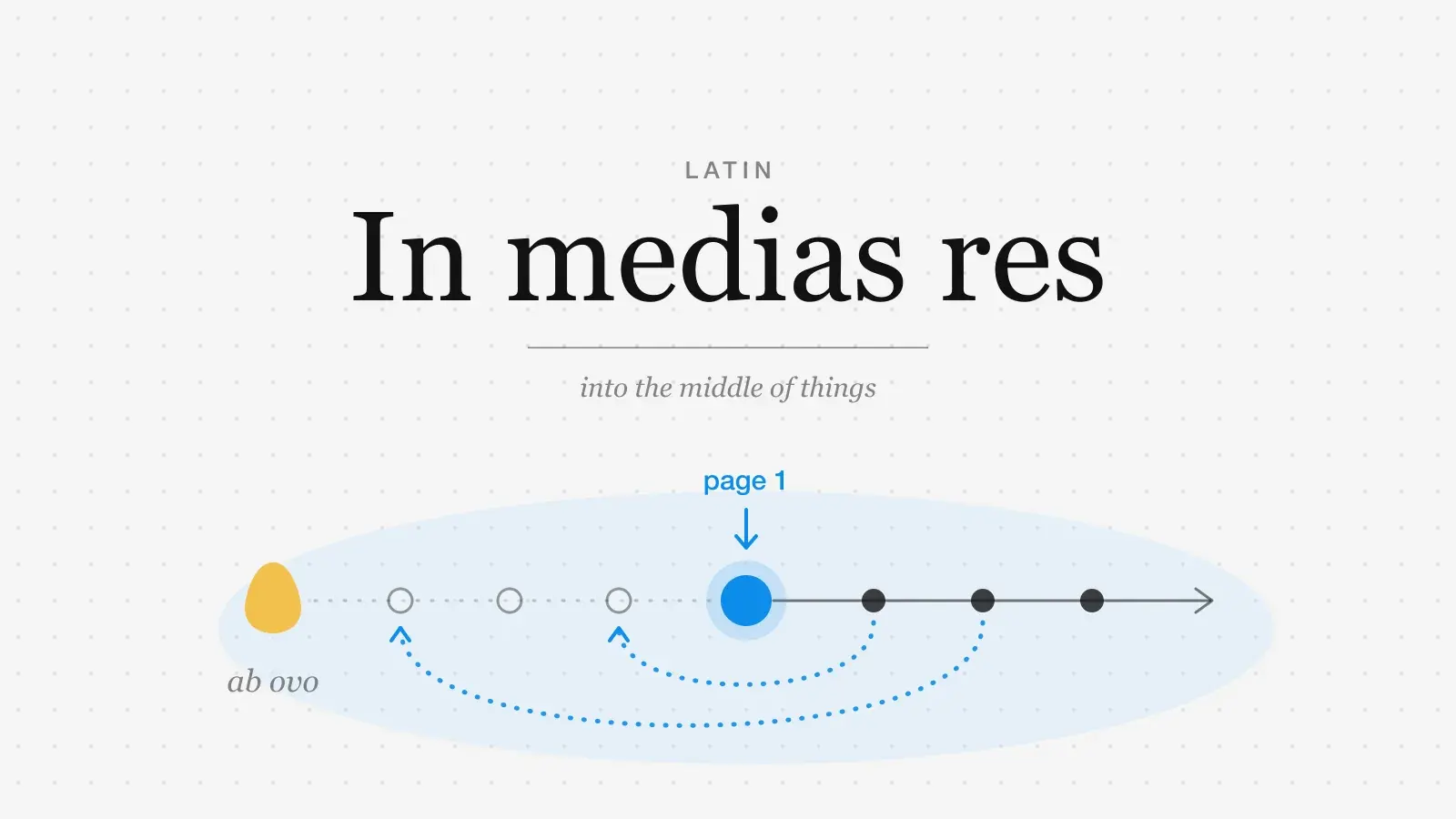
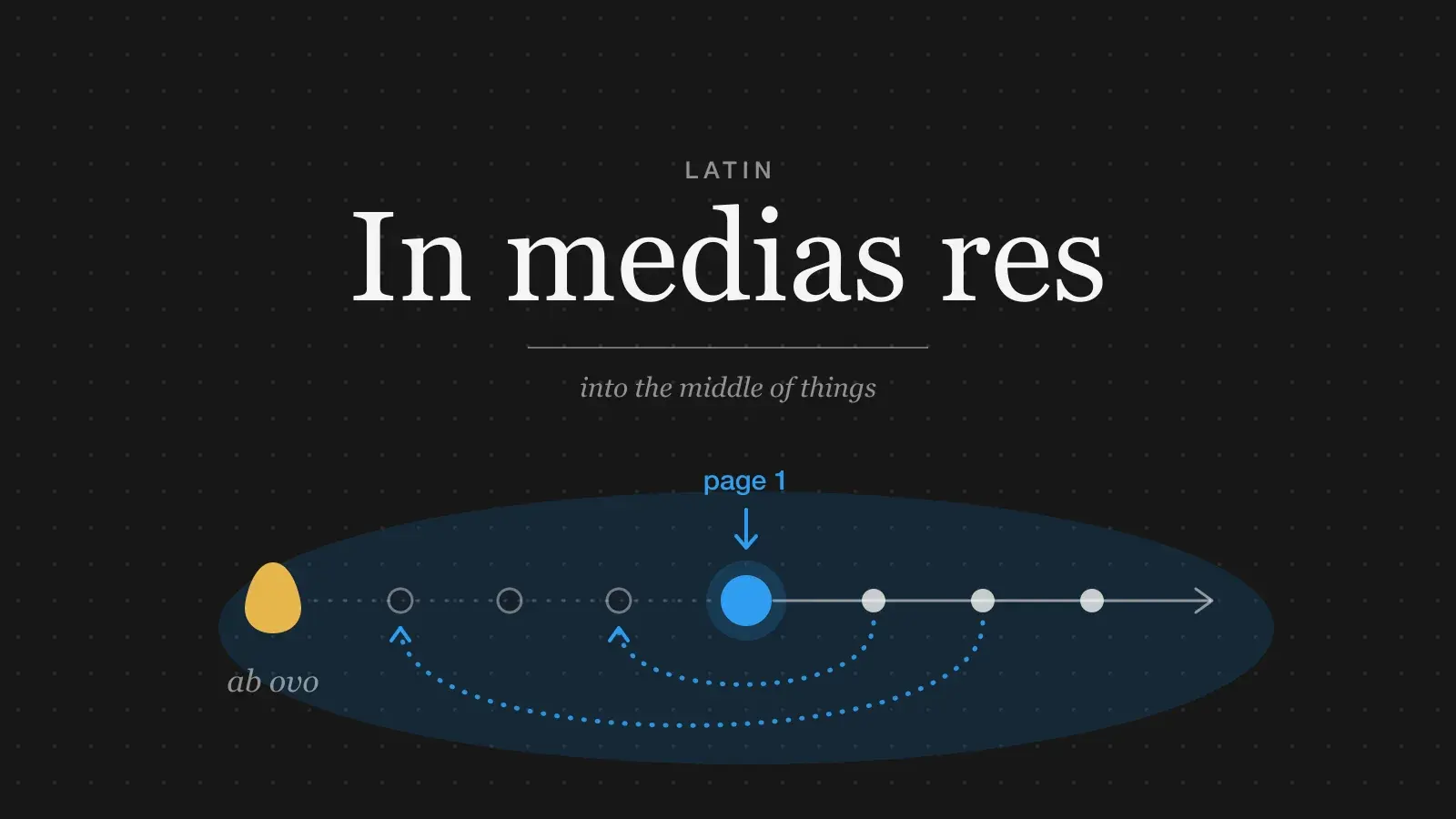
Try opening one scene later, then another, until the next cut would lose something the reader needs. Arrivals, packing and long drives usually happen before the story does. Opening after the trouble has begun is called in medias res.
- Choose whose eyes the reader borrows
The first viewpoint is a promise about whose story this is. Decide it before the opening line, because the voice of the first paragraph is hard to change later. The point of view guide compares the options.
- Give the character something to do
Not the big goal of the book: a small, immediate want. She is trying to catch a train, hide a letter, get through dinner without mentioning the divorce. The want gives the scene a direction, and whatever blocks it gives the scene tension.
- Be plain about what, quiet about why
Most readers will wait a long time to learn why something is happening, but not long to learn what is happening. Name the person and the place early, make the situation clear, and hold back the cause, the history or the secret.
- Rewrite the opening after the draft
Draft any opening that gets you writing. When the draft is done, find the line where the story wakes up, often a few paragraphs in. Cut everything above it, then move back only the facts the reader misses.
10 ways to start a story
Each opening below does most of the jobs in the table but leads with a different one. Pick the technique that matches the main pleasure of your story: a voice, a mystery, a danger, a relationship.
1. A character already in motion
Ruth Abernathy had eleven minutes to catch the 7:40 to Albany, and she spent four of them going back for the dog's ashes.
One sentence gives a name, a deadline and a choice that says more about Ruth than a paragraph of description would, and the reader wants to know why the ashes are going to Albany. Action openings work when the action shows character. A chase involving a stranger doesn't, because nobody cares yet who wins.
2. Dialogue
“Tom!”
No answer.
“TOM!”
No answer.
“What's gone with that boy, I wonder? You TOM!”
No answer.
Before Tom appears, the reader knows he is missing, probably on purpose, and that the woman calling him is running out of patience. The opening starts away from its hero and still raises his question: where is Tom, and what is he up to this time? Dialogue openings work when the line implies a relationship and a conflict. They misfire when two unnamed people trade small talk in a place the reader can't picture.
3. A narrator's voice
I am a rather elderly man.
…
While of other law-copyists I might write the complete life, of Bartleby nothing of that sort can be done.
Six plain words, then a long, careful sentence about his profession, and the narrator has told you more than he means to: he is cautious, a little pleased with himself and ready to explain at length. Then the turn: the one copyist worth a story is the one whose life he can't write. A voice opening works when the telling is one of the story's pleasures and the voice has a blind spot the story will expose. Without a situation close behind, it turns into a monologue.
4. A statement with trouble in it
Buck did not read the newspapers, or he would have known that trouble was brewing, not alone for himself, but for every tide-water dog, strong of muscle and with warm, long hair, from Puget Sound to San Diego.
The sentence is a joke (of course he doesn't read the papers: he's a dog) and a threat at once, a danger Buck can't know about. The next sentence names it: men have found a yellow metal in the Arctic and thousands are rushing north. A statement opening works when it leads straight into the story. A grand claim about life that the story then ignores is just a quotation.
5. In the middle of things
None of them knew the colour of the sky.
They can't look up because they are watching the waves. The shipwreck is over before the story starts (Crane's subtitle says these are four men from a sunk steamer), so every page goes to the one thing that matters: getting to shore alive. This works when the situation is clear even though its history isn't. Mystery about what is happening is confusion, not suspense.
6. A situation in plain sentences
A man stood upon a railroad bridge in northern Alabama, looking down into the swift water twenty feet below. The man's hands were behind his back, the wrists bound with a cord. A rope closely encircled his neck.
Bierce writes like a court reporter: no feelings, just position, distance and the cord, and the flat tone makes the rope land harder. Who the man is, and how he came to be there, wait for the second section. A plain opening works when the situation is already dramatic and only needs to be seen.
7. A setting that already holds a story
The reservoir above Calder had dropped nine feet since June, and every week it gave something back: a rowboat, the steeple of the drowned Methodist church, and on the last Tuesday in August a blue Buick with Ohio plates and the windows rolled up.
Weather and landscape make weak openings when they are scenery. This one is a list that ends on a question: who was in the Buick? Setting works as an opening when it is changing, threatening or about to matter, and when it points at the genre.
8. A mystery the reader can hold
The note in my mother's coat pocket said Don't let them dig up the garden, and it wasn't in her handwriting.
The mystery is specific: a note, a garden, a stranger's hand. A mystery opening works when the reader knows exactly what the question is. “Something terrible happened that summer” is only a promise. A wrong detail the reader can see is a hook.
9. A glimpse of the ending
Squire Trelawney, Dr. Livesey, and the rest of these gentlemen having asked me to write down the whole particulars about Treasure Island, from the beginning to the end, keeping nothing back but the bearings of the island, and that only because there is still treasure not yet lifted, I take up my pen in the year of grace 17—, and go back to the time when my father kept the Admiral Benbow inn and the brown old seaman with the sabre cut first took up his lodging under our roof.
Before the story starts, the reader knows Jim survived, the island was found and some treasure is still out there. The glimpse sets the question instead of killing it: how does a boy from his father's inn get there? A flash-forward does the same job in a scene, and a prologue at greater length. Give the outcome away only when the pleasure lies in how it happens.
10. An ordinary moment about to break
On Thursdays Mr. Feld closed the pharmacy at six, counted the till twice and walked his niece to the bus stop on Gratiot Avenue, and on the Thursday the stop was taped off, he did all three in the wrong order.
An ordinary-world opening shows the routine and the crack in the same breath. Readers will sit through a page of normal life if they can feel it straining. Without the crack, the routine is a warm-up.
Short stories vs novels
A short story has no room to warm up. Edgar Allan Poe put it most strictly in an 1842 review of Nathaniel Hawthorne's tales: a skilled writer first settles on “a certain unique or single effect to be wrought out” and builds every incident toward it. Then he goes further:
If his very initial sentence tend not to the outbringing of this effect, then he has failed in his first step.
Few writers plan that tightly today, but in a story of 4,000 words the first lines are already part of the climb. A novel can open on a smaller disturbance and take a chapter or more to reach the main trouble, as long as each page has tension of its own. In flash fiction, the first sentence often sets the situation, the voice and the tension at once.
| Short story | Novel | |
|---|---|---|
| Where to start | Short storyClose to the climax | NovelAt or just before the inciting incident |
| People on page one | Short storyOne or two | NovelWhoever the scene needs |
| Backstory | Short storyA line, or none | NovelPaid out over chapters |
Openings to cut
These turn up in first drafts again and again. Each can work in skilled hands, but each starts the reader at a disadvantage.
- Waking up. The alarm, the stretch, the coffee. The day has started, but the story hasn't.
- The weather report. Fog and sunsets that do nothing. Keep weather when it acts on someone, as the drought does above.
- The dream fake-out. A thrilling scene that turns out to be a dream or a film. Many readers feel tricked on page two and trust you less after it.
- The history lesson. Paragraphs on the kingdom or the family before a person appears: an info dump. Move each fact to the scene that first needs it.
- The crowd scene. Seven named characters on page one, and none of them sticks. Name the ones who matter today.
- The mirror. A narrator studies her reflection to tell you what she looks like. Let someone else notice her instead.
- The throat-clearing. “My name is Dana, and this is the story of the worst summer of my life.” Start the summer.
Before. Port Sorrel had been a fishing town for two hundred years before the cannery closed in 1994. Mara Quint's uncle opened Quint's Marine Supply on Water Street the year she was born, and when he died he left it to her, debts and all. She had moved there after her divorce and come to love the quiet winters. She had no idea that everything was about to change.
After. The man who wanted to buy Mara Quint's shop was waiting on the step at six, holding two coffees, and he knew how she took hers.
The revision drops the town's history, the uncle's will and the empty promise of “everything was about to change”, and starts at the change: a stranger who knows something he shouldn't. The cannery, the debts and the divorce can come back later, a line at a time.
Check your first page
One last test: cover the first paragraph and start reading at the second. If nothing is lost, that is where the story starts.
For a second opinion on that test, ask the Strokes Assistant where it thinks your story starts and which sentences on the first page explain history the scene doesn't use. Then cover everything above that line and read on yourself before you cut.
Frequently asked questions
Should you start a story with dialogue?
You can, if the line tells the reader something about the speaker and hints at a conflict. Little Women and The Adventures of Tom Sawyer both open with a character speaking. Dialogue openings go wrong when the speakers are unnamed, the talk is small talk, or the reader can't picture where they are, so ground the scene within a line or two.
How do you start a story in the middle of the action?
Pick a moment after the trouble has started, make the present situation clear and keep its history back. The reader should know who, where and what is happening, even if they don't yet know why. Fill in the past later, a piece at a time, when a scene makes the reader want it. The technique is called in medias res.
What should the first sentence of a story do?
It should make the reader want the second sentence. Most strong first lines raise a question, set a distinctive voice, or put a character in a situation with tension. A first sentence doesn't have to do everything, because the first paragraph and the first page share the work. Many writers settle it last, once they know what the story is.
Is it bad to start a story with a character waking up?
It's one of the most common first-draft openings and an easy reason for a reader to lose interest, because nothing has happened yet. It can work if the waking itself is strange: the wrong room, a stranger in the kitchen, a phone full of missed calls. Otherwise start later, at the first moment of the day that matters.