When to use it
- Planning a reported feature or profile before you write the first line
- Turning interview notes and documents into a news story in the right order
- Showing an editor the shape of an assigned piece before you draft it
- Building an explainer or an opinion piece around the reader's questions
- Reverse-outlining a draft, or an article you're studying, to see how it's built
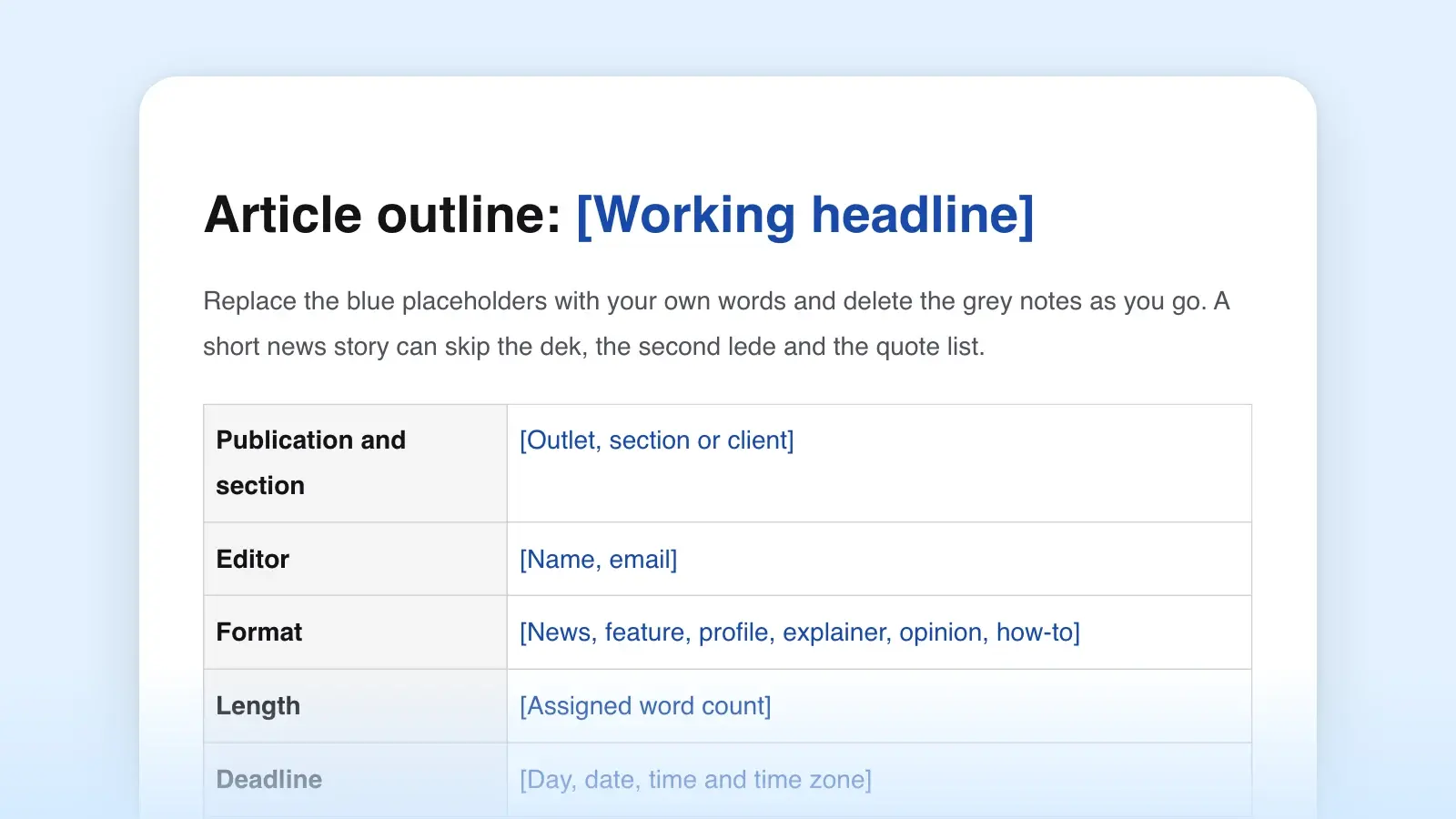
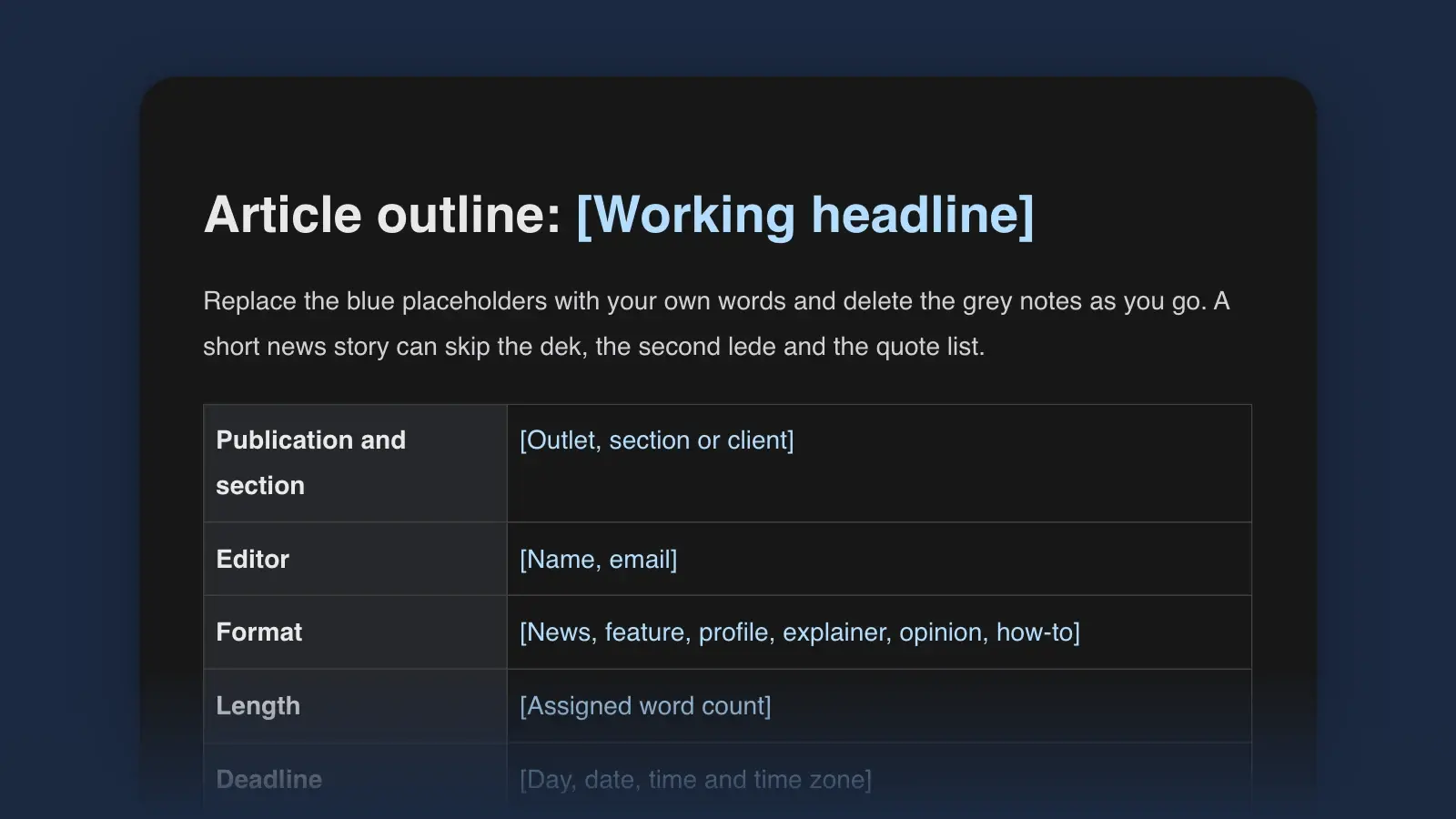
To outline an article, write the story in one sentence, choose a structure that fits it, then list the sections in the order the reader needs them, each with the fact, source or quote that carries it, from the lede and nut graf to the kicker. This template does that on one page for news stories, features, explainers and opinion pieces, with a source list and a fact-check list at the end. A filled-in outline for a 1,500-word feature comes first, then the instructions and four shorter outlines.
All of that is for an article you're writing. Outlining one you've read, for a class or a summary, runs the other way, from finished paragraphs back to the plan; it has its own section near the end.
Article outline example: a 1,500-word feature
This is a freelancer's outline for an assigned magazine feature, filled in after two weeks of reporting and before the first draft. It stands on one sentence: Port Calder's 312 school pianos have one tuner, he retires in June, and the board has just cut the job that would have replaced him. Every other part of the outline is there to prove that sentence or to show what it means.
At a glance. Calder Bay Monthly, City section. Editor: Nina Okonkwo. Profile feature, 1,500 words. Due Fri., Apr. 16, 2027. Status: reporting done, outline sent to the editor.
The story in one sentence. Port Calder's 312 school pianos have one tuner, Walt Ferris, 67, who retires in June, and the school board has just cut the job that would have replaced him.
Why now. The board voted on April 9 to drop a second technician's position from next year's budget.
Headline and dek. The last tuner. One man keeps 312 school pianos playing. In June he retires, and nobody is coming after him.
Structure. Scene, nut graf, body, kicker.
Lede A, scene. At 6:40 a.m., before the first bus, Ferris has the front off a 1962 upright in the Roosevelt Middle School auditorium and is playing the same A over and over, listening for the wobble.
Lede B, news. Port Calder's schools will start next year with 312 pianos and no one to tune them.
Nut graf. Ferris has been the district's only piano technician since 1994. When he retires on June 18, the job goes with him: the April 9 budget dropped the position. Music teachers say an untuned piano gets them through about a year. After that, choirs learn to sing around it.
Sections.
- On the route, 300 words: a morning with Ferris at three schools. Ride-along, Mar. 3.
- How a school piano ages, 250 words: heat, humidity, hard use. Ferris, plus an independent tuner to confirm.
- The cut, 250 words: the April 9 vote. Board minutes, budget page 41, the board chair (asked, no reply yet).
- What teachers do now, 300 words: two music teachers, one choir rehearsal.
- Who could replace him, 200 words: the college course that closed in 2019, and what a private tuner charges.
Quotes worth using. Ferris: “A piano doesn't break. It drifts.” Lena Ruiz, choir teacher: “We sing around the dead keys.”
Kicker, 100 words. Back at Roosevelt at 3 p.m., Ferris plays the A once more, listens, and closes the lid.
Sources. Walt Ferris, district piano technician: Mar. 3 and Mar. 17, on the record. Lena Ruiz, choir teacher at Eastside High: Mar. 22, on the record. Alan Pierce, board chair: emailed Apr. 9, reply requested by Apr. 12. Rosa Lindqvist, independent tuner: Apr. 1, on background.
Data and documents. 312 pianos: district asset list, checked Apr. 2. Position cut: budget page 41 and board minutes, checked Apr. 10. $160 a visit: Lindqvist's published rates, checked Apr. 1. Course closed in 2019: college catalog archive, still to check.
Open questions. How many of the 312 are beyond repair? Has any nearby district hired a tuner since 2020? Could the district contract the work out instead?
Why it works. The story sentence names a person, a number and a deadline, so every section can be tested against it. Take section 2, How a school piano ages. It earns its 250 words because the nut graf claims an untuned piano lasts about a year, and a reader has no reason to believe that until heat, humidity and hard use are explained and a second tuner confirms it. A section on the history of the district's music program had no such job, so it isn't in the outline. The word budgets add up to the assignment, and every fact already has a source and a date, which answers the editor's first question in advance. The open questions are honest: the answer to the first one could change the nut graf, and the outline says so before the draft does.
How to use this template
- Write the story in one sentence
Fill in The story in one sentence before anything else: who is doing what, and why it matters now. “School pianos” is a topic. “Port Calder's 312 school pianos have one tuner, and he retires in June” is a story. If you can't write the sentence yet, you probably need more reporting, not more outline. The same sentence becomes the first draft of your nut graf.
- Choose the structure
Pick one from the table below and write it on the Structure line. News usually goes in an inverted pyramid, most features open on a scene and widen to the nut graf, and explainers follow the reader's questions in order. The structure decides where your best material goes.
- List the sections as points, not topics
Each row in the Sections table is something the article says, with the evidence for it and where that evidence came from. “The budget” is a topic. “The board cut the second technician's job on April 9” is a point. A row with no evidence is a gap: report it or cut it.
- Name a source for every fact
Put every person you'll quote in Sources, with their role and whether they're on the record, and every number or document in Data and documents, with the date you checked it. Editors ask “Where's this from?” The outline should answer before they do.
- Draft two ledes and the kicker
Write two openings in different styles, such as a scene and a straight news lede, and choose after you've drafted the body. Write the kicker early too. Knowing the last line keeps the middle from wandering.
- Budget the words
Give each section a word count, and make the counts add up to the assigned length. A 1,500-word feature has room for about five sections. If you have nine, check whether some of them belong to another story.
Article outline format, section by section
| Part | What it does | Example |
|---|---|---|
| PartAt a glance | What it doesPublication, editor, format, length, deadline, status | Example“Calder Bay Monthly, City section, 1,500 words, due Fri., Apr. 16” |
| PartThe story in one sentence | What it doesSays what the piece is about and why now | Example“Port Calder's 312 school pianos have one tuner, and he retires in June” |
| PartHeadline and dek | What it doesA working headline and the line under it | Example“The last tuner” |
| PartStructure | What it doesThe order the article follows | Example“Scene, nut graf, body, kicker” |
| PartLede | What it doesTwo candidate openings | Example“At 6:40 a.m., before the first bus…” |
| PartNut graf | What it doesWhy the story matters, in one paragraph | Example“Ferris is the district's only piano technician…” |
| PartSections | What it doesPoints in order, each with evidence, source and a word budget | Example“The cut: April 9 vote, board minutes, 250 words” |
| PartQuotes worth using | What it doesLines only your sources could have said | Example“A piano doesn't break. It drifts.” |
| PartKicker | What it doesThe closing scene or line | Example“Back at Roosevelt, the last note of the day” |
| PartSources | What it doesWho, their role, when you talked, on the record or not | Example“Walt Ferris, tuner, Mar. 3 and 17, on the record” |
| PartData and documents | What it doesEvery number and document, with where it came from | Example“312 pianos: district asset list, checked Apr. 2” |
| PartOpen questions | What it doesWhat you still need to find out | Example“Has any nearby district hired a tuner since 2020?” |
| PartBefore you file | What it doesThe checks to run before the draft goes in | Example“Every name spelled the way the person spells it” |
The last four parts are what make this an outline for reported work rather than a list of headings. A blog post built around a search phrase needs different notes, and the blog post outline template has them. If an editor hasn't assigned the piece yet, the story sentence and the nut graf are also most of your pitch; see how to pitch an article.
Choose a structure
| Structure | Order | Best for |
|---|---|---|
| StructureInverted pyramid | OrderThe news first, then details in order of importance, background last | Best forBreaking news, announcements, short reports |
| StructureScene, nut graf, body, kicker | OrderA scene or anecdote, why it matters, sections that alternate scene and fact, a closing scene or line | Best forFeatures, profiles, trend stories |
| StructureChronological | OrderEvents in the order they happened, often after a short summary | Best forReconstructions, narrative features |
| StructureQuestion by question | OrderThe reader's questions, in the order they'd ask them | Best forExplainers, service pieces |
| StructureClaim, reasons, objection, action | OrderThe argument first, the evidence, the best objection, what should happen | Best forOp-eds, columns, reviews |
| StructureNumbered | OrderSteps or items, one section each | Best forHow-to and list articles |
A news feature often opens with a summary lede and then turns chronological, and a long profile can drop in medias res into a scene before the nut graf. The guide to feature story examples shows the second structure in full.
Article outline examples by type
Shorter outlines for four other kinds of article, each in the order you'd write it. The stories are invented. The news story and the explainer cover the same school-board vote, so you can see how the order changes when the job does.
News article outline
- Lede: the school board voted 5–2 on Tuesday to close two elementary schools in June
- Which schools, how many students, and where they go next fall
- The board president's reason, then a parent who spoke at the meeting
- The numbers behind it: enrollment, the budget gap, the savings the district claims
- What the two board members who voted no said
- What happens next: the transfer list, the next meeting
- Background: the earlier study that recommended closures
The order is by importance to the most readers: the decision, who it affects, why, who disagreed, what comes next. Background goes last, so the story still works if it's cut from the bottom. Every number in line 4 needs a row in Data and documents. The guide on how to write a news article covers the lede.
Explainer outline
- The answer in two sentences: which two schools close in June, and where their students go in the fall
- Is my child's school affected? The two schools, and the streets each one serves
- Why the board closed them: enrollment and the budget gap, in the district's own numbers
- What changes for families: bus routes, start times and after-school care
- Can the decision still change? Petitions, appeals and the next board meeting
- What happens to the two buildings
The facts overlap with the news story; the order doesn't. The news story ranks them by importance to everyone. The explainer follows the questions one family would ask, in the order they'd ask them, so the vote count and the dissent, which a parent rarely needs first, drop out or move down.
Profile outline
- Scene: the subject doing the thing they're known for
- Nut graf: who they are and why we're writing about them now
- How they got here, in two or three turning points, not a résumé
- Outside voices: a colleague, a rival, a customer
- The tension: what they're up against or unsure about
- A second scene, different from the first
- Kicker: a line of theirs that sums up the piece without saying so
Two scenes and three outside voices help keep a profile from reading like a press release about its subject.
Opinion article outline
- The claim, in the first two sentences, tied to this week's news
- Reason one, with evidence
- Reason two, with evidence
- The strongest objection, stated fairly, and your answer to it
- What should happen, and who should do it
- A last line that returns to the news
An opinion piece still needs the Sources table: every reason rests on a fact someone can check. For finished pieces in this shape, see these op-ed examples.
Outlining an article you're reading
When the article already exists, for a class, a summary or to learn how it's built, you work from the finished paragraphs back to the plan. You don't need the template for this, only two columns:
- Read the article once through without taking notes.
- Write one line per paragraph with two parts: what the paragraph says, and what it does, such as opening on a scene, giving evidence or answering an objection.
- Group the lines into the article's sections.
- Write the article's main point in one sentence at the top.
- Ferris tunes a 1962 upright at 6:40 a.m. Does: opens on a scene.
- He has tuned every school piano in the city since 1994. Does: widens to the subject.
- He retires June 18, and the board cut the job on April 9. Does: the nut graf, the news.
- Teachers say an untuned piano lasts about a year. Does: the stakes.
- His route: 28 schools, one van, one list. Does: returns to the scene, starts the body.
- How heat, humidity and hard use wear a piano down. Does: explains.
For a class, the “says” column is your summary and the “does” column is the analysis; with the main point on top, that is the outline most assignments ask for. The same two columns also check a draft of your own: three paragraphs in a row that do the same job often mean one too many, and a point that turns up in two places usually means the order needs work.
Tips for a stronger outline
- Outline from your notes, not your memory. Go through every transcript and document and pull the usable facts in before you put them in order. The material you forget is often the best you have.
- Write the nut graf before the lede. It's the paragraph most first drafts leave out, and the lede is easier to choose once you know what it leads to.
- Spend your best quote where it works hardest. Usually that's just after the nut graf or at the turn, rarely in the first line.
- Mark gaps in brackets. [Need number], [call back Pierce]. An outline with honest gaps is more useful to you and your editor than a smooth one.
- One point per section. If a row needs “and,” it's probably two rows.
- Put the deadline on the calendar. For several assignments at once, track them in the editorial calendar template.
“Use this template” opens the outline in Strokes as a document you can edit and export. Keep it in one project with your interview notes, attach the notes to a chat with the Strokes Assistant and ask it to review the outline: it tells you which points nothing in the notes supports.
Frequently asked questions
Should you outline before or after reporting?
Both, at different sizes. Before reporting, write the story sentence as a guess and list the questions it raises; that tells you whom to call and which documents to request. After reporting, build the full outline from your notes, because what you can prove often differs from what you expected. If the guess turns out wrong, rewrite the sentence before you outline.
How long should an article outline be?
One or two pages for most articles. A 500-word news story may need only six or seven lines, while a long feature can fill two pages once sources and data are listed. If the outline is approaching the length of the article, it has turned into a draft, so stop outlining and write.
What is the difference between an article outline and an essay outline?
An essay outline is built around a thesis and the argument that proves it, usually from your own reading. An article outline is built around a story: what happened or what matters now, stated in the nut graf, and the reporting behind it, meaning who said what, which documents show it and what still needs checking.