A feature story is journalism that explains a subject through people, scenes and detail instead of leading with the newest facts. A news story reports that the school district is short of bus drivers. A feature rides along with the driver covering two routes. Features are reported as carefully as news, but they are built differently: they open on a moment, say why it matters in a paragraph called the nut graf, and save something for the last line.
Below is one complete short feature with notes on each part, openings for eight common types, four ways to start the same story, a short list of famous features worth studying, and the steps to write your own. Every person, town and number in the examples is invented. The structure is the part to borrow.
How a feature story is built
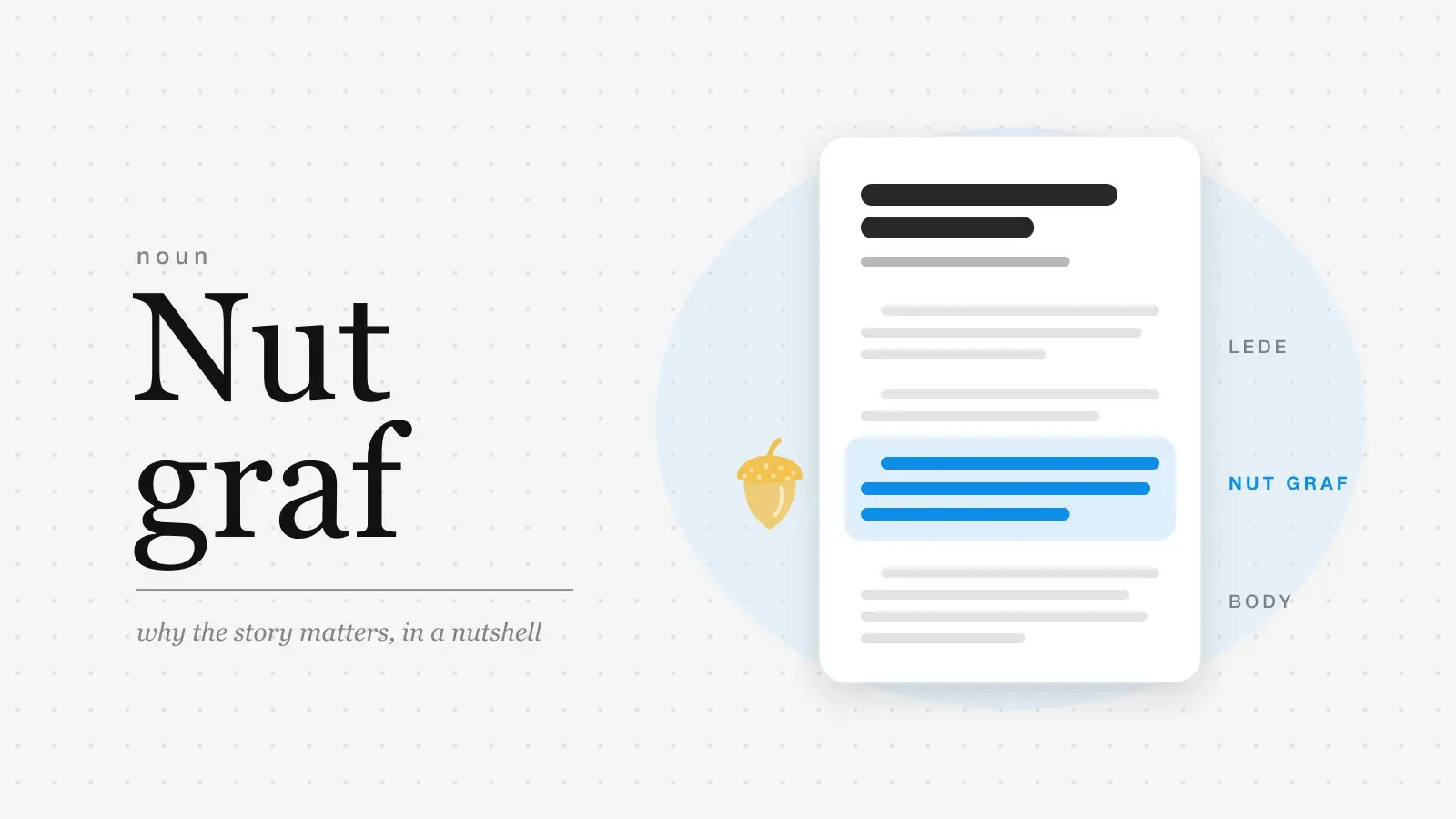
A news article uses the inverted pyramid: the most important fact first, everything else in descending order, so an editor can cut from the bottom. A feature can't be cut that way, because its ending matters. Most features, from a short newspaper piece to a magazine cover story, use four parts in this order. Journalism teachers often call it the Wall Street Journal formula, after the paper most associated with it.
| Part | What it does | Usual length |
|---|---|---|
| PartLede | What it doesOpens on a scene, a person, a detail or a puzzle | Usual lengthOne to three paragraphs |
| PartNut graf | What it doesSays what the story is about and why it matters now | Usual lengthOne paragraph, right after the lede |
| PartBody | What it doesAlternates scenes with facts, numbers, voices and the other side | Usual lengthMost of the story |
| PartKicker | What it doesEnds on an image, a quote or a return to the opening | Usual lengthA paragraph or two |
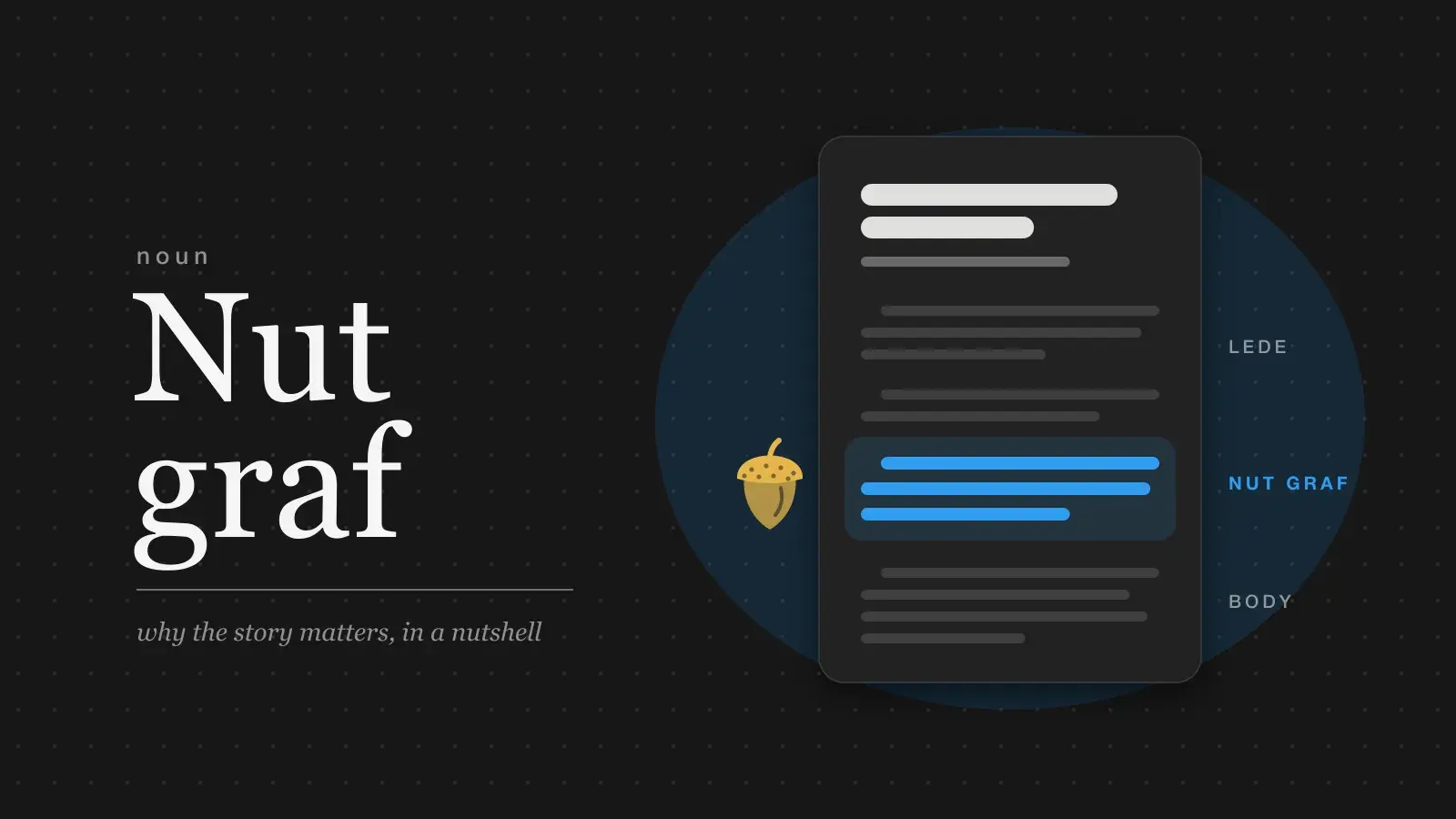
The nut graf is the part most first drafts leave out. It is the promise the story makes: this scene is one example of something larger, here is how large, and here is why you are reading about it this week. Without it, readers enjoy the opening and then drift, because they don't know what they signed up for.
A short feature, annotated
Here is a complete news feature of about 440 words, the size a local paper or regional news site might run on a weekend. Read it once for the story, then use the notes below it to see the parts.
One driver, two routes: inside Harlan County's bus shortage
At 5:40 on a Tuesday morning, Linda Marsh walks the length of Bus 14 with a flashlight, kicking each tire with the toe of her boot. She has done this check every school day for nineteen years. Since September she has done it twice each morning, once for Bus 14 and once for Bus 22, because there is no one else to drive Bus 22.
Her first route, elementary students along Route 9, ends at Cedar Elementary at 7:52. Then she swings north, picks up the high schoolers on Quarry Road and Mill Street, and pulls up at Harlan High at 8:31, sixteen minutes after first bell.
Marsh is one of 31 drivers covering 38 routes for Harlan County Schools this fall, the widest gap the district has recorded, according to transportation director Ray Okafor. Seven routes now run as doubles, so about 400 students reach school late every day. Next month the school board votes on a plan to raise driver pay by $3 an hour, and parents on the north side want to know why it took this long.
The shortage didn't arrive all at once. Okafor keeps a list of every driver who has left since 2021. Most retired. Six took jobs at the distribution warehouse off Exit 41, which pays more and doesn't split the day in half. "A bus job is two short shifts with five hours of nothing in between," Okafor said. "That works if you're retired. It doesn't work if you're thirty and paying rent."
New drivers take months to train. Each needs a commercial driver's license with a school bus endorsement, and Okafor's last class of five recruits started in August. Two have finished. One quit after a week of practice runs on the hill roads above Pike Creek.
On the north side, the late mornings add up. Tasha Greene's son, a sophomore, has missed eleven first-period chemistry labs since September. "He's not skipping," she said. "He's sitting on a bus." On days she works the late shift, Greene drives him herself, and she now runs a carpool for six families on her street.
Board member Paul Dietz supports the raise but says the district can pay for it only by cutting two field-trip buses and putting off new buses for a year. "Everyone agrees on the problem," he said. "Nobody agrees on what we stop paying for."
Marsh plans to retire in June. She hasn't told Okafor yet. At 2:40 she'll be back in the lot with her flashlight, starting on Bus 14's tires, then Bus 22's.
- Lede (paragraphs 1 and 2). A person doing something ordinary, with one detail, the second tire check, that hints at the problem. No numbers yet.
- Nut graf (paragraph 3). The size of the problem (31 drivers, 38 routes), what it costs readers (400 late students) and the news peg (next month's vote). A reader who stops here knows the story.
- Body (paragraphs 4 to 7). Each paragraph answers the next question a reader would ask: why, why not hire more, who is hurt, what would fixing it cost. The board member is the other side.
- Kicker (last paragraph). It returns to the opening image and adds one fact the reader didn't have. The flashlight means more the second time.
Feature story examples by type
Editors and journalism textbooks sort features in slightly different ways, and plenty of stories mix two types: a news feature often holds a short profile. Most features fall into one of these eight.
| Type | Built around | Example on this page |
|---|---|---|
| TypeProfile | Built aroundOne person's character | Example on this pageA piano tuner's last August |
| TypeHuman interest | Built aroundAn unusual habit or moment | Example on this pageA mail carrier's birthday letters |
| TypeNews feature | Built aroundA news event, through the people in it | Example on this pageThe bus shortage above |
| TypeTrend | Built aroundSomething spreading, and why now | Example on this pageLibraries lending cake pans |
| TypeExplanatory | Built aroundA question readers already have | Example on this pageWhy the river turns green |
| TypeBehind the scenes | Built aroundWork readers never see | Example on this pageA hospital kitchen at 2 a.m. |
| TypePlace | Built aroundA setting as the main character | Example on this pageA cafe that is the town's grocery |
| TypeFirst person | Built aroundThe writer trying something | Example on this pageThree nights on a snowplow |
Each example below is the opening of a story, the lede and nut graf, because that is where the type shows.
Profile
Maribel Ortiz hears the problem before she lifts the lid. "Middle C is sulking," she says, two notes into the upright in the Eastfield Middle School band room, and reaches into a canvas bag for a tuning lever worn smooth where her thumb goes. She is 71. She has tuned every piano in the district, all 46 of them, every August for 34 years, and she keeps their histories in a spiral notebook: which ones the custodians move too often, which one a seventh grader once filled with gummy bears. This is her last August. The district has hired a company from the city to take over next year, and Ortiz has spent the summer deciding what to do with the notebook.
Why it works. A profile is about character, not a résumé. The first line shows how Ortiz works before it says who she is, the notebook gives the story an object to return to, and the last two sentences are the reason to write about her now.
Human interest
On the first of every month, Walt Brennan, 79, opens a ledger of birthdays he started in 1994, when he still delivered mail on Route 6 in Pell Harbor. Then he sits at his kitchen table and writes, by hand, to every child from his old route who turns 18 that month. Most haven't seen him since they were in diapers. He has written 312 letters. Fewer than half of the recipients have written back, and he keeps the replies in a shoebox that is now three shoeboxes. In a town where the post office opens three days a week, Brennan's letters have become the closest thing Pell Harbor has to a town record.
Why it works. A human-interest story doesn't need a news peg. It needs one unusual habit and the numbers that make it real. The last sentence is a light nut graf: it says what the habit means beyond one kitchen table.
Trend story
The most borrowed item at the Westbrook Public Library last month wasn't a book. It was a cake pan shaped like a dinosaur, checked out eleven times in March and reserved through May. Westbrook now lends 140 cake pans, along with sewing machines, a karaoke set and a soil tester, and it isn't alone. Three other libraries in Dale County have started lending collections of things in the past two years, and in June the county library board will ask for money to share them between branches.
Why it works. A trend story has to prove something is spreading: several examples, a rough start date and a number that is moving. The old newsroom joke is that three examples make a trend. Editors will want more than that, plus a source who can say why it is happening now.
Explanatory feature
Every year around the second week of August, the Kessel River turns the color of pea soup below the Route 3 bridge, and every year the county gets the same calls. Is it sewage? Is it safe for dogs? It is algae, fed by warm, slow water and fertilizer washed off fields upstream, and this summer the state added the Kessel to the list of waters it tests weekly for algal toxins. Here is what turns the river green, what the tests look for, and how to tell when the water is safe again.
Why it works. An explainer opens on a question readers already have, answers it in a sentence, and then says what the rest of the piece covers. That last sentence is the nut graf, written as a promise.
Behind the scenes
At 2 a.m., the brightest room in Mercy Valley Hospital is in the basement, where eleven cooks are making breakfast for people they will never meet. By 6:30, 640 trays will go up on carts, each matched to one of 23 diets: low sodium, diabetic, pureed, kosher, clear liquids. Head cook Darnell Price checks every tenth tray himself. "Somebody on clear liquids who gets pancakes is going to eat the pancakes," he said. Patients rate the food every quarter, and Mercy Valley's scores have risen two years running, which the kitchen will tell you is not an accident.
Why it works. Behind-the-scenes features answer a question readers never thought to ask: who does this, and how? Exact times and counts carry the piece, and the rising scores give the reader a reason to care about this kitchen in particular.
Place
The Prairie Star Cafe opens at 4:30 a.m. because that's when the grain trucks start rolling, and by five its counter holds most of Coldwater's economy: two truckers, a seed salesman, a vet in muddy boots and the mayor, who also owns the hardware store. Coldwater has 640 residents and hasn't had a grocery store since 2019. The cafe sells milk, bread and eggs from a cooler by the register, and for some people in town it is the only place to buy them without an hour's drive.
Why it works. A place piece treats the setting as the main character. Instead of describing scenery, it shows who gathers there and what the place does for them, and the nut graf says what the town would lose without it.
First person
The blade on Truck 7 is eleven feet wide, and on my first pass down Ridge Road I take out a mailbox with it. Earl Jansen, who has plowed this route for 22 winters, doesn't look up from his coffee. "Everybody gets one," he says. "Most people get it the second night." I spent three overnight shifts with the Brook County road crew in January to find out why a county with 14 trucks and 410 miles of road can't clear every street by morning. The short answer is arithmetic. The long answer involves salt prices, a mechanic shortage and Earl.
Why it works. In a first-person feature the writer is the reader's stand-in, not the subject. The mailbox earns the "I," and the nut graf turns a stunt into a question every reader in the county has asked.
Four ways to open the same story
The scene lede in the bus story is the reporting version of starting in medias res: drop the reader into a moment and explain later. It is the most common feature opening, not the only one. Here is the same story opened four other ways, each built from material already in the reporter's notebook.
Anecdote. Tasha Greene learned about the bus shortage from her son's chemistry teacher, who called in October to ask why he had missed eleven labs.
Contrast. The warehouse off Exit 41 pays its drivers more than Harlan County Schools does, and it doesn't ask them to sit idle from 9 a.m. to 2 p.m. Six of the district's bus drivers have made the switch.
Puzzle. Every school morning in Harlan County, about 400 students arrive late, and none of them can be marked tardy.
Portrait. Linda Marsh has driven a Harlan County school bus long enough to carry the children of children she once carried. This fall she drives two.
Pick the one that leads most directly into your nut graf. The puzzle works for a reader skimming a news site; the portrait suits a Sunday magazine. Three openings almost never work: a quote from an official ("Kids need to get to school," said Okafor), a dictionary definition, and a question to the reader ("Have you ever wondered how your child gets to school?").
Endings, called kickers, have fewer patterns. The four that work most often are a return to the opening, as in the bus story; a last quote that sums up without summarizing; a look ahead to the vote, the season or the retirement; and one final image the reader keeps. Avoid the ending that restates the nut graf or tells readers how to feel.
Famous feature stories to study
Original examples show the parts. Published features show what the form can do at full length. These five are worth finding. Read each twice: once as a reader, then with a pencil, marking where the nut graf falls and what each section is for.
| Story | Writer and outlet | What to study |
|---|---|---|
| StoryHiroshima | Writer and outletJohn Hersey, The New Yorker, 1946 | What to studySix survivors followed from the moment the bomb fell. About 31,000 words; the magazine gave it the whole issue. |
| StoryFrank Sinatra Has a Cold | Writer and outletGay Talese, Esquire, 1966 | What to studyA profile written without an interview: Sinatra declined, so Talese watched him for months and talked to the people around him. |
| StoryAn account of a brain operation | Writer and outletJon Franklin, The Baltimore Sun | What to studyWon the first Pulitzer Prize for Feature Writing, in 1979. One surgery told as a narrative. |
| StoryPearls Before Breakfast | Writer and outletGene Weingarten, The Washington Post, 2007 | What to studyA staged experiment as the reason for the story: a star violinist plays unrecognized in a subway station. |
| StoryFatal Distraction | Writer and outletGene Weingarten, The Washington Post, 2009 | What to studyA painful subject handled through several families. Weingarten won the feature Pulitzer for this and the story above. |
How to write a feature story
- Find the person inside the topic
Topics aren't stories. "The bus shortage" is a topic; a driver covering two routes is a story. Look for someone with something at stake, a change underway and a reason it matters now. If you are freelancing, that reason is also the heart of your pitch to an editor.
- Report for scenes, not just quotes
Spend time where things happen and write down times, objects, sounds and exact words. Talk to the main subject, the people around them, someone with the numbers and someone who disagrees. Keep each conversation in interview notes so every quote is easy to check later.
- Write the nut graf before the lede
In one paragraph, say what the story is about, how big it is and why now. If you can't, report more. That paragraph becomes your filter: anything that doesn't serve it comes out.
- Choose the lede from your notes
Look for the moment that shows the nut graf without explaining it: an action, an object, something said in passing. Draft three openings and keep the one that leads most directly into the nut graf.
- Build the body in sections
Order sections by the questions a reader would ask next, and alternate scene with context so a few paragraphs never pass without a person in them. Let what people do show what you could otherwise only claim.
- End, cut and check
Write the kicker, then cut second examples, transitions that clear their throat and quotes that repeat the paragraph before them. Check every name, number and quote against your notes and your publication's style guide, then write a headline that promises what the story delivers.
Drafting a feature in Strokes
A feature produces far more material than story: interview notes, a timeline, three versions of the lede. Strokes, a desktop editor, keeps them as documents in one project folder on your own machine. You can add your notes to an AI Assistant chat and ask whether the nut graf arrives early enough, or select a slow paragraph, press ⌘K and ask for a tighter version. Use it as an editor reading over your shoulder, not a reporter: every fact and quote has to come from your notebook. Version history keeps the long draft when you cut, and the finished piece exports to Word or PDF for your editor.
Frequently asked questions
What is the difference between a feature story and a news story?
A news story leads with the newest, most important facts and arranges the rest in descending order, so it can be trimmed from the bottom. A feature opens on a scene or a person, explains why it matters in a nut graf, and is built to be read to the end. Both have to be accurate and fairly reported.
How long is a feature story?
As long as the editor assigns. Newspaper and website features usually run shorter than magazine features, and pieces past about 2,000 words are generally called long-form. John Hersey's Hiroshima ran about 31,000 words. If you are pitching, read a few of the outlet's recent features and propose a length that matches them.
Can a feature story be written in the first person?
Yes, when the writer's experience is the way into the story, as when a reporter tries a job or rides along for a shift. Most features are written in the third person. Use "I" only when your presence shows the reader something they couldn't learn another way.
What are the main types of feature stories?
Profiles, human-interest stories, news features, trend stories, explanatory features, behind-the-scenes pieces, place pieces and first-person features. Many stories combine two, such as a news feature built around a short profile.