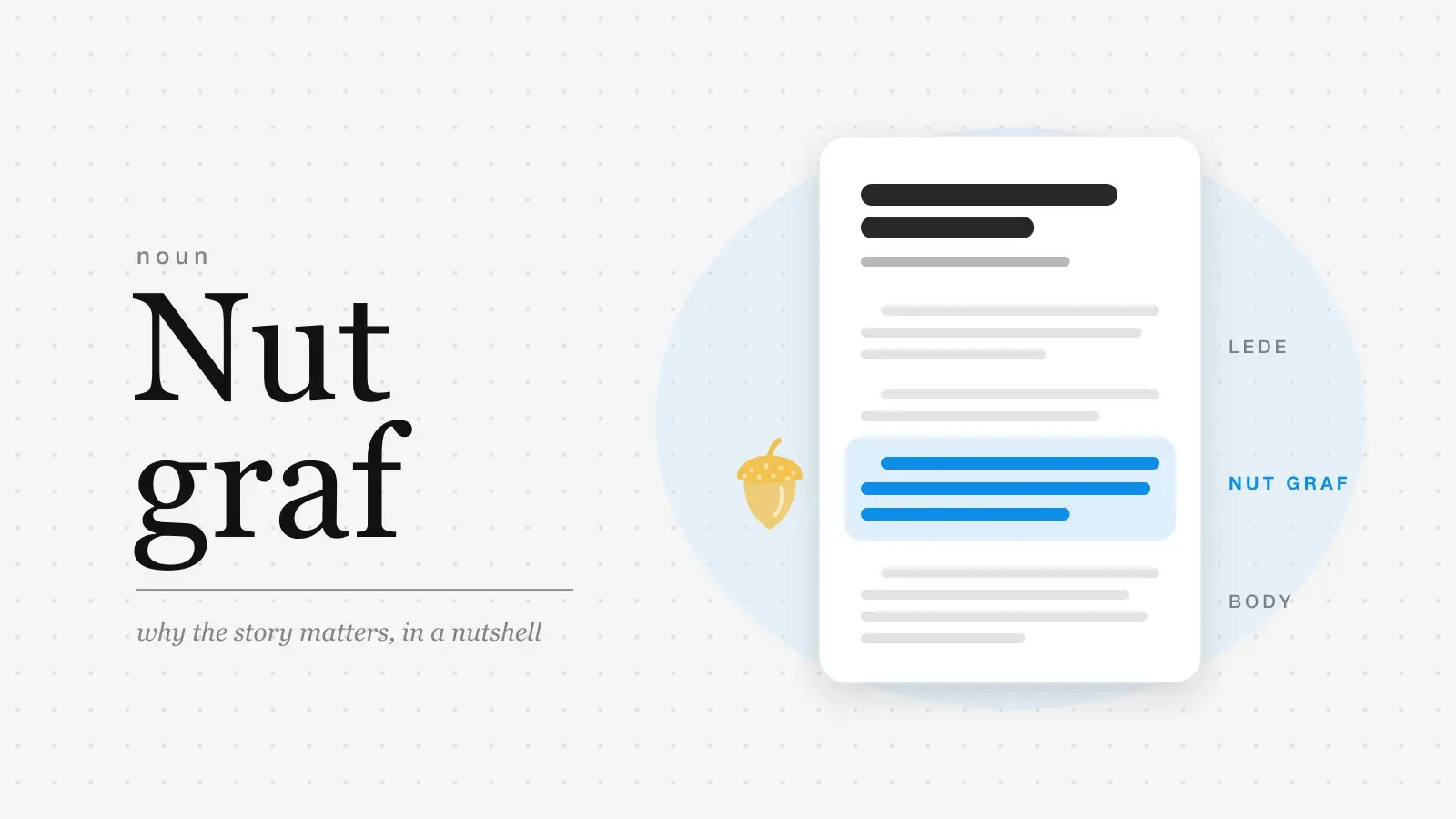
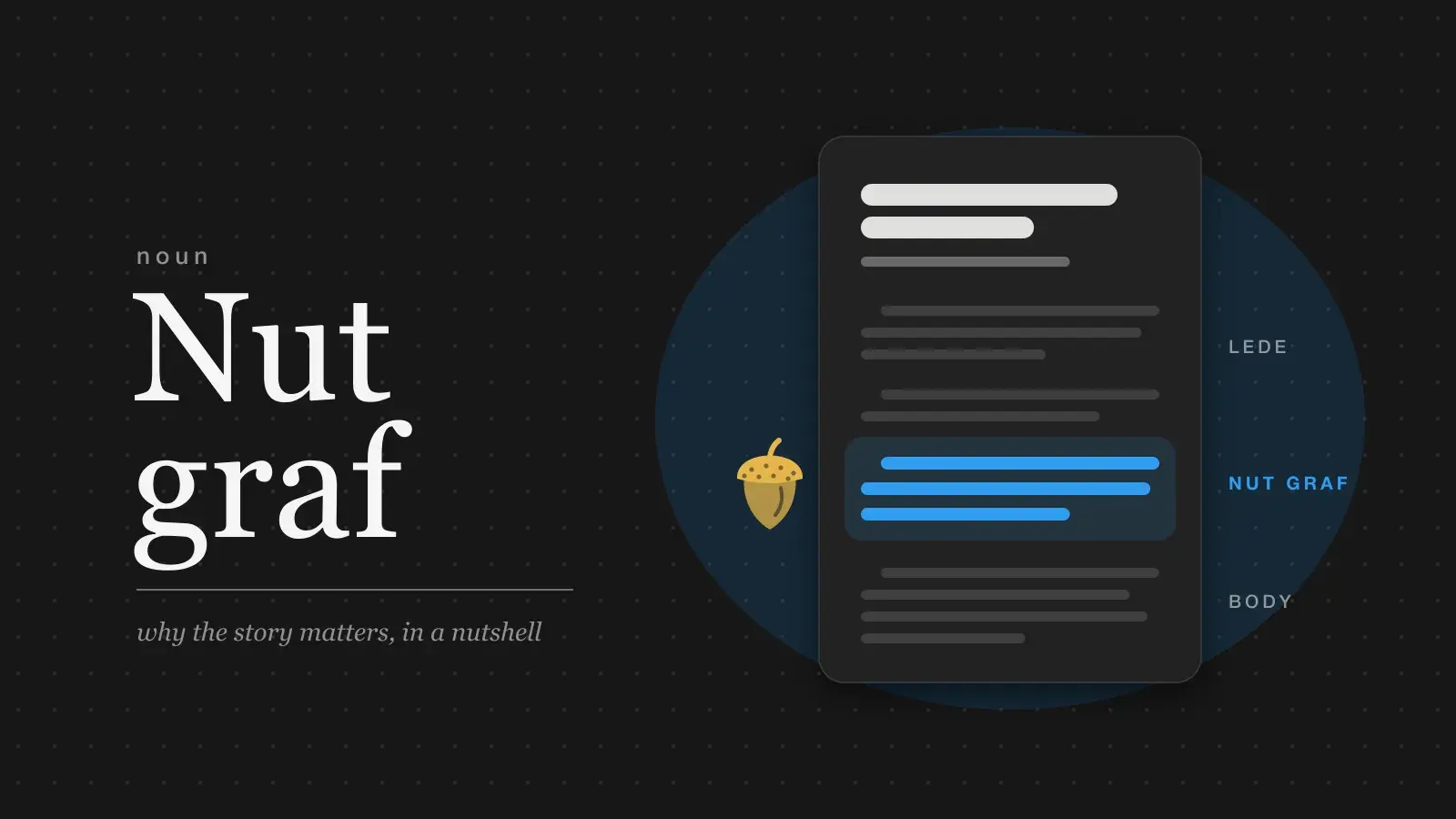
A nut graf is the paragraph in a news or feature story that tells readers what the story is about and why it matters now. It usually comes second, third or fourth, right after a lede that opens on a scene, a person or a puzzle.
The name is short for "nutshell paragraph," and newsroom jargon spells paragraph "graf" the way it spells lead "lede." You will also see it spelled nut graph. The form is most closely tied to The Wall Street Journal. Chip Scanlan, writing for the Poynter Institute, links it to a rule set by Barney Kilgore, who became the paper's managing editor in 1941: no "yesterday" or "today" in leads. Scanlan sees that rule as the opening for a new kind of front-page story, one built to explain the news rather than repeat it.
What a nut graf answers
The lede earns attention. The nut graf tells readers what they have signed up for, usually by answering some of these:
| Question | What the nut graf supplies |
|---|---|
| QuestionSo what? | What the nut graf suppliesThe claim: the scene in the lede is one example of something larger |
| QuestionWhy now? | What the nut graf suppliesThe news peg: a vote, a report, a closing, a season |
| QuestionHow big? | What the nut graf suppliesOne number or comparison that sizes it |
| QuestionWho's affected? | What the nut graf suppliesThe people with something at stake, ideally including the reader |
| QuestionWhat's ahead? | What the nut graf suppliesA hint of what the story will show, without the ending |
It is usually one paragraph. In a news story, Scanlan writes, it should not run past two or three, or the story bogs down before it starts.
Nut graf examples
Lede. At 7:40 on a Tuesday morning, twenty minutes before the doors open, eleven people are waiting under the awning of the Millbrook Public Library. Most have laptops. One man has a printed list of job openings and a highlighter.
Inside, Ruth Okafor, the branch's only full-time librarian, is clearing a jam in the copier. "They'll want the printer first," she says. "Then the quiet room."
Nut graf. The line outside has a reason, and it isn't books. Since the county closed its last two job centers in March, the library has become the only place within 30 miles where people without home internet can file unemployment claims, print résumés or sit for the video interviews many employers now require. Visits are up by a third this year. The library's budget, flat since 2019, goes before the county board on May 9.
The first sentence turns from the scene. The rest gives cause, scale and stakes, then stops short of how the vote will go. That is what the other 1,200 words are for.
Fritz's dispatch from Rwanda opens in Karubamba, a village where no one was left alive, and stays among the dead for several paragraphs. Then, writing on deadline, he pulls back to how it happened: the plane crash that killed Rwanda's president, and the killing of Tutsis and moderate Hutus by Hutu extremists that followed. Fritz won the 1995 Pulitzer Prize for International Reporting for his coverage of Rwanda.
And hard by Temple Bar, in Lincoln's Inn Hall, at the very heart of the fog, sits the Lord High Chancellor in his High Court of Chancery.
Dickens opens on London mud and fog. The Lord Chancellor gets one clause in the first paragraph, then disappears for two more paragraphs of weather. In the fourth, Dickens seats him at the heart of it, and the weather starts to read as a verdict on his court. Novelists don't call it a nut graf, but the move is the same: a scene, then the paragraph that says what the scene stands for.
The move works outside the newsroom too. In a pitch to an editor, a short scene comes first and the nut graf second, followed by the length you propose and why you are the one to write it. For the rest of the pitch, see How to pitch an article to an editor.
How to write a nut graf
- Write it before the lede. Put the story's point in one or two sentences while your notes are open. If you can't, the reporting isn't finished, and no opening scene will hide that.
- Turn from the scene. Let the first words point back at the lede ("The line outside has a reason") so the reader sees the scene as evidence, not decoration.
- Give a reason it's news now. A vote, a closing, a new report. Without one, the story could run any month, and an editor will treat it that way.
- Size it with one fact. One number or comparison shows the scene isn't a one-off. Dates and the news peg can sit beside it, but if every sentence carries a statistic, the paragraph has turned into a table.
- Stop before the ending. James B. Stewart, a former front-page editor at the Journal, warns in Follow the Story against a nut graf that gives away so much the reader has no reason to go on. Promise the answer. Don't give it.
Whatever the nut graf claims, the body has to prove, so Scanlan's advice is to follow it with the evidence. Weak ones tend to fail in two ways. Some arrive after six paragraphs of scene, when the readers who wanted to know why have left. More often they are vague.
Before: Stories like Dale's are becoming more common, and they raise important questions about the future of farming in America.
After: Dale is one of 41 dairy farmers in the county who have sold their herds since 2020, more than half of those milking when the decade began. The county's last milk plant closes in June. After that, the farmers who remain will have to truck their milk 140 miles or quit.
The second version answers how big, why now and what's at stake, and still leaves the story to tell: who stays, who sells, what Dale does next.
In Strokes you can open the AI Assistant beside the draft, add your notes document to the chat as context, and ask for a version of the soft nut graf that uses one number from those notes and says why the story matters this month. Check every figure anyway. A model will supply a plausible number if your notes don't have one, and that is a hallucination with your byline on it.
Nut graf vs. lede, thesis and kicker
| Part | Its job | Where it sits |
|---|---|---|
| PartLede | Its jobGets the reader to start: the news itself in hard news, often a scene in a feature | Where it sitsThe first paragraph in hard news, often the first few in a feature |
| PartNut graf | Its jobSays what the story is about and why it matters now | Where it sitsRight after the lede |
| PartThesis statement | Its jobStates the argument an essay will defend | Where it sitsUsually the end of an essay's introduction |
| PartAbstract | Its jobSummarizes a paper's question, method and findings | Where it sitsAt the top of a research paper, before the introduction |
| PartKicker | Its jobEnds the story, often on a quote or image that echoes the lede | Where it sitsThe last paragraph |
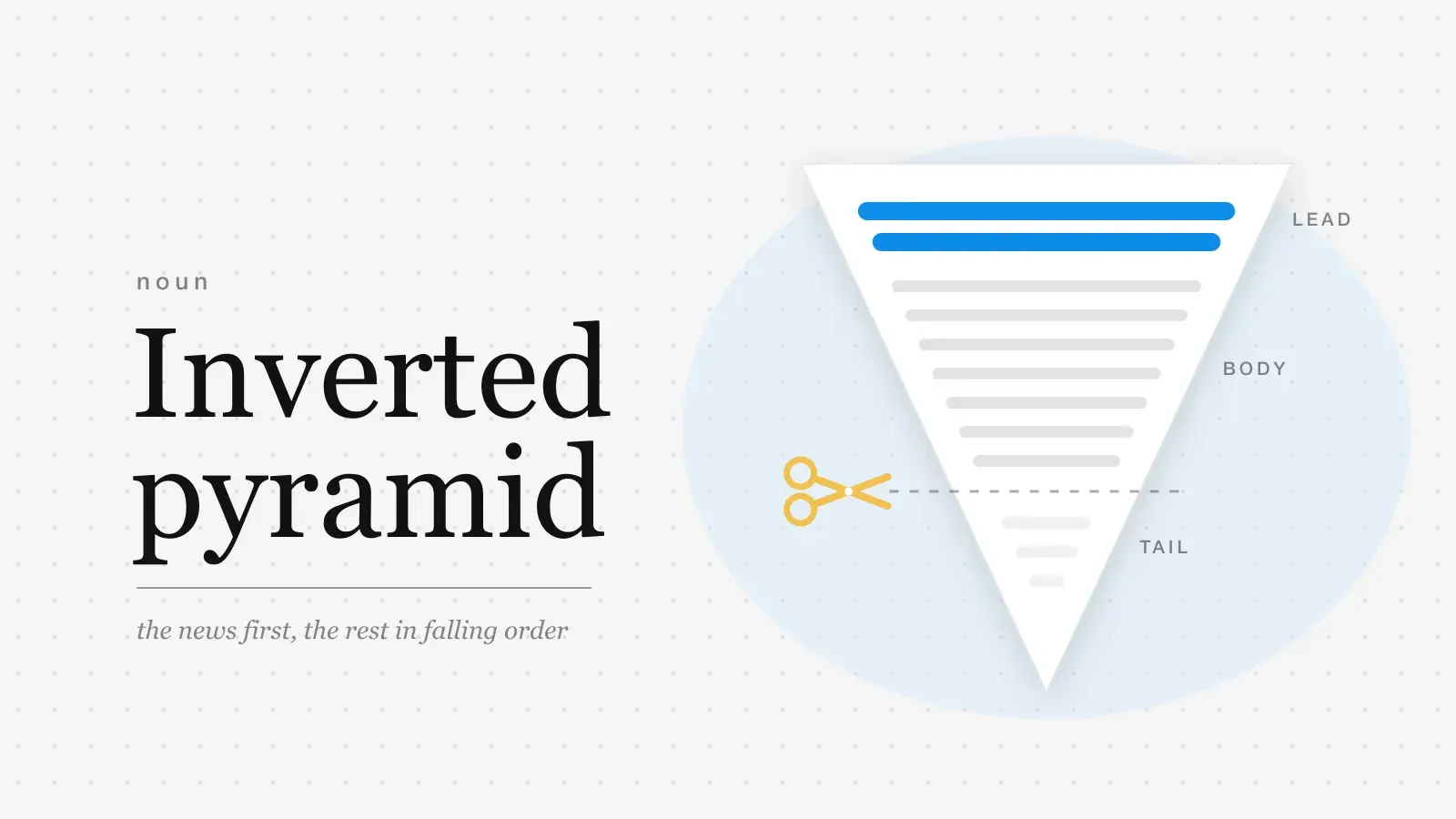
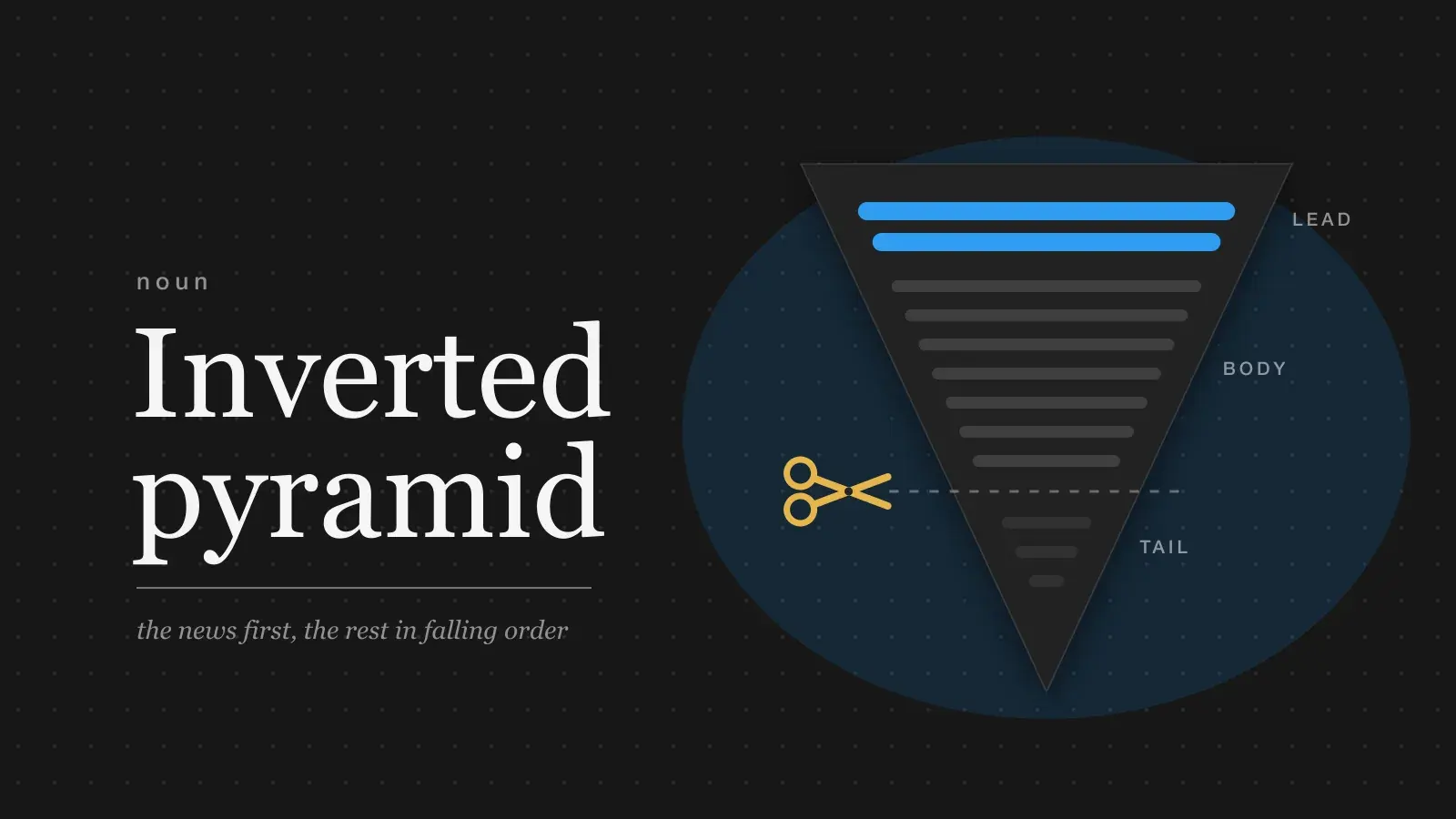
An inverted pyramid story states the news in its first sentence, so it needs less of a nut graf, though the second or third paragraph often still says why the news matters. Axios marks it with a bold "Why it matters" lead-in. The thesis statement is the nut graf's classroom cousin. Both make a claim early and promise evidence, but a thesis argues and a nut graf reports.
Related terms: in medias res, the fiction writer's scene-first opening; logline, the one-sentence summary that tests whether a premise is clear; and IMRaD, the research-paper structure. The abstract that sits on top of it does the nut graf's job. For the whole form, from lede to kicker, read Feature story examples and how to write one.