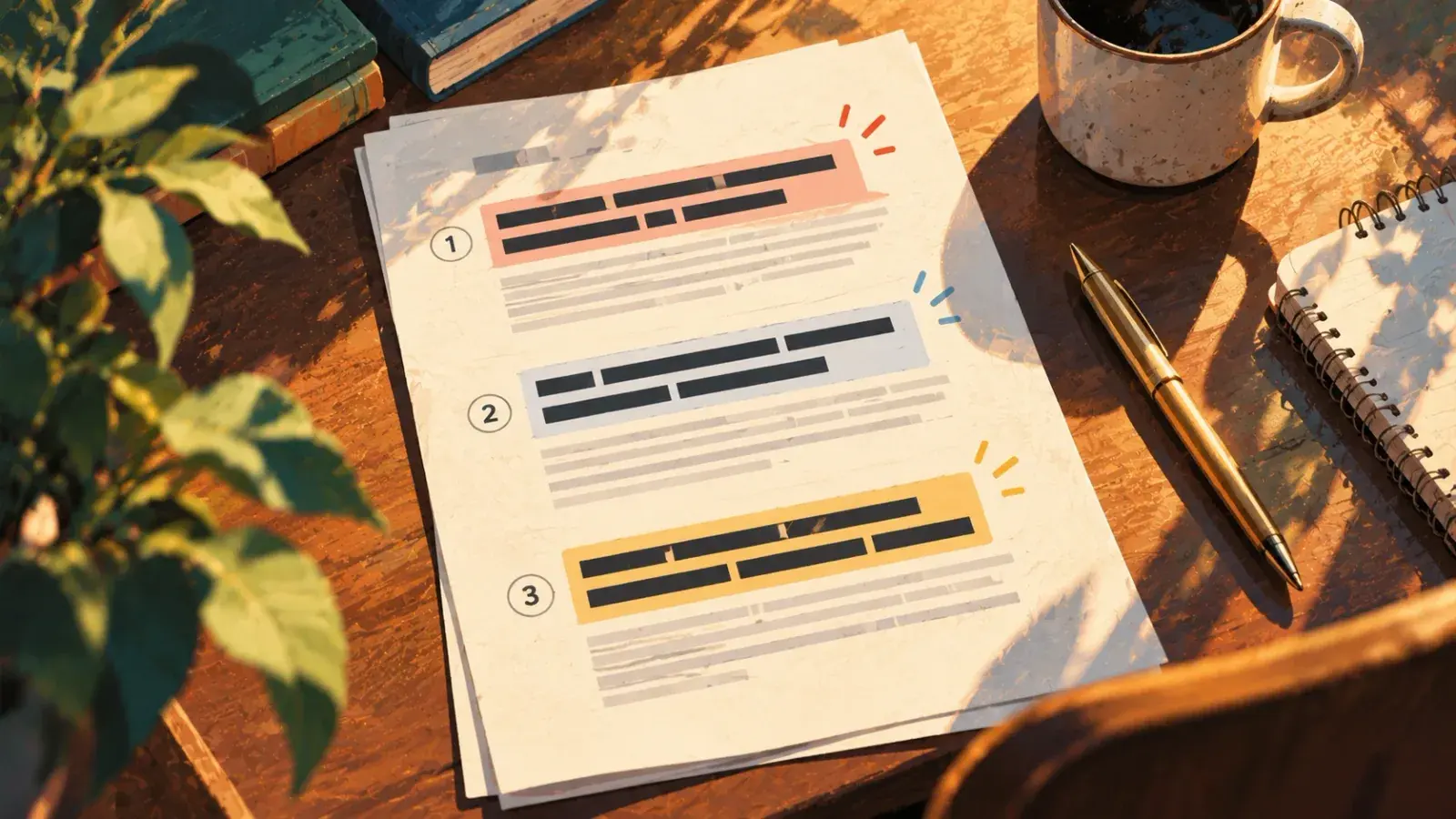
To write a news article, find the one thing that changed and who it affects, and put it in a single opening sentence, the lede, of about 25 to 30 words. Follow it with the details readers will ask for next, in order of importance: a quote from someone with direct knowledge by the third or fourth paragraph, the other side, and what happens next. Attribute every fact you did not witness, keep paragraphs to a sentence or two, and leave yourself and your opinions out. A full example report, annotated paragraph by paragraph, is below.
Find the news before you write
Most weak news stories fail before the first sentence, because the writer has a topic instead of a piece of news. "The city council meeting" is a topic. "The Elm Street bridge will close for 14 months" is news: something changed, and somebody's commute is different because of it.
Journalism courses teach a short list of news values to test a story against. The ones that matter most for everyday reporting:
- Timeliness. It happened today, or it is about to.
- Impact. It changes something for a lot of people, or changes a lot for a few.
- Proximity. It happened where your readers live or work.
- Conflict. People disagree, and the outcome is in doubt.
- Prominence. It involves people or institutions readers know.
- Novelty. It is unusual, a first, or a reversal.
Then try to say the news out loud in one breath to someone who wasn't there. If you can't, you are not ready to write. Go back to your notes, find the fact that changes things for the reader, and circle it.
The parts of a news article
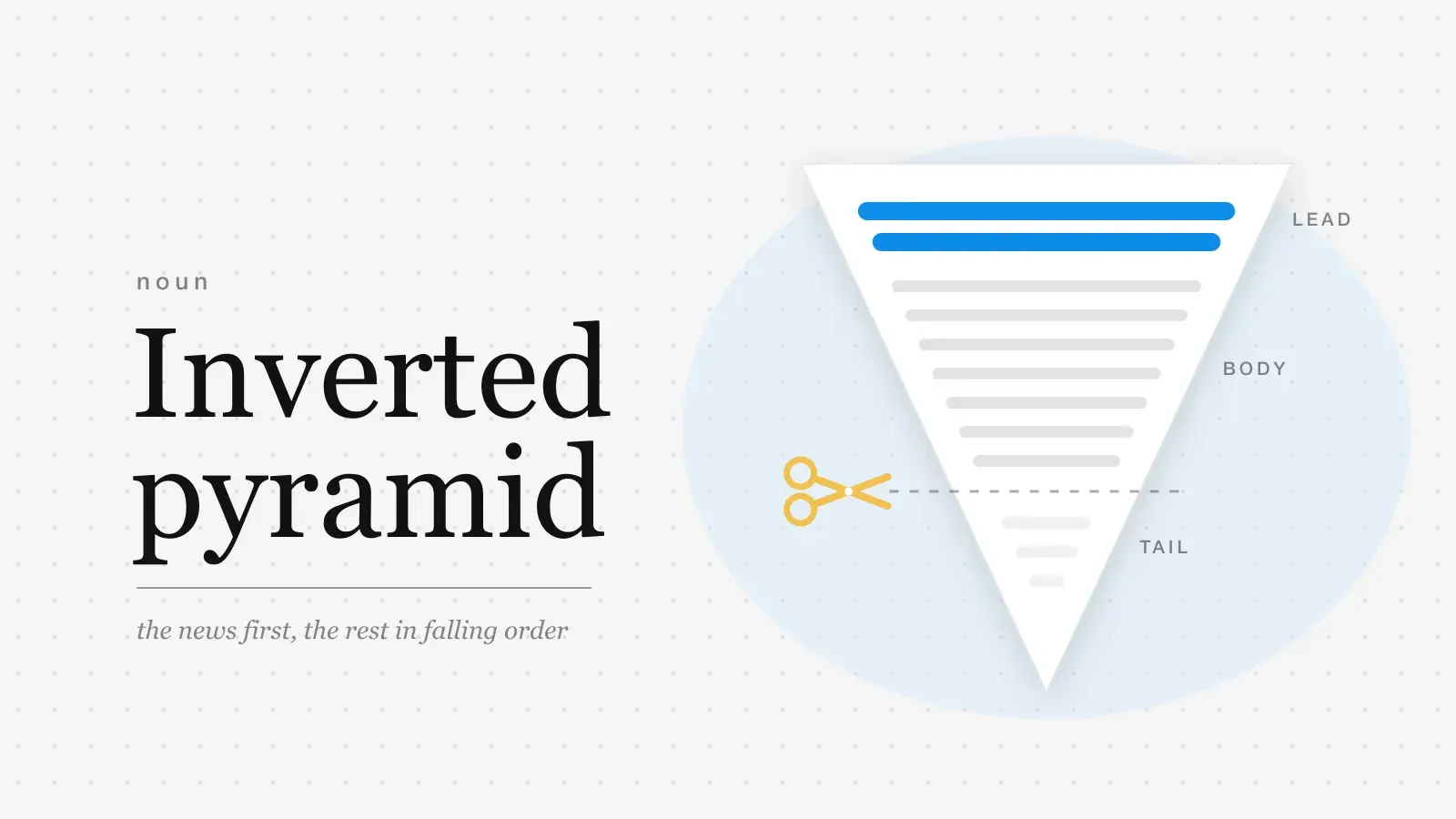
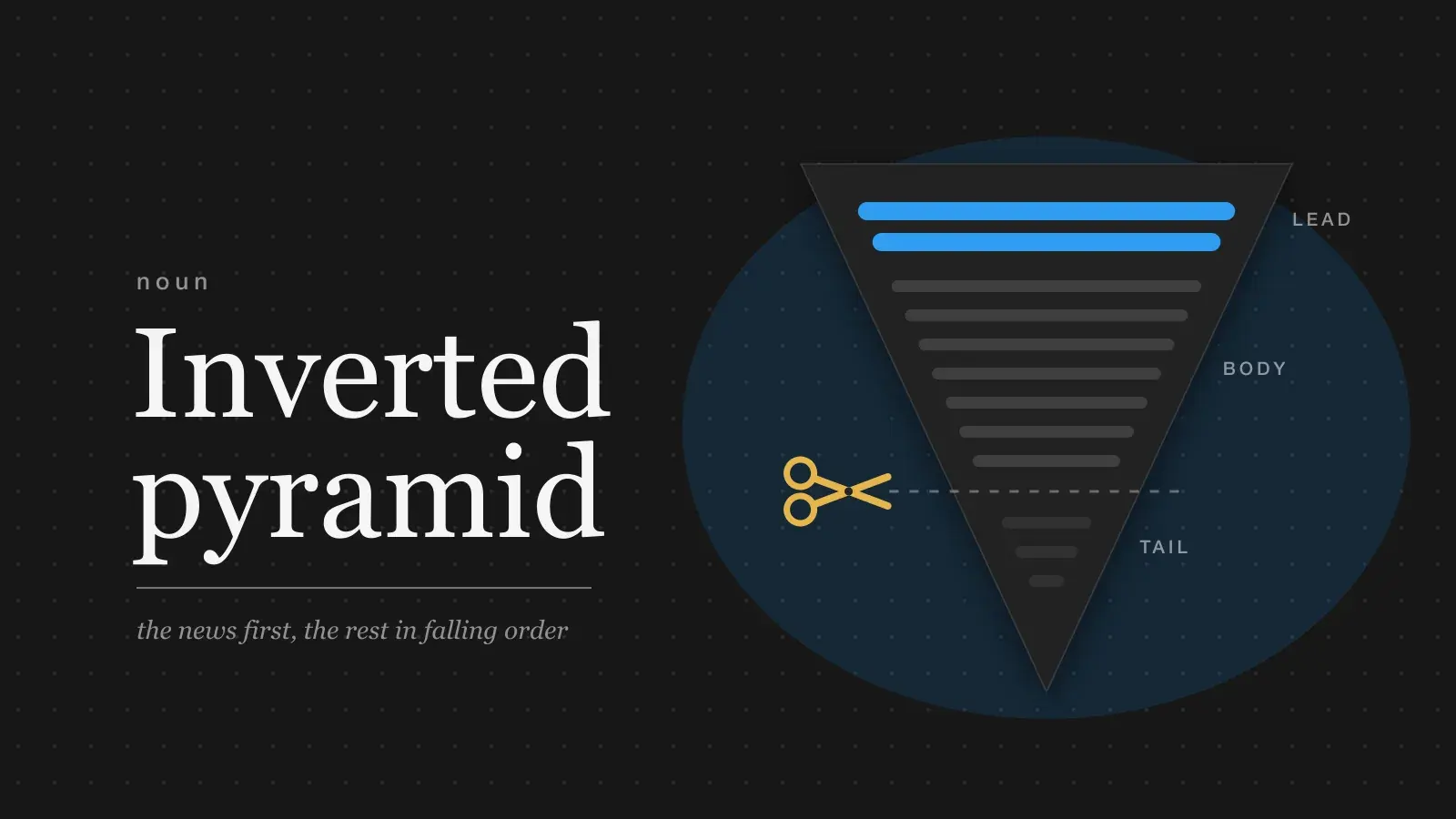
A straight news story uses the inverted pyramid: the most important fact first, then everything else in falling order of importance. Around that core sit a few fixed parts. A headline says the news in a handful of words. A byline names the writer. A dateline, set before the first sentence, names the city the story was reported from, in capital letters. Then come the lede, the supporting paragraphs, the quotes, the other side, what happens next, and background at the bottom, where it can be cut first.
News paragraphs are short, often one or two sentences each. The habit comes from narrow newspaper columns, and it suits a phone screen just as well. Here is how the parts fit together in a complete report.
An example news report
Elm Street bridge to close to cars for 14 months
By Jordan Ellis
RIVERMONT, Ohio — The Elm Street bridge will close to cars for 14 months starting March 2 after the City Council voted 5-2 Monday to replace its cracked deck, sending about 9,000 daily drivers onto detours.
Crews will remove and rebuild the bridge's concrete deck, which a state inspection in June found cracked across almost half its surface, city engineer Priya Nair told the council. A temporary walkway will let pedestrians and cyclists cross for all but about six weeks of the project.
"We've patched this deck four times in six years, and every patch buys us less time," Nair said. "If we wait, we stop getting to choose when it closes."
Drivers will be sent to the Route 9 bridge, about a mile and a half north. The city's traffic study estimates the detour will add 10 to 15 minutes to a rush-hour trip downtown.
A federal bridge grant will pay for most of the $11.4 million project. The city will cover the remaining $2.1 million from its capital budget.
Council members Tom Akers and Denise Hall voted against the plan. Akers said the city should rebuild the deck one half at a time so a lane could stay open. Nair said that approach would add about eight months and $3 million to the job.
"Fourteen months is a long time to cut a town in half," Akers said.
Marcus Webb, who owns Webb's Diner on the east end of Elm Street, said about half his lunch customers walk across from Rivermont General Hospital. "The walkway matters more to me than the cars," he said.
The city will hold a public meeting on detour routes Feb. 10 at 6 p.m. at the Rivermont Public Library. Detour maps will be posted on the city's website by mid-February, Nair said.
The two-lane bridge opened in 1961 and was last resurfaced in 1998.
How the example is built
| Paragraph | What it does |
|---|---|
| Paragraph1. Lede | What it doesWhat changes, for how long, from when, who decided, and how many people it hits. 33 words, under the usual 40-word ceiling. |
| Paragraph2. Why | What it doesThe reason (the inspection) and the first named source with her title. Then the walkway, the next question a walker would ask. |
| Paragraph3. Quote | What it doesThe engineer's reasoning in her own words, which a paraphrase would flatten. |
| Paragraph4–5. Impact and cost | What it doesThe detour, the delay and the money, each tied to where the number came from. |
| Paragraph6–7. Other side | What it doesThe two no votes, their alternative, and the city's answer to it. |
| Paragraph8. Someone affected | What it doesA business owner, quoted on the thing he actually cares about. |
| Paragraph9. What's next | What it doesA date, time and place a reader can act on. |
| Paragraph10. Background | What it doesHistory. The first paragraph to go if the story runs long. |
How to write the lede
The lede carries the news. Purdue University's Online Writing Lab puts a typical lede at 25 to 30 words and rarely more than 40, usually in one sentence. That limit forces a choice. The five Ws and an H (who, what, when, where, why, how) are the questions a reader brings, the "six honest serving-men" of Rudyard Kipling's 1902 poem, but a lede that answers all six reads like a form. Pick the two or three that matter most and let the second paragraph carry the rest.
A few habits make ledes stronger:
- Start with the subject that affects readers (the bridge, the family, the water bill), not with the meeting, the date or the official.
- Use an active verb that says what changed: will close, voted, escaped.
- Be specific. "Changes to local roads" tells the reader nothing, and "the Elm Street bridge" tells them whether to keep reading.
- Use the day of the week rather than "yesterday" or "today." A story is read for days after it is written.
- Don't open with "It," which most editors discourage, and save question and quote ledes for rare cases. Both delay the news.
Starts with the meeting: The Pinecrest Library Board held its monthly meeting Tuesday night at the main branch.
Rewrite: Pinecrest's public libraries will stop charging late fines Jan. 1 and will forgive about $48,000 in fines already owed, the library board decided Tuesday.
Tells it in order: Firefighters were called to a house on Birch Lane at 2:40 a.m. Sunday after a neighbor reported smoke.
Rewrite: A family of four escaped a fire that destroyed their Birch Lane home early Sunday after a neighbor saw smoke and pounded on their door, fire officials said.
Vague: Rising costs are affecting local households in many ways.
Rewrite: Water bills for a typical Rivermont household will rise about $9 a month in January, the first increase in five years, under rates the City Council approved Monday.
Summary lede or delayed lede
The rewrites above are summary ledes, the default for breaking and local news. A delayed lede opens on a person or a scene and holds the news for a paragraph or two. It suits stories where the news is less urgent than the people in it, and it only works if a nut graf follows quickly to say what the story is and why it matters now. Here is the bridge story opened that way:
Marcus Webb can tell the time by who walks into his diner. At 11:30 it's the nurses from Rivermont General, who cross the Elm Street bridge on foot and are back on shift by 12:15.
Starting March 2, that bridge will close to cars for 14 months while crews replace its cracked deck, after a 5-2 City Council vote Monday. A temporary walkway will keep Webb's lunch crowd coming for most of that time. The 9,000 drivers who cross each day will go a mile and a half north instead.
The second paragraph is the nut graf. If you are unsure which opening to use, write the summary lede. It is rarely wrong for news, while a delayed lede is wrong whenever the reader needed the facts first. Longer, scene-led pieces are covered in feature story examples.
Attribution and quotes
Attribution tells readers how you know what you are telling them. Attribute anything you did not see yourself and that isn't common knowledge: numbers, accusations, predictions and every opinion. You can state that the council voted 5-2 if you were in the room, but the cracks in the deck come from the inspection, and the detour time comes from the traffic study.
| Write | Instead of | Why |
|---|---|---|
| WriteNair said | Instead ofNair claimed, Nair admitted | Why“Claimed” casts doubt and “admitted” implies guilt. “Said” takes no side. |
| WriteAkers said the plan would hurt businesses | Instead ofAkers feels the plan will hurt businesses | WhyYou know what people said, not what they feel. |
| Write“…,” Nair said. “…” | Instead ofThree quoted sentences, then the name | WhyReaders need to know who is talking by the end of the first sentence. |
| Writecity engineer Priya Nair, then Nair | Instead ofPriya | WhyFull name and title first, last name after. A few papers add Mr. or Ms. |
| Writesaid | Instead ofsays | WhyNews is past tense. Features often use “says.” |
Quote what only that person can say: a judgment, a reason, a phrase nobody else would use. Paraphrase plain facts. "The meeting started at 6 p.m.," the clerk said, wastes a quote. Never change words inside quotation marks. If a quote needs trimming, paraphrase it or use an ellipsis. If it needs explaining, it is probably the wrong quote.
If the story criticizes someone, call them before you publish and say in the story whether they responded. Confirm anything important with a second source or a document where you can. It helps to keep names, titles and exact quotes in one place while you report. The interview notes template has fields for each.
Body, ending and style
After the lede, order the paragraphs by the reader's next question. "The bridge is closing" raises "can I still walk across?" and "how do I get downtown?" before it raises "who voted no?" Answer them in that order. Give every number a source and, where you can, a comparison that makes it mean something.
News stories don't have conclusions. There is no closing summary and no "only time will tell." End on what happens next (a meeting, a deadline, a court date) or on the last useful fact. A kicker, a closing line with some snap to it, belongs to features. And keep yourself out: no "I," no "our city," no adjectives that judge, such as shocking or much-needed. Opinion has its own form, covered in how to write an op-ed.
News style basics
Most US newsrooms follow the Associated Press Stylebook, sometimes with a house style guide on top. A few AP rules come up in nearly every story:
| Rule | Write | Not |
|---|---|---|
| RuleSpell out one to nine; figures for 10 and up | Writefive votes, 14 months | Not5 votes, fourteen months |
| RuleSpell out a number that starts a sentence | WriteFourteen months is… | Not14 months is… |
| RuleFigures for all ages | Writea 7-year-old | Nota seven-year-old |
| RuleAbbreviate Jan., Feb., Aug., Sept., Oct., Nov. and Dec. with a date; no -th | WriteFeb. 10, March 2 | NotFebruary 10th, Mar. 2 |
| RuleTimes without :00; noon and midnight in words | Write6 p.m., noon | Not6:00 PM, 12 p.m. |
| RuleCapitalize a formal title only before a name | WriteMayor Ana Ortiz; Ortiz, the mayor | NotAna Ortiz, the Mayor |
| RuleCity in capitals in the dateline; spell out states in the text | WriteRIVERMONT, Ohio — | NotRivermont, OH — |
Writing a news article, step by step
- Find the news
Write one sentence on what changed and for whom. If you can't, report more before you write anything.
- Report it
Get the documents (the inspection, the budget, the police report) and talk to the people with direct knowledge, the people affected, and the people who disagree. Write down how every name is spelled, every title and every number as you go.
- Write the lede first
Draft it before the rest, aim for 25 to 30 words, and rewrite it until a stranger would understand it with no other context.
- Order the rest by importance
List the facts and quotes you have, then number them by what the reader needs next. Background goes last.
- Attribute and quote
Put a strong quote in the top third of the story and a source on every fact you didn't witness. Include the other side.
- End with what happens next
Close on the next date, decision or step. Delete any paragraph that sums up or moralizes.
- Check it against your notes
Read every name, number, date and quote against your notes or recording. Then cut the story from the bottom one paragraph at a time. Each version should still be accurate.
- Write the headline
Write it last, from the lede, in present tense. The guide on how to write a headline covers the rest.
Common mistakes
- Burying the lede. Telling events in the order they happened puts the news in paragraph four. Ask what the reader most needs and start there.
- Overloading the lede. Five names, two dollar figures and a vote count in one sentence. Keep the two or three facts that matter and move the rest down.
- Editorializing. "Controversial," "finally" and "sadly" tell readers what to think. Let the vote count and the quotes do that.
- Numbers without sources. "About 9,000 drivers" needs to come from somewhere, and the story should say where.
- Quotes that repeat the facts. If the quote says what the paragraph above it already said, cut one of them.
- A closing summary. The last paragraph is the first one an editor cuts. Make it the least important fact, not a recap.
Drafting news stories in Strokes
Strokes keeps each story as a document in a project folder, so your interview notes and the draft sit side by side as files on your own machine. When a story develops, version history saves versions automatically and whenever you ask, so you can compare the version you filed with the update, changes marked. Select a lede that runs long and press ⌘K to ask for a tighter version. Or add your notes to a chat with the AI Assistant and ask which sentences in the draft the notes don't support. It reads your files, not the world, so confirming the facts with sources stays your job. When the story is ready, export it as Word or PDF for your editor.
Before a story runs, an editor will usually give it a copy edit for style, spelling and consistency. The checklist above means that edit finds less.
Frequently asked questions
How long should a news article be?
As long as the news needs and the space allows. A brief can be three or four paragraphs, and a major story runs much longer. If an editor or teacher gives you a length, write to it. The lede stays short either way: one sentence, about 25 to 30 words.
What is the difference between a news article and a feature story?
A news article reports something that just happened or is about to, leads with the facts and runs in order of importance. A feature explores a person, place or trend, can open with a scene and a nut graf, and is written to be read to the end.
Does a news article need a conclusion?
No. News stories end on what happens next or on the least important fact, so an editor can cut from the bottom without losing anything essential. A closing summary only repeats the lede.
What tense is a news article written in?
The body is in past tense: the council voted, the engineer said. Upcoming events take the future tense. Headlines use present tense for things that have already happened, as in “Council approves bridge plan.”
Can I use “I” or give my opinion in a news article?
No. A news article is written in the third person and keeps the reporter out of it. Opinion belongs in a column, an editorial or an op-ed, which are labeled as opinion.