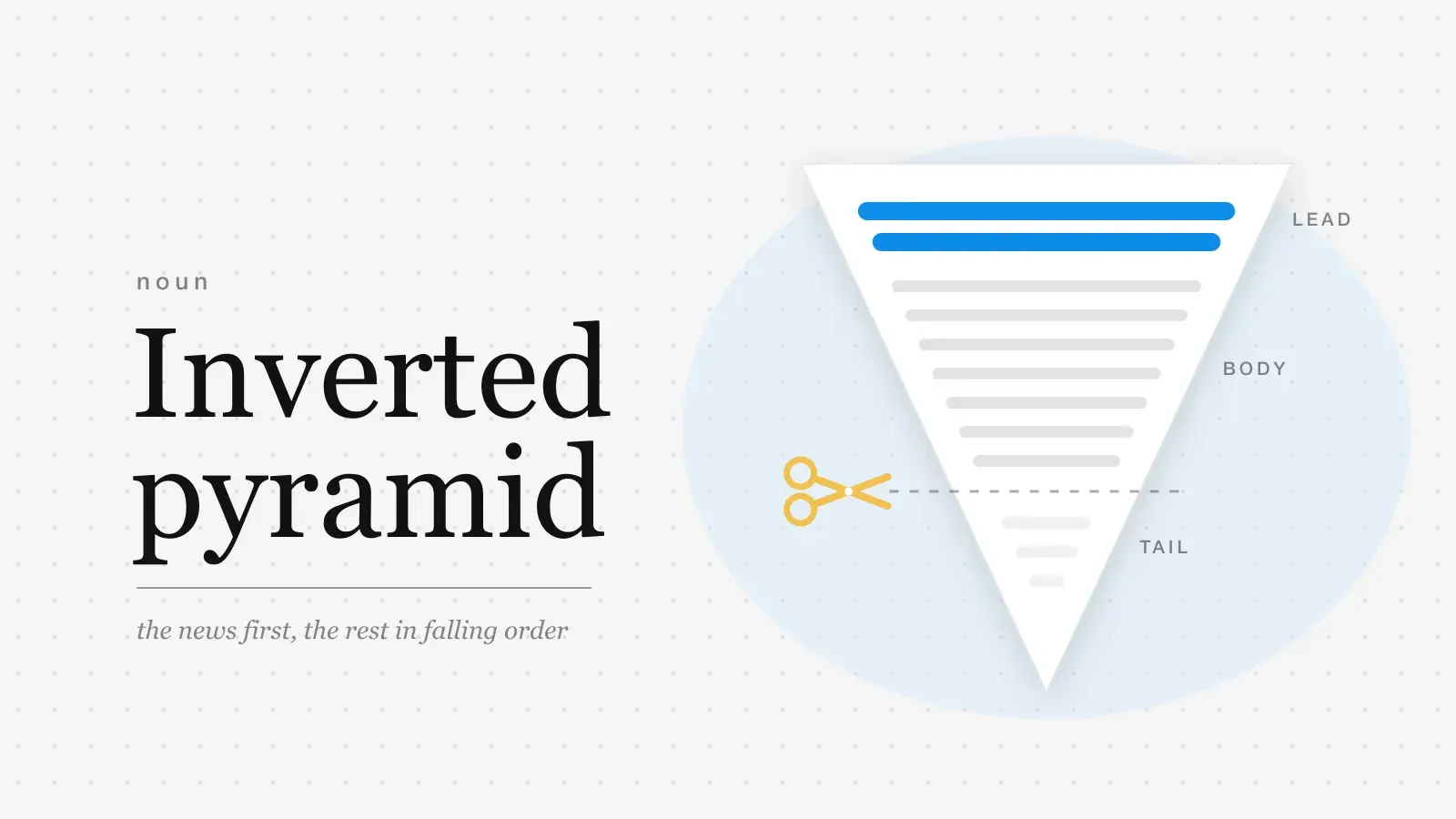
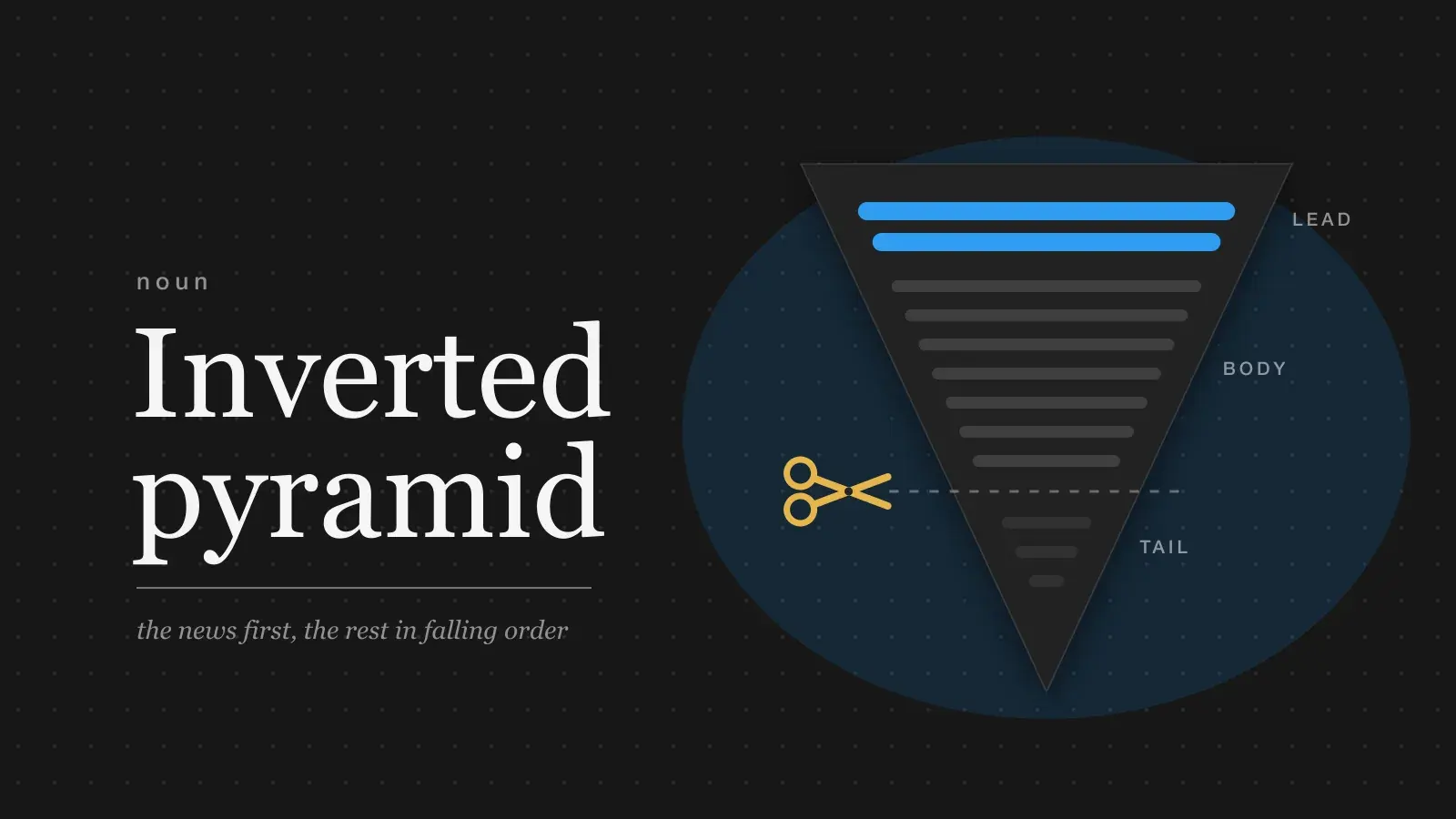
The inverted pyramid is a way of ordering a news story with the most important facts first, usually in a single opening sentence, and everything after it in descending order of importance. A reader can stop at any paragraph and still have the news, and an editor can cut from the bottom without rewriting.
Picture a triangle standing on its point. The wide top is the lead, which answers the questions a reader asks first: who, what, when, where, why and how. Newsrooms often spell it "lede," and hiding the real news in paragraph four is called burying the lede.
Parts of an inverted pyramid
| Layer | What goes there | When space runs out |
|---|---|---|
| LayerLead | What goes thereThe news in one sentence: what happened, to whom, and why it matters now | When space runs outNever cut |
| LayerBody | What goes thereDetails in the order readers want them: numbers, the best quote, what happens next, reactions | When space runs outTrimmed from the last paragraph up |
| LayerTail | What goes thereBackground, history, related events, minor detail | When space runs outCut first |
Inverted pyramid examples
This evening at about 9:30 p.m. at Ford's Theatre, the President, while sitting in his private box …, was shot by an assassin, who suddenly entered the box and approached behind the President.
Lincoln's secretary of war sent this telegram to New York while the president lay dying, and newspapers printed it the next morning. It opens on the shooting at a time when many reports still told events in the order they happened. The historian David T. Z. Mindich, in Just the Facts (1998), points to Stanton's wartime dispatches, this one above all, as among the earliest examples of the form. Even so, "The wound is mortal" waits until the fourth sentence. A desk editor today would move it up.
The same lead today: President Lincoln was shot in the head at Ford's Theatre in Washington tonight and is not expected to live.
Lead. Fairview's only public pool will stay closed this summer after inspectors found a crack in its main drain line, the city's parks department said Tuesday.
Body. Repairs will cost about $310,000, and work cannot start until the city council approves the money. Parks director Dana Ruiz said the job would take ten to twelve weeks once it begins.
"We would rather lose one summer than open a pool we can't promise is safe," Ruiz said.
Swim lessons booked for June will move to the YMCA on Orchard Street. Season-pass holders can get refunds at City Hall through May 31.
Tail. The pool opened in 1968 and was last renovated in 2004.
Cut that story after any paragraph and what remains is still true. The refund line sits above the history because a parent holding a season pass needs it more than anyone needs the pool's birthday.
Merriman Smith of United Press International was riding in the press car in President Kennedy's motorcade when he heard the shots. He grabbed the car's radio-telephone and dictated a bulletin that said only that three shots had been fired at the motorcade. At Parkland Hospital he asked a Secret Service agent how badly the president was hurt, then found another phone and sent a flash that Kennedy had been seriously wounded, perhaps fatally. Each message led with the most important thing Smith could report at that minute, with detail to follow. The coverage won him the 1964 Pulitzer Prize for National Reporting.
Writing an inverted pyramid story
- Find the news before you write. Ask what changed and for whom. If you could send one text message about the story, that message is your lead.
- Choose your Ws. A lead that answers all six questions reads like a form. Pick the two or three the reader needs most and save the rest for the second paragraph. Most newswriting guides keep the lead to one sentence of roughly 20 to 30 words, though the limit varies by teacher and newsroom.
- Order the rest by the reader's next question. After "the pool is closed" come "for how long?" and "what about the swim lessons?" Answer them in that order.
- Get a quote in early. A real voice by the third or fourth paragraph backs up the lead and keeps the body from reading like a list.
- Run the cut test. Delete the last paragraph, then the one above it, and keep going. Every version should still be accurate. If a cut leaves the story misleading, the paragraph you removed belongs higher.
The most common failure is the buried lede, and it usually comes from writing events in the order you saw them.
Before: The Lakeview school board met Thursday evening in the high school library. Members approved the minutes of the March meeting and heard a report on spring sports before turning to the transportation budget. After an hour of debate, they voted 4-3 to cut it by ending bus service in September for students who live within a mile of school.
After: Lakeview students who live within a mile of school will lose bus service in September after the school board voted 4-3 Thursday to cut the transportation budget.
The meeting was the occasion, not the news. Parents care about the buses, so the buses go first, and the vote, the day and the reason still fit in one sentence of 27 words.
Two other mistakes are common: a lead crammed with names, titles, a dollar figure and a quote, and a caveat or the other side's response placed so low that the first trim removes it.
Inverted pyramid vs. hourglass and nut graf
| Structure | Opens with | Suits | Survives a trim? |
|---|---|---|---|
| StructureInverted pyramid | Opens withThe news in one sentence | SuitsBreaking news, announcements, press releases | Survives a trim?Yes |
| StructureHourglass | Opens withA summary lead and a few key paragraphs, then a turn into chronology | SuitsCrimes, rescues, storms | Survives a trim?The top half does |
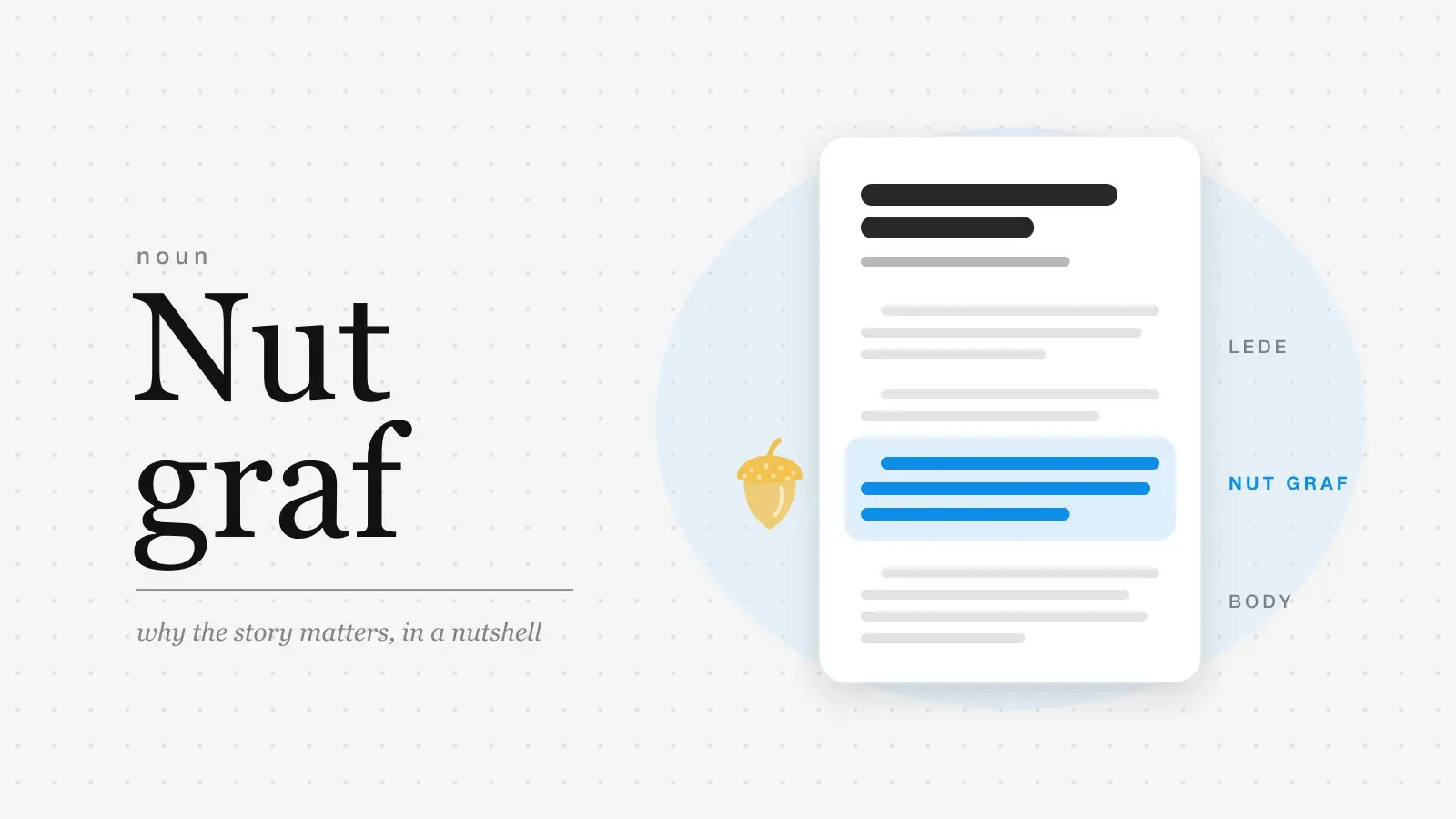
| StructureNut graf | Opens withA scene or a person, then a paragraph on why it matters | SuitsFeatures, trend stories, explainers | Survives a trim?Rarely |
| StructureChronological | Opens withThe first thing that happened | SuitsNarrative features, memoir | Survives a trim?No |
The writing teacher Roy Peter Clark named the hourglass in 1983. Its top gives the news, a line such as "witnesses described it this way" marks the turn, and the rest is told in order. A nut graf story trades the summary lead for a scene and explains a few paragraphs in why the scene is news. Both are written for a reader who has already decided to stay.
Fiction seldom uses the pyramid, because a novel runs on what the reader does not know yet. Even books that announce the ending on page one, such as Gabriel García Márquez's Chronicle of a Death Foretold, hold back the how and the why. Opening in medias res is a different move: it drops the reader into the action, not the outcome. Where the pyramid does belong is the writing around a book. A launch announcement, an author bio and an email to your agent about a missed deadline all read better with the news first.
Inverted pyramids online and at work
Jakob Nielsen made the case for the web in a 1996 column, "Inverted Pyramids in Cyberspace": web readers skim, and many never reach the bottom of a page. The Nielsen Norman Group still teaches the pattern for every page, section and paragraph. The US Army's correspondence regulation, AR 25-50, asks for the same order in memos and calls it "bottom line up front," or BLUF. The academic cousin is the abstract, which states the findings of an IMRaD paper before the paper argues for them.
A quick check works for any of these forms: ask an AI model to state the news of your draft in one sentence. If the answer sounds like your third paragraph, the lede is buried. In Strokes you can ask the AI Assistant beside the document, then select your opening, press ⌘K and ask for a version that leads with that sentence.
Related terms: logline, which puts a whole story through the same one-sentence test, and style guide. For the full process, read How to write a news article. For the same shape in a company announcement, start from the press release template.