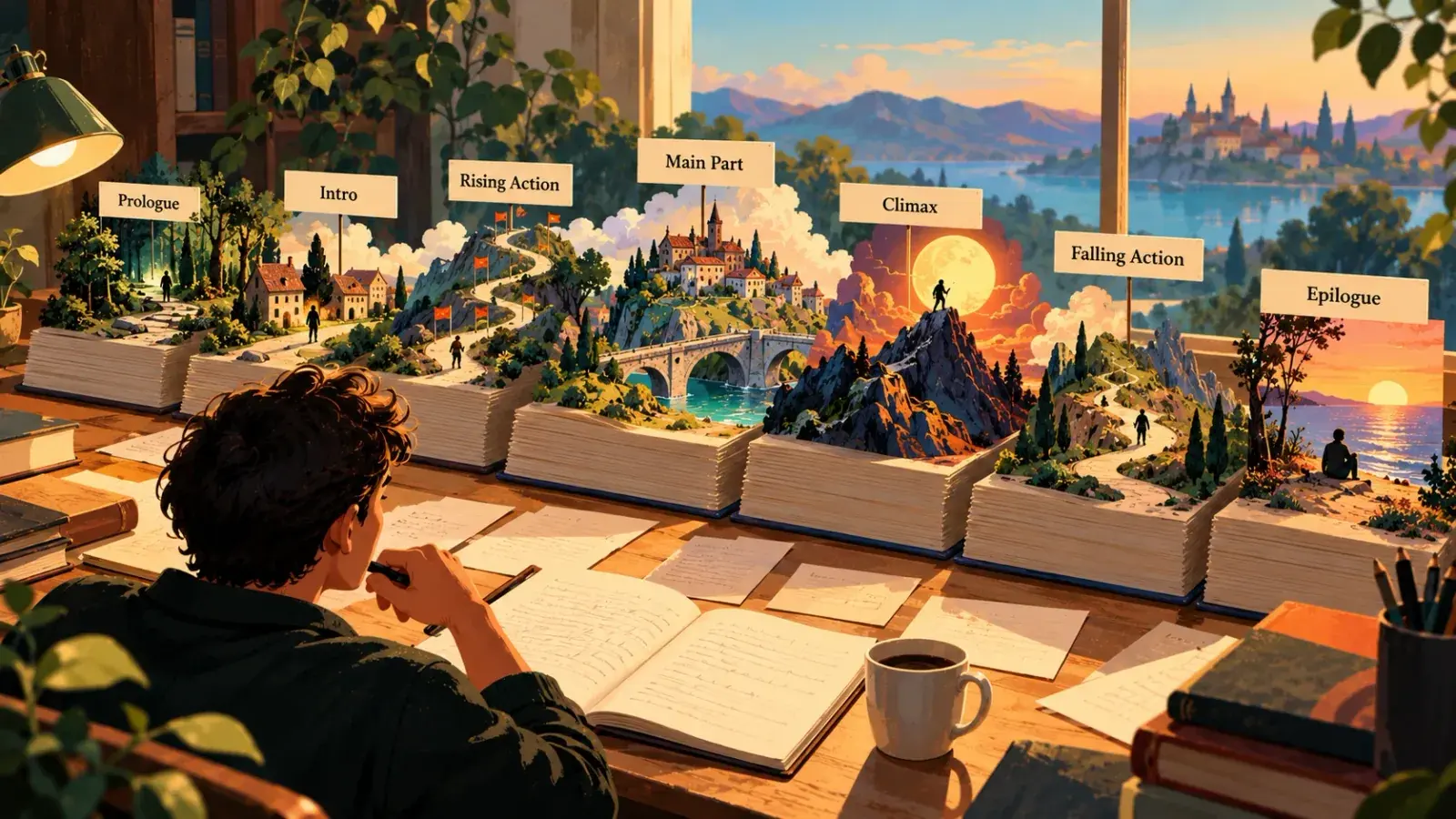
Pacing in writing is how fast a story feels to the reader. To pace a story, you decide how many words each stretch of story time gets. To speed up, summarize or skip what changes nothing, cut description, shorten sentences and paragraphs, and end chapters on an open question. To slow down, play a moment out in full, add the character's thoughts and senses, and let sentences run long.
Good pacing moves between the two: tension, then a breather that sets up the next rise. A slow middle is rarely slow everywhere. Usually it is too much of the same.
What pacing measures
Every passage covers some amount of story time in some number of words. The ratio between the two is the pace. Literary theorists have names for the main settings: Gérard Genette described four in the early 1970s, and Seymour Chatman added a fifth, stretch, in Story and Discourse (1978). You don't need the theory, but the five speeds make a useful checklist when a chapter feels off.
| Speed | Story time vs words | Looks like | Use it for |
|---|---|---|---|
| SpeedEllipsis | Story time vs wordsTime passes, no words | Looks like"Three weeks later" | Use it forAnything the reader can assume |
| SpeedSummary | Story time vs wordsMuch time, few words | Looks likeA whole winter in a paragraph | Use it forRoutine, travel, repetition |
| SpeedScene | Story time vs wordsAbout real time | Looks likeA conversation, line by line | Use it forDecisions, conflict, reveals |
| SpeedStretch | Story time vs wordsSeconds over pages | Looks likeA fall, a verdict, a first kiss | Use it forThe moments the book builds toward |
| SpeedPause | Story time vs wordsTime stops | Looks likeDescription, reflection, backstory | Use it forSetting, meaning, a breath after a peak |
Speed is not the same as pull. A reader will race through a slow scene if a question hangs over it, and drag through a fast one if nothing is at stake. So pacing has two dials: how quickly the telling moves, and how badly the reader wants the next line.
Scene vs summary
The biggest pacing decision in a chapter is what to dramatize and what to summarize. A scene puts the reader in the room as things happen. Summary reports what happened over a span of time. Scenes are vivid but expensive, summary is quick but distant, and a book needs both.
The working rule: dramatize where something changes, summarize where nothing does. A decision, a reversal, a reveal, the confrontation the reader has waited 200 pages for: these get full scenes. The drive to the airport, three weeks of rehearsals, the fourth witness who knows nothing: summary, or a cut.
Summary. Mara rehearsed the speech all spring: in the car, in the shower, in the dark before sleep. By May she could say it without the cards. By June she no longer believed a word of it.
Scene. "You're not going to read it," Dev said.
"I'm going to read it." She held up the cards. "I've read it two hundred times."
"That's what worries me."
Stretch. The cards were damp where her thumb had held them. At the back of the hall a chair scraped, and four hundred faces turned toward the sound and then back to her, and she understood that she had about three seconds before the silence became the thing everyone would remember.
The summary covers three months in three sentences. The scene runs at the speed of talk. The stretch spends a long sentence on three seconds, which tells the reader this is the moment that matters.
Poe slows down and speeds up inside a single paragraph:
It took me an hour to place my whole head within the opening so far that I could see him as he lay upon his bed. … And this I did for seven long nights—every night just at midnight—but I found the eye always closed …
The narrator describes his nightly routine once, in slow detail: the latch, the lantern, a full hour to ease his head through the door. Then "seven long nights" folds every repetition into a single clause, because nothing changed on any of them. The eighth night, when something does happen, gets the slowest writing in the story, including the line "A watch's minute hand moves more quickly than did mine."
Summary at the scale of a book
Virginia Woolf built To the Lighthouse (1927) on the same principle, planning it in her notes as "two blocks joined by a corridor." The first part follows a single afternoon and evening and is the longest of the three. The middle part, "Time Passes," covers ten years and is by far the shortest. Deaths a conventional novel would dramatize arrive in square brackets:
[Mr. Ramsay stumbling along a passage stretched his arms out one dark morning, but, Mrs. Ramsay having died rather suddenly the night before, he stretched his arms out. They remained empty.]
Few novels compress that hard, but you make the same choice in every chapter: a death can get a page or a clause.
Scene and sequel
Dwight V. Swain's Techniques of the Selling Writer (1965) gives a practical frame for the rhythm between scenes. In his terms, a scene is a unit of conflict: a character pursues a goal, meets opposition and ends in a setback he calls a disaster. A sequel follows: the character's reaction, the dilemma the setback creates, and a decision that becomes the next scene's goal. Swain listed controlling tempo among the sequel's jobs. Cut sequels to a line and the story speeds up. Let them run and it slows, giving the reader time to feel the blow.
Sentences, paragraphs and white space
Below the level of scenes, pace lives in the prose. Short sentences and short paragraphs read fast: the eye drops down the page and the white space does part of the work. Long sentences with clauses hold the reader inside a moment. Neither is better on its own. A short sentence after three long ones lands harder than a page of short ones.
To speed up
- Short sentences, often one action each.
- Short paragraphs, with the odd line standing alone.
- Dialogue with few tags and no thoughts between the lines.
- Strong verbs and only the detail the moment needs.
- Scenes that start late and end early.
To slow down
- Longer sentences and fuller paragraphs.
- The character's thoughts between lines of dialogue.
- Sensory detail: the smell of the room, a sound in the hall.
- A key moment played out beat by beat.
Fast. The car came out of nowhere. Lights. A horn. She jumped. Gravel tore her palms.
Slow. She didn't see the car until its lights filled the road, and even then her body lagged behind her mind, which had time to register the horn, the dark shape behind the windshield and the oddly polite thought that she ought to step aside, before she was on her knees in the gravel with her palms on fire.
The fast version is how the moment felt. The slow one is how it will be remembered. Action is usually written fast, but the single beat everything turns on often deserves the slow treatment.
Dialogue is the fastest-reading kind of scene, because so much of it is white space. Keep an argument tight while it escalates, and let thought in when someone has to decide. There is more on tags and beats in how to write dialogue.
Chapter and scene breaks
Where you cut is a pacing tool. A screenwriting rule of thumb, enter late and leave early, works just as well on the page: start a scene as close to its turn as you can, and leave once it has turned. Skip the arrival, the greetings, the walk back to the car. Many first-draft scenes start a page before the story does.
Chapter endings set the reader's speed through the book. A chapter that ends on an open question (a knock, a refusal, a fact that changes what the reader believed) pulls them into the next one. A chapter that ends on resolution lets them put the book down, which you also need at the end of an act or after a climax. Short chapters read fast, and a run of them toward the climax makes an ending accelerate. Typical lengths by genre are in how long a chapter should be.
A scene break (a blank line or a centered mark) is a smaller cut that skips time or switches threads. Cutting between two threads at their tensest moments is one of the oldest ways to keep both moving.
Tension and release
Readers can't stay at full tension for long. Action without a pause turns into noise, and the fifth explosion lands softer than the first. A well-paced book alternates: a rise, a peak, a release, then a higher rise. The quiet scenes are where readers come to care about the characters, so the next peak has more to hit.
A release still has to work. A good breather scene closes one question and opens another: the characters patch themselves up after the fight, and one of them notices a wound the fight didn't cause. Leave out that second question and readers start to skim.
Two devices add pull without adding speed. A deadline makes the reader feel time running out, so they read faster even through slow scenes. Rising stakes do the same over the length of a book: the inciting incident sets them, and the midpoint and the pinch points on either side of it raise them in steps.
Pace and genre
Genre sets the baseline. Thrillers keep chapters short and sequels brief. Romance slows down for the moments between the two leads. Horror alternates long stretches of dread with short shocks. Literary fiction spends more words in reflection. To calibrate, take three recent books in your category and mark where they summarize and where they slow down.
How to fix a slow middle
The middle of a novel usually sags for structural reasons, not sentence-level ones: the protagonist waits instead of acting, the same conflict comes back in new clothes, or events keep happening without anything changing. Trimming sentences won't fix that. Map the middle first.
- Reverse-outline the middle
List every scene in the middle third of the draft, one line each: who wants what, and what happens. Work from the draft, not from your original plan. A scene outline template gives you the columns.
- Mark the speed and the change
Beside each scene, note its main speed (summary, scene, stretch or pause) and what is different at its end: what someone knows, wants, has or has lost. If you can't name a change, flag the scene.
- Score the pull
Give each scene a number from 1 to 5 for how much a reader would want the next one. You are looking for the shape, not precision: rises, peaks, drops and long flat runs.
- Find the patterns
Look for three or more scenes in a row without a change, two scenes doing the same job (the same argument twice, the same failed attempt), a midpoint that turns nothing, and sequels that run longer than the scenes before them.
- Fix the structure, then the prose
Cut or merge scenes that repeat. Compress unchanged stretches into summary. Give the protagonist a decision that drives the next scene, or add a reversal at the midpoint. Only then tighten sentences.
Readers rarely say "pacing" when something is wrong. They say it dragged, or they skimmed, or the ending felt rushed. When notes come back from a beta reader, translate them into causes before you change anything:
| What readers say | Likely cause | Try |
|---|---|---|
| What readers say"It took a while to get going." | Likely causeSetup and backstory before the first change | TryOpen nearer the trouble and feed backstory in later |
| What readers say"I put it down in the middle." | Likely causeRepeated conflict, a reactive hero | TryMerge repeats and give the hero a costly choice |
| What readers say"I skimmed the descriptions." | Likely causePauses where the reader wants events | TryMove description to a quieter moment, or cut it |
| What readers say"The ending felt rushed." | Likely causeThe climax told in summary | TryWrite the climax in scene and stretch its key moment |
| What readers say"Too much happened to follow." | Likely causeNo sequels or breathers | TryAdd reaction and decision after big events |
Common pacing mistakes
- Rushing the climax. The scene the whole book promised gets a page of summary. Slow down at the peak. That is where stretch belongs.
- Front-loading the world. An info dump in chapter one stops the story before it starts. Give the reader a question first, or open in medias res, and feed in the history as they need it.
- Slowing down with inventory. More description does not deepen a scene. Slow down with what the character notices and feels, not with a list of furniture.
- A cliffhanger on every chapter. When every chapter ends on an emergency that dissolves on the next page, readers stop trusting the cliff.
Check pacing chapter by chapter
Pacing is easier to see when each chapter is its own document. In Strokes, a book can be a project folder with one document per chapter. Add a chapter to a chat with the AI Assistant and hand it the tedious half of the diagnosis: listing the scenes, labeling each one's speed and saying what changes. You still make the call. The model is a second reader, not a measuring tool.
Prompt
Read this chapter and list its scenes in order. For each scene, give:
- one line on what happens
- its main speed: summary, full scene, slowed-down moment or pause
- what is different at the end (knowledge, goal, relationship, stakes)
- the open question that carries the reader into the next scene
Then point out any run of three or more scenes where nothing changes.
Before you cut a slow chapter hard, keep the old draft. Version history saves versions as you work and restores an earlier one in one click if the faster version lost something you needed.
Frequently asked questions
What is pacing in writing?
Pacing is the speed at which a story moves for the reader. It depends on how many words you spend on each stretch of story time and on tension: how much the reader wants to know what happens next.
How do you speed up the pacing of a story?
Summarize or skip stretches where nothing changes, start scenes later and end them sooner, cut description and inner thought in tense moments, shorten sentences, paragraphs and chapters, and end chapters on an open question.
How do you slow down pacing without boring the reader?
Slow down only at moments that matter, and keep a question open while you do. Play the moment out beat by beat, with the character's thoughts and sensory detail. Slow passages bore when nothing is at stake, not because they are long.
What causes a slow middle in a novel?
Usually structure: a protagonist who reacts instead of acting, conflicts that repeat, subplots that never touch the main plot, or a midpoint that changes nothing. Reverse-outline the middle and fix the scene list before you trim sentences.
Should a story be fast-paced all the way through?
No. Constant speed becomes monotonous, and readers need quieter scenes to care about what comes next. Most novels alternate tension with release and speed up toward the climax.