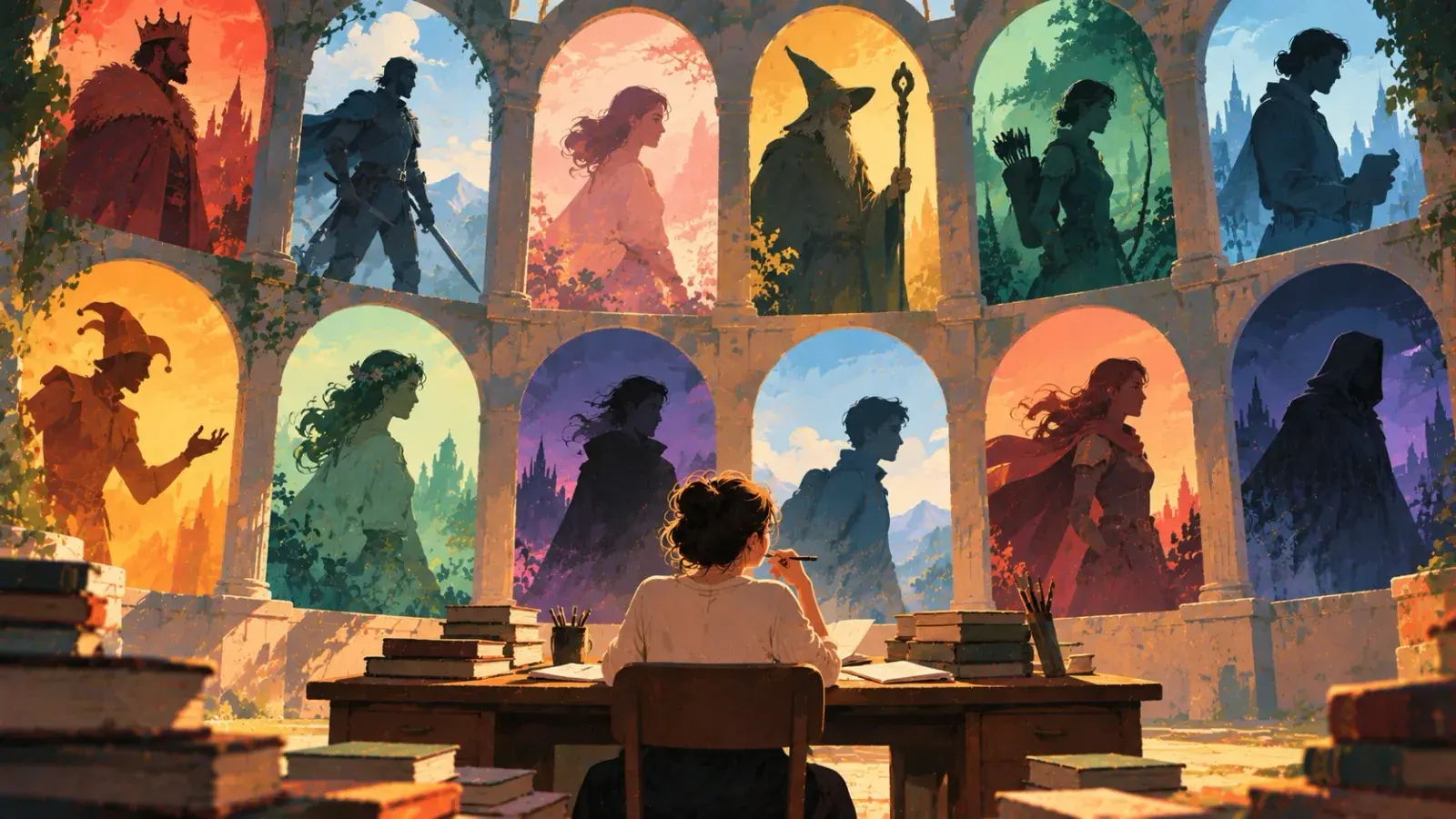
A character archetype is a pattern of motive that readers recognize across stories: the Hero who must prove their worth, the Sage who must know the truth, the Ruler who must keep control. The list most writers use has 12: Innocent, Everyman, Hero, Caregiver, Explorer, Rebel, Lover, Creator, Jester, Sage, Magician and Ruler. Each is defined by a desire and a fear, and its typical flaw is that desire pushed too far. A second set, from mentor to shadow, describes the job a character does in the plot. Use either as a starting point, then make the choices no list can make for you.
Where archetypes come from
The Swiss psychiatrist Carl Jung first used the word "archetype" in a 1919 essay, for patterns he believed sat in a collective unconscious shared by everyone: figures such as the shadow, the wise old man, the trickster and the great mother. He never fixed a list, and suggested there were as many archetypes as there are typical situations in life.
Joseph Campbell's The Hero with a Thousand Faces (1949) traced one shape, the hero's journey, through myths from around the world. In the mid-1980s Christopher Vogler, then a story analyst at Disney, condensed Campbell into a memo for screenwriters, which became the book The Writer's Journey (1992). Vogler names eight archetypes by the job they do in a story.
The famous 12 come from elsewhere. Carol S. Pearson set out twelve archetypes for personal growth in Awakening the Heroes Within (1991), then reworked them with Margaret Mark for marketing in The Hero and the Outlaw (2001). That brand version is the one most writing guides now call "the 12 Jungian archetypes", which is why the names drift (Everyman or Orphan, Rebel or Outlaw).
The 12 character archetypes
Each archetype below has a core desire, the fear that shadows it, the flaw that appears when the desire goes too far, and an example from a classic you can read free online. The table is the short version, and the examples come after it.
| Archetype | Wants | Fears | Flaw |
|---|---|---|---|
| ArchetypeInnocent | WantsSafety, goodness | FearsDoing wrong | FlawNaivety |
| ArchetypeEveryman (Orphan) | WantsTo belong | FearsBeing left out | FlawLoses self to fit in |
| ArchetypeHero | WantsTo prove their worth | FearsWeakness | FlawPride |
| ArchetypeCaregiver | WantsTo protect others | FearsSelfishness | FlawMartyrdom |
| ArchetypeExplorer | WantsFreedom | FearsBeing trapped | FlawRestlessness |
| ArchetypeRebel (Outlaw) | WantsTo overturn what's broken | FearsPowerlessness | FlawGoes too far |
| ArchetypeLover | WantsCloseness | FearsBeing alone | FlawLoses self in another |
| ArchetypeCreator | WantsTo make something lasting | FearsMediocrity | FlawObsession |
| ArchetypeJester | WantsJoy in the moment | FearsBoredom | FlawFrivolity |
| ArchetypeSage | WantsThe truth | FearsBeing deceived | FlawDetachment |
| ArchetypeMagician | WantsTo transform things | FearsUnintended consequences | FlawManipulation |
| ArchetypeRuler | WantsControl, order | FearsChaos | FlawRigidity |
The Innocent
The Innocent wants a world that makes sense and fears doing wrong. Flaw: naivety that hardens into denial. Voltaire's Candide (1759) repeats his tutor's lesson that all is for the best through war, shipwreck and earthquake, and only at the end settles for tending his garden.
The Everyman (Orphan)
The Everyman wants to belong and dreads being singled out. Flaw: giving up who they are to fit in. Pip in Great Expectations (1861), a blacksmith's apprentice, wants a place in Estella's world and grows ashamed of Joe, the man who loved him most. Readers ride along easily inside an Everyman, which is why so many stories use one as the POV character.
The Hero
In Beowulf, the aging king insists the dragon is his fight alone, and his death leaves his people exposed. The Hero wants to prove their worth and fears weakness. Flaw: pride, and a habit of treating every problem as a fight. Give yours a problem that strength cannot solve.
The Caregiver
The Caregiver wants to protect others and fears being selfish. Flaw: martyrdom. They neglect themselves and let others lean too hard. Beth March in Little Women (1868) keeps visiting a poor family when her sisters are too busy, holds their baby as it dies, and catches scarlet fever. Give the Caregiver one thing they want for themselves.
The Explorer
Freedom is the Explorer's want, and being trapped or tamed the fear. Flaw: restlessness. They leave before anything can hold them. Huck Finn ends Mark Twain's novel planning to "light out for the Territory" rather than be adopted by Aunt Sally, which is why an Explorer needs something worth staying for.
The Rebel (Outlaw)
The Rebel wants to overturn what isn't working and fears powerlessness. Flaw: going too far, until the fight becomes the point. Robin Hood, in the old ballads and Howard Pyle's 1883 retelling, lives outside the law in Sherwood, robbing rich travelers and defying the Sheriff of Nottingham. Make the order the Rebel fights genuinely unjust, and the price of fighting it high.
The Lover
Romeo pines for Rosaline in the first act, falls for Juliet that night, marries her the next day and kills Tybalt that same afternoon. The Lover wants closeness, to a person or a place, a craft or a cause, and fears being alone. Flaw: losing themselves in the other and acting on feeling before thought.
The Creator
The Creator wants to make something that lasts and fears mediocrity. Flaw: obsession. People come second to the work. Victor Frankenstein (1818) labors for nearly two years to bring his creature to life, then flees the room the moment it opens its eyes.
The Jester
The Jester wants to enjoy the moment and fears boredom. Flaw: frivolity. The joke becomes a way to dodge pain and duty. Falstaff, in Shakespeare's Henry IV plays, is the best company in any tavern, and Prince Hal, once crowned, dismisses him with "I know thee not, old man." Let the Jester's mask slip once.
The Sage
Sherlock Holmes, in A Study in Scarlet (1887), tells Watson he will do his best to forget that the earth goes around the sun, because the fact is no use to his work. The Sage wants the truth and fears being deceived. Flaw: detachment. They study a problem when they should act, and treat people as puzzles. Let the Sage be wrong at least once.
The Magician
The Magician is after transformation and afraid of what it might set loose. Flaw: manipulation. They move people like pieces. Prospero, in The Tempest, raises a storm, steers his daughter's romance and stages a reckoning with the brother who exiled him, then renounces his magic.
The Ruler
The Ruler wants control and fears chaos. Flaw: rigidity. They cannot hear what they don't want to hear. King Lear divides his kingdom by asking his daughters to declare their love, then banishes Cordelia, the one who won't flatter him.
Story roles: mentor to shadow
The 12 describe personality. Vogler's archetypes describe function: the job a character does for the plot at a given moment. His list starts with the hero, which in this sense simply means the MC, whatever their personality. The other seven:
- Mentor. Trains, advises or equips the hero, then usually steps aside so the hero faces the climax alone. The word comes from Mentor in Homer's Odyssey, whose appearance the goddess Athena borrows to guide Odysseus's son, Telemachus.
- Herald. Announces that change is coming and can't be refused. Marley's ghost in A Christmas Carol (1843) arrives to tell Scrooge that three spirits are on their way.
- Threshold guardian. Blocks the way into the new world and tests whether the hero is ready. The Sphinx guards Thebes with a riddle until Oedipus answers it. Guardians can be outwitted, bypassed or won over.
- Shapeshifter. Someone whose loyalty the hero, and the reader, can't pin down. Long John Silver in Treasure Island (1883) is a friendly ship's cook, then a mutineer, then something in between.
- Shadow. The force that opposes the hero, often a dark version of the hero. Stevenson made it literal in Strange Case of Dr Jekyll and Mr Hyde (1886). For building one, see how to write a villain.
- Trickster. Brings chaos and comedy that knock the plot sideways. Puck, in A Midsummer Night's Dream, enchants the wrong Athenian's eyes and gives Bottom a donkey's head.
- Ally. Travels with the hero, covers what they lack and gives them someone to talk to. Dr. Watson is Holmes's ally and also his foil: the ordinary mind that makes the extraordinary one visible.
Vogler's key point is that these are masks, not identities. Little John blocks Robin Hood's way on a narrow bridge, knocks him into the stream with a staff, then joins his band: guardian first, ally after. Your Sage can be the mentor in act one and the shadow in act three.
Archetype vs. stereotype vs. trope
The three words get swapped freely, but they work at different levels.
| Term | What it is | Example |
|---|---|---|
| TermArchetype | What it isA pattern of motive: what a character wants and fears | ExampleThe Caregiver |
| TermTrope | What it isA recurring story device readers recognize | ExampleThe mentor dies before the final battle |
| TermStereotype | What it isTraits assumed about a group, with no individual behind them | ExampleThe dumb jock |
An archetype is abstract by design: you can't write one, only a person who fits it. A trope is a concrete move, and readers seek many of them out. A stereotype is what you get when a character is built from assumptions instead of choices. The quick test: ask what this character wants that no one else in the story wants, and what they would never do. A stereotype has no answer to either.
How to subvert and combine archetypes
Readers know these patterns, which is the opportunity: you can use their expectations against them. Five moves that work:
- Keep the desire, change the method. A Caregiver who protects people by controlling them is still a Caregiver, and far more interesting.
- Let the archetype be wrong. A mentor whose advice gets someone hurt forces the hero to think for themselves.
- Combine two whose desires conflict. A Sage-Lover must choose between the truth and the person. A Rebel who becomes the Ruler is now the system they fought.
- Put the pattern in an unexpected life. The Hero can be a 70-year-old bookkeeper, and the Explorer someone who has never left her town and maps it street by street.
- Switch masks mid-story. The ally who turns out to be the shapeshifter, the shadow who ends as a mentor.
Build a character from an archetype
- Start from what the story needs
Choose the archetype for the pressure your plot will apply, not by browsing the list. A story about losing control needs someone who craves it: a Ruler.
- Make the desire concrete
"Wants safety" is an archetype. "Wants to keep her father's bakery open through one more winter" is a character. Name the object, the person, the deadline. The want, need, wound and arc method takes this further.
- Name the fear and the belief under it
The fear explains what the character avoids. Write the false belief behind it in one sentence ("If I stop working, everything falls apart"). That sentence is what the story will test.
- Turn the flaw into a scene
Write down one moment where the flaw costs the character something they want. If you can't, the flaw is decoration.
- Add a contradiction
Borrow one trait from a second archetype, ideally one that pulls against the first. Real people are inconsistent in specific ways.
- Assign a story role for each act
Decide which mask the character wears at the start, the middle and the end. This is easiest to see while you outline the novel.
- Choose the arc, then test it
Decide whether the character grows past the flaw, falls into it, or holds steady and changes the people around them. Then write a scene that shows the archetype without naming it.
- Story need: a family novel about a business that is quietly failing.
- Desire: Marguerite Vance, 63, wants the family hardware store to pass to her son intact, every rule she set still in force.
- Fear and belief: that without her the family will scatter. "Order is love. If I loosen my grip, they leave."
- Flaw on the page: she overrules her son's plan to sell online in front of the staff, and he starts interviewing elsewhere.
- Contradiction (Caregiver): she has paid a laid-off clerk's rent for a year and told no one.
- Roles: threshold guardian to her son in act one, shadow in act two, mentor in act three.
- Arc: she learns that letting go is how she keeps them.
Testing the character in a scene is where most archetypal characters fail: the writer knows the pattern, so the character announces it. Let behavior carry it instead. Here a Sage shows both the desire and the flaw in four lines.
"Theo, the inspector said it was an accident."
"The inspector stood in the doorway for four minutes. I timed him." He was already kneeling by the stove. "Accidents don't clean up after themselves."
"Her funeral is in an hour."
"Then I have fifty minutes."
For more on making lines do this work, see how to write dialogue.
Common archetype mistakes
- Writing the costume. A mentor with a beard and riddles, and nothing else, is a prop. Start from motive, not appearance.
- Desire without fear. A Hero who isn't afraid of anything has nothing to lose, so nothing is at stake.
- The mentor as explainer. A mentor who exists to deliver backstory is an info dump with a name.
Keep character notes beside the draft
One document per main character is enough, holding the desire, fear, belief, flaw and roles from the steps above. The character profile template has a field for each. In Strokes, a book can be a project folder with the chapters and these profiles side by side. Add a profile and a chapter to an AI Assistant chat as context and ask where the character acts against their stated fear, or ask for a scene that would test the flaw. Version history keeps earlier drafts, so the version of a character you rewrote is still there if you want it back.
Frequently asked questions
What are the 12 Jungian archetypes?
The list most writers use is Innocent, Everyman (or Orphan), Hero, Caregiver, Explorer, Rebel (or Outlaw), Lover, Creator, Jester, Sage, Magician and Ruler. Despite the name, Jung never published a fixed list. This set comes from The Hero and the Outlaw (2001) by Margaret Mark and Carol S. Pearson, a marketing book that adapted the twelve archetypes in Pearson's Awakening the Heroes Within (1991).
What is the difference between the hero archetype and the protagonist?
The protagonist is whoever the story follows. The Hero archetype is a personality built around proving worth through courage. Many protagonists are Heroes, but a protagonist can just as well be an Innocent, a Sage or a Rebel. In Vogler's story-role sense, the hero simply means the protagonist.
What is the mentor archetype?
A story role: the character who trains, advises or equips the hero, then usually steps back before the climax so the hero acts alone. Any personality can play the part, and a Jester or a Rebel makes a less predictable mentor than a Sage.
How many character archetypes are there?
There is no fixed number. Jung suggested there were as many as there are typical situations in life. Writers mostly use two working sets: the 12 personality archetypes and Vogler's eight story roles. Use whichever helps you make decisions about a character.