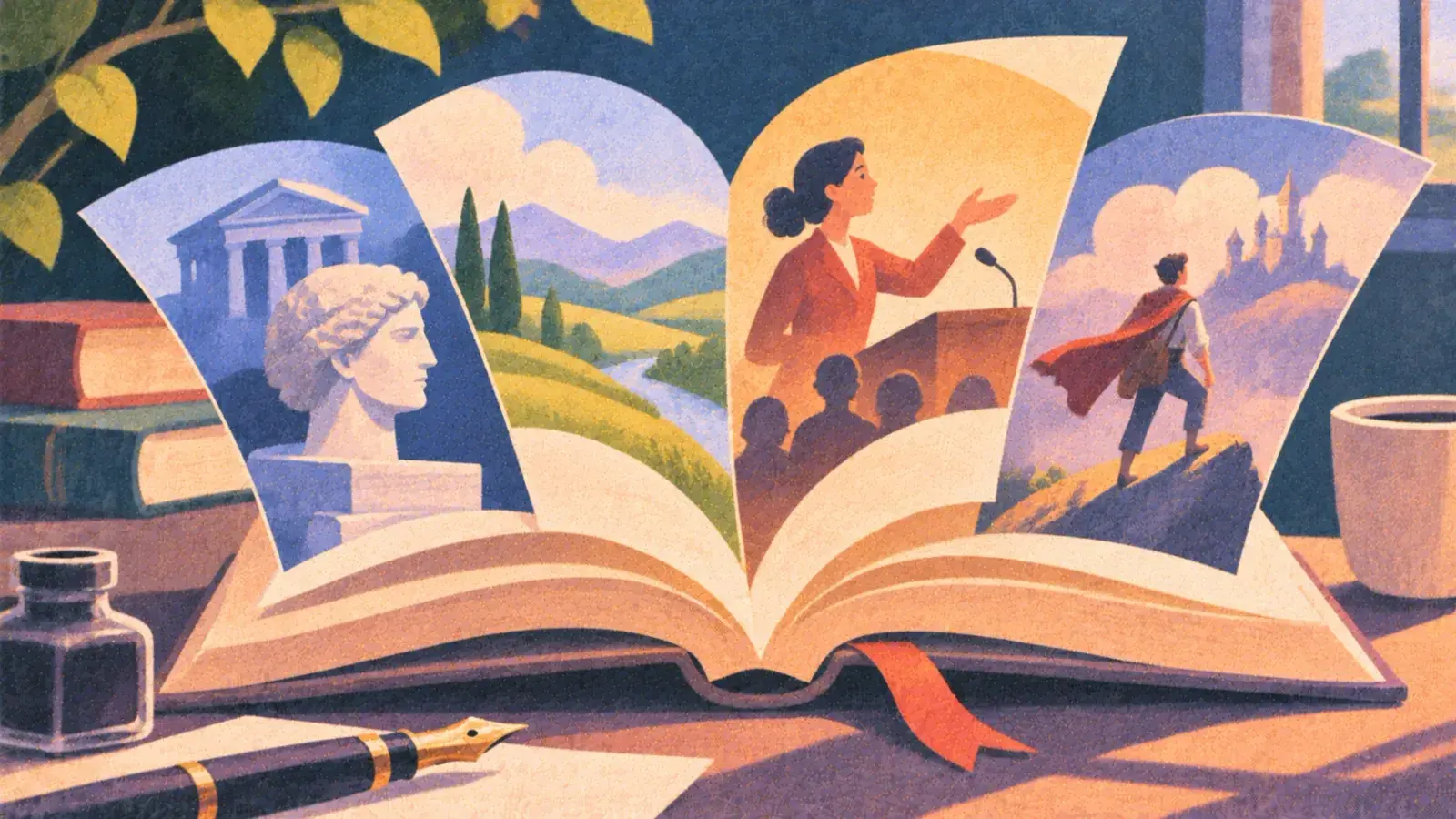
The four main types of writing styles are expository, descriptive, persuasive and narrative. Expository writing explains, descriptive writing makes the reader see, persuasive writing argues for a position, and narrative writing tells a story. They are often called the four modes of writing, and many real pieces mix them: a news feature can open with a scene, explain a policy and end on a quote that argues a point.
“Writing style” has a second meaning too: the way a writer sounds, plain or ornate, spare or lavish, conversational or academic. This page covers both. First the four types, with one subject written in all four modes and a public-domain example of each, then ten prose styles and where they overlap with the types, and finally how to find and refine a style of your own.
The four types at a glance
| Type | Purpose | Where you see it | Signals |
|---|---|---|---|
| TypeExpository | PurposeExplain or inform | Where you see itTextbooks, news, manuals, reports, how-to guides | SignalsFacts, definitions, steps, a neutral tone, clear structure |
| TypeDescriptive | PurposeMake the reader see, hear and feel | Where you see itFiction, travel writing, memoir, poetry | SignalsSensory detail, precise nouns, comparisons |
| TypePersuasive | PurposeWin agreement or action | Where you see itOp-eds, speeches, ads, proposals, cover letters | SignalsA claim, reasons, evidence, appeals, a call to act |
| TypeNarrative | PurposeTell what happened | Where you see itNovels, short stories, memoir, anecdotes, case studies | SignalsCharacters, events in order, conflict, a point of view |
The division is old. It was first set out in Samuel P. Newman's A Practical System of Rhetoric (1827) and still shapes writing classes and standardized tests. Composition scholars have long questioned how well it describes writing outside school, and Robert J. Connors traced its history in a 1981 essay, “The Rise and Fall of the Modes of Discourse.” For working writers, the modes are most useful as a question to ask of any paragraph: what is this one for?
One subject, four modes
Few published pieces use one mode from start to finish. Here is the opening of an invented newspaper feature, with each sentence labeled by the job it does.
Narrative. At 7:40 on a Tuesday, Arturo Bellini rolls up the steel shutter of Bellini Office Machines on Carver Street, the last typewriter repair shop in Harlow Falls.
Descriptive. Inside, the air smells of machine oil and old paper, and three hundred typewriters wait on wire shelves, their keys yellowed like old piano ivories.
Expository. New parts stopped coming years ago, so Bellini keeps his customers running with springs and keys salvaged from machines that can't be saved.
Persuasive. “People call it nostalgia,” he says. “It's a machine that still works after seventy years. Name one other thing in your house that can say that.”
Each mode does something different to the reader. The scene earns attention, the description makes the shop real, the exposition is the nut graf that says why the story matters, and the quote makes the argument the reporter can't make in her own voice. Knowing the four types can show you which one a weak paragraph is missing. The sections below take each mode in turn.
Expository writing: to explain
Expository writing explains how something works, what happened or what a term means. It is the type most people read and write every day, in work email, reports, instructions, news and textbooks. Its signals are a stated subject, definitions, examples, steps or causes in a clear order, and a neutral tone. The writer's opinions stay in the background, and the test is whether the reader understands.
I purpose, in return for the honour you do us by coming to see what are our proceedings here, to bring before you, in the course of these lectures, the Chemical History of a Candle. … There is not a law under which any part of this universe is governed which does not come into play, and is touched upon in these phenomena.
Faraday's lectures, given “before a juvenile audience at the Royal Institution,” open the way much good exposition does: they name the subject, then give the listener a reason to care. The rest of the book explains the candle flame step by step, with demonstrations.
Reports and documentation are expository at heart, and so are many essays. The expository essay examples show the school and college forms, from process essays to cause-and-effect.
Descriptive writing: to show
Descriptive writing makes the reader see, hear, smell and feel a person, place or moment. It uses sensory detail, precise nouns and verbs, and comparisons, and it chooses a few details over a full inventory. Description rarely stands alone for long. It slows a story down at the moments that matter, or gives an argument a picture the reader will remember.
There seemed to be nothing to see; no fences, no creeks or trees, no hills or fields. If there was a road, I could not make it out in the faint starlight. There was nothing but land: not a country at all, but the material out of which countries are made.
Cather describes the Nebraska prairie mostly by what isn't there, then lands one image the reader keeps: land as raw material, not yet a country. Good description often works this way, by choosing the one comparison that does the work of twenty adjectives.
For vocabulary sorted by sense, person and place, see the descriptive words list.
Persuasive writing: to convince
Persuasive writing tries to change what the reader believes or does. It makes a claim, gives reasons and evidence, answers objections and usually ends by asking for something. It draws on the three classical appeals, ethos, pathos and logos: the writer's credibility, the reader's emotions and the logic of the case.
These are the times that try men's souls. The summer soldier and the sunshine patriot will, in this crisis, shrink from the service of their country; but he that stands it now, deserves the love and thanks of man and woman. Tyranny, like hell, is not easily conquered; yet we have this consolation with us, that the harder the conflict, the more glorious the triumph.
Paine names the reader's temptation (to quit), shames it with two memorable labels, then offers a reward for staying. The sentences are built to be read aloud and balanced so they stick, and the first one has been quoted ever since.
The persuasive techniques guide covers fifteen methods in detail, from the three appeals to techniques of structure.
Narrative writing: to tell
Narrative writing tells a story: characters, events in an order, a conflict and some change. Fiction is narrative by definition, but the type runs through nonfiction too, in memoir, case studies, the anecdote that opens a speech and the scene at the top of a feature. Its signals are time markers, a point of view, and a pull toward what happens next.
One dollar and eighty-seven cents. That was all. And sixty cents of it was in pennies. Pennies saved one and two at a time by bulldozing the grocer and the vegetable man and the butcher until one's cheeks burned with the silent imputation of parsimony that such close dealing implied. Three times Della counted it.
Before we know who Della is, we know her problem, her pride and her budget. Narrative writing often sets up a want and a situation quickly, then makes the reader wait to see what the character will do.
For nonfiction stories, see the narrative essay examples. In fiction, how the story sounds depends on the teller, which is the subject of the guide to narrative voice.
Ten prose styles, with examples
Style in the second sense is how prose sounds. To see the range, here is one event, a river flooding a town library overnight, written ten ways.
| Style | How it sounds, and what the reader gets | The flood, in this style |
|---|---|---|
| StylePlain | How it sounds, and what the reader getsShort words, direct sentences. The reader gets the fact at once. | The flood, in this styleThe river rose overnight and flooded the library's ground floor. |
| StyleOrnate | How it sounds, and what the reader getsElaborate words, long rhythms, rich figures. The reader is asked to linger. | The flood, in this styleIn the small hours the river, swollen with a week of rain, crept over its banks and laid its brown silk across the library's lower rooms. |
| StyleMinimalist | How it sounds, and what the reader getsSpare and flat. The reader supplies the feeling. | The flood, in this styleThe river came up in the night. In the morning the books were wet. |
| StyleMaximalist | How it sounds, and what the reader getsLong, crowded sentences. The reader gets the whole texture of the place. | The flood, in this styleThe river came over the wall at three, past the returns slot and the flyers for yoga and lost cats, into the children's room, where it lifted the beanbags and the reading rug and a paper moon someone had hung from the ceiling in October. |
| StyleConversational | How it sounds, and what the reader getsA person talking to you. The reader feels addressed. | The flood, in this styleSo the river finally did it. Came right up into the library overnight, and the kids' section got the worst of it. |
| StyleFormal | How it sounds, and what the reader getsImpersonal, complete, no contractions. The reader hears an institution. | The flood, in this styleThe municipal library sustained significant flood damage overnight when the river exceeded its banks. |
| StyleAcademic | How it sounds, and what the reader getsPrecise and hedged. The reader learns how far to trust the claim. | The flood, in this styleDamage to the ground-floor collection suggests that riverside civic buildings remain vulnerable to extreme rainfall (see Table 2). |
| StyleJournalistic | How it sounds, and what the reader getsFacts first, attributed. The reader gets the news and its source in one sentence. | The flood, in this styleFloodwater from the Asher River swept into the public library early Wednesday, damaging thousands of books, officials said. |
| StyleTechnical | How it sounds, and what the reader getsExact and ordered. The reader knows what to do. | The flood, in this styleIf water enters the building, switch off power at the main panel, then move items from the two lowest shelves to an upper floor. |
| StyleLyrical | How it sounds, and what the reader getsRhythmic and image-led. The reader gets a feeling before a fact. | The flood, in this styleAll night the river read the library, page by page, and in the morning every story had gone soft. |
The two lists overlap. Some styles come with a purpose built in: technical prose is expository by nature, and journalistic style is mostly expository, with narrative openings. Others, such as plain and ornate, can serve any of the four types. A persuasive speech can be plain or ornate, and a description can be minimalist or lyrical, so it often helps to name both: a plain persuasive op-ed, a lyrical descriptive essay.
Most of these styles come in pairs, and many writers move between the two ends of a pair rather than living at one of them. The sections below take four pairs in turn.
Plain and ornate
Plain style values clarity over display. One of its best-known rules comes from a little book by William Strunk Jr., a professor of English at Cornell:
Vigorous writing is concise. A sentence should contain no unnecessary words, a paragraph no unnecessary sentences, for the same reason that a drawing should have no unnecessary lines and a machine no unnecessary parts. This requires not that the writer make all his sentences short, or that he avoid all detail and treat his subjects only in outline, but that he make every word tell.
George Orwell's version, in “Politics and the English Language” (1946), is shorter still: “Never use a long word where a short one will do.” Ornate style goes the other way, toward long rhythms, unusual words and stacked images, and at its best it is meant to be savored, as in the famous conclusion to Walter Pater's essays on the Renaissance:
Not the fruit of experience, but experience itself, is the end. A counted number of pulses only is given to us of a variegated, dramatic life. How may we see in them all that is to be seen in them by the finest senses? How shall we pass most swiftly from point to point, and be present always at the focus where the greatest number of vital forces unite in their purest energy? To burn always with this hard, gemlike flame, to maintain this ecstasy, is success in life.
The risk of ornate style is purple prose, writing that draws more attention to itself than to its subject. The risk of plain style is flatness. A lot of good prose is plain most of the time and rises when the moment can carry it.
Minimalist and maximalist
Minimalism cuts to the bone: short declarative sentences, little figurative language, and emotion carried by what is left out. Ernest Hemingway's stories of the 1920s and Raymond Carver's stories are the usual examples. Maximalism piles on, with long sentences, lists, digressions and the sense that nothing is too small to include. Herman Melville can do it in one breath:
Whenever I find myself growing grim about the mouth; whenever it is a damp, drizzly November in my soul; whenever I find myself involuntarily pausing before coffin warehouses, and bringing up the rear of every funeral I meet; and especially whenever my hypos get such an upper hand of me, that it requires a strong moral principle to prevent me from deliberately stepping into the street, and methodically knocking people's hats off—then, I account it high time to get to sea as soon as I can.
The repeated “whenever” builds pressure, the details get stranger as they go, and the dash releases it all into one plain decision. Long sentences tend to work when they are built this carefully, with a pattern the reader can ride.
Conversational and academic
Conversational style sounds like a person talking: first and second person, contractions, short paragraphs, the occasional joke. It suits newsletters, blogs, speeches and personal essays. Mark Twain opens an essay on storytelling in exactly that voice:
I do not claim that I can tell a story as it ought to be told. I only claim to know how a story ought to be told, for I have been almost daily in the company of the most expert story-tellers for many years. There are several kinds of stories, but only one difficult kind—the humorous.
Academic style sits at the other end: precise terms, claims hedged to match the evidence, citations, and structures such as IMRaD that readers in a field expect. It is formal by default, though style manuals such as APA's now encourage active verbs and “we” for describing your own work. Where conversational prose can turn chatty, academic prose fails the other way: so qualified and abstract that the claim disappears.
Journalistic and technical
Both are styles of service. Journalistic style puts the most important facts first, in the inverted pyramid, attributes every claim and keeps paragraphs short, usually following a house style guide such as AP. Technical style is written to be followed: consistent terms, numbered steps, one action per sentence, nothing the reader has to interpret. In both, a good sentence is one the reader can act on without reading it twice.
How to find your writing style
Style isn't something you choose once. It is the residue of thousands of small choices, and you can make them more deliberately.
- Read like a writer
Keep a file of passages you admire, from any genre, and write one line under each on what it does: the long sentence that lands, the verb you wouldn't have thought of. After a few months the file shows you what you are drawn to.
- Imitate on purpose
Benjamin Franklin describes teaching himself to write this way in his autobiography:
Franklin's methodAbout this time I met with an odd volume of the Spectator. It was the third. I had never before seen any of them. I bought it, read it over and over, and was much delighted with it. I thought the writing excellent, and wished, if possible, to imitate it. With this view I took some of the papers, and, making short hints of the sentiment in each sentence, laid them by a few days, and then, without looking at the book, try'd to compleat the papers again, by expressing each hinted sentiment at length, and as fully as it had been expressed before, in any suitable words that should come to hand. Then I compared my Spectator with the original, discovered some of my faults, and corrected them.
Benjamin Franklin, Autobiography (written 1771–1790) The exercise still works: take notes on a page you admire, put it away for a few days, rebuild it from the notes, then compare.
- Measure your own habits
Take three recent pieces and look at them as an editor would: how long your sentences run on average, which words you reach for, how your paragraphs begin, how often you hedge. Some habits are your style. Others are tics.
For a second reading, attach a sample of the style you're aiming for and ask the Strokes Assistant where your draft's sentences run longer, or its vocabulary more formal, than the sample's.
- Fit the style to the reader
A writer can have a home style and still move along the scale. A grant report, a newsletter and a short story ask for different settings, and a publication's house style overrides your preferences on its pages.
- Cut what isn't yours
Read your draft aloud and mark every phrase you have heard a hundred times before. Borrowed phrases are the fastest way to sound like everyone else.
- Write your rules down
A one-page personal style sheet (contractions or not, serial comma or not, words you never use, your default sentence length) keeps long projects consistent. Copy editors keep a style sheet for each manuscript they edit for the same reason.
Frequently asked questions
Is persuasive writing the same as argumentative writing?
They overlap, and many teachers use the terms interchangeably. When they are separated, persuasive writing aims to move a particular reader to agree or act, using values and emotion as well as evidence, while argumentative writing addresses a neutral reader and rests its case on research and reasoning.
Are creative writing and technical writing types of writing too?
Some schemes list them as extra types, but they are better seen as families of genres. Creative writing (fiction, poetry, drama, memoir) mostly combines narrative and descriptive writing. Technical writing (manuals, documentation, procedures) is expository writing in a technical style. That is why some lists show four types and others five or six: they sort by different things.
Can a writer use more than one style?
Yes, and many professional writers do. A journalist may write news in a terse style and a weekend essay in a conversational one, and a novelist may move from lyrical description to plain dialogue on the same page. The skill is choosing the style each reader and purpose calls for.