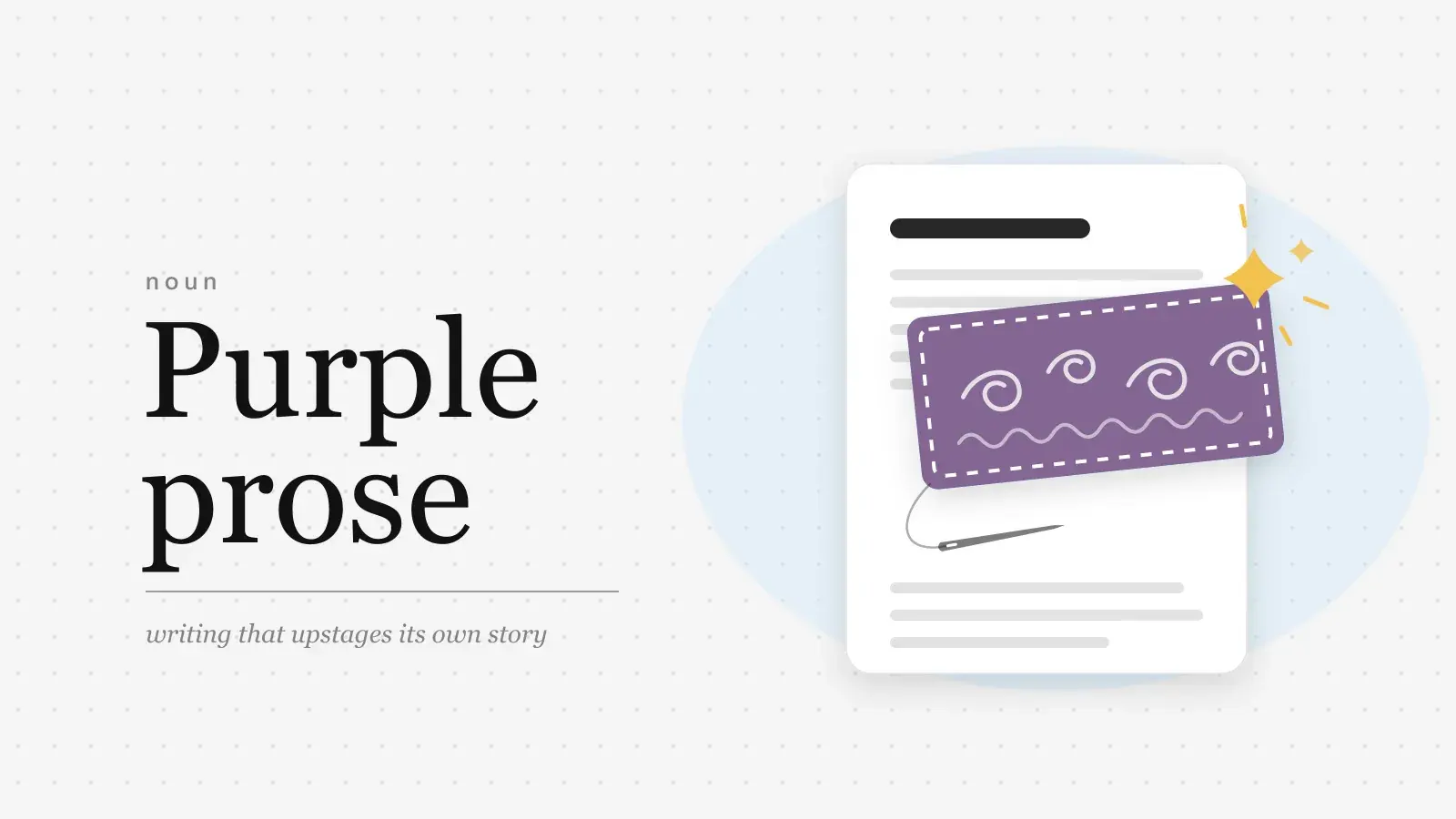
Purple prose is writing so ornate that the language gets more attention than the thing it describes. The usual signs are stacked adjectives and adverbs, metaphors piled on metaphors, grand words for plain things and feelings pitched louder than the scene has earned. When the excess is confined to one passage, it's called a purple patch.
The term comes from Horace. In the Ars Poetica, a verse letter on the craft of poetry from the late first century BC, he complains that serious works often have a purpureus pannus, a purple patch, sewn on to shine far and wide: a description of Diana's grove and altar, a stream winding through fields, the Rhine, a rainbow. Purple dye was expensive and a mark of rank, so the patch is costly and conspicuous. Horace doesn't say the descriptions are badly made. His objection is that this was not the place for them (sed nunc non erat his locus). That is still the most useful definition: purple prose is ornament in the wrong place.
Purple prose examples
Purple prose is easier to recognize than to define, so here are the cases editors and writers keep coming back to, plus three where the ornament is doing a job.
It was a dark and stormy night; the rain fell in torrents, except at occasional intervals, when it was checked by a violent gust of wind which swept up the streets (for it is in London that our scene lies), rattling along the house-tops, and fiercely agitating the scanty flame of the lamps that struggled against the darkness.
The sentence is less florid than its reputation. Its trouble is that it works hard and goes nowhere: 58 words of weather that does nothing for the plot, an aside to the reader in parentheses, and lamps that "struggled" against the dark. Charles Schulz gave the first seven words to Snoopy, who opens his novels with them. From 1982 until 2025, when its founder retired it, the Bulwer-Lytton Fiction Contest, started by Professor Scott Rice at San José State University, asked entrants for "the opening sentence to the worst of all possible novels."
Sympathise with me, indeed! Ah, no! Cast your sympathy on the chill waves of troubled waters; fling it on the oases of futurity; dash it against the rock of gossip; or, better still, allow it to remain within the false and faithless bosom of buried scorn.
Ros's husband paid a printer to publish her first novel as a tenth-anniversary present, and the whole book sounds like this: four unrelated metaphors for one refusal, and in the next sentence Irene paces "the beach of limited freedom." Ros also hates to name a thing twice. In Chapter 12 a woman opens her eyes, and one sentence later she casts "her heavily-laden orbs of blinded brilliancy" around the room. The Fowler brothers called that habit elegant variation in The King's English (1906), and it is the small, common version of Ros worth catching in your own draft: the second mention of eyes that becomes "orbs." The Inklings, the Oxford circle of C. S. Lewis and J. R. R. Tolkien, held contests to see who could read her aloud longest without laughing.
During the whole of a dull, dark, and soundless day in the autumn of the year, when the clouds hung oppressively low in the heavens, I had been passing alone, on horseback, through a singularly dreary tract of country; and at length found myself, as the shades of the evening drew on, within view of the melancholy House of Usher.
By modifier count this is as heavy as Bulwer-Lytton. The difference is that every one of them points the same way: dull, dark, soundless, low, alone, dreary, melancholy. The sentence builds a single mood and holds the house back until its last words. In a gothic story the airlessness is the point, so the style is doing the plot's work.
Gibbons found the earthy rural novels of her day overblown, Mary Webb's among them, and wrote her first novel as a parody of the genre. She marked the most overwritten passages with one to three asterisks, a system explained in a spoof foreword addressed to an invented man of letters, Anthony Pookworthy, so readers could find the fine writing for themselves. The starred passages are lush, heaving nature writing, and they're funny because they are only slightly exaggerated.
Humbert Humbert narrates in puns, alliteration and showy allusion, and the first chapter warns you about it: a murderer, he says, can always be counted on for a "fancy prose style." The lushness is characterization. Humbert, an unreliable narrator, is charming the reader so they won't look straight at what he did, and the style is there to be distrusted. Purple on purpose is a different thing from purple by accident.
How to spot purple prose
Most purple prose comes from trying hard on the pages that feel important: openings, the first look at a setting or a love interest, emotional peaks, endings. Check those first. Any one sign below is harmless on its own. Purple prose is several at once, in a scene that didn't need them.
| Sign | Looks like | Try instead |
|---|---|---|
| SignAdjective stacks | Looks likethe cold, gray, merciless sea | Try insteadThe one detail only this sea has |
| SignAdverbs on strong verbs | Looks likewhispered softly, slammed violently | Try insteadThe verb alone |
| SignThesaurus words | Looks likeorbs, tresses, cerulean, lachrymose | Try insteadThe word your narrator would use |
| SignMetaphor pileups | Looks likea fortress of silence, a storm of grief | Try insteadOne image per thing, or none |
| SignShowy dialogue tags | Looks likeshe hissed, he chortled, she breathed | Try insteadsaid, or an action |
| SignEmotion at full volume | Looks likea tidal wave of unspeakable grief | Try insteadWhat she does next |
| SignScenery doing no work | Looks likea page of sunset before anything happens | Try insteadWhat this character notices today |
Dialogue tags deserve a special look, because a run of hissed, growled and breathed lines turns a conversation into a performance. Mark Twain's 1895 essay "Fenimore Cooper's Literary Offenses" covers most of the table in two of its rules: use the right word, "not its second cousin," and "eschew surplusage." Pudd'nhead Wilson (1894) adds one you can apply with a pencil: "As to the Adjective: when in doubt, strike it out."
Fixing it in your manuscript
Before: The ancient, weathered farmhouse crouched malevolently beneath the bruised and brooding sky like a wounded beast awaiting its final breath, and as Eleanor's tear-filled cerulean orbs drank in its haunted visage, a tidal wave of unspeakable sorrow crashed mercilessly over the very depths of her shattered soul.
After: The farmhouse was smaller than she remembered. Someone had painted the porch green, the wrong green, and her father's boot scraper was still bolted by the door. Eleanor left the engine running.
The first version tells you she's sad four times (tear-filled, sorrow, crashed, shattered) and describes a house that could be any haunted house in any book. The second describes this one, through a daughter's eyes. The size is her childhood, the paint is a stranger, the boot scraper is her father, and the running engine is the grief. It's also 15 words shorter.
- Find the patch. Read the chapter aloud and mark every place you catch yourself admiring a sentence instead of seeing the scene.
- Ask Horace's question. Is this the place? If a description doesn't change what the reader knows or feels, cut it to a line, or cut it.
- Strike modifiers first. Delete the adverbs and most of the adjectives, then reread. Usually nothing is missing. Where something is, add one concrete noun instead of putting the adjectives back.
- Keep one image per thing. If a silence is a fortress, it can't also be a storm two clauses later.
- Hand the description to your viewpoint character. A farmer doesn't see "verdant pastures"; she sees the field that flooded in March. Staying inside one point of view is the quickest cure for generic detail.
An AI assistant is better as a detector than a rewriter here. Add the chapter to a chat (the AI Assistant in Strokes takes a whole document as context) and ask for a list of every sentence with three or more modifiers or more than one metaphor, without rewrites. A request to "make it more vivid" invites more ornament, not less, so make the cuts yourself and keep them in your voice.
Purple prose vs. lyrical prose
Rich language isn't purple by itself. Lyrical prose is dense, musical and figurative, and its flourishes carry something: mood, character, a way of seeing. Purple prose has the surface without the cargo. At the other end sits beige prose, writing so plain it has no texture, which is what you often get from a writer who has cut every adjective on principle.
| Purple | Lyrical | Beige | |
|---|---|---|---|
| Ornament | PurpleEverywhere, at equal volume | LyricalWhere the scene needs it | BeigeAlmost none |
| Details | PurpleGeneric: any sunset | LyricalSpecific: this sunset | BeigeOnly what you need to follow |
| Cut a sentence and you lose | PurpleThe sound | LyricalMood, character or meaning | BeigeInformation |
| The reader notices | PurpleThe writer | LyricalThe world | BeigeThe plot |
Where the line falls depends on genre and reader. A gothic novel can carry more ornament than a thriller, and critics disagree about individual writers all the time. In 1985 the novelist Paul West argued for rich, sensuous, intensified writing in "In Defense of Purple Prose," an essay for The New York Times. In 2001 B. R. Myers went the other way in "A Reader's Manifesto" in The Atlantic, attacking what he saw as growing pretentiousness in acclaimed American literary prose. Calling a passage purple is a judgment that it costs the reader more than it gives back, so test it against the scene rather than against a rule.
Related terms
Purple prose is often what goes wrong when writers try to show, don't tell by adding description instead of evidence. It's usually caught at the line editing stage, where an editor works sentence by sentence on rhythm and word choice. Long descriptive passages also slow a book down, which Pacing in writing covers in detail.