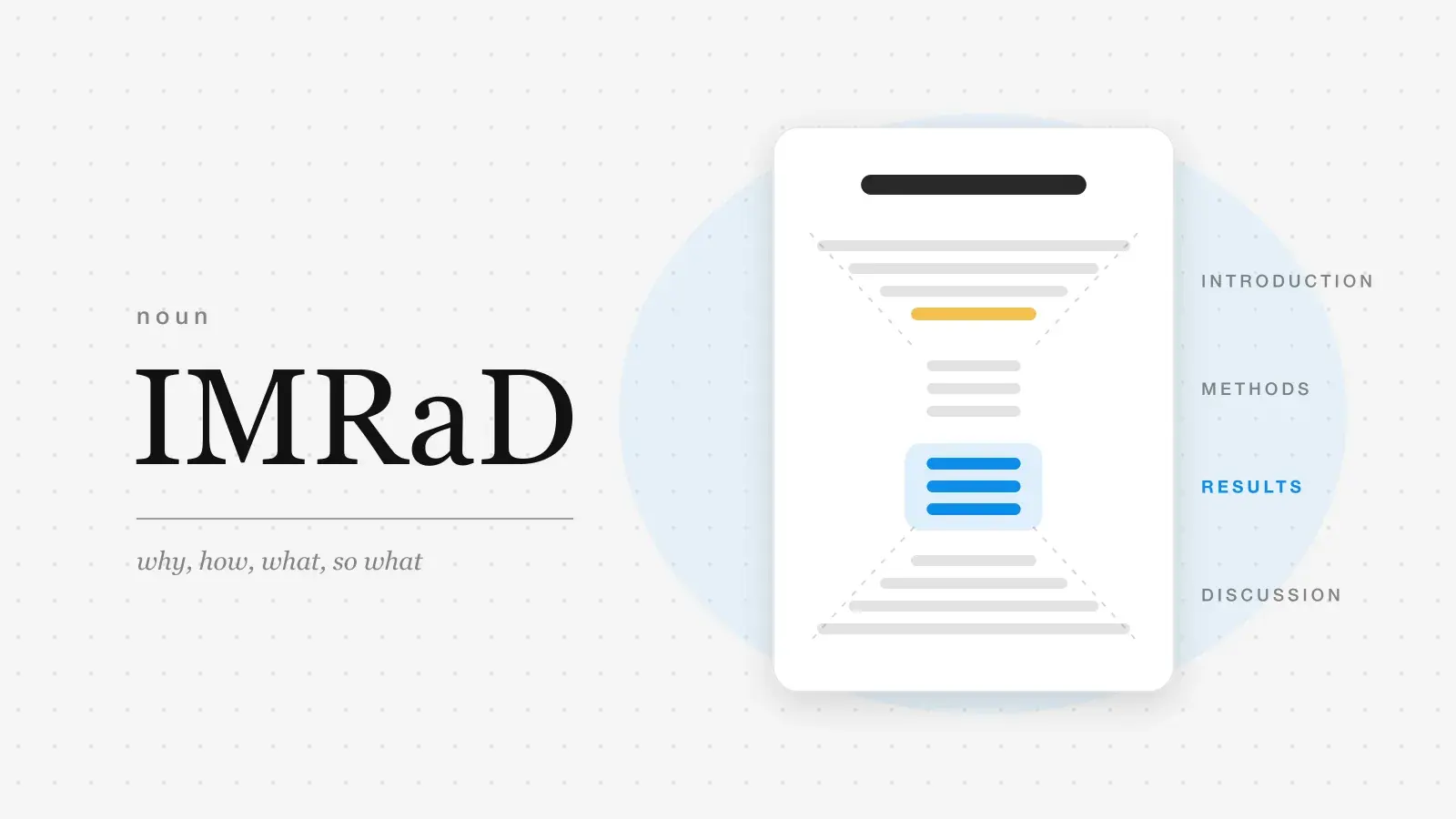
IMRaD is the standard structure of a research paper in the sciences and social sciences: Introduction, Methods, Results and Discussion, in that order. Each section answers one question about the study (why, how, what, so what), so a reader can go straight to the part they need.
The lowercase "a" stands for "and" (a few guides read it as "analysis"), and many journals write it IMRAD. The title and abstract sit in front and the references at the end, but they are not part of the acronym; some writers add an A for the abstract and call it AIMRaD. The structure is younger than it looks. A 2004 survey by Sollaci and Pereira in the Journal of the Medical Library Association traced articles in the BMJ, JAMA, The Lancet and the New England Journal of Medicine from 1935 to 1985. IMRaD first appeared there in the 1940s, reached about 80 percent of articles by the 1970s and was the only pattern for original research by the 1980s. The International Committee of Medical Journal Editors (ICMJE) calls it "not an arbitrary publication format but a reflection of the process of scientific discovery."
The four sections
| Section | Answers | Put in | Keep out |
|---|---|---|---|
| SectionIntroduction | AnswersWhy ask this? | Put inWhat is known, the gap, your question or hypothesis | Keep outYour results; a tour of everything ever published |
| SectionMethods | AnswersHow did you find out? | Put inWho or what you studied, materials, procedure, analysis | Keep outWhy the topic matters; any findings |
| SectionResults | AnswersWhat did you find? | Put inFindings, in the past tense, with tables and figures | Keep outInterpretation and comparison with other studies |
| SectionDiscussion | AnswersWhat does it mean? | Put inThe answer, how it fits other work, limitations, implications | Keep outNew data; every number repeated |
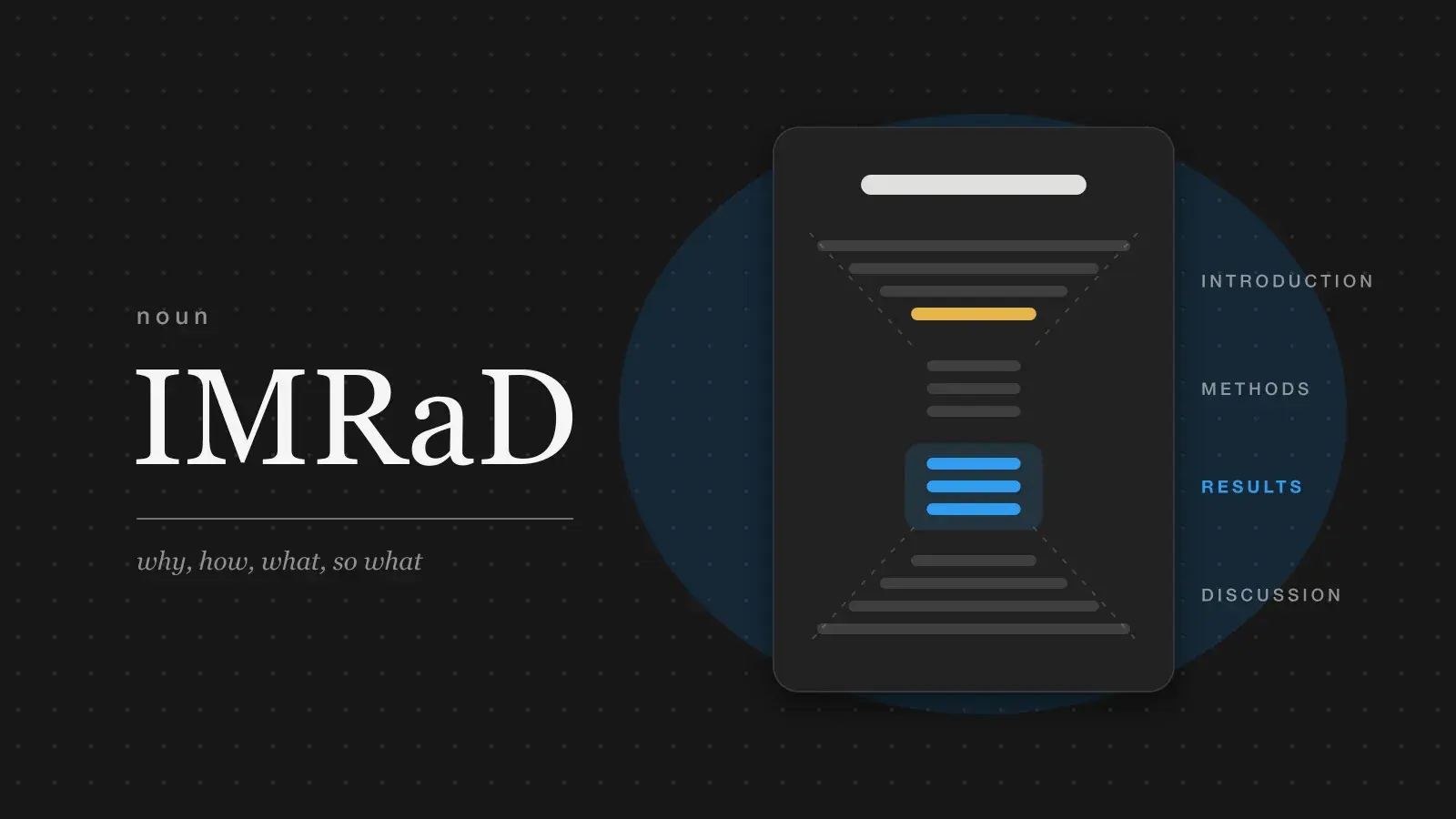
Writing teachers often draw the structure as an hourglass. The introduction starts wide, with the field, and narrows to one question. Methods and results stay narrow: this study, these data. The discussion widens again, from what you found to what it means for everyone else.
The headings vary by style guide and journal. APA style gives the introduction no heading at all (the paper's title sits above it) and uses the singular "Method." Biology journals often say "Materials and Methods." Some journals print the methods last, short papers sometimes merge "Results and Discussion," and many fold the conclusion into the last paragraph of the discussion. The four jobs stay the same.
IMRaD examples
Introduction. Writing guides often tell writers to read drafts aloud, on the theory that the ear catches what the eye skips. We tested that advice: does reading aloud find more errors than reading silently, and which kinds?
Methods. Forty undergraduate volunteers each proofread two 600-word passages, one aloud and one silently. Each passage contained 20 planted errors: 8 missing or repeated words, 7 misspellings and 5 agreement errors. We counterbalanced the order of passages and conditions and timed each reading.
Results. Participants found more errors reading aloud (mean 13.2 of 20) than silently (10.6). Most of the difference came from missing and repeated words, 6.1 of 8 found aloud against 3.9 silently. Misspellings were found at similar rates. Reading aloud took longer, 6.8 minutes against 4.9.
Discussion. Reading aloud helped most with errors the eye corrects without noticing: a skipped "the" or a doubled "and" has to be spoken, so it is heard. It did little for spelling. The readers were students and the errors were planted; writers checking their own drafts may do worse in both conditions, since they know what they meant to say. For a final pass on a short piece, the advice appears to hold.
Notice what each section leaves out. The results never say why reading aloud worked; the discussion never introduces a number the results did not report.
Background: Writers are often told to read drafts aloud. We tested whether this finds more errors than silent reading. Methods: 40 undergraduates proofread two 600-word passages with 20 planted errors each, one aloud and one silently, in counterbalanced order. Results: Reading aloud found more errors (13.2 vs. 10.6 of 20), mainly missing and repeated words, and took about 40% longer. Conclusions: Reading aloud is worth the time on a final pass, especially for dropped and doubled words.
ICMJE's recommendations call for structured abstracts on original research, systematic reviews and meta-analyses, and note that the headings differ from journal to journal. Whatever the labels, a structured abstract is IMRaD compressed to a sentence or two per part. For descriptive and informative abstracts and typical lengths, see How to write an abstract.
Lind's account of his 1747 trial has no section titles, but the moves are all there. The problem is scurvy at sea. The method: on May 20, aboard HMS Salisbury, he took twelve sailors with scurvy, kept them on the same diet and gave six pairs six different remedies, from cider and vinegar to seawater and citrus. The result: when the fruit ran out after six days, one of the two men given oranges and lemons was fit for duty. The rest of the book argues from that result. Read with IMRaD in mind, it is a methods section and a results section buried in a treatise.
- Introduction: why freelance editors' rates vary so widely, and the question: how do editors set them?
- Methods: Participants (14 freelance editors), Interviews (45 to 60 minutes, semi-structured), Analysis (thematic coding by two readers)
- Findings: Pricing by the word; Pricing by the hour for heavy edits; Rates borrowed from peers
- Discussion: what the themes mean for new editors, and the limits of 14 voices
Results become "Findings," organized by theme, with quotations as the evidence. The frame around them does not change.
Writing a paper in IMRaD
Write the sections out of order. Draft the methods first, while you still remember what you did, then the results, starting from your tables and figures. The UNC Writing Center's guide to scientific reports says many writers find that drafting those two first clarifies their own idea of the study. Write the discussion next, then the introduction, now that you know which question the paper actually answers. The abstract and title come last. The research paper outline template is laid out in this order.
Most weak IMRaD papers fail at the borders, when one section does the next one's job. Interpretation creeps into the results, or the discussion adds a finding the results never reported. The introduction turns into a literature review with no question at the end. Methods and results go in the past tense; in the discussion, verbs like "suggests" and "indicates" claim what the data support and no more.
Before (Results): Readers found more errors aloud (13.2 vs. 10.6), which proves that hearing the text is the better way to proofread because the ear cannot skip words.
After (Results): Readers found more errors aloud (13.2 vs. 10.6 of 20), mostly missing and repeated words.
After (Discussion): The gain came almost entirely from omitted and doubled words, which suggests that speaking forces attention to each word in a way silent reading does not.
In Strokes you can keep each section as its own document in a project folder, then add the results document to an AI Assistant chat while you draft the discussion and ask it to flag any claim the results do not support. Check whatever it says against your data. A model that supplies a plausible number your study never produced is a hallucination in your paper.
Reading an IMRaD paper as a writer
If you write nonfiction or cover science, you will read far more of these papers than you write, and you do not have to read them in order. Start with the title and abstract, then the figures and tables, then the first paragraph of the discussion, which usually restates the main finding. Then go to the methods for what limits the claim: how many people, which people, compared with what, for how long. The limitations paragraph near the end of the discussion is where the authors say what the study cannot show.
When you write about the paper, quote the results for what happened and the discussion for what the authors think it means, and tell your reader which is which. If a number in the abstract does not match the results table, trust the table and ask the authors.
IMRaD vs. other structures
| Structure | Used for | Shape |
|---|---|---|
| StructureIMRaD | Used forOriginal research articles, lab reports, empirical theses | ShapeIntroduction, Methods, Results, Discussion |
| StructureAIMRaD, IMRaD with Conclusion | Used forThe same, naming the abstract or a closing section | ShapeIMRaD with one more part at an end |
| StructureLiterature review | Used forSummarizing existing research | ShapeIntroduction, themed sections, gaps, conclusion |
| StructureThesis-driven essay | Used forHumanities and argumentative papers | ShapeThesis, one section per claim, conclusion |
| StructureCase report, narrative review, editorial | Used forJournals, alongside research articles | ShapeLooser; ICMJE allows unstructured formats |
| StructureInverted pyramid | Used forNews stories | ShapeMost important facts first, details in falling order |
The abstract plays the part of an inverted pyramid lead: the finding up front for readers who stop there. The paper below it runs in the order the research did, or seems to. In a 1963 BBC radio talk, printed in The Listener as "Is the Scientific Paper a Fraud?", the biologist and Nobel laureate Peter Medawar argued that the standard paper misrepresents how scientists think, presenting a tidy march from observation to conclusion when the idea usually comes first. Editors keep the form anyway, because readers can find things in it.
Related terms: nut graf, the paragraph that does in a feature story what the end of an introduction does in a paper, and inverted pyramid. For a full annotated paper, read Research paper example: structure explained section by section; for the section most people get wrong, see the methodology section example.