Ethos, pathos and logos are the three means of persuasion Aristotle described in his Rhetoric. Ethos persuades through the speaker's character, pathos through the emotions the audience feels, and logos through the argument itself: its reasons and evidence. Nearly every persuasive speech or essay uses all three, in different proportions.
Aristotle called them pisteis, proofs, and the Greek words mean more than their textbook glosses. Ēthos is character. Pathos is what a person undergoes or feels. Logos is word, speech and reason at once. In W. Rhys Roberts's translation of Book I, Chapter 2:
Of the modes of persuasion furnished by the spoken word there are three kinds. The first kind depends on the personal character of the speaker; the second on putting the audience into a certain frame of mind; the third on the proof, or apparent proof, provided by the words of the speech itself.
Two points in that chapter get lost in most summaries. Aristotle insists that ethos be achieved "by what the speaker says, not by what people think of his character before he begins to speak." A title helps, but the trust has to be earned on the page. And he ranks it high: the speaker's character "may almost be called the most effective means of persuasion he possesses."
| Appeal | Works through | Built with | Abused as |
|---|---|---|---|
| AppealEthos | Works throughTrust in the speaker or writer | Built withPrecise knowledge, fairness to the other side, a visible stake | Abused asBorrowed authority, attacks on a person instead of an argument |
| AppealPathos | Works throughThe audience's emotions and values | Built withOne specific case, concrete detail, the audience's own values | Abused asFear out of proportion to the facts, guilt, staged outrage |
| AppealLogos | Works throughThe argument itself | Built withClaims, reasons, evidence, examples, analogies | Abused asCherry-picked numbers, false choices, changing the subject |
Examples of ethos, pathos and logos
I thrice presented him a kingly crown,
Which he did thrice refuse: was this ambition?
Brutus has just told the crowd that Caesar was ambitious, and Antony is allowed to speak only if he does not blame the conspirators. So he argues sideways, using all three appeals. For ethos he plays the plain man: "I am no orator, as Brutus is." For logos he answers the charge with evidence, three pieces of it: the ransoms Caesar brought into the treasury, his tears for the poor, the crown he refused. Between them comes the refrain "Brutus is an honourable man," until the phrase means its opposite. A citizen concludes, "Methinks there is much reason in his sayings." Then pathos finishes the job. Antony teases the crowd with Caesar's will, comes down to the body, and points to each dagger hole in the cloak. The crowd leaves to burn the conspirators' houses.
My reasons for marrying are, first, that I think it a right thing for every clergyman in easy circumstances (like myself) to set the example of matrimony in his parish…
Mr. Collins proposes to Elizabeth the way a man presents a case. He numbers his reasons, and the third is that his patroness, Lady Catherine, told him to marry: authority borrowed in place of his own. The only feelings he addresses are his. Darcy, fifteen chapters later, has the opposite fault. His proposal is full of feeling, also his own, and he spends much of it on how far beneath him she and her family are. Elizabeth's refusal names exactly what was missing. She might have felt some concern in refusing him "had you behaved in a more gentlemanlike manner." That is ethos in Aristotle's sense, character shown in the act of speaking, and Darcy admits near the end of the novel that the line tortured him.
At a time like this, scorching irony, not convincing argument, is needed.
Douglass tells his audience he will not argue that slavery is wrong, because doing so "would be to make myself ridiculous, and to offer an insult to your understanding." The time for that kind of argument, he says, is past, and "the feeling of the nation must be quickened." Yet even while declining to argue, he argues. One long sentence lists Black Americans plowing, building ships, working as lawyers, editors and teachers, raising families, and lands on "we are called upon to prove that we are men!" The list is evidence. The outrage in its last line is pathos. The speech shows that choosing an appeal is a judgment about what the audience is missing.
Last night Japanese forces attacked Hong Kong. Last night Japanese forces attacked Guam.
The day after Pearl Harbor, Roosevelt spoke for about six and a half minutes, and most of it is report rather than argument. He lists the other places attacked, one flat sentence each: Malaya, Hong Kong, Guam, the Philippine Islands, Wake Island, Midway. Then comes the conclusion, with the logician's word in it: "Japan has, therefore, undertaken a surprise offensive extending throughout the Pacific area." The repetition stirs feeling too, but no sentence in the list tells the listener what to feel. Congress declared war the same day.
Eight white Alabama clergymen had called the Birmingham protests "unwise and untimely" and blamed outsiders. King answers with all three appeals. For ethos, he gives his standing as president of the Southern Christian Leadership Conference, explains that its Birmingham affiliate invited him, and then sets himself beside the prophets of the eighth century B.C. and the Apostle Paul, who also carried a message beyond their home towns. For logos, he separates just laws from unjust ones, drawing on Augustine and Aquinas, so that breaking a segregation law becomes a reasoned position rather than disorder. For pathos, he writes one sentence of about three hundred words, a run of "when you" clauses that includes explaining to his six-year-old daughter why she can't go to an amusement park she saw advertised on television. It ends on why "we find it difficult to wait," which is the answer to "untimely."
The first vote is eleven to one for guilty, on a charge that carries a death sentence. Juror 8 does not claim the defendant is innocent. He asks the others to talk about it first, and over the film he takes the prosecution's case apart with logos: the switchblade that was supposed to be unique isn't, a witness could not have heard what he claimed over a passing train or reached his door in time, and another witness turns out to wear glasses she would not have had on in bed. The last holdout, Juror 3, is not moved by any of it. His certainty comes from his estrangement from his own son, and he gives way only when he breaks down over it. For a novelist, that is the useful pattern: reasons move most of the room, and the hardest character to persuade is held by something else.
Using the three appeals in your writing
Ethos. In Book II Aristotle names three things that make an audience trust a speaker: "good sense, good moral character, and goodwill." On the page, good sense shows in precise detail: the right date, the exact rule, the name of the thing. Character shows in fairness, such as conceding the strongest point against you before you answer it. Goodwill shows when it is clear you want something good for the reader and not only a win. One clause of credentials early on is plenty. A paragraph of them reads as insecurity.
Pathos. One person in one situation, rendered exactly, does more than a row of adjectives telling the reader how to feel. This is show, don't tell applied to argument. Pathos is also wider than sadness. Aristotle devotes ten chapters of Book II to emotions including anger, fear, shame, pity, indignation and envy, then three more to how the young, the old and people in their prime differ in character. Know who is reading before you decide which feeling the case needs.
Logos. A claim, a reason, and evidence that supports the reason. Aristotle's enthymeme is an argument with a premise left unsaid, and everyday persuasion is full of them. "She has published four novels, so her advice on query letters is sound" quietly assumes that writing novels teaches you how agents read queries. Find your own hidden premises and check that your audience actually holds them.
Pathos alone: "Harmon Street is a death trap. Every parent in this neighborhood lives in fear, and it's only a matter of time before something terrible happens. How many children have to get hurt before the city acts?"
All three: "I've walked my daughter across Harmon Street every school morning for three years. Drivers coming down the hill can't see the kids until they're past the delivery vans parked at the corner. Two weeks ago a boy in a yellow raincoat stepped out from behind one, and a pickup stopped about a car length short of him. He laughed. His mother, a step behind him, didn't. Our crossing guard counted the children using that corner for a week, and her tally is attached. The council already has a budget line for crosswalks in school zones. I'm asking you to put this corner on the list."
The rewrite is calmer and harder to refuse. Three years of mornings give the speaker standing without a word of self-praise. One boy and one pickup carry the fear that "death trap" only announced. The tally and the existing budget line make the request a small, reasonable step, and asking for something the council can actually grant is goodwill, Aristotle's third ingredient of ethos.
In fiction the appeals do a second job: they characterize. The appeal a character reaches for tells the reader who they are. Mr. Collins leans on numbered reasons and a patron's authority. Antony reads his crowd and plays it. A persuasion scene gets interesting when someone uses the wrong appeal for the listener, as Darcy does, and the failure shows more than they meant to. The narrator has an ethos too. Readers extend trust to a first-person voice on credit, and an unreliable narrator is one who spends it. In memoir, admitting what you got wrong is often what earns belief for everything else.
Each appeal has a counterfeit, listed in the table above: an actor in a lab coat, fear out of proportion to the facts, a red herring that changes the subject. One test catches all of them. Does the appeal carry the evidence, or stand in for it?
Ethos, pathos, logos and kairos
Many teachers add a fourth term, kairos: the opportune moment, and what the occasion allows. It was central to the sophists, and Aristotle uses the idea in the Rhetoric, but it is not one of his three proofs. The appeals are about how a case persuades. Kairos is about why this case, to these people, now. Douglass asking what the Fourth of July means to a slave, on the day after the Fourth, and King answering "untimely" were both kairos decisions as much as appeals.
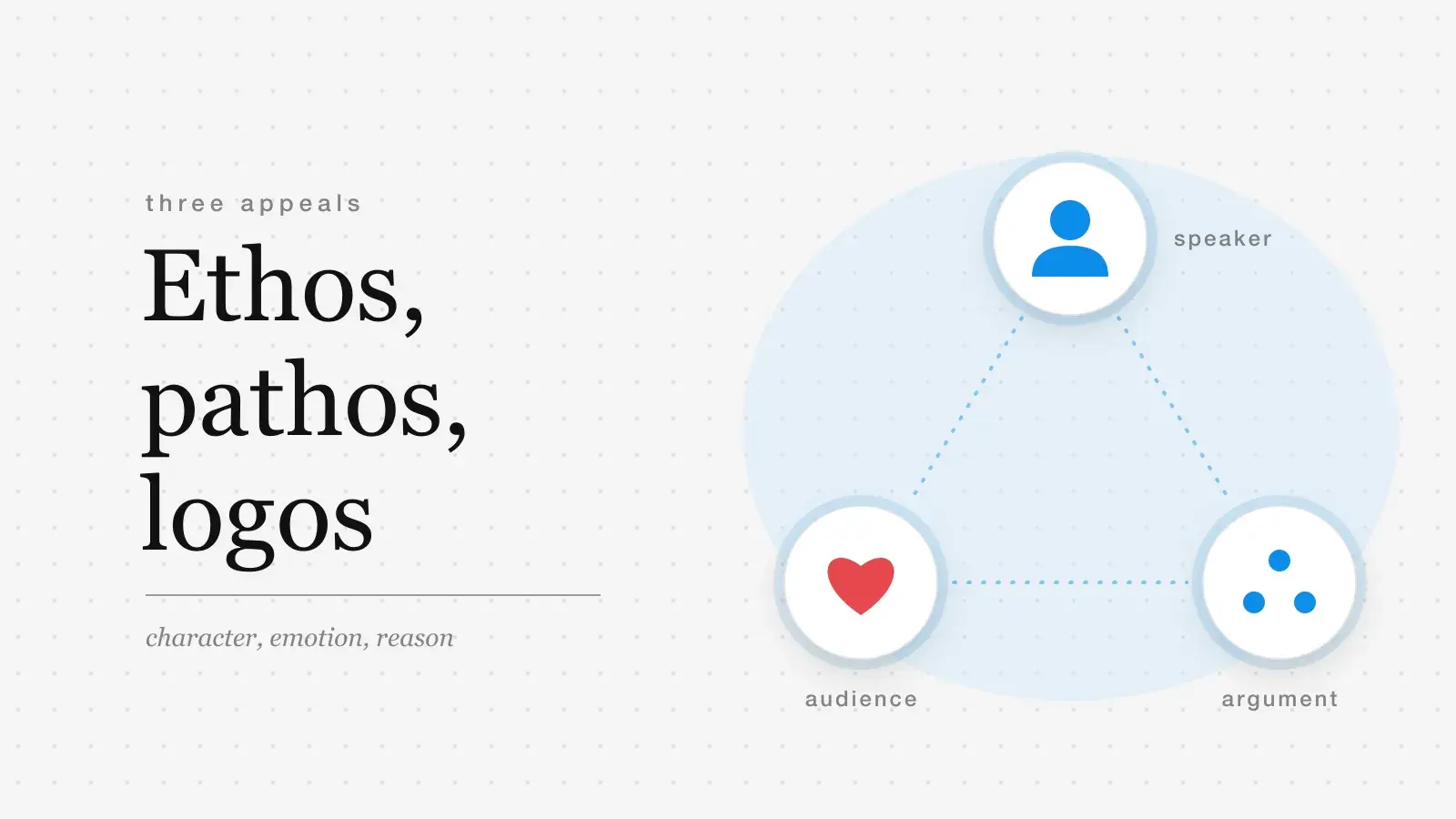
The rhetorical triangle puts speaker, audience and message at three corners, one for each appeal. It is a later classroom diagram, not Aristotle's, but it makes a good check on a draft: if you can't say who is speaking, who is listening and what exactly is being claimed, no technique will save the piece.
Two mix-ups are worth correcting. Ethos is not the same as credentials. It is the character a reader infers from the text, which is why your tone of voice carries so much of it. And logos is not only statistics. Aristotle counts the example, reasoning from one case to a similar one, as a kind of proof beside the enthymeme, which is why a well-chosen story can do the work of a number.
The appeals are the ends, and rhetorical devices such as Antony's repetition and Roosevelt's parallel sentences are the means. For a full set of methods built on them, read Persuasive techniques: 15 methods with examples. To take a speech apart appeal by appeal, follow this rhetorical analysis example, and to plan a persuasive essay of your own, start from the essay outline template.