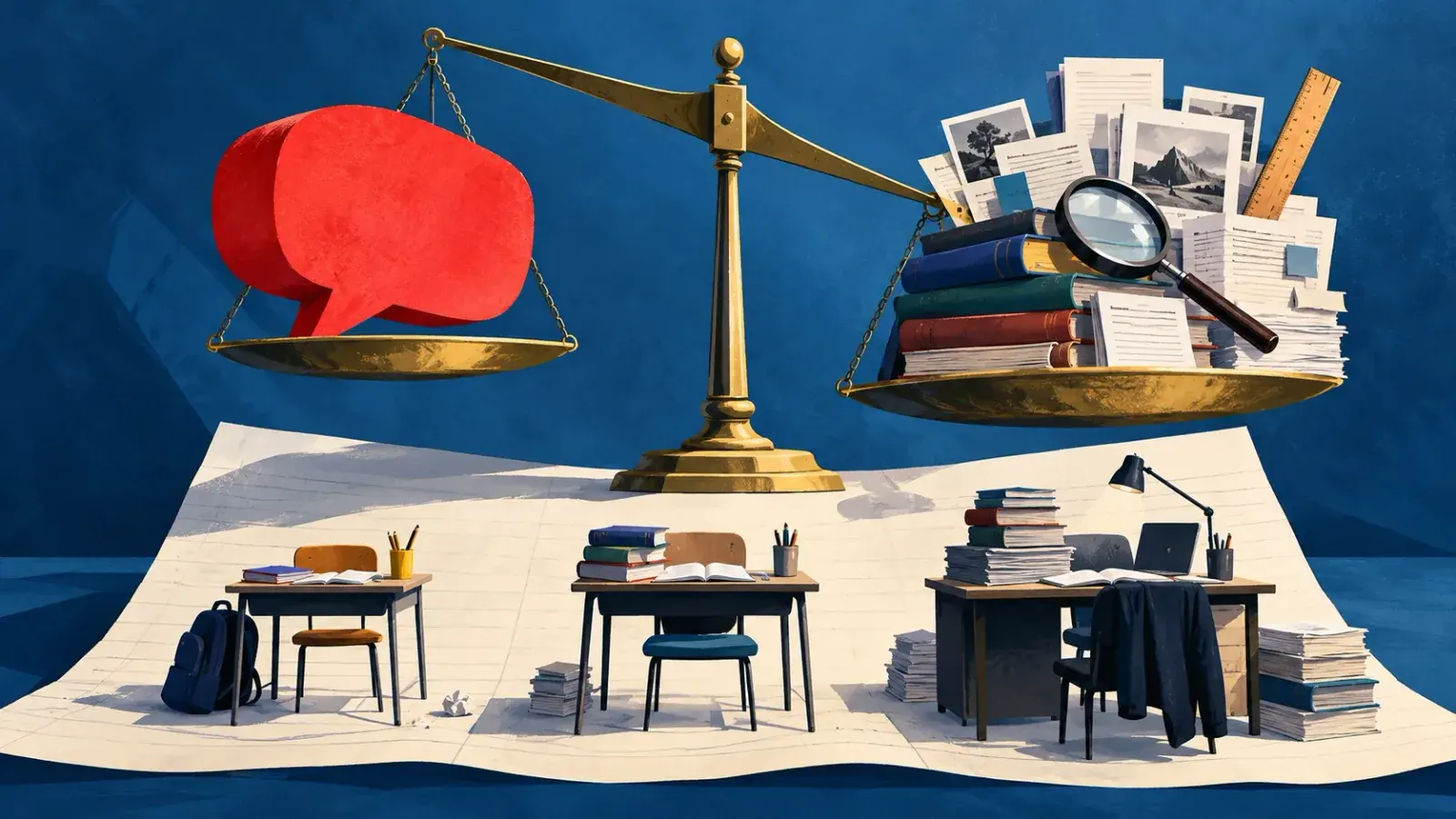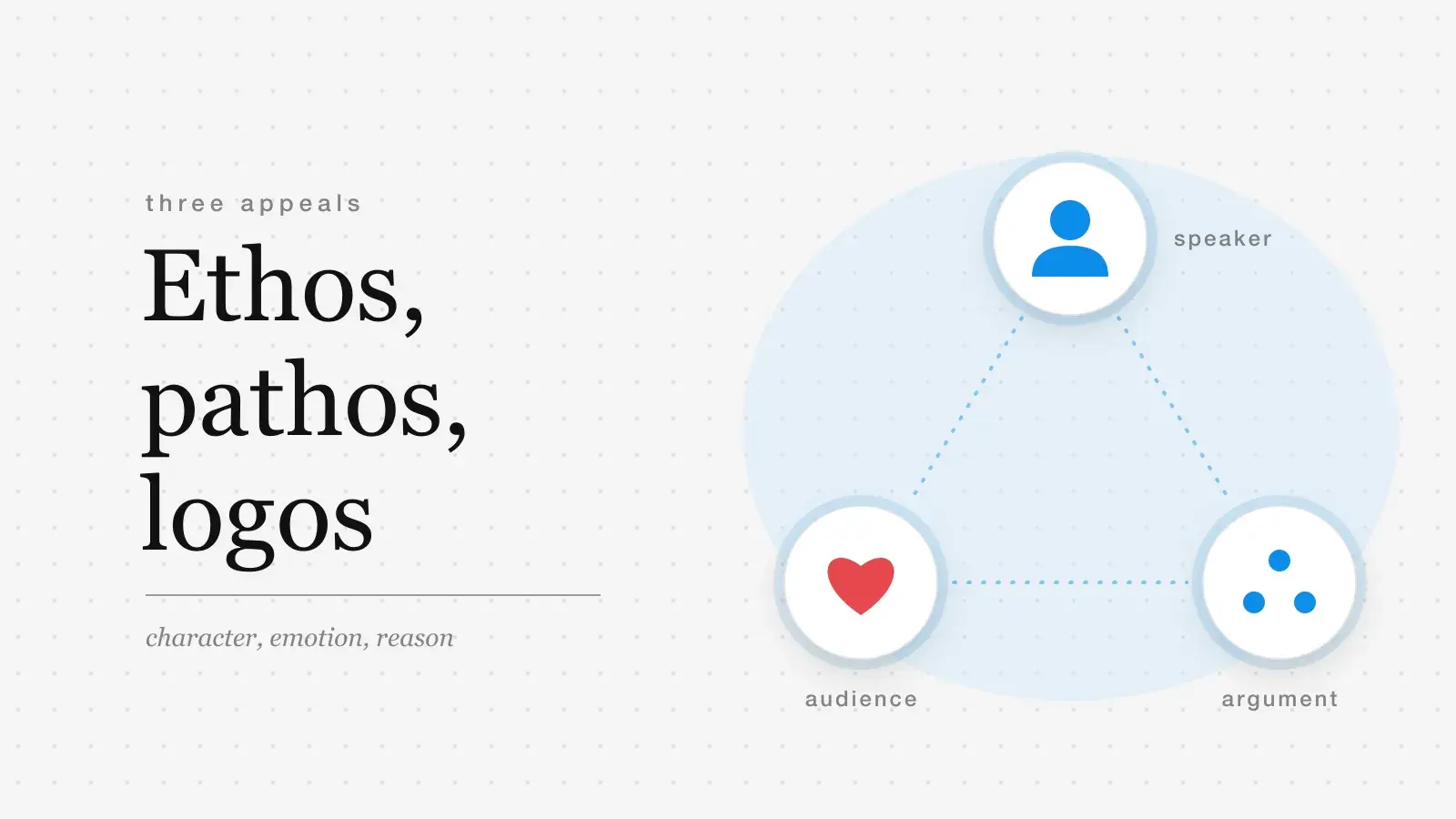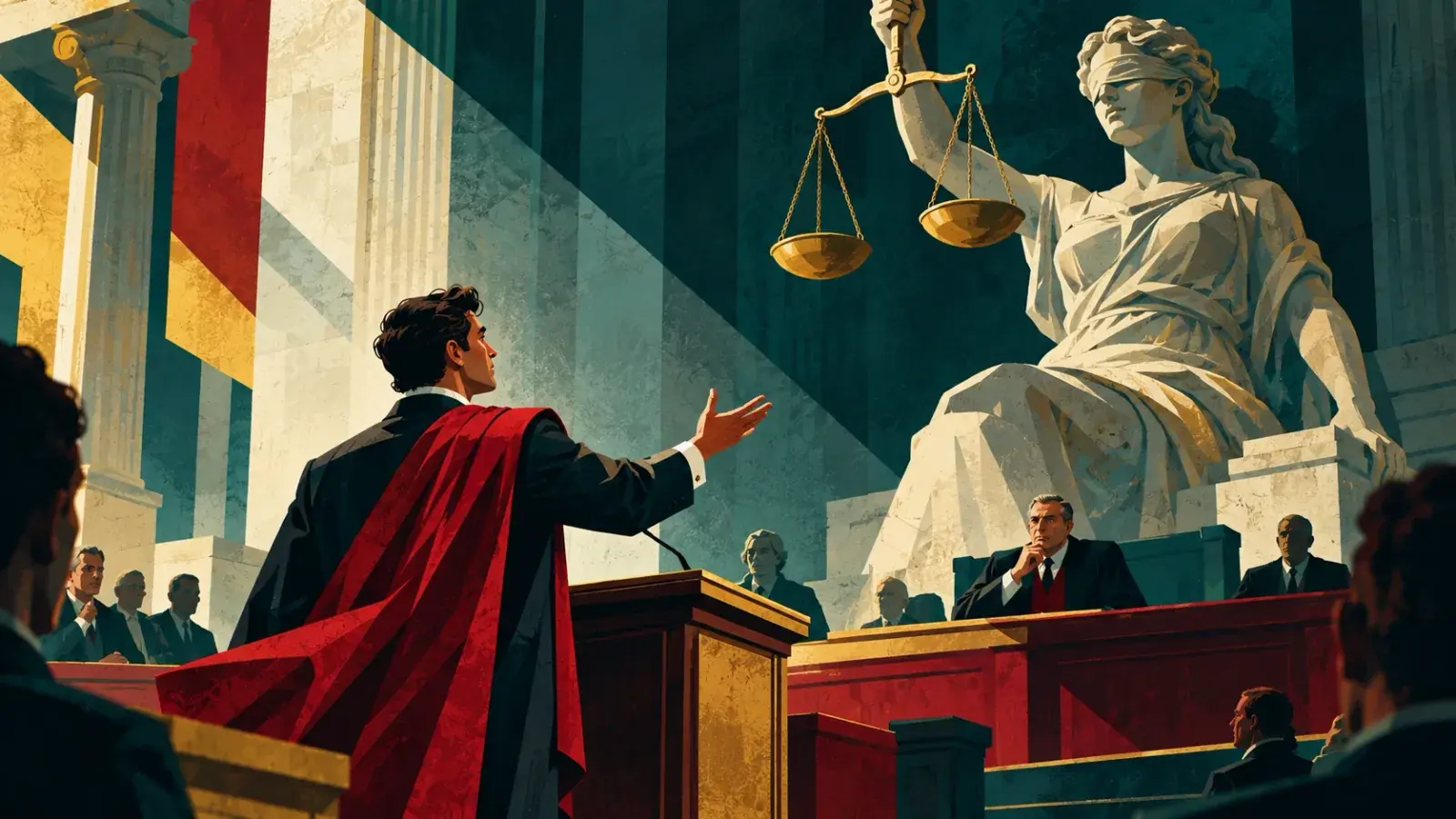
Persuasive techniques are the methods a speaker or writer uses to move an audience from doubt to agreement, or from agreement to action. Most go back to the three appeals Aristotle described in his Rhetoric: ethos, pathos and logos, or trust in the speaker, emotion and reason. The other twelve below are ways of delivering those appeals through evidence, through the sound of the language and through the order of the argument. You do not need all fifteen. A strong speech or essay leans on three or four, chosen for the people in front of it.
The 15 techniques at a glance
Each technique is explained below with an example. The original examples all argue one case, a teacher asking a town council to keep the Maple Street library open on Sundays, so you can see how each move changes the same argument. The public-domain examples show the same moves in speeches people still study. To take one apart yourself, see this rhetorical analysis example.
| Technique | What it does | Works on |
|---|---|---|
| Technique1. Ethos | What it doesMakes the audience trust you | Works onTrust |
| Technique2. Pathos | What it doesMakes them feel what is at stake | Works onFeeling |
| Technique3. Logos | What it doesShows the reasoning step by step | Works onReason |
| Technique4. Specific numbers | What it doesTurns size into something you can picture | Works onReason |
| Technique5. Expert testimony | What it doesBorrows the credibility of someone who knows | Works onTrust |
| Technique6. Social proof | What it doesShows that others already agree or act | Works onTrust |
| Technique7. A short story | What it doesPuts one person inside the problem | Works onFeeling |
| Technique8. Analogy | What it doesExplains the new through the familiar | Works onReason |
| Technique9. Repetition | What it doesMakes the key phrase impossible to miss | Works onMemory |
| Technique10. Rule of three | What it doesGives a point rhythm and a sense of completeness | Works onMemory |
| Technique11. Rhetorical questions | What it doesLets the audience reach the conclusion | Works onReason |
| Technique12. Antithesis | What it doesLets a contrast do the arguing | Works onMemory |
| Technique13. Inclusive language | What it doesPuts you and the audience on one side | Works onTrust |
| Technique14. Answering objections | What it doesDisarms the main counterargument | Works onTrust |
| Technique15. Call to action | What it doesTurns agreement into a specific act | Works onAction |
The three appeals: ethos, pathos, logos
Aristotle named three kinds of proof a speaker controls: the character of the speaker, the state of mind of the audience, and the argument itself. Many teachers add a fourth, kairos, the right moment, which returns below in the call to action.
1. Ethos: earn the right to be heard
Ethos is the audience's trust in you. It comes from relevant experience, fairness to the other side, and a sense that you share the audience's interests. State your credentials once, early, and tie them to the question at hand. Admitting a cost helps too: it shows you are not hiding the weak side of your case. Shakespeare's Mark Antony wins a hostile crowd by claiming to be no speaker at all: "I am no orator, as Brutus is."
"I've taught English at Westfield High for eleven years, and I live four blocks from the Maple Street branch. On Sundays I see my students there more than anywhere else. I'm not here to tell you the budget is easy. I'm here because I know who uses that building the day before most of their homework is due."
2. Pathos: make the stakes felt
Pathos makes the audience feel what is at stake: worry, pride, anger, hope. Adjectives rarely do it. Images do. "Devastating for vulnerable families" asks the listener to supply the feeling, while a specific scene supplies it for them. Use emotion to carry a point you can also prove, and keep it in proportion. A library budget is not a tragedy, and an audience notices when you pretend it is.
Shows the stakes
- "Every Sunday a ninth grader sits at the corner table, finishing homework on the library Wi-Fi because there is none at home."
- One person, one place, one detail the listener can see.
Tells the listener what to feel
- "Closing on Sundays would be devastating for the most vulnerable families in our community."
- Abstract nouns and big adjectives that leave the audience to do the work.
3. Logos: show the reasoning
Logos is the argument itself: claims, evidence and the links between them. The usual weakness is a missing step, where the conclusion follows only if the listener supplies something you never said. Write the chain out as "because" sentences and check each link. If a link needs a fact, go and find it.
"The high school library closes at four on Friday and stays closed all weekend. Most assignments are due on Monday. On Sunday, Maple Street is the only free, quiet room with computers within walking distance of the school. Close it on Sundays, and the students without a desk or a laptop at home lose the one place they can do Monday's work."
Techniques of evidence
Evidence gives the audience a reason they can check, and it is the best defense against the charge that you are playing on feelings.
4. Specific numbers
A number persuades when the audience can picture it. Large totals are hard to feel, so divide them into units people know: per visit, per household, per day. Round honestly, say where the figure comes from, and use two numbers rather than ten.
"Sunday hours cost the town $38,000 a year. Last year the branch counted 9,500 Sunday visits. That is four dollars a visit, about what the café across the street charges for a coffee."
5. Expert testimony
Expert testimony borrows credibility from someone the audience already trusts on the subject. It works when the expert is relevant (a reading specialist on reading, not a celebrity on reading), clearly identified, and cited on the narrow point you need. With a skeptical audience, the strongest witness comes from their own side.
"I asked the county's literacy coordinator, who has run the Sunday reading hour for five years, who comes. Mostly, she said, children with no other quiet place to read. She has the sign-in sheets."
6. Social proof
Before deciding, people look at what others like them are doing. Robert Cialdini made the term social proof familiar in his 1984 book Influence, and a 2008 hotel study he co-wrote found that a card saying most guests reused their towels worked better than the usual appeal to protect the environment. Show the audience they would be joining others, not taking a risk alone. Popularity does not make a thing right, so pair it with a reason.
"Fourteen of the seventeen branches in our county system open on Sundays. If we close Maple Street, we will be the only town on the east side that doesn't."
7. A short story
An anecdote turns an issue into a person. Keep it to four or five sentences, make it true (or say plainly that it is hypothetical), and end on the point rather than on a moral you spell out. One story per argument is usually enough. Three in a row starts to look like a tactic.
"Last March one of my students, I'll call her Ana, failed two quizzes in a row. Her family had moved in with her aunt: one table, five people. She found the Sunday reading room on her own. By May she had a B. She still goes every Sunday, and she gets there before it opens."
8. Analogy
An analogy explains the unfamiliar through something the audience already knows, and brings the feelings attached to the familiar thing along with it. It persuades only as far as the two things really match. Abraham Lincoln built a whole speech to the Illinois Republican convention on one image.
"A house divided against itself cannot stand." I believe this government cannot endure, permanently half slave and half free. I do not expect the Union to be dissolved — I do not expect the house to fall — but I do expect it will cease to be divided. It will become all one thing, or all the other.
Techniques of language
Language techniques work on the ear. They make a point easier to remember and harder to ignore, which matters most in a speech, where nobody can reread. Most are rhetorical devices with Greek names and a long history.
9. Repetition
Repeating a word or phrase tells the audience what matters and gives a speech a beat. Repeating the opening words of successive sentences is called anaphora. Repetition gains force when something changes around the repeated line. In Mark Antony's funeral speech, each return of "Brutus is an honourable man" follows a fact that makes it harder to believe, until the phrase means its opposite.
He was my friend, faithful and just to me:
But Brutus says he was ambitious;
And Brutus is an honourable man.
He hath brought many captives home to Rome
Whose ransoms did the general coffers fill:
Did this in Caesar seem ambitious?
10. The rule of three
Lists of three feel complete. Two items sound like a comparison, four like an inventory. Classical rhetoric calls the pattern a tricolon, and it works best when the items build in weight. Lincoln used it twice in the few minutes of the Gettysburg Address: once for what the living cannot do, and once to end the speech.
But, in a larger sense, we can not dedicate — we can not consecrate — we can not hallow — this ground.
… that government of the people, by the people, for the people, shall not perish from the earth.
11. Rhetorical questions
A rhetorical question makes the audience supply the answer, and people trust conclusions they reach themselves. It works only when one answer is reasonable. If the room could answer the other way, you have handed the floor to your opponent. A run of questions can also take apart an objection, as in Patrick Henry's 1775 speech to the Second Virginia Convention, known from the version his biographer William Wirt published in 1817.
They tell us, sir, that we are weak; unable to cope with so formidable an adversary. But when shall we be stronger? Will it be the next week, or the next year? Will it be when we are totally disarmed, and when a British guard shall be stationed in every house?
12. Antithesis
Antithesis sets two opposite ideas side by side in matching grammar, so the contrast does the arguing. It is a tight form of juxtaposition. When the second half reverses the words of the first (chiasmus), the line becomes even easier to remember. In the library speech: "We can afford to keep the doors open. We cannot afford what happens when they close."
Let us never negotiate out of fear. But let us never fear to negotiate.
And so, my fellow Americans: ask not what your country can do for you — ask what you can do for your country.
13. Inclusive language
"We" and "our" put the speaker and the audience on the same side of the problem, which lowers resistance. Say "we" only about things you truly share, and switch to "you" when you ask the audience to act. Susan B. Anthony, arrested for voting in the 1872 election, turned the first words of the Constitution into an argument about who "we" includes.
It was we, the people; not we, the white male citizens; nor yet we, the male citizens; but we, the whole people, who formed the Union. And we formed it, not to give the blessings of liberty, but to secure them; not to the half of ourselves and the half of our posterity, but to the whole people — women as well as men.
Techniques of structure
Structure decides what the audience hears first, what it hears last, and whether its own doubts get an answer before it leaves.
14. Answering objections
Raise the strongest objection yourself and answer it before anyone else can. It shows you have thought about the other side, which builds ethos, and takes the objection out of your opponent's mouth. State it in a form its supporters would recognize. A straw man convinces only people who already agree. In the library speech: "Some of you will say the town can't afford it this year. Here is what it costs, and here is what closing costs." Frederick Douglass, in his 1852 Fourth of July address, voiced the complaint against abolitionists before he answered it.
But I fancy I hear some one of my audience say, it is just in this circumstance that you and your brother abolitionists fail to make a favorable impression on the public mind. Would you argue more, and denounce less, would you persuade more and rebuke less, your cause would be much more likely to succeed. But, I submit, where all is plain there is nothing to be argued.
15. A call to action, at the right moment
Persuasion that ends in agreement without action has done half its job. Ask for one specific thing, make it easy, and tie it to a date. The date is kairos at work: the same request lands differently the week before a vote than the week after. The ask belongs in the last minute, and this guide to ending a speech covers how to land it.
Specific, easy, dated
- "Before Thursday's budget vote, email the five council members. Their addresses are on the card on your chair. One sentence is enough: keep Sunday hours."
Vague
- "Please support your library."
- "I hope you'll think about what I've said tonight."
How to choose and order them
Start with the audience, not the technique. Ask what they believe now and what would have to be true for them to change their minds. The answer tells you which techniques to lead with.
| Audience | Lead with | Go easy on |
|---|---|---|
| AudienceAlready agrees | Lead withCall to action, inclusive language, repetition | Go easy onLong proofs: they need a reason to act, not to agree |
| AudienceUndecided | Lead withLogos, specific numbers, one short story | Go easy onHeavy emotion before the facts |
| AudienceSkeptical | Lead withEthos, answered objections, an expert from their side | Go easy onRhetorical questions and loaded words |
| AudienceReading, not listening | Lead withEvidence and sources they can check | Go easy onHeavy repetition: readers can reread |
A dependable order: Monroe's motivated sequence
For a persuasive speech, a five-step order developed by the American professor Alan H. Monroe in the 1930s still works, and each step has techniques that fit it naturally. Draft the speech in these five parts with a speech outline template. The same order serves a persuasive essay, where the action step becomes the conclusion.
| Step | What it does | Techniques that fit |
|---|---|---|
| StepAttention | What it doesGets the room listening | Techniques that fitA short story, a rhetorical question, one striking number |
| StepNeed | What it doesShows the problem and who it hurts | Techniques that fitLogos, specific numbers, pathos |
| StepSatisfaction | What it doesOffers the solution and meets the doubts | Techniques that fitExpert testimony, answered objections |
| StepVisualization | What it doesShows the future with and without it | Techniques that fitPathos, analogy, antithesis |
| StepAction | What it doesSays exactly what to do next | Techniques that fitCall to action, inclusive language, repetition |
When persuasion becomes manipulation
Most techniques have a dishonest twin, usually a named logical fallacy. The line is the same each time: the honest version carries evidence to the audience, and the dishonest one stands in for it.
| Technique | Honest use | Turns into |
|---|---|---|
| TechniquePathos | Honest useFeeling in proportion to the facts | Turns intoAppeal to fear: a threat out of all proportion |
| TechniqueExpert testimony | Honest useA relevant expert on the narrow point | Turns intoAppeal to authority: fame or a title instead of expertise |
| TechniqueSocial proof | Honest useWhat others chose, plus a reason | Turns intoBandwagon: "everyone does it" as the whole case |
| TechniqueSpecific numbers | Honest useSourced and in context | Turns intoCherry-picking: the one figure that flatters you |
| TechniqueRhetorical questions | Honest useOnly one reasonable answer | Turns intoLoaded question: an accusation dressed as a question |
| TechniqueAnswering objections | Honest useThe other side's best case | Turns intoStraw man: a weak version that is easy to knock down |
| TechniqueCall to action | Honest useA real deadline | Turns intoFalse urgency: a deadline that does not exist |
A quick test before you deliver: would the argument still stand if the audience knew exactly what you were doing? Honest technique survives being noticed. If you are practicing on a persuasive speech topic, run the draft through this table once before you rehearse it.
Test your argument in Strokes
Persuasive drafts improve fastest when someone pushes back. In Strokes, a desktop editor that keeps your documents as files on your own machine, the AI Assistant opens beside the draft. Ask it to check the argument in a passage, name the strongest objection a skeptical listener would raise, or point out where a paragraph leans on emotion without evidence. Select a weak paragraph and press ⌘K to ask for a rewrite with one concrete image or one specific number, and check any fact it adds before you use it. If the old version was better, version history brings it back in one click.
Frequently asked questions
What are the three main persuasive techniques?
Ethos, pathos and logos, the three appeals Aristotle described in his Rhetoric: the credibility of the speaker, the emotions of the audience and the logic of the argument. Most other techniques, from statistics to rhetorical questions, are ways of delivering one of the three.
What is the most effective persuasive technique?
It depends on the audience. People who already agree need a specific call to action. Undecided readers are usually moved by clear evidence and one concrete story. A skeptical audience listens first for credibility and a fair answer to its main objection, and emotional language aimed at it tends to read as pressure.
What is the difference between persuasive techniques and rhetorical devices?
Persuasive techniques are strategies for changing someone's mind, such as citing an expert or answering an objection. Rhetorical devices are patterns of language, such as anaphora, antithesis or the tricolon. Many devices serve persuasion, but they also appear in poems, novels and toasts that are not trying to persuade anyone.
Which persuasive techniques does advertising use?
Mostly social proof (reviews, best-seller badges), authority (experts and endorsements), scarcity and urgency (limited stock, countdown timers), repetition (slogans and jingles) and emotional stories. The same two checks apply as in a speech: is there evidence under the technique, and is the deadline real?