A style guide is a document of rules for how a person or a team writes: which spelling to use, how to punctuate, which terms to prefer and how formal to sound. It settles the small decisions once, so that nobody has to make them again and so that a help page, a newsletter and a contract all read as if the same careful person wrote them. Publishers call the result house style, and many use the same words for the rulebook itself.
Large organizations publish theirs at book length. Newspapers follow the AP Stylebook or a guide of their own, book publishers lean on the Chicago Manual of Style, and software companies keep guides for their documentation. Most teams need far less than that. A page of decisions, kept where people can find it, does most of the work.
What it looks like
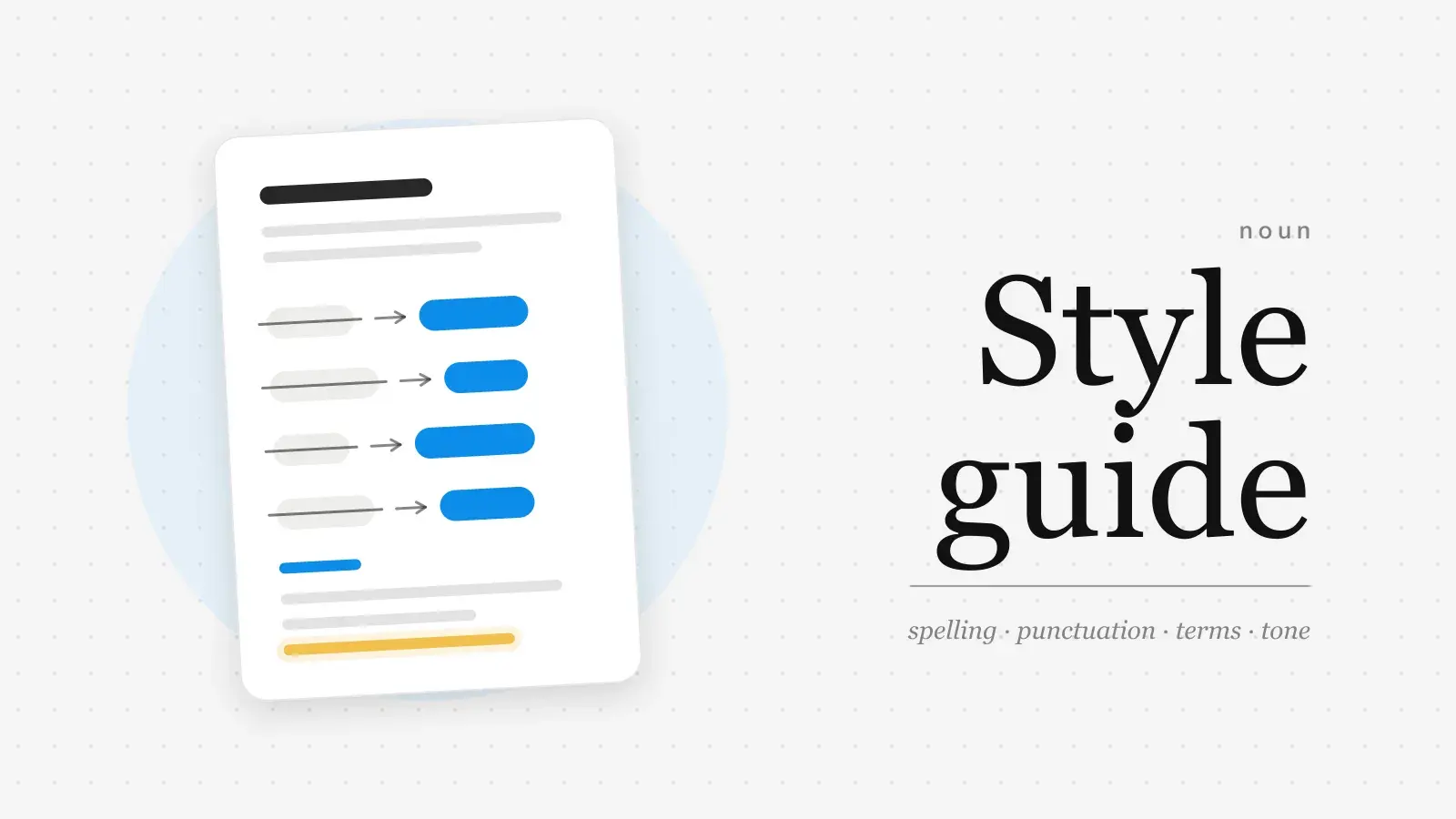
A one-page style guide
Spelling      American: organize, color, canceled.
Numbers       Words up to nine, figures from 10. Dates as October 8, 2026.
Punctuation   Serial comma. One space after a period. Em dashes rarely.
Capitals      Sentence case in headings. Product names as the maker writes them.
Terms we use  "customer" (not "user"), "sign in" (not "log in"),
              "document" (not "file") when talking to readers.
Avoid         leverage, seamless, simply, just, robust.
Tone          Plain and direct. Short sentences. Contractions are fine.
              Address the reader as "you". No exclamation marks.
Formatting    One idea per paragraph. Lists for steps, prose for reasons.
That is the whole thing for many teams. Each line records a choice that would otherwise be made differently by every writer, or argued over in every review.
What a one-page style guide holds
- Spelling and region. American or British, and the handful of words where the difference shows.
- Punctuation. Serial comma or not, how you handle quotation marks and dashes, when numbers become figures.
- Capitalization. Sentence case or title case in headings; how product names and job titles are written.
- Preferred terms. The words you use for your customers, your product and its parts, with the alternatives you have retired.
- Words to avoid. Hype words, hedges and jargon that readers outside the team will not know.
- Tone. A few concrete choices (contractions, second person, typical sentence length) and a short sample paragraph to match. This is the tone of voice section, and the one most worth writing well.
- Formatting. Paragraph length, when to use a list, how links are labeled.
Stop when adding a rule would not change what anyone writes. The one-pager template is a sensible container: a title, a few headed sections, one page.
Why it matters
Consistency is a large part of trust. A reader who meets "log in" on one page and "login" on the next, or a cheerful introduction followed by a paragraph that sounds like a legal notice, senses that nobody is in charge of the text. Written rules also save time. Writers stop re-deciding, editors stop re-arguing, and a review can be about whether the piece is right rather than whether "email" takes a hyphen. A guide that asks for short sentences and familiar words raises the readability of everything the team publishes without anyone thinking about it.
Handing the guide to an AI
A style guide is worth giving to a language model, because the model's defaults (a neutral register, a set of favorite words) are exactly what a style guide exists to override. Given your rules, it follows most of them, and the ones it misses are easy to spot. There are two ways to hand it over.
- As context. Add the guide to the conversation, or paste it above your request, and ask for the draft or the edit "following the style guide". This works in any tool and costs a few hundred tokens each time.
- As a system prompt. Tools that let you set a system prompt can carry the guide as a standing instruction, so every request starts from it without your pasting it in. This suits a guide you use daily.
Either way, write the rules as instructions ("use the serial comma") rather than values ("we care about clarity"), and include the sample paragraph. A model matches an example more reliably than it interprets an adjective.
Style guides in Strokes
Keep the style guide as a document in the same project as the writing it governs. When you open the AI Assistant, add the guide to the chat as context and ask for what you need. In Agent mode the Assistant writes the change into the document and shows each edit for you to accept, so you can see at once whether a sentence still follows the rules. A select-and-⌘K rewrite can name a rule directly: "match the style guide: sentence case, no exclamation marks".
Related terms: tone of voice, the part of a guide that is hardest to write and easiest to lose; readability; copy editing; style sheet.