The main speaker at the dedication of the cemetery at Gettysburg, on November 19, 1863, was Edward Everett, a former secretary of state and the best-known orator of his day. He spoke for two hours, about 13,607 words. Abraham Lincoln followed with 271 words and sat down after roughly two minutes. Everett's oration is a footnote. Lincoln's is carved into the wall of the Lincoln Memorial.
Most of what famous speeches can teach a writer sits in the gap between those two. The ones people still quote are mostly short, built for the ear and drafted more than once, and a few are not quite what was said. Below are seventeen, with the move each is worth studying for, then a closer look at the moves, quoted in full where a speech is in the public domain.
Famous speeches at a glance
| Speech | Speaker and year | The move to borrow |
|---|---|---|
| SpeechFuneral Oration | Speaker and yearPericles, 431 BC | The move to borrowHonor the dead by praising what they died for |
| SpeechSpeech to the troops at Tilbury | Speaker and yearElizabeth I, 1588 | The move to borrowAdmit the weakness, then overturn it |
| Speech"Give me liberty, or give me death!" | Speaker and yearPatrick Henry, 1775 | The move to borrowClose on a choice between two things |
| Speech"Ain't I a Woman?" | Speaker and yearSojourner Truth, 1851 | The move to borrowArgue from your own life, not from principle |
| Speech"What to the Slave Is the Fourth of July?" | Speaker and yearFrederick Douglass, 1852 | The move to borrowTurn the occasion back on its audience |
| SpeechGettysburg Address | Speaker and yearAbraham Lincoln, 1863 | The move to borrowPast, present and future in ten sentences |
| SpeechSecond inaugural address | Speaker and yearAbraham Lincoln, 1865 | The move to borrowA short sentence after a long one |
| SpeechFirst inaugural address | Speaker and yearFranklin D. Roosevelt, 1933 | The move to borrowName the fear before the plan |
| Speech"The luckiest man on the face of the earth" | Speaker and yearLou Gehrig, 1939 | The move to borrowBad news first, then gratitude |
| Speech"We shall fight on the beaches" | Speaker and yearWinston Churchill, 1940 | The move to borrowKeep the verb, change the place |
| Speech"A date which will live in infamy" | Speaker and yearFranklin D. Roosevelt, 1941 | The move to borrowFacts in a list, one per sentence |
| SpeechInaugural address | Speaker and yearJohn F. Kennedy, 1961 | The move to borrowReverse a phrase so it sticks |
| SpeechFarewell address | Speaker and yearDwight D. Eisenhower, 1961 | The move to borrowOne memorable phrase to carry a warning |
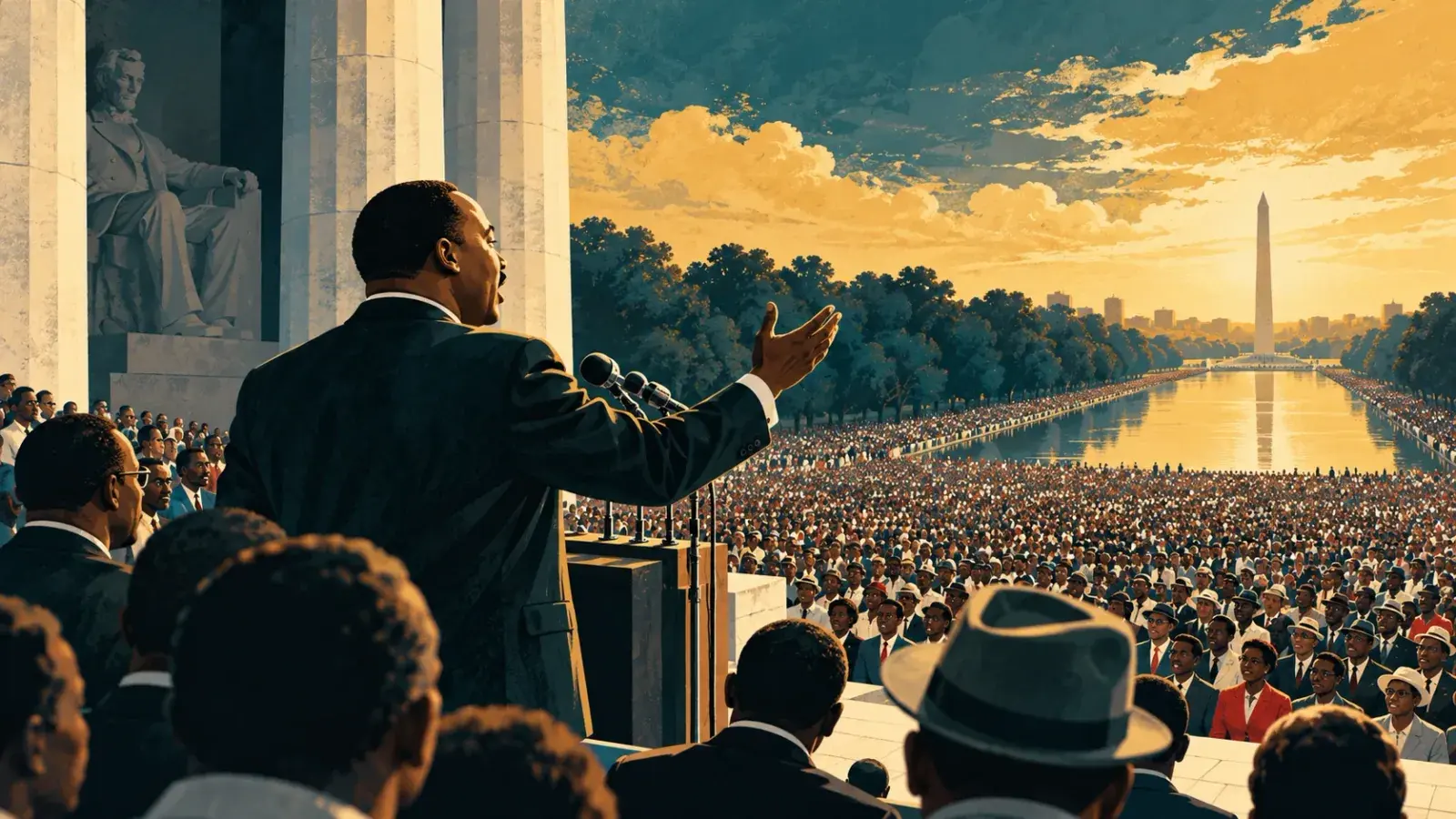
| Speech"I Have a Dream" | Speaker and yearMartin Luther King Jr., 1963 | The move to borrowA refrain that adds a new picture each time |
| Speech"I Am Prepared to Die" | Speaker and yearNelson Mandela, 1964 | The move to borrowSave the stakes for the last sentence |
| SpeechOn the death of Martin Luther King Jr. | Speaker and yearRobert F. Kennedy, 1968 | The move to borrowSay the hard news first, then your own loss |
| SpeechSpeech at the Brandenburg Gate | Speaker and yearRonald Reagan, 1987 | The move to borrowAddress one person by name |
Most of them are short
Length is the easiest lesson to take from famous speeches and the one most often ignored. Here are the ones with reliable counts, shortest first.
| Speech | Length | Note |
|---|---|---|
| SpeechWashington, second inaugural, 1793 | Length135 words | NoteShortest inaugural on record |
| SpeechLincoln, Gettysburg, 1863 | Length271 words, about 2 minutes | NoteThe Bliss copy, the standard text |
| SpeechRoosevelt, Pearl Harbor, 1941 | LengthAbout 500 words, 6.5 minutes | NoteCongress declared war 33 minutes later |
| SpeechRobert F. Kennedy, Indianapolis, 1968 | LengthUnder 6 minutes | NoteFrom notes, on a flatbed truck |
| SpeechLincoln, second inaugural, 1865 | Length700 words | NoteAlso carved in the Lincoln Memorial |
| SpeechKennedy, inaugural, 1961 | Length1,366 words | NoteDrafted with Ted Sorensen |
| SpeechRoosevelt, first inaugural, 1933 | Length1,880 words, about 20 minutes | NoteThe "fear itself" speech |
| SpeechHarrison, inaugural, 1841 | LengthAbout 8,450 words | NoteLongest inaugural on record |
| SpeechEverett, Gettysburg, 1863 | Length13,607 words, two hours | NoteThe main oration that day |
| SpeechMandela, Rivonia Trial, 1964 | LengthAbout three hours | NoteRead from the dock |
Two things in that table matter for your own drafts. Time is not a fixed function of words: Roosevelt's 500 or so words took about six and a half minutes, under 80 a minute, while Lincoln got through 271 in about two. Time yourself reading aloud at the pace you will really use, because a words-per-minute rule does not know your pace or your room.
And the long speeches had reasons. Mandela chose to speak from the dock instead of testifying, which spared him cross-examination, and used three hours to put the state on trial for the record, ending on the line the speech is named for: an ideal "for which I am prepared to die." A courtroom has to listen. A wedding reception or a town meeting does not.
The Gettysburg Address in full
This is the speech other speechwriters study. Kennedy had Ted Sorensen study it before drafting the 1961 inaugural, and King first designed his March on Washington speech as a homage to it, a hundred years after the Emancipation Proclamation. Here is the version Lincoln signed.
Four score and seven years ago our fathers brought forth, on this continent, a new nation, conceived in Liberty, and dedicated to the proposition that all men are created equal.
Now we are engaged in a great civil war, testing whether that nation, or any nation so conceived and so dedicated, can long endure. We are met on a great battle-field of that war. We have come to dedicate a portion of that field, as a final resting place for those who here gave their lives that that nation might live. It is altogether fitting and proper that we should do this.
But, in a larger sense, we can not dedicate—we can not consecrate—we can not hallow—this ground. The brave men, living and dead, who struggled here, have consecrated it, far above our poor power to add or detract. The world will little note, nor long remember what we say here, but it can never forget what they did here. It is for us the living, rather, to be dedicated here to the unfinished work which they who fought here have thus far so nobly advanced. It is rather for us to be here dedicated to the great task remaining before us—that from these honored dead we take increased devotion to that cause for which they gave the last full measure of devotion—that we here highly resolve that these dead shall not have died in vain—that this nation, under God, shall have a new birth of freedom—and that government of the people, by the people, for the people, shall not perish from the earth.
Three paragraphs, three tenses. The first is the past (the founding), the second the present (the war, this field), the third the future (what the living owe). A eulogy, a retirement speech or a commencement address can borrow that frame whole.
The words do the linking. "Here" appears eight times, "dedicate" or "dedicated" six, "nation" five. Each repetition ties a sentence back to the field the crowd was standing on. "I" never appears at all: the President of the United States spoke for two minutes without once mentioning himself.
The middle turns the occasion around. The crowd came to dedicate a cemetery, and Lincoln tells them they cannot. Three verbs, each stronger than the last (climax, in the old catalog of rhetorical devices), then the reason: the soldiers already did it. The turn moves the speech from ceremony to obligation.
One long sentence carries the charge. The first nine sentences run 10 to 30 words each. The tenth runs to 82 words, almost a third of the speech, and stacks four clauses that open with "that" before it lands on "of the people, by the people, for the people." Short sentences for what is true, one long one for what must be done.
Moves worth borrowing
Repeat the frame, change the fact
Yesterday the Japanese Government also launched an attack against Malaya.
Last night Japanese forces attacked Hong Kong.
Last night Japanese forces attacked Guam.
Last night Japanese forces attacked the Philippine Islands.
Last night the Japanese attacked Wake Island. And this morning the Japanese attacked Midway Island.
The frame stays still, so the listener hears only what changes: one place per sentence, no adjectives. Then "last night" becomes "this morning," and the room understands that the attack is still going on. Churchill's "we shall fight" passage of June 1940 runs on the same engine. The verb holds while the place moves, from France and the seas to the beaches, the landing grounds, the fields, the streets and the hills. King's "I have a dream" comes eight times, and each time it brings a new picture.
Repetition fails when the repeated line carries nothing new. Here is the move applied to an ordinary speech.
Before: Closing the Eastside branch will have serious consequences for many people in our community.
After: On Monday the Eastside branch closes. On Tuesday the homework club has nowhere to meet. On Wednesday the job-search class moves across town, two bus transfers away. On Thursday Mrs. Alvarez, who has read every large-print mystery on the second shelf, finds the door locked.
Put the short sentence after the long one
Both parties deprecated war; but one of them would make war rather than let the nation survive; and the other would accept war rather than let it perish. And the war came.
The long sentence weighs one side against the other, clause against clause, and four words end the weighing. A listener cannot reread, so rhythm is how a speech marks the line that matters. Kennedy's "ask not what your country can do for you—ask what you can do for your country" works by reversal: the second half swaps the terms of the first, a juxtaposition that is hard to forget. Reagan in Berlin cut the short sentence to its bones, a name, a verb and an object aimed at one man who was not in the crowd: "Mr. Gorbachev, tear down this wall!"
Concede, then turn
Elizabeth I, addressing troops at Tilbury as the Spanish Armada threatened in 1588, met the objection head on: "I know I have the body but of a weak, feeble woman; but I have the heart and stomach of a king, and of a king of England too." Lou Gehrig, retiring with a fatal illness in 1939, opened with the "bad break" his fans had been reading about, then called himself "the luckiest man on the face of the earth." Robert F. Kennedy told an Indianapolis crowd, many of whom had not yet heard, that King had been killed, then spoke of his own brother's murder, which his aides had never heard him do in public.
Frederick Douglass gave the boldest version. Invited by the Rochester Ladies' Anti-Slavery Society to speak on July 5, 1852, he spent the first part of his speech praising the founders, but always as "your fathers" and "your national independence," never "our." Then he asked: "What, to the American slave, is your 4th of July?" The day, he said, "is yours, not mine. You may rejoice, I must mourn." The pronouns had set up that turn from the start. Each of these speakers earns the hearing by saying the hard part first, the credibility rhetoric calls ethos (see ethos, pathos and logos).
Great speeches were drafted
Roosevelt dictated his Pearl Harbor speech to his secretary, Grace Tully, at about five in the afternoon on December 7, then marked up the typed draft by hand. Its first line read "a date which will live in world history." He replaced the last two words with one, and made three more changes on the reading copy.
The most famous word in Roosevelt's speech was a correction.
Eisenhower's farewell address, the one that warned of the "military-industrial complex," went through at least 21 drafts. Kennedy's "Let us never negotiate out of fear. But let us never fear to negotiate" came almost word for word from a suggestion by the economist John Kenneth Galbraith. Peter Robinson drafted Reagan's Berlin line, and the chief of staff, Howard Baker, called it "extreme" and "unpresidential." Reagan kept it.
King's speech began as drafts titled "Normalcy, Never Again," and the dream passage was not in the text he brought to the podium. He left the page near the end, just after Mahalia Jackson called out to him to tell them about the dream. But he had used the refrain before, in Rocky Mount, North Carolina, in 1962 and in Detroit two months before the march. The famous improvisation was a passage he had already tested.
So keep every draft. The line you cut on Tuesday may be the one you want on Friday. In Strokes, version history saves versions automatically as you work and whenever you ask, so you can preview an earlier draft with the changes marked and restore it in one click.
The text you know may not be what was said
Several famous speeches reached us through someone else's pen, and the differences matter if you quote them.
- Pericles. Thucydides says his speeches give the gist of what was said, not the words, and he introduces this one as words "like these."
- Elizabeth I. The Tilbury text comes from a letter by Leonel Sharp, who was in the camp that day, printed in 1654. Most historians accept it.
- Patrick Henry. No transcript exists. William Wirt rebuilt the speech for an 1817 biography, 42 years later, from elderly witnesses' memories, and historians still argue over how much of it is Wirt's, the famous last line included.
- Sojourner Truth. The transcript Marius Robinson printed in June 1851, after going over it with her, does not contain "Ain't I a woman?" That refrain comes from Frances Dana Barker Gage's version of 1863, which also gave Truth a Southern dialect. She grew up in New York and spoke only Dutch until she was nine.
- Churchill. He gave the June 4, 1940 speech in the House of Commons and did not broadcast it; a BBC newsreader read extracts that evening. The recording people know was made in 1949.
When you quote one of these, name the version: "as Wirt reconstructed it," "in Robinson's 1851 transcript." And when you give a speech yourself, the text you hand out afterward becomes the record, so make it the one you delivered.
If you are writing a speech of your own, start with the shape before the lines. The step-by-step guide on how to write a speech and the speech outline template will get you to a first draft, and how to end a speech covers closings that land the way Mandela's last sentence did. If you are writing about one of these speeches for a class, the rhetorical analysis example shows how to turn notes like these into an essay.