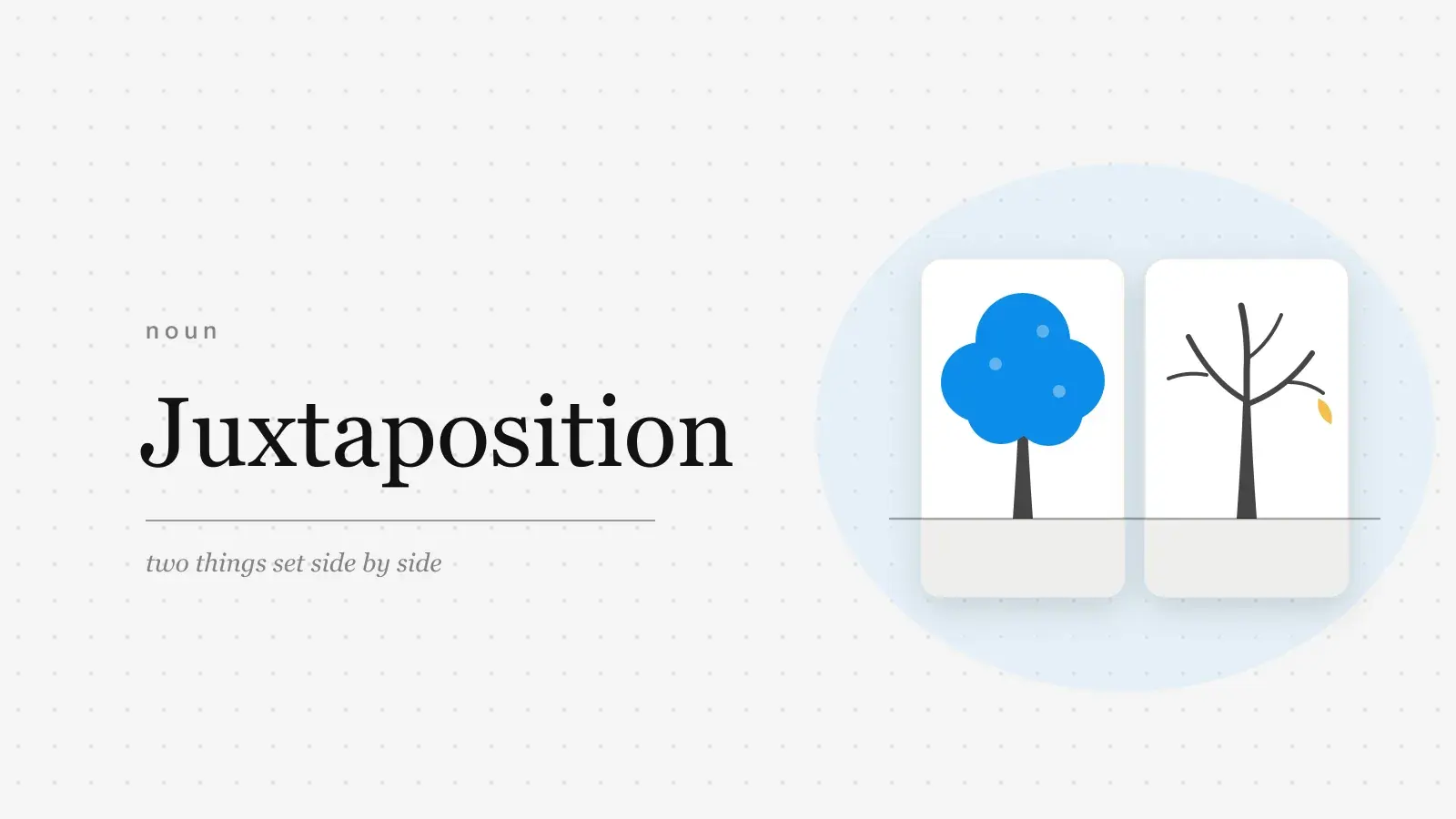
Juxtaposition is placing two things side by side, such as two images, characters, scenes or ideas, so the reader compares them. The pairing makes a meaning that neither part carries alone: usually a contrast, sometimes an unexpected likeness. The writer arranges the two, and the reader draws the conclusion.
The word reached English from French and is built from the Latin iuxta, "next to," and position. Nearness is the whole device. A contrast spread across two hundred pages is something a careful reader might notice. Put the same two things in one paragraph, or in back-to-back scenes, and the comparison happens whether the reader means to make it or not.
Examples of juxtaposition in literature
The day is hot, the Capulets abroad.
Act 2 ends with Friar Laurence leading the lovers off to be married. The next scene opens in a hot street, with Benvolio begging Mercutio to go indoors before they run into the Capulets. Within a few pages Mercutio and Tybalt are dead and Romeo is banished. Shakespeare puts the vows and the killing back to back, so the brawl lands as the price of the marriage. The play does the same thing in a single line when Juliet learns who Romeo is: "My only love sprung from my only hate!"
The street shone out in contrast to its dingy neighbourhood, like a fire in a forest.
The novel opens on a London side street of polished shop fronts. Two doors from the corner, a windowless block thrusts its gable into that bright street, with a blistered door that has no bell and no knocker. Hyde comes and goes by that door, and it turns out to be the back way into Dr. Jekyll's laboratory. Before either man is on the page, the street has shown a respectable face with something shabby built into it.
Did he who made the Lamb make thee?
Blake printed his new poems with his old ones and subtitled the book "Shewing the Two Contrary States of the Human Soul." Several titles appear in both halves. The Innocence "Holy Thursday" watches charity children file into St Paul's with clean faces. The Experience poem of the same name asks whether it is holy to see children fed "with cold and usurous hand." Alone, the first poem is a hymn. Beside its twin, it starts to sound naive. "The Tyger" makes the pairing explicit with the question above.
The apparition of these faces in the crowd;
Petals on a wet, black bough.
Fourteen words, no verb, and nothing to say how the two lines relate. A simile would tell you the faces were like petals. Pound sets one image under the other and leaves the connection to you. He said the poem began as thirty lines, and he cut until only the pairing was left.
Near the end of the film Michael Corleone stands godfather to his sister's baby. As the priest asks whether he renounces Satan, the film cuts to his men killing the heads of the rival families, then back to Michael at the font, answering that he does. No one comments on any of it. The vows and the killings, intercut, tell you what Michael has become.
The book ends with the animals at a farmhouse window, watching the pigs play cards with the neighboring farmers. They look from the pigs to the men and back again and can no longer tell which is which. Juxtaposition usually sharpens a difference. Here it shows that the difference is gone.
Using juxtaposition in your manuscript
Film editors tell a story about why this works. As Vsevolod Pudovkin described it, Lev Kuleshov cut one expressionless close-up of the actor Ivan Mozzhukhin against a bowl of soup, a girl in a coffin and a woman on a divan, and audiences praised the actor's hunger, grief and desire. The face was the same shot each time. Attempts to repeat the experiment have had mixed results, but the instinct behind it is one every novelist uses: readers assume that whatever sits together belongs together, and they supply the link.
You can put that instinct to work at any scale:
- Sentence. Two clauses that pull against each other: "He sent lilies to the funeral and an invoice the next morning."
- Image. One detail set beside another in a description, like a child's crayon drawing taped to the wall of a prison visiting room.
- Character. Two people who start from the same place and choose differently. When one exists mainly to show up the other, you have a foil.
- Scene. What closes one scene and opens the next. The cut between them is a comment of its own.
- Structure. Dual timelines, alternating narrators, paired chapters, or a motif that comes back in a new setting.
Three habits make it land. Keep the two things close, since the reader compares what is near at hand. Give them one element in common, such as the same room, the same gesture or the same words: two weddings make a contrast, while a wedding and a hurricane are merely different. And leave the comparison unstated. Once the narrator says the contrast could not have been sharper, there is nothing left for the reader to do. This is show, don't tell applied to arrangement.
Told: While her sister fussed over napkins for the wedding, Nora couldn't stop thinking about their father in the hospital. The contrast between the two felt almost unbearable.
Juxtaposed: "Eggshell or ivory?" Dana held the two napkins up to the window. "Be honest."
Nora's phone buzzed against the table. The hospital again. She turned it face down.
"Ivory," she said.
The second version never mentions a contrast. The napkins and the phone share a table and a minute, and the reader feels the distance between them, along with the call Nora is choosing not to take.
Juxtaposition fails in two familiar ways. The first is the cartoon: a banker eating oysters while a beggar shivers outside the window. When the pairing is that obvious, it reads as a sermon. The second is the accident. Adjacent scenes always comment on each other, so a farcical chapter placed right after a death can read as callous when you never meant it to. If a sequence feels wrong and neither scene is at fault, check the order before you rewrite. Nonfiction writers face a third risk: setting a quotation beside an unrelated statistic implies a link you haven't shown, so pair facts only when the connection holds.
Juxtaposition vs. antithesis, oxymoron and foil
Textbooks draw these borders in slightly different places. The cleanest way to sort them is that juxtaposition is about placement at any scale, and the other terms name particular forms of it.
| Term | What it is | Example |
|---|---|---|
| TermJuxtaposition | What it isAny two things placed together to be compared | ExampleA wedding scene followed by a street fight |
| TermAntithesis | What it isOpposites in parallel grammar, usually in one sentence | Example"It was the best of times, it was the worst of times" |
| TermOxymoron | What it isTwo contradictory words fused into one phrase | Example"O loving hate!" |
| TermFoil | What it isA character whose contrast shows up another's traits | ExampleMercutio's jokes beside Romeo's sighing |
| TermParadox | What it isA statement that seems to contradict itself but holds true | Example"The Child is father of the Man" |
Dickens's opening to A Tale of Two Cities is the usual example for both juxtaposition and antithesis, and it is both: the clauses are built as matching opposites, and the opposites keep coming for an entire paragraph-long sentence. Simile and metaphor are the other near neighbors. They state the comparison ("faces like petals"). Juxtaposition leaves it out, as Pound's poem does.
Antithesis, oxymoron and paradox belong to the larger family of rhetorical devices, and a repeated pairing that gathers meaning over a book becomes a motif. Back-to-back scenes also set the speed of a story, so if you are deciding what follows what, read Pacing in writing: how to speed up and slow down a story.