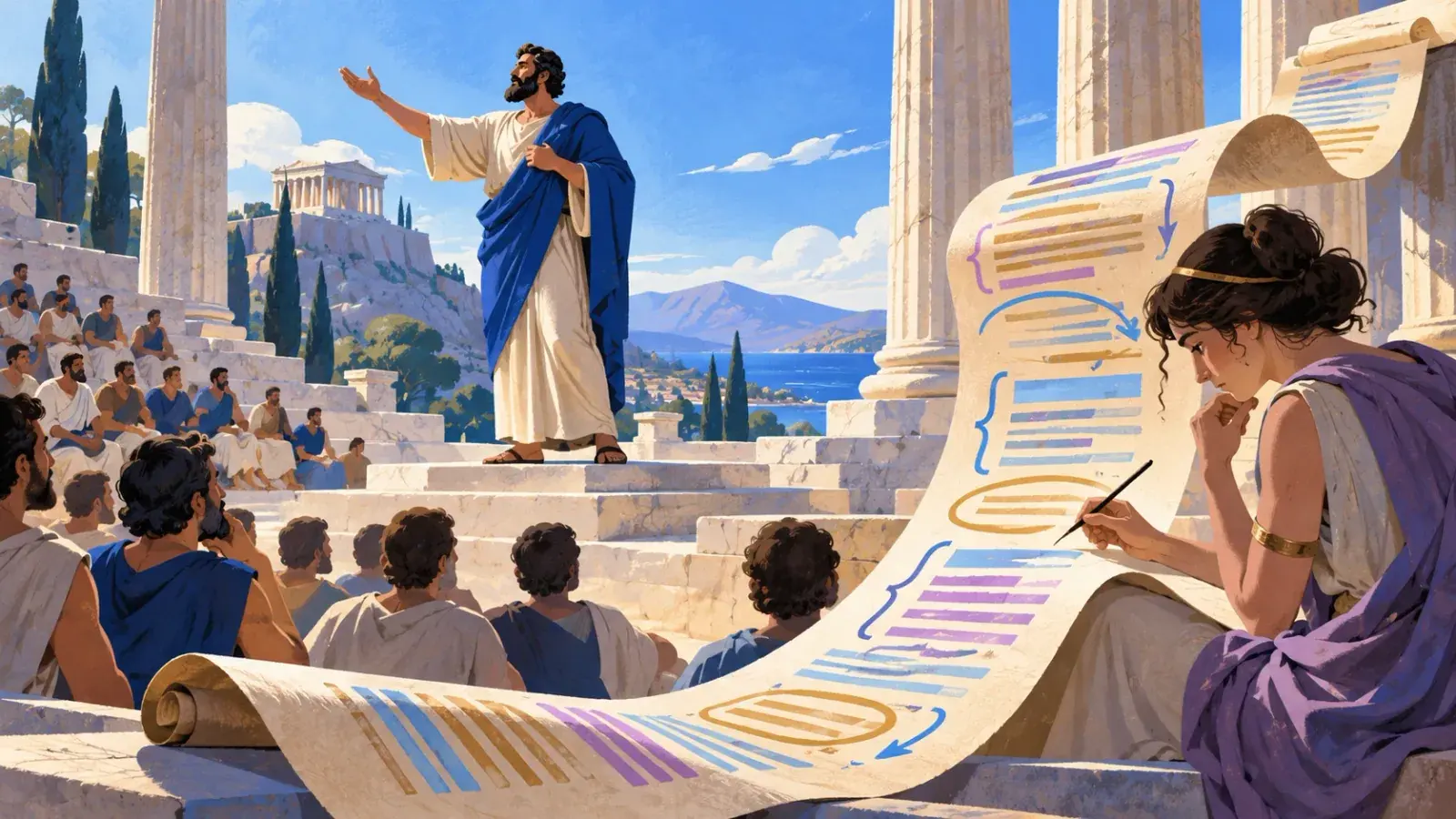
Rhetorical devices are deliberate patterns of language, such as repeating an opening phrase, setting opposites side by side or asking a question nobody needs to answer, that make an argument easier to follow, remember and believe. Speechwriters use them constantly. So do essayists, lawyers, preachers and novelists.
Most of the names are Greek or Latin, because classical teachers of rhetoric catalogued the patterns two thousand years ago. Aristotle defined rhetoric as the ability to see "the available means of persuasion" in any case. The devices are those means at the scale of a sentence. Teachers sort them into schemes, which change the arrangement of words (anaphora, antithesis), and tropes, which change their meaning (metaphor, irony). You can use every one of them without knowing its name. The names help you spot them, in other people's speeches and in your own drafts.
Below are thirty, grouped by what they do. Each has a definition, a classic example from a public-domain speech, play or book, and an original example. All thirty originals come from one imaginary speech: a night-shift nurse asking her city council not to cut the 12:40 a.m. bus that takes hospital staff home. Watching one argument wear thirty devices shows what each adds, and why no real speech should use all of them.
Choose a device by its job
If you know what a passage needs to do, this table points to the devices that do it best. Most do more than one job.
| You want to | Reach for |
|---|---|
| You want toMake a line stick | Reach forAnaphora, tricolon, chiasmus, alliteration |
| You want toDraw a sharp contrast | Reach forAntithesis, paradox, oxymoron |
| You want toBuild to a peak | Reach forClimax, anadiplosis, polysyndeton |
| You want toSound quick and decisive | Reach forAsyndeton, tricolon |
| You want toMake an abstract point concrete | Reach forMetaphor, simile, analogy, synecdoche |
| You want toAnswer doubts before they're raised | Reach forProcatalepsis, hypophora |
| You want toLet the audience finish the thought | Reach forRhetorical question, irony, litotes |
| You want toRaise a point without seeming to | Reach forApophasis, allusion |
| You want toRaise the emotional temperature | Reach forEpizeuxis, hyperbole, apostrophe |
Devices of repetition
Repetition is the oldest tool in speechmaking because listeners can't reread. A repeated word works as a signpost: it tells the audience where they are and what kind of sentence is coming.
1. Anaphora
The same word or phrase at the start of successive clauses or sentences. It builds momentum and warns the listener that a series is coming. Three is the usual count. Past four it starts to sound like a chant, which is occasionally what you want.
Last night Japanese forces attacked Hong Kong. Last night Japanese forces attacked Guam. Last night Japanese forces attacked the Philippine Islands.
Roosevelt reads the attacks out like incoming dispatches. The repeated opening turns a list of places into a single, spreading event.
In the bus speech: "Ask the nurse who clocks out at midnight. Ask the baker who clocks in at four. Ask the cleaner who does both."
2. Epistrophe
The mirror image of anaphora: the same word or phrase at the end of successive clauses. The end of a sentence is where the stress falls, so epistrophe drives the repeated word home. Lincoln's "of the people, by the people, for the people" is the best-known case.
When I was a child, I spake as a child, I understood as a child, I thought as a child: but when I became a man, I put away childish things.
Three clauses end on "as a child," so the turn to "became a man" lands with the weight of all three behind it.
In the bus speech: "The route was planned by the city, it is paid for by the city, and it carries the people who look after the city."
3. Anadiplosis
The last word of one clause becomes the first word of the next, so the ideas link like a chain. It suits cause and effect, because each link seems to follow from the one before.
My conscience hath a thousand several tongues,
And every tongue brings in a several tale,
And every tale condemns me for a villain.
Richard's guilt multiplies link by link, from conscience to tongues to tales to a verdict.
In the bus speech: "We need the bus. The bus needs riders. And riders need to know it will come."
4. Epizeuxis
One word repeated immediately, with nothing in between. It is the bluntest form of emphasis and the easiest to overuse, so save it for a moment of real feeling.
Thou'lt come no more,
Never, never, never, never, never!
Lear holds his dead daughter. One word, five times, because no other word will come.
In the bus speech: "It is a long walk home. Long, long, when you have been on your feet since seven."
5. Alliteration
The same consonant sound at the start of nearby words. It makes a phrase easy to say and hard to forget, which is why so many slogans and headlines use it. Repeated s sounds, called sibilance, can sound hushed or menacing.
And the silken, sad, uncertain rustling of each purple curtain
The s sounds are the rustle. Poe lets you hear the curtain before he names it.
In the bus speech: "The last bus is the late shift's lifeline."
Devices of arrangement
These work on the shape of a sentence more than on its words: what sits beside what, in which order, joined by what. Most grow from the broader idea of juxtaposition, placing two things together so the audience compares them.
6. Parallelism
Giving related ideas the same grammatical form: noun with noun, clause with clause. The matching shape tells the listener the items belong together. A broken series ("to plan, to budget and hiring") is one of the commonest faults in persuasive writing.
With malice toward none, with charity for all, with firmness in the right as God gives us to see the right, let us strive on to finish the work we are in
Three "with" phrases of matching shape set out the terms of the peace before the verb arrives.
In the bus speech: "It costs the city very little. It saves the hospital a great deal."
7. Tricolon
A series of three parallel words, phrases or clauses. Three feels complete in a way two does not, and four starts to feel like a list. When each part is longer than the one before, the series builds. The Latin name for that is tricolon crescens.
that among these are Life, Liberty and the pursuit of Happiness.
Two single words, then a phrase. The longest item comes last, where it has room to land.
In the bus speech: "It is cheap, it is full, and it is the only way home."
8. Antithesis
Opposing ideas set in balanced, parallel clauses. It makes a choice look stark and the speaker look certain, so it is the natural device for a thesis or a closing line.
Not that I loved Caesar less, but that I loved Rome more.
Brutus explains a murder in twelve words by setting less against more and Caesar against Rome.
In the bus speech: "You can balance this budget on a spreadsheet, or you can balance it on the backs of the night shift."
9. Chiasmus
Two clauses in which the second reverses the order of the first: A B, then B A. When the same words come back reversed, the narrower name is antimetabole. The reversal makes the second half sound like proof of the first.
ask not what your country can do for you—ask what you can do for your country.
"Country" and "you" trade places, and so do the obligations.
In the bus speech: "We look after this city every night. Tonight we are asking the city to look after us."
10. Climax
Words or ideas arranged in rising order of importance, often chained together with anadiplosis. The audience feels the build and expects the peak, so the last step has to be the strongest. It is also called gradatio.
knowing that tribulation worketh patience; And patience, experience; and experience, hope
Each step picks up the last word and climbs, from suffering to hope.
In the bus speech: "Lose the bus and we lose the ride. Lose the ride and the ward loses a nurse. Lose the nurse and a patient waits."
11. Asyndeton
Leaving out the conjunctions in a series. The list moves faster and sounds final, as if nothing more needed saying.
Veni, vidi, vici. (I came, I saw, I conquered.)
Caesar's report of a quick victory at Zela, in what is now Turkey. With no "and," the war sounds as short as it was.
In the bus speech: "Nurses, porters, cooks, cleaners, guards: they are all on the 12:40."
12. Polysyndeton
The opposite: a conjunction between every item. It slows the sentence and makes each item feel like a separate event, which suits weariness, abundance or a disaster that keeps getting worse.
And the rain descended, and the floods came, and the winds blew, and beat upon that house; and it fell
Each "and" piles more weight on the house built on sand until it gives way.
In the bus speech: "And then I wait, and it starts to rain, and the app says twenty minutes, and then it says forty."
13. Zeugma
One word governing two others in different senses, usually one literal and one figurative. It is a comic device more than a persuasive one, good for a dry aside that wakes a room up.
went straight home, in a flood of tears and a sedan-chair.
"In" does two jobs at once, and the second punctures the first. Dickens uses it to deflate Miss Bolo's exit.
In the bus speech: "Most nights I catch the 12:40 and about four hours of sleep."
Devices of comparison
These are the tropes: they describe one thing in terms of another. In an argument they turn an abstraction, like a budget line, into something the audience can picture.
14. Metaphor
Saying one thing is another, without "like" or "as." A good metaphor hands the audience a picture with an argument folded inside it. Kept going over several lines, it becomes an extended metaphor.
All the world's a stage,
And all the men and women merely players
Jaques sustains the metaphor for a whole speech, through seven ages of a life.
In the bus speech: "That bus is the hospital's back door."
15. Simile
A comparison that announces itself with "like" or "as." Because it admits to being a comparison, a simile asks less of the audience than a metaphor, and it is easier to qualify.
O my Luve's like a red, red rose,
That's newly sprung in June
One comparison carries the color, the freshness and the season.
In the bus speech: "At 12:40 the bus is like a second staff room: half the ward is on it."
16. Analogy
A comparison worked out as an argument: this case is like that one, so what holds for one holds for the other. It persuades only as far as the two cases really match, which is exactly where an opponent will attack.
In no instance hath nature made the satellite larger than its primary planet
Paine is arguing that it is absurd for an island to govern a continent. Borrowing the solar system makes independence look like natural law.
In the bus speech: "Cutting the night bus to save money is like removing the fire exit because nobody used it last month."
17. Metonymy
Naming something by a thing closely associated with it: "the White House" for the president's staff, "the press" for journalists. It turns institutions into objects the audience can see.
The pen is mightier than the sword.
The pen stands for writing and the sword for force, so a large claim fits in seven words.
In the bus speech: "City Hall doesn't ride this bus. The ward does."
18. Synecdoche
A close cousin of metonymy in which a part stands for the whole, or the whole for a part: "hands" for workers, "wheels" for a car. Choosing which part to name is choosing what the audience notices.
Was this the face that launch'd a thousand ships
Helen is reduced to her face, the one part of her that mattered to the men who went to war over her.
In the bus speech: "This bus carries forty pairs of hands the hospital can't run without."
19. Personification
Giving human qualities to something that is not human. In argument it gives an abstraction intentions, so it can be blamed or thanked.
Because I could not stop for Death –
He kindly stopped for me –
Death arrives as a courteous gentleman with a carriage, which is far more unsettling than a skeleton.
In the bus speech: "This budget has a long memory for costs and a short one for people."
20. Allusion
A brief reference to a story, person or text the audience already knows, which brings that story's meaning along for free. It works only if the audience catches it, so match the source to the room.
Suffer not yourselves to be betrayed with a kiss.
Nine words recast Britain's friendly gestures as the kiss of Judas.
In the bus speech: "We are not asking you to part the Red Sea. We are asking you to keep one bus running."
Devices of emphasis and tone
These change how strongly a claim is put, or say one thing and mean another. All of them rely on the audience sharing your sense of proportion and your tone.
21. Hyperbole
Deliberate exaggeration that no one is meant to take literally. It conveys feeling, not fact, so keep it well away from any number the audience might check.
Will all great Neptune's ocean wash this blood
Clean from my hand?
Macbeth answers himself: his hand will turn the seas red. The scale of the image is the scale of his guilt.
In the bus speech: "At two in the morning, a mile and a half is the longest walk in the world."
22. Litotes
Understatement made by denying the opposite: "not bad," "no small feat." It sounds modest and lets the audience supply the emphasis, so it often lands harder than the plain claim would.
I am a man which am a Jew of Tarsus, a city in Cilicia, a citizen of no mean city
Paul could have called Tarsus great. "No mean city" claims the same and sounds like modesty.
In the bus speech: "A twelve-hour shift on a ward is no small thing."
23. Irony
Saying the opposite of what you mean, or something that means more than it says, and trusting the audience to hear the gap. Irony needs a shared assumption. Use it with a hostile or literal-minded audience and it can be quoted back to you as your real view.
It is a truth universally acknowledged, that a single man in possession of a good fortune, must be in want of a wife.
The "truth" is the neighbors' wish, not the man's need, and the rest of the chapter shows whose truth it is: Mrs. Bennet's.
In the bus speech: "The report calls night riders 'low demand.' Come and meet the low demand at 12:40. It's standing room only."
24. Paradox
A statement that seems to contradict itself but turns out to be true. It stops the listener for a second while they work out the sense, which is the point.
I must be cruel, only to be kind
Hamlet's excuse for the harsh things he has just said to his mother.
In the bus speech: "The cheapest route to cut could be the most expensive one to lose."
25. Oxymoron
Two contradictory words fused into one phrase: "open secret," "deafening silence." A paradox in miniature, best used once and where both halves are literally true.
Parting is such sweet sorrow
Juliet can't bear to say goodbye and can't wait for tomorrow, both at once.
In the bus speech: "Twelve-forty is the busiest quiet hour in this city."
Devices aimed at the audience
The last group works on the listener directly: questions, objections and asides that pull the audience into the argument instead of lecturing at it.
26. Rhetorical question
A question asked for effect, with the answer assumed. It makes the audience supply the conclusion, and people trust conclusions they reach themselves. It backfires when the audience could plausibly answer the other way.
If you prick us, do we not bleed? if you tickle us, do we not laugh? if you poison us, do we not die?
Shylock's questions have only one possible answer, and that answer is his argument.
In the bus speech: "Which of you would walk a mile and a half home at one in the morning after twelve hours on your feet?"
27. Hypophora
Asking a question and answering it yourself. It presents your next point as the answer to something the audience was already wondering, which makes it a natural signpost in a speech.
What, to the American slave, is your 4th of July? I answer: a day that reveals to him, more than all other days in the year, the gross injustice and cruelty to which he is the constant victim.
Invited to speak for the holiday, Douglass asks what it means to the people it leaves out, and answers before anyone else can.
In the bus speech: "So what does the city get for its money? A hospital that opens every morning with a full staff."
28. Procatalepsis
Raising an objection before your opponent can, and answering it. It shows you have considered the other side, and it takes away their best line.
But I fancy I hear some one of my audience say ... Would you argue more, and denounce less, would you persuade more, and rebuke less
Douglass voices the polite objection to his anger, then answers it: the case against slavery has already been made, and the moment calls for something sharper than argument.
In the bus speech: "You will say ridership is down. It is down because the bus has run late for a year and people stopped trusting it."
29. Apophasis
Raising a point by saying you won't raise it. The point gets made while the speaker seems to stay above it. Audiences often see the trick, so it works best with a light touch.
Let but the commons hear this testament—
Which, pardon me, I do not mean to read—
Antony waves Caesar's will at the crowd while refusing to read it, until they demand that he does.
In the bus speech: "I won't mention that this council approved a new parking garage the same week it proposed this cut."
30. Apostrophe
Turning from the audience to address someone absent or dead, or something not human at all. It lets the speaker show feeling directly, and the audience overhears instead of being lectured.
Death, be not proud, though some have called thee
Mighty and dreadful, for thou art not so
Donne argues with Death to its face, and by the last line tells it that it will die.
In the bus speech: "And to whoever drives the 12:40 tonight: thank you. You have kept better time than this council."
Rhetorical devices in your writing
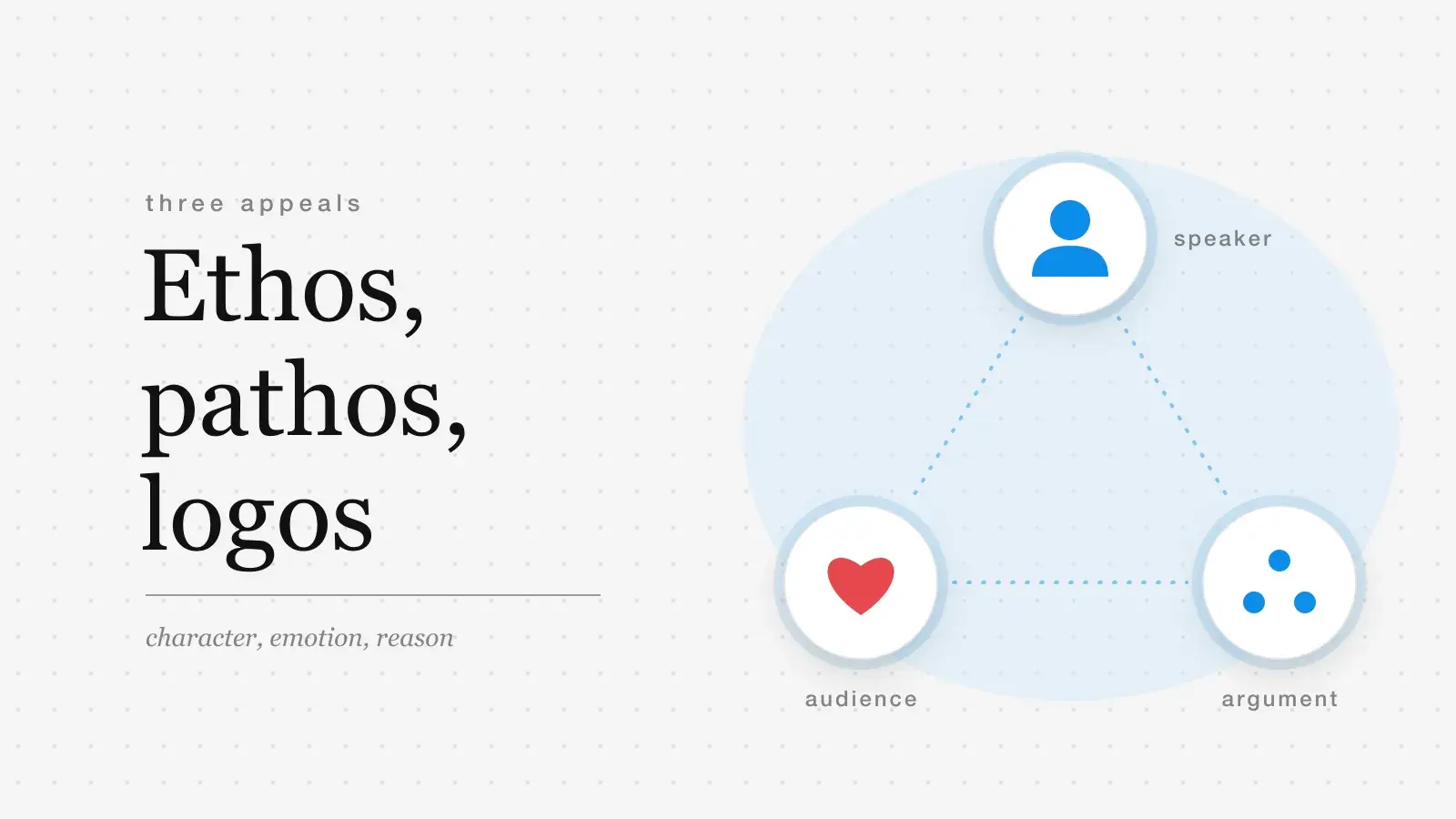
Devices are amplifiers. They make a good argument louder and a weak one more obviously weak. Start with the claim and the reasons an audience should accept it, which is the territory of ethos, pathos and logos. Then spend devices where the weight falls: the opening, the turn and the close.
- Write for the ear when it will be heard. A speech needs more repetition than an essay because the audience can't go back a paragraph. Anaphora and tricolon are signposts as much as ornament.
- One strong device per paragraph is plenty. Stack them and the audience hears technique instead of argument. In prose the same habit produces purple prose.
- Put the weight at the end. The last word of a sentence gets the most stress, which is why epistrophe, climax and the long third item of a tricolon all work.
- Match the device to the room. Irony, allusion and litotes depend on shared knowledge. A mixed audience may miss them, and a hostile one may quote them back.
- Read it aloud. Rhythm you can't see on the page is obvious the moment you say it.
Before: The proposal to cut the 12:40 bus would save some money, but it would cause problems for hospital staff who work late. Many of them depend on it and have no other way home. We think the council should reconsider.
After: The 12:40 is cheap, it is full, and it is the only way home. You can balance this budget on a spreadsheet, or you can balance it on the backs of the night shift. Which of you would walk home at one in the morning after twelve hours on your feet?
The revision adds no new facts. A tricolon replaces the vague "problems," an antithesis turns "reconsider" into a choice, and a rhetorical question hands the conclusion to the council.
In fiction, rhetoric belongs to characters, and how they use it tells the reader who they are. Shakespeare gives Brutus a funeral speech in prose, built on tidy antitheses, and gives Antony verse full of repetition, irony and apophasis. Brutus convinces the crowd for a few minutes. Antony sends it out to burn the conspirators' houses. A character who speaks in polished chiasmus is someone who has rehearsed. Let the manipulator have the devices, keep the narrator plain, and readers will feel the difference without being told.
Rhetorical vs. literary devices
The lists overlap, and many textbooks use the terms loosely. The useful difference is purpose. A rhetorical device is chosen to move an audience toward a view or an action. A literary device serves a story or poem. Metaphor and irony are both. Foreshadowing and flashback are literary devices with no persuasive job, while procatalepsis rarely turns up in a plot.
| Term | What it covers | Examples |
|---|---|---|
| TermRhetorical devices | What it coversWording chosen to persuade or move an audience | ExamplesAnaphora, antithesis, rhetorical question |
| TermLiterary devices | What it coversTechniques that shape a story or poem | ExamplesForeshadowing, flashback, motif |
| TermFigures of speech | What it coversThe older umbrella for schemes and tropes | ExamplesChiasmus, metaphor, hyperbole |
| TermRhetorical appeals | What it coversThe grounds of persuasion, not the wording | ExamplesEthos, pathos, logos |
If you are analyzing a speech rather than writing one, the five groups above make a checklist: repetition at the starts and ends of sentences, pairs and threes, comparisons, shifts in tone, and moments when the speaker turns to the audience or away from it. Naming the device is only the first step. Say what it does to the listener and why the speaker needed it there. The rhetorical analysis example works through a whole speech that way.
Related terms: juxtaposition, ethos, pathos and logos, motif (repetition across a whole work rather than a passage) and purple prose. To put the devices to work, start with How to write a speech and the speech outline template.