A rhetorical analysis explains how a speaker or writer tries to move a particular audience, and why those choices work. It does not ask whether the argument is right. It asks what the speaker did with words, for whom, and to what end.
Below is a complete sample essay on Abraham Lincoln’s Gettysburg Address, with a note on what each paragraph does. After it come shorter examples on Frederick Douglass and John F. Kennedy, thesis statements from weak to strong, and a seven-step method for writing your own.
What a rhetorical analysis looks at
Every analysis starts from the rhetorical situation: who is speaking, to whom, on what occasion, and what problem the speech is meant to solve. The rhetorician Lloyd Bitzer called that problem the exigence in a 1968 essay, and the idea is useful because it keeps you honest. A choice is only effective relative to a situation. A joke that works at a retirement party fails at a funeral.
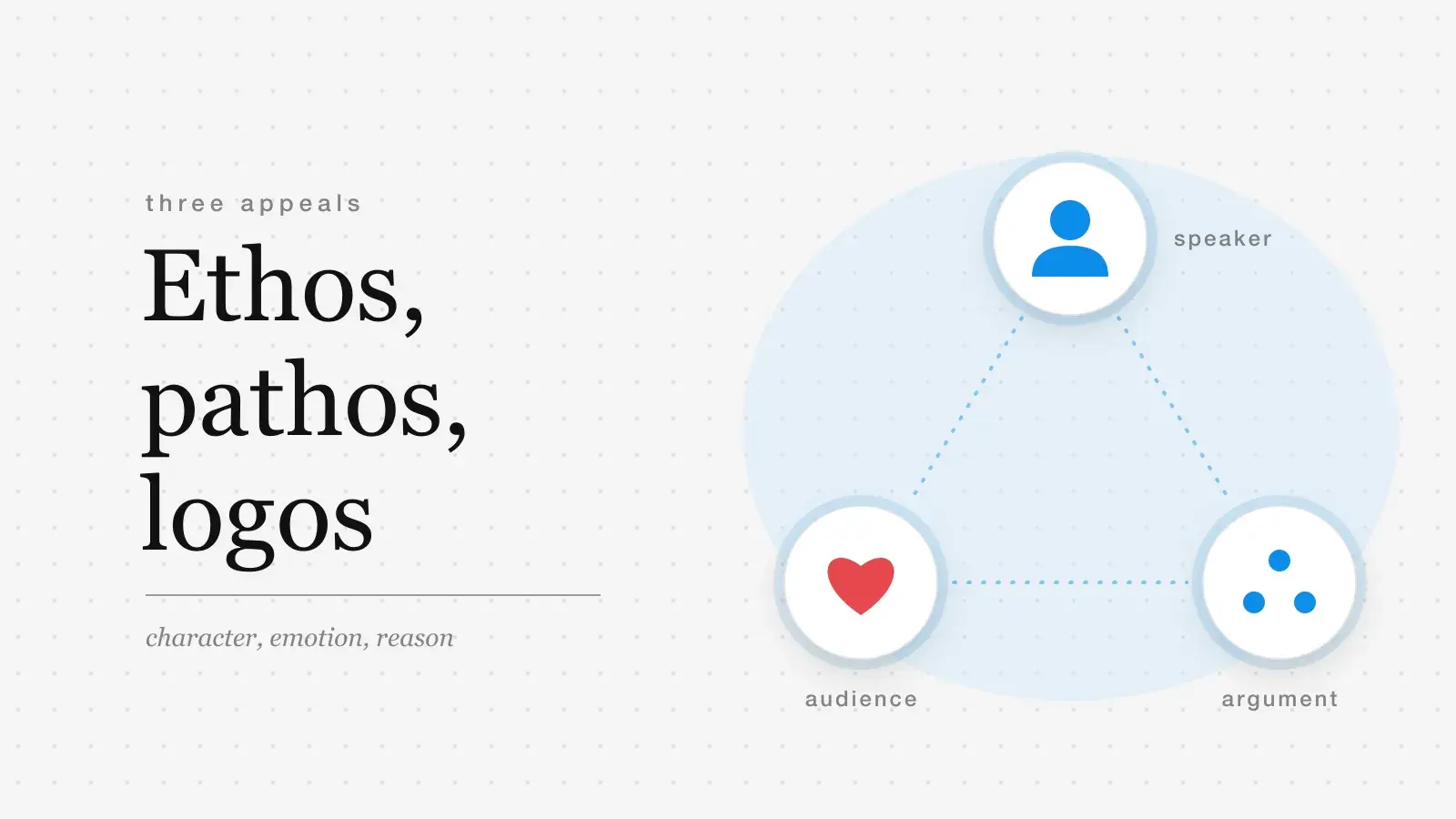
From there you look at the appeals (ethos, pathos and logos, plus kairos, the sense of the right moment) and at style: word choice, sentence shape, structure, tone, and the rhetorical devices that carry them. Here is that checklist applied to the speech in the full example below.
| Element | Ask | In the Gettysburg Address |
|---|---|---|
| ElementSpeaker | AskWhat authority or baggage do they bring? | In the Gettysburg AddressA wartime president, invited to add “a few appropriate remarks” |
| ElementAudience | AskWho is listening, and who will read it later? | In the Gettysburg AddressAbout 15,000 people at the ceremony; newspaper readers after |
| ElementOccasion | AskWhat happened, and what is expected now? | In the Gettysburg AddressDedicating a soldiers’ cemetery, months after the battle |
| ElementPurpose | AskWhat should the audience think or do afterward? | In the Gettysburg AddressRecommit to the war as a fight for the founding idea |
| ElementAppeals | AskHow does it earn trust, feeling and assent? | In the Gettysburg AddressShared history, the dead, the founding “proposition” |
| ElementStyle | AskWhich words and patterns stand out? | In the Gettysburg AddressRepeated “here” and “dedicate,” contrasts, birth imagery |
Full example: the Gettysburg Address
Lincoln spoke on November 19, 1863, at the dedication of the Soldiers’ National Cemetery in Gettysburg, Pennsylvania, four and a half months after the battle. The main speaker, Edward Everett, had just given a two-hour oration. Lincoln spoke for about two minutes. The text below is the Bliss copy, which Lincoln wrote out and signed in 1864 and which is the version most often reproduced. It runs about 270 words, so read it twice before the essay.
Four score and seven years ago our fathers brought forth on this continent, a new nation, conceived in Liberty, and dedicated to the proposition that all men are created equal.
Now we are engaged in a great civil war, testing whether that nation, or any nation so conceived and so dedicated, can long endure. We are met on a great battle-field of that war. We have come to dedicate a portion of that field, as a final resting place for those who here gave their lives that that nation might live. It is altogether fitting and proper that we should do this.
But, in a larger sense, we can not dedicate—we can not consecrate—we can not hallow—this ground. The brave men, living and dead, who struggled here, have consecrated it, far above our poor power to add or detract. The world will little note, nor long remember what we say here, but it can never forget what they did here. It is for us the living, rather, to be dedicated here to the unfinished work which they who fought here have thus far so nobly advanced. It is rather for us to be here dedicated to the great task remaining before us—that from these honored dead we take increased devotion to that cause for which they gave the last full measure of devotion—that we here highly resolve that these dead shall not have died in vain—that this nation, under God, shall have a new birth of freedom—and that government of the people, by the people, for the people, shall not perish from the earth.
Introduction
By November 1863 the Union had won at Gettysburg, but the war was far from over, and the new cemetery held men who had died there in July. Edward Everett, the day’s main speaker, had already given a two-hour oration on the battle. Lincoln, invited only to add “a few appropriate remarks,” spoke for about two minutes, and in that space he does something a dedication speech is not expected to do: he declares the ceremony inadequate. By framing the nation’s history as a life still at risk, refusing to let the gathering dedicate the ground, and redirecting the act of dedication to his listeners, Lincoln turns a memorial for the dead into a commitment demanded of the living.
Why it works. The context is limited to what a reader needs to judge the choices: the war, the occasion, the expectation of brevity. The thesis names three strategies in the order the essay treats them and states the effect in one clause. It is also arguable: it claims the speech works against its own genre.
Body paragraph 1: a nation’s life story
Lincoln builds his argument on a timeline. The first sentence looks back “four score and seven years,” to 1776 and the Declaration of Independence rather than the Constitution, and it describes the nation in the language of birth: “brought forth,” “conceived in Liberty.” The second paragraph moves to the present, a war “testing whether that nation … can long endure,” and the last reaches into the future, toward “a new birth of freedom” or a government that might “perish from the earth.” The speech tells the life story of a nation that could still die. For an audience standing among fresh graves, the metaphor does quiet work: the soldiers’ deaths become part of a larger life their survivors can still save. Dating the nation from the Declaration also makes its “proposition that all men are created equal” the thing on trial, not merely the survival of the Union.
Why it works. The paragraph opens with a claim about a choice, quotes only the words it analyzes, and spends most of its length on commentary: what the birth imagery does for this audience, in this place.
Body paragraph 2: the refusal
The speech turns on a refusal. Having called the dedication “altogether fitting and proper,” Lincoln reverses himself: “we can not dedicate—we can not consecrate—we can not hallow—this ground.” Each verb is more sacred than the last, and each is denied. The soldiers, he says, have already consecrated the field “far above our poor power to add or detract.” Then comes the contrast at the center of the address: “The world will little note, nor long remember what we say here, but it can never forget what they did here.” Setting saying against doing, and “we” against “they,” Lincoln ranks the speakers, himself included, below the dead. It is an unusual move for a president at a public ceremony, and it builds his credibility through modesty: a speaker who insists his words do not matter is hard to accuse of using the dead for political ends. The prediction turned out to be wrong, which is part of the speech’s afterlife but not of its strategy.
Why it works. The devices (a rising triad, a juxtaposition of saying and doing) are never the point. The paragraph explains what they do to the relationship between the speaker, the audience and the dead, and it connects that to ethos without announcing “this is ethos.”
Body paragraph 3: the shift to the living
Having emptied the ceremony of its usual purpose, Lincoln gives it a new one. The word “dedicate” returns, but now its object is the audience: “It is for us the living, rather, to be dedicated here to the unfinished work.” The speech uses “here” eight times and some form of “dedicate” six, so the place and the act stay fixed while their meaning moves from the cemetery to the crowd. The final sentence is long and suspended, a chain of clauses set off by dashes, each one a pledge: increased devotion, a resolve “that these dead shall not have died in vain,” “a new birth of freedom.” It ends on a triad that sets the stakes above the war itself: “government of the people, by the people, for the people.” Lincoln never names Gettysburg, the Confederacy, slavery or the Union, and there is no “I” in the speech at all, only “we,” “us” and “our.” That restraint lets every listener, and every later reader, find a place inside the promise.
Why it works. Counts and patterns are evidence only when they are tied to an effect. Here the repetition proves the third part of the thesis, the shift from the ground to the living.
Conclusion
A dedication speech is expected to honor the dead and console the living. Lincoln’s honors the dead by insisting that words cannot, and consoles the living by giving them a task. In about 270 words he reframes the war around a founding promise of equality and asks his audience to finish what the soldiers began. The address works less as a eulogy than as a vow, and its brevity is part of the argument: having said that what is said here matters little, Lincoln stops talking.
Why it works. It does not repeat the thesis word for word. It widens the claim (eulogy versus vow) and ends on an observation that only makes sense after the analysis.
Shorter examples from other speeches
Teachers often assign a single analytical paragraph as practice. These two follow the same pattern, a choice, a short quotation and commentary, on speeches with very different purposes.
Frederick Douglass: the Fourth of July
Douglass delivered “What to the Slave Is the Fourth of July?” on July 5, 1852, at Corinthian Hall in Rochester, New York, at a meeting organized by the Rochester Ladies’ Anti-Slavery Society.
Douglass’s sharpest tool is the possessive pronoun. Early in the speech he praises the founders as “statesmen, patriots and heroes,” but he calls them “your fathers,” a distinction the audience could hear without alarm. Then he asks, “why am I called upon to speak here to-day?” and the distinction becomes the argument: “This Fourth [of] July is yours, not mine. You may rejoice, I must mourn.” The balanced clauses put speaker and audience on opposite sides of the same holiday, and the short sentences, after long periodic ones, land like a verdict. Because he has already honored the founders, the audience cannot dismiss him as hostile to their history, so the pronoun shift wounds rather than merely offends. He even names his method, saying the moment calls for “scorching irony, not convincing argument.” His reason is in the text: the moral case is already conceded (“Must I undertake to prove that the slave is a man? That point is conceded already”), so what the nation needs is not proof but shame.
John F. Kennedy: the inaugural address
Kennedy was sworn in on January 20, 1961, in the middle of the Cold War, and addressed both “my fellow Americans” and “my fellow citizens of the world.”
Kennedy’s address leans on reversal. “Let us never negotiate out of fear. But let us never fear to negotiate” repeats the same words in swapped order, and the swap carries the policy: firmness and openness in one breath, in a speech that addresses “old allies” and “those nations who would make themselves our adversary” alike. The best-known line uses the same pattern to reassign responsibility: “ask not what your country can do for you—ask what you can do for your country.” The command form and the old-fashioned word order lend it the weight of ceremony, and the symmetry makes it easy to remember and repeat. The device is doing political work. It turns a new president’s promises into the audience’s obligations.
Thesis statements, from weak to strong
Many weak analyses go wrong at the thesis, before a single paragraph is written. Here are three versions for the Gettysburg Address.
Weak: In the Gettysburg Address, Lincoln uses ethos, pathos and logos to persuade his audience.
True of nearly every speech. It names categories, not choices, and gives no purpose.
Better: Lincoln uses repetition, contrast and imagery to honor the soldiers who died at Gettysburg.
Names real choices, but the purpose is just the occasion, and there is no claim about effect.
Strong: By framing the nation’s history as a life still at risk, refusing to let the ceremony dedicate the ground, and redirecting dedication to his listeners, Lincoln turns a memorial for the dead into a commitment demanded of the living.
Specific strategies, in order, tied to a purpose and an effect that someone could dispute.
A pattern to start from, then rewrite in your own words:
Thesis pattern
By [choice 1], [choice 2] and [choice 3], [speaker] [does what] for [audience], so that they [think, feel or do what].How to write a rhetorical analysis
- Read once for the argument
Read the whole text without marking it. Then write one sentence: what does the speaker want this audience to think or do? Every later decision hangs on that sentence.
- Map the situation
Note the speaker, audience, occasion and purpose. If the prompt gives a headnote, read it closely; it often holds the context you need. Two or three sentences of context go in your introduction, not a history lesson.
- Annotate choices, not devices
On the second read, mark every place where the speaker could have done otherwise: a loaded word, a pronoun shift, a sudden short sentence, a turn. Name the device afterward, if it has a name.
- Group the marks by what they do
Sort your marks into two to four effects, such as building trust, staging a contrast, or shifting responsibility. Each group becomes a body paragraph. Follow the order of the text when the speech’s structure is part of its argument, as at Gettysburg; otherwise organize by strategy.
- Write the thesis
Name the strategies, the purpose and the effect in one or two sentences. If nobody could disagree with it, it is a summary.
- Draft each paragraph as claim, evidence, commentary
Open with a claim about a choice, embed a short quotation in your own sentence, then explain how it works on this audience and why it serves the purpose. Commentary should be longer than the quotation. Write in the present tense: Lincoln argues, Douglass asks.
- Conclude by widening, then revise
End with the larger point the analysis proves rather than a restatement. Then reread each paragraph and ask “so what?” after every quotation. Wherever you have no answer, the paragraph is still summary.
The skeleton below fits most assignments. For a blank version with room for thesis and supporting points, use the essay outline template.
Rhetorical analysis outline
Introduction
  Context: speaker, occasion, audience (2–3 sentences)
  Thesis: strategies + purpose + effect

Body paragraph 1: first strategy (or first movement of the text)
  Claim about the choice
  Short quotation, embedded
  Commentary: how it works on this audience, why it serves the purpose

Body paragraphs 2–3: same pattern

Conclusion
  The larger point the analysis proves
On a timed exam
The AP English Language and Composition exam includes one rhetorical analysis question among its three essays. The free-response section lasts 2 hours 15 minutes, including a 15-minute reading period, and each essay is scored from 0 to 6: one point for the thesis, up to four for evidence and commentary, and one for sophistication. Evidence and commentary carry most of the score, so spend your planning minutes on what each quotation does, not on finding more devices. Check the College Board’s current course page, since details can change.
Mistakes that cost the most
Analysis
- Explaining why a choice works on this audience
- Lincoln repeats “here” eight times, pinning every pledge to the ground
- Judging how well a strategy fits the occasion
- Organizing by strategy or by the movement of the text
- Short quotations woven into your own sentences
Summary or device-spotting
- Retelling what the speech says, in order
- Lincoln uses repetition (and nothing after it)
- Arguing whether the speaker is right
- One paragraph each for ethos, pathos and logos by default
- Long block quotations with one line of comment
One quick test: find every “uses” in your draft and replace it with a verb that says what the choice does. Lincoln does not use antithesis; he ranks the living below the dead. Douglass does not use pronouns; he divides the room. If no stronger verb comes, you have not yet found the effect.
Drafting and checking in Strokes
If you write in Strokes, keep the speech and your draft as two documents in one project and add the speech to an AI Assistant chat as context. Then ask questions that test your reading rather than replace it: “Which sentences in my second paragraph summarize instead of analyze?” or “Does paragraph three support the last part of my thesis?” Version history saves drafts as you go, so you can restructure from chronological to strategic order and preview the earlier version with the changes marked. Check your school’s rules on AI before using any assistant on graded work.
For the techniques themselves, see 15 persuasive techniques with examples, and for a longer study of a modern speech, our rhetorical analysis of “I Have a Dream”.
Frequently asked questions
How long should a rhetorical analysis essay be?
There is no standard length. A timed exam essay is usually an introduction, two or three body paragraphs and a conclusion; a class assignment sets its own word count. Depth matters more than length: each body paragraph should analyze one strategy fully.
What is the difference between a rhetorical analysis and an argumentative essay?
In an argumentative essay you argue your own position on a topic. In a rhetorical analysis you argue about how someone else's text persuades its audience. Both need an arguable thesis, but the analysis is a claim about method and effect, not about who is right.
Do I have to write about ethos, pathos and logos?
Only if the prompt asks for them. They are a useful vocabulary, but the strongest analyses follow specific choices such as structure, word choice and sentence shape, and mention an appeal only where it explains the effect.
Should a rhetorical analysis be written in present tense?
Usually, yes. Most teachers expect the literary present (Lincoln argues, Douglass asks) and third person. Use past tense for historical context, such as when and where the speech was given, and follow your assignment's instructions where they differ.
Which speech should I choose to practice on?
Pick a short speech with a clear occasion, such as the Gettysburg Address or a presidential inaugural address. Short texts force you to analyze individual choices instead of summarizing, and a well-known speech lets you compare your reading with published commentary afterward.