Winston Churchill gave the speech now known as “We shall fight on the beaches” in the House of Commons on Tuesday, June 4, 1940, the day the Dunkirk evacuation ended and 25 days after he became prime minister. Hansard, the official record of Parliament, has him on his feet from 3:40 to 4:14 p.m., about 34 minutes. By our count of the Hansard text the speech runs to 3,778 words, and the lines everyone quotes are roughly the last 180.
The other 3,600 words are a military report, and most of the news in it is bad. That proportion explains the speech. Churchill spent half an hour telling Parliament what had been lost before he said what Britain would do next, and the ending lands because of everything that comes before it.
The speech at a glance
| Fact | Detail |
|---|---|
| FactDate | DetailTuesday, June 4, 1940 |
| FactPlace | DetailHouse of Commons, London |
| FactSpeaker | DetailWinston Churchill, prime minister since May 10, 1940 |
| FactOccasion | DetailA statement on the war after the Dunkirk evacuation |
| FactLength | DetailAbout 34 minutes; 3,778 words in Hansard |
| FactThe famous passage | DetailRoughly the last 180 words, under 5 percent of the speech |
| FactHow the public heard it | DetailExtracts read by a BBC announcer on the evening news |
| FactRecording | DetailNone in 1940; Churchill recorded it at Chartwell in 1949 |
| FactOfficial text | DetailHansard, House of Commons, vol. 361, cols. 787–798 |
What had happened by June 4
Churchill took office on May 10, 1940, the day Germany attacked the Netherlands, Belgium and France. Within ten days German armored divisions had broken through at Sedan and reached the Channel at Abbeville, cutting off the British Expeditionary Force and its allies in the north. Their way out was one port, Dunkirk, and the beaches beside it.
| Date (1940) | What happened |
|---|---|
| Date (1940)May 10 | What happenedGermany invades the Low Countries and France. Churchill becomes prime minister. |
| Date (1940)May 13 | What happenedHis first speech to the Commons as prime minister: “blood, toil, tears and sweat.” |
| Date (1940)May 20 | What happenedGerman armor reaches the Channel at Abbeville, cutting off the northern armies. |
| Date (1940)May 26 | What happenedOperation Dynamo, the evacuation from Dunkirk, begins. |
| Date (1940)May 28 | What happenedBelgium capitulates. Churchill tells the House to prepare for “hard and heavy tidings.” |
| Date (1940)June 4 | What happenedThe evacuation ends. Churchill reports to the Commons: the “beaches” speech. |
| Date (1940)June 18 | What happened“This was their finest hour,” which Churchill also read on BBC radio that evening. |
| Date (1940)June 22 | What happenedFrance signs an armistice with Germany. |
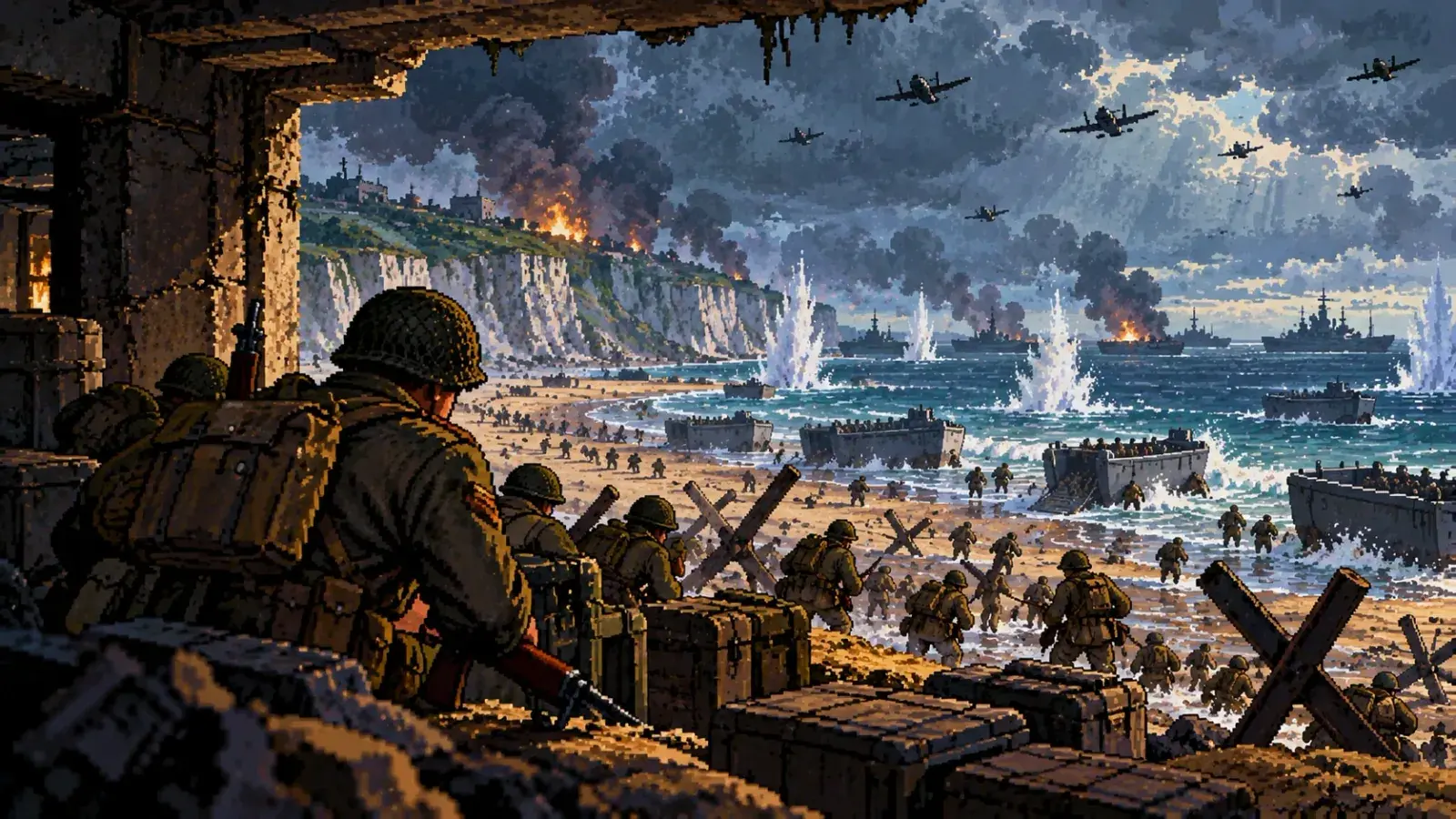
The planners of Operation Dynamo had hoped to bring about 45,000 men off in two days. By the end, 338,226 had crossed to England, more than 100,000 of them French. The country greeted the rescue with enormous relief, and that relief was one of Churchill's problems. An army had escaped, but it had left its guns and vehicles in France, and the Germans now held the coast across the Channel. Relief was not the same as confidence: Mass-Observation, the social research project, had been reporting very low morale in many areas.
So the speech had several jobs at once. It had to report a defeat without dressing it up, warn of invasion without suggesting Britain might lose, prepare listeners for France leaving the war without releasing France from its obligations, and restate the aim Churchill had set on May 13: victory, however long it took. It also had to be heard in Washington. The United States was neutral, and Britain needed it.
How the speech is built
Hansard prints the speech as 19 paragraphs. Grouped by subject, they fall into six parts.
| Part | Words | What Churchill does |
|---|---|---|
| Part1. The breakthrough | Words~600 | What Churchill doesTraces the German armored thrust from Sedan to the sea, and credits the four-day stand at Calais with keeping Dunkirk open. |
| Part2. The week he feared | Words~700 | What Churchill doesAdmits he had expected to announce the greatest military disaster in British history, with perhaps 20,000 or 30,000 men saved. Covers Belgium's surrender and the fight around the port. |
| Part3. The rescue | Words~870 | What Churchill doesOver 335,000 men brought off with nearly 1,000 ships of all kinds. He calls it a deliverance, warns that it is not a victory, and finds the real victory in the air fighting overhead. |
| Part4. The bill | Words~650 | What Churchill doesOver 30,000 killed, wounded and missing. Nearly 1,000 guns and all the army's transport lost. He calls the campaign a colossal military disaster. |
| Part5. Home defense | Words~650 | What Churchill doesThe invasion threat, set against Napoleon's year at Boulogne. Tighter measures against enemy aliens and suspects, and new powers against a fifth column. |
| Part6. The peroration | Words~300 | What Churchill doesConfidence that Britain can hold out, alone if it must. The resolve of government, Parliament and nation. The “we shall” sequence, then the Empire and the new world. |
Two things about this shape are easy to miss if you only know the ending. First, three quarters of the speech, about 2,800 words, is an account of a campaign Britain had just lost, and the invasion warning takes most of the rest. The famous passage gets less than a twentieth.
Second, the good news never stands alone. Part three is the emotional high point of the report, where Churchill gives the rescue its most generous phrase, “a miracle of deliverance.” Five sentences later he takes the applause back: “Wars are not won by evacuations.” Then he offers something real in its place, a victory inside the deliverance, won by the RAF above the beaches. Then he turns to the losses. Relief, correction, consolation, cost. By the time he reaches the end, the House has watched him refuse an easy cheer, which is why it believes him when he asks for a hard one. In the terms of ethos, pathos and logos, the report builds the ethos the ending spends.
The defiance at the end is believable because the speech has already admitted everything that went wrong.
Rhetorical devices in the ending
The final passage turns on a seven-word sentence, a promise to go on to the end, then runs through a series of clauses that each begin the same way. These are the rhetorical devices that do the work, in the ending and in the report that sets it up.
| Device | In the speech | What it does |
|---|---|---|
| DeviceAnaphora | In the speech“We shall” 11 times in the last 180 words, 14 in the whole speech | What it doesTurns a policy into a vow, with a beat a listener can follow. |
| DeviceTricolon | In the speechThree aims before the vow: defend the island home, ride out the storm, outlive the tyranny | What it doesSets a rising rhythm, then qualifies it: “if necessary for years, if necessary alone.” |
| DeviceA list that moves | In the speechFrance, the seas, the air, then the island: beaches, landing grounds, fields, streets, hills | What it doesFollows an invader inland, giving up ground at each step and never the fight. |
| DevicePlain words | In the speechShort words of Old English stock, with surrender the one French import | What it doesThe one borrowed word is the one he refuses. |
| DeviceHistorical analogy | In the speechNapoleon waiting at Boulogne; the German offensive of March 1918 | What it doesMeasures the present against an invasion that never came and a loss Britain survived. |
| DeviceConcession | In the speechImagines the island conquered and starving, and says he does not believe it | What it doesNames the worst case before anyone can use it against him. |
| DeviceIndirect address | In the speechNever names the United States; ends on “the new world” | What it doesSpeaks to Washington without asking in public. |
The list of places reads like a map. It starts abroad, in France and at sea, rises into the air, then comes ashore and moves inland: the coast, the airfields (“landing grounds” in 1940 usage), the farms and towns, the high ground. Each clause concedes a little more of Britain and none of the resolve. The word beaches had already appeared four times in the speech, every time about Dunkirk. In the ending the beaches are British.
The diction is famously plain. It is often pointed out, by Melvyn Bragg in The Adventure of English among others, that every word in the run from the beaches to “never surrender” comes from Old English except surrender itself, a borrowing from French. Whether or not Churchill planned it, the juxtaposition works: a run of old, short, native words, and then the one borrowed word, rejected.
Then comes the part most quotations cut. In Hansard, “we shall never surrender” does not end a sentence. It runs on through a long conditional, in which Churchill imagines the island overrun, to the Empire carrying on the fight, guarded by the British Fleet, and closes on the new world stepping in to rescue the old. The sentence that begins with the beaches is 99 words long, and it ends on hope of an ally rather than on defiance. The historian Richard Toye points out that the fleet clause was something Washington wanted to hear: Roosevelt had asked through secret channels for a commitment that Britain, even if defeated, would send its fleet to the Empire rather than surrender it.
How Britain heard it
Most of Britain did not hear Churchill say these words in 1940. Parliament was not broadcast, and unlike the June 18 speech he did not repeat this one on the radio. That evening a BBC announcer read extracts on the news. Vita Sackville-West wrote to her husband, Harold Nicolson, that even in the announcer's voice it sent shivers down her spine. The recording people know was made in 1949 at Chartwell, Churchill's country house, for a Decca album. Toye has collected accounts from people who later remembered hearing him on the wireless in 1940 all the same. The story that the actor Norman Shelley voiced it does not hold up either: the 1942 Shelley disc that revived the rumor is a different speech.
In the chamber the effect was immediate. Jock Colville, one of Churchill's private secretaries, wrote in his diary that it was a magnificent oration and obviously moved the House. The Conservative MP Chips Channon noted that several Labour members cried. Josiah Wedgwood, a Labour MP, wrote to Churchill that the speech was worth a thousand guns.
Outside the chamber the reaction was more mixed than the legend. The Ministry of Information's report on public morale found that the grave tone had made some impression, and that the reference to fighting alone had caused apprehension and a little more doubt about France. The phrase a modern reader hears as defiance sounded, to many people that June, like a forecast. Within three weeks it was one.
What speechwriters can take from it
Say the worst yourself. Churchill put the losses in his own words and numbers: over 30,000 men, nearly 1,000 guns, a colossal military disaster. A speaker who volunteers the bad numbers is believed when they get to the good ones.
Correct your own applause line. He gave the rescue a phrase people would repeat, then qualified it before the House could settle into it. If your audience wants to celebrate too early, tell them, and give them something truer to hold instead.
Build the ending out of the body. Almost every place in the closing list has been in the speech already: street fighting at Calais, the Navy at sea, the RAF in the air, the beaches, parachute landings. The peroration feels inevitable because it is an index of the speech. Test your own ending the same way: every line should point back to a paragraph that earned it.
Don't stop on the slogan. The quotable words sit in the middle of the last sentence. The speech ends on what comes next, and on the listener it most needed to reach.
If you draft speeches in Strokes, you can select the closing passage and ask the AI Assistant whether every promise in it is backed by something earlier in the draft. Version history keeps the previous endings, in case the new one is worse.
For a method you can follow on your own speech, read how to end a speech, and plan the body first with the speech outline template. For a speech that uses repetition to build hope rather than resolve, read our analysis of “I Have a Dream”.