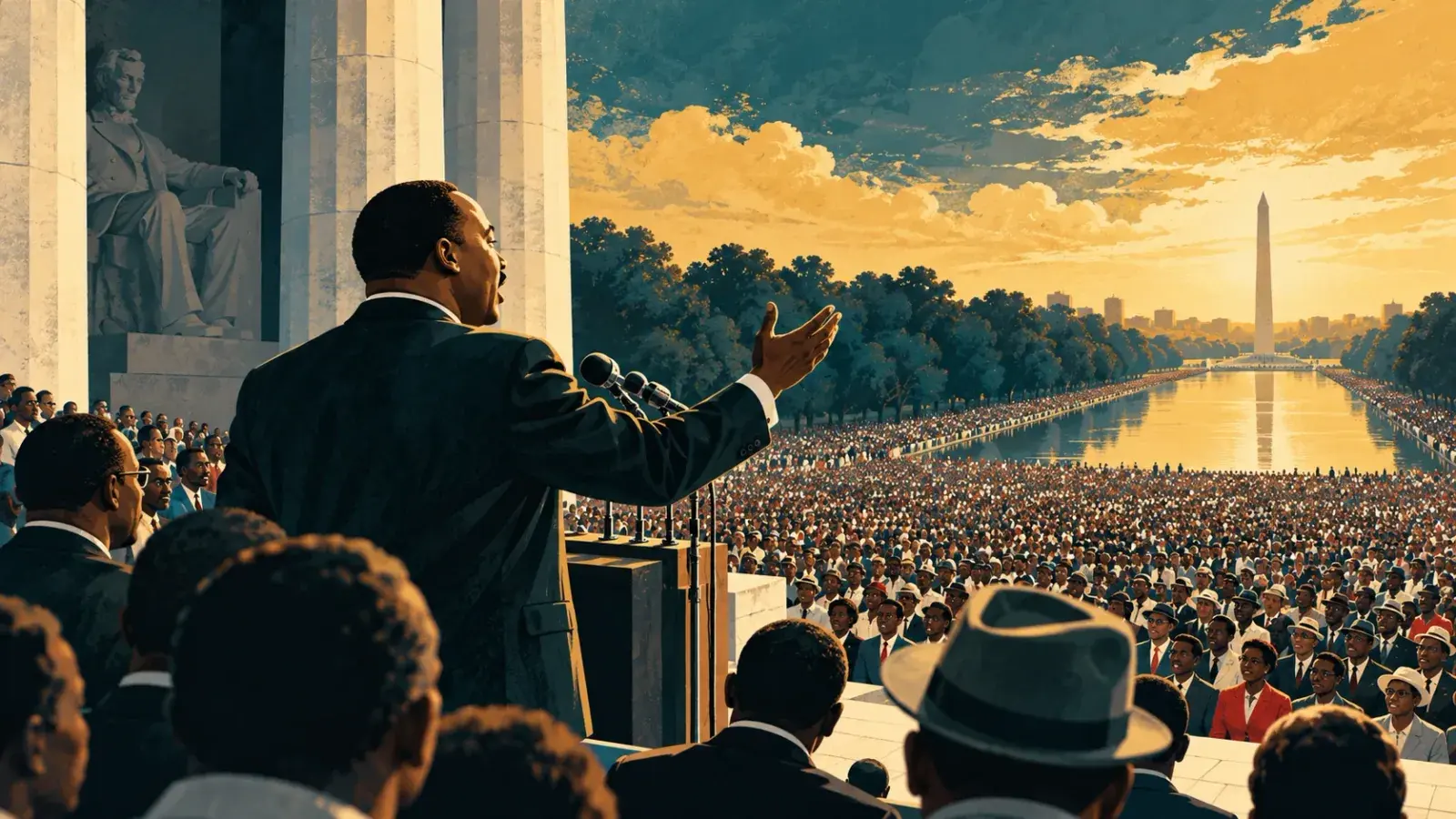
Martin Luther King Jr. gave “I Have a Dream” on August 28, 1963, from the steps of the Lincoln Memorial, to a crowd most often estimated at 250,000. In roughly 1,600 to 1,700 words it does three things in order: it names a promise the country made, shows the promise broken, and then describes the promise kept. Each stage rides on a refrain, and much of the speech's authority is borrowed from texts its audience already trusted: Lincoln, the Declaration of Independence, the Hebrew prophets, a patriotic hymn.
Below is the speech section by section, its main rhetorical devices with a count for each refrain, the allusions traced to their sources, and what a speechwriter can take from it. The text is still under copyright, so this page quotes short phrases only. Keep a transcript or the recording open beside it.
The speech in brief
The March on Washington for Jobs and Freedom ran most of the day, and the television networks pooled their cameras to cover it. King was the sixteenth of eighteen speakers on the official program and spoke as it drew to a close. His prepared text had been drafted with advisers including Clarence B. Jones and Stanley Levison, under the working title “Normalcy, Never Again.” By the King Institute's account at Stanford, he finished it at 3:30 that morning.
He read from that text for most of the speech. Near the end he left it, and the passage that gave the speech its name came from the part he did not read. In a 1999 poll of scholars of public address it ranked first among American speeches of the twentieth century, and the Library of Congress added the recording to the National Recording Registry in 2002.
Structure, section by section
The speech has no headings, but it moves in clear blocks, most of them announced by a repeated opening.
| Section | What it does | Main device |
|---|---|---|
| Section1. The promise | What it doesOpens on Lincoln and the Emancipation Proclamation | Main deviceAllusion |
| Section2. The default | What it doesShows the promise unkept, four ways | Main deviceAnaphora, antithesis |
| Section3. The bad check | What it doesRecasts the founding documents as a debt the nation has not paid | Main deviceExtended metaphor |
| Section4. The urgency | What it doesRejects cooling off and “gradualism” | Main deviceAnaphora, light and dark imagery |
| Section5. A word to his own side | What it doesAsks for discipline and nonviolence, and welcomes white allies | Main deviceDirect address, antithesis |
| Section6. The grievances | What it doesNames what must change: police brutality, segregated hotels, the vote | Main deviceAnaphora, concrete examples |
| Section7. Go back | What it doesSends the crowd home to the South and the northern cities | Main deviceAnaphora, place names |
| Section8. The dream | What it doesDescribes the promise kept, place by place | Main deviceAnaphora, Isaiah |
| Section9. Faith and freedom | What it doesTurns the vision into resolve, then calls the roll of the country's mountains | Main deviceAnaphora, hymn, spiritual |
Two things stand out. One is the split: the first half argues and the second half sings. Sections 2 to 6 make a case with evidence; sections 8 and 9 are a vision. The hinge is section 7, where King stops listing grievances and starts sending people home with something to carry.
The second is that the shape is built on time. The speech opens a century back with the Emancipation Proclamation, insists on now, and spends its last third in a future that King describes as if he could already see it.
Rhetorical devices at a glance
| Device | Where it appears | What it does |
|---|---|---|
| DeviceAnaphora | Where it appearsMost sections open a run of sentences with the same words | What it doesBuilds momentum while each line adds a new image |
| DeviceExtended metaphor | Where it appearsThe promissory note, the bad check, the bank of justice | What it doesTurns a legal argument into a debt anyone understands |
| DeviceAllusion | Where it appearsLincoln, the Declaration, Amos, Isaiah, Shakespeare, a hymn, a spiritual | What it doesMakes a demand sound like the nation's own creed |
| DeviceAntithesis | Where it appearsSkin color against character; physical force against “soul force” | What it doesPuts a choice in a pair that is easy to remember |
| DeviceLight and dark | Where it appearsA beacon, a long night, daybreak, a sunlit path | What it doesFrames the moment as morning after a long night |
| DeviceHigh and low | Where it appearsValleys, quicksand, rock, mountains | What it doesBuilds a landscape for the finale to climb |
| DevicePlace names | Where it appearsGeorgia, Mississippi, Alabama, Stone Mountain | What it doesMakes the vision local; listeners hear their own state |
| DeviceDirect address | Where it appears“My friends”; a passage to “my people” | What it doesChanges audience mid-speech without losing the room |
Antithesis does much of the quiet work. It is a close cousin of juxtaposition: two things set side by side so each sharpens the other. The third “one hundred years later” puts an island of poverty inside an ocean of prosperity. The most quoted line of the speech is built the same way, with skin color on one side and character on the other.
The refrains, counted
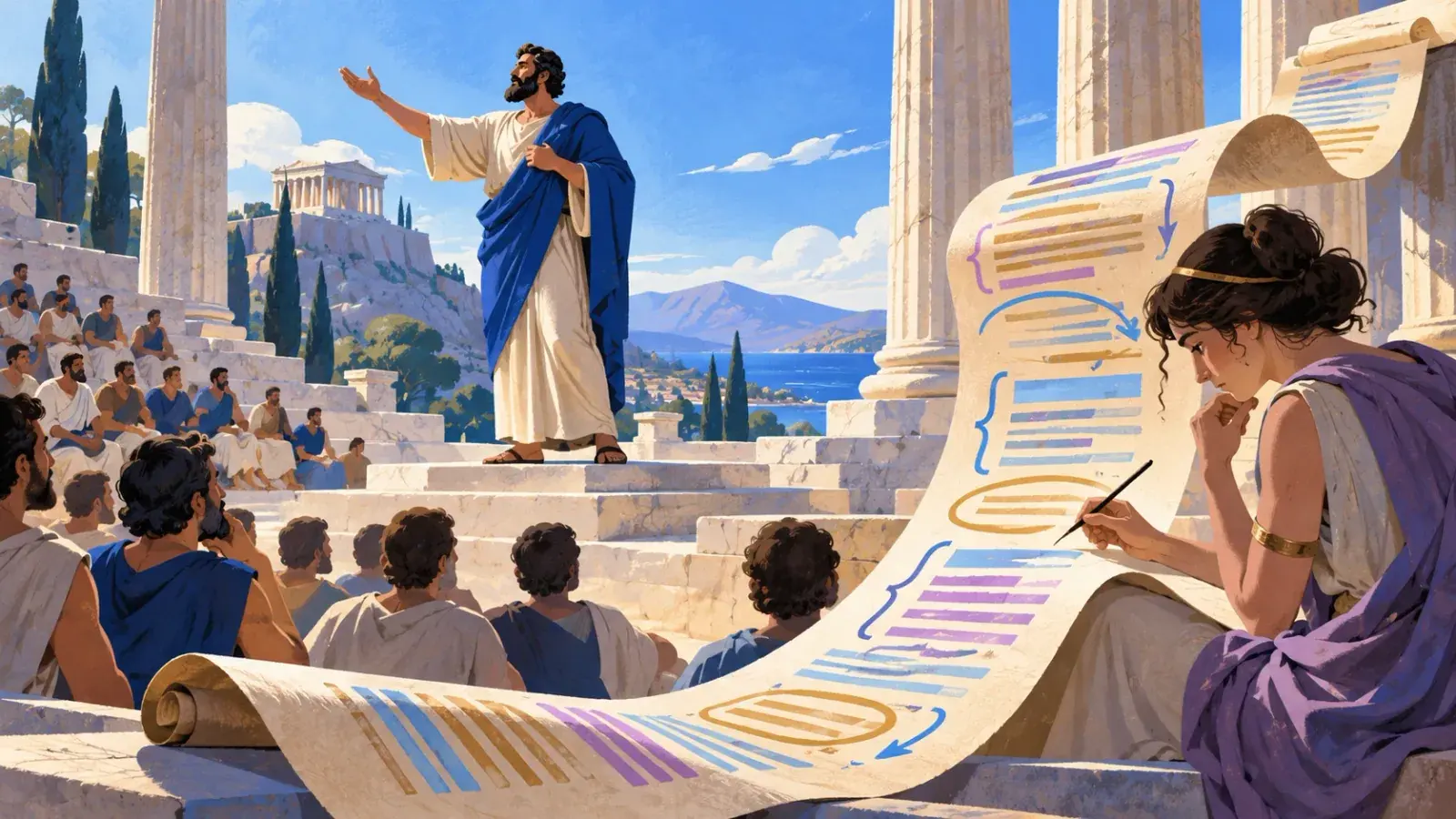
Anaphora is the repetition of the same words at the start of successive sentences. The speech uses it in nearly every section, and the five main runs are easy to count.
| Refrain | Times | What changes each time |
|---|---|---|
| Refrain“One hundred years later” | Times4 | What changes each timeThe condition: not free, segregated, poor, an exile at home |
| Refrain“Now is the time” | Times4 | What changes each timeThe movement: promise to reality, dark to light, sinking ground to rock |
| Refrain“I have a dream” | Times8 | What changes each timeThe scene: the nation's creed, a table in Georgia, Mississippi, four children, Alabama, Isaiah's valleys |
| Refrain“With this faith” | Times3 | What changes each timeWhat faith makes possible: hope, harmony, the struggle shared |
| Refrain“Let freedom ring” | Times11 | What changes each timeThe mountain: eight named places, New Hampshire to Mississippi |
The rule behind every run is the same: the opening stays fixed and the rest of the sentence gets more specific. Look at the order inside the dream sequence. It starts with the nation's creed, narrows to a table on the red hills of Georgia, then to one state, then to King's own four children, before widening to Alabama and finally to scripture. Abstract, then personal, then universal.
The freedom roll call has an order too. It runs through the North and West first, New Hampshire to California, then turns south to Stone Mountain in Georgia, the site of a Confederate memorial begun in the 1920s, and Lookout Mountain in Tennessee. It ends on “every hill and molehill” of Mississippi: the smallest rise in the state the speech has already singled out three times. The list is geography and argument at once.
The bad check
The longest single image is financial. The Constitution and the Declaration were a promissory note; America has defaulted on it and handed its Black citizens a check that came back marked “insufficient funds.” King then refuses to believe the bank of justice is bankrupt, and says the crowd has come to cash the check. According to the King Institute, the promissory-note idea came from Clarence Jones.
The metaphor does argumentative work. A debt is owed, not granted, so the marchers stand as creditors rather than petitioners. It also makes a constitutional argument concrete for anyone who has written a check. Carried across several sentences, it becomes a small story with a setup (the note), a crisis (the bounce) and a demand (pay).
Allusions and their sources
Much of the language is borrowed, and the borrowing is deliberate. The rhetoric scholar Keith D. Miller calls it voice merging: the speaker merges his voice with a tradition the audience holds sacred, so a demand for change sounds like a return to first principles. The sources below are in the public domain, so their lines are quoted in full.
| Source | The original | What King does with it |
|---|---|---|
| SourceGettysburg Address (1863) | The original“Four score and seven years ago” | What King does with itOpens with “Five score years ago,” standing at Lincoln's memorial |
| SourceDeclaration of Independence (1776) | The original“all men are created equal” | What King does with itQuotes it in the first dream as the creed the nation must live out |
| SourceAmos 5:24, King James Version | The original“let judgment run down as waters, and righteousness as a mighty stream” | What King does with itCloses the grievances: no rest until justice rolls down like waters |
| SourceIsaiah 40:4–5, King James Version | The original“Every valley shall be exalted, and every mountain and hill shall be made low” | What King does with itQuoted almost whole as the last dream |
| SourceShakespeare, Richard III | The original“Now is the winter of our discontent” | What King does with itTurned into a sweltering summer of discontent |
| Source“America,” Samuel Francis Smith (1831) | The original“From every mountainside / Let freedom ring!” | What King does with itRecited as a quotation, then made literal: a roll call of mountains |
| SourceA spiritual | The original“Free at last” | What King does with itThe closing words, credited in the speech to an old spiritual |
Two details are easy to miss. King's Amos blends two translations: justice rolling down like waters matches the Revised Standard Version of 1952, while the mighty stream is the King James. And the Shakespeare is reversed. In Richard III, winter turns to glorious summer. In King's version summer is the grievance, the season of heat that has to end, and the relief is an autumn of freedom and equality.
The improvised ending
King read most of the speech from his typescript. Near the end, the gospel singer Mahalia Jackson called out from behind him to tell the crowd about the dream. He moved away from the text, began the refrain and did not go back to the manuscript. He said afterward that he started out reading the speech, and that the crowd's response led him to a passage he had used before. In Taylor Branch's account, King reached for the first run of oratory that came to him and could not say whether Jackson's call had reached him.
The dream itself was not new. King had used the refrain in Rocky Mount, North Carolina, in November 1962, and in Detroit in June 1963, two months before Washington. The “let freedom ring” finale goes back further: King closed a 1957 rally in St. Louis with the same hymn line, and the roll call of mountains echoes a 1952 Republican convention speech by the Chicago minister Archibald Carey Jr., which also named Stone Mountain. What sounded spontaneous was material King had tried on other crowds, ready to hand when the moment came.
The improvised ending was older than the prepared text.
That also explains why the structure holds. The prepared text had built the frame: a promise, a default, a demand. The dream supplies the missing piece, the promise kept, so the improvisation reads as the speech's natural end rather than a detour.
What writers can take from it
None of this needs a quarter of a million listeners. The same moves work in a commencement address, a eulogy or five minutes at a council meeting.
- Give every repetition new cargo. A refrain works when the words after it change and get more specific. “We need change” said five times is a chant. A dream followed by a red hill in Georgia and the speaker's own four children is an argument.
- Pick one metaphor and extend it. The check runs for several sentences and carries a whole argument. One metaphor followed through beats five dropped after a line.
- Borrow words your audience already trusts. The founding document, the scripture, the song everyone knows. Quote accurately, and the borrowed line turns your claim into a reminder.
- Order the speech in time. Then, now, next is a structure a listener can follow without a slide.
- Say the hard thing to your own side. The passage on nonviolence is addressed to supporters, and it earns the credibility, the ethos, that the visionary ending spends.
- Keep tested passages ready. Draft your strongest lines early, try them on smaller audiences, and keep them close on the day.
Flat: We need this library. We need it for our kids. We need it for our future. We need it for our community.
Specific: We need this library for the nine-year-old who finishes the summer reading list by the Fourth of July. We need it for the retired machinist who does his taxes on the third computer from the window. We need it for the forty people who filled the community room last Tuesday, because it is the only room on the east side that stays open after six.
The refrain is identical in both. Only the second gives the council something to picture, and something to lose.
When you revise a speech of your own, read it for refrains the way this page reads King's. In Strokes you can select the draft and ask the AI Assistant to list each repeated opening and what follows it; a refrain with nothing new behind it stands out in that list. Version history keeps the earlier draft if a cut goes too far.
To write a full analysis essay of your own, the rhetorical analysis example works through the Gettysburg Address step by step. To put these techniques into a speech, start with how to write a speech and the speech outline template. For a different method under different pressure, read our analysis of Churchill's “We shall fight on the beaches”, or see how King's speech sits beside Lincoln, Kennedy and others in famous speeches in history.