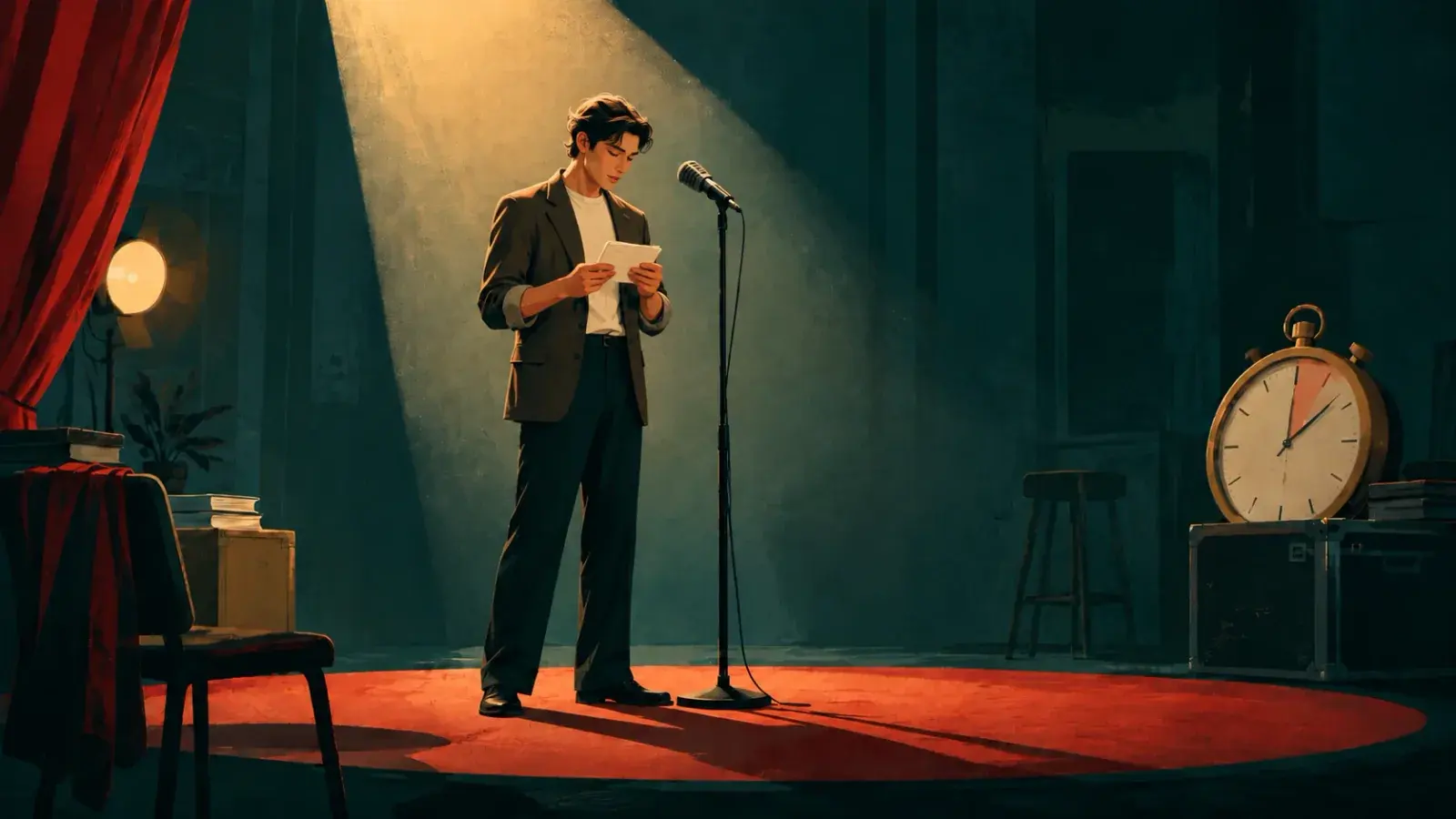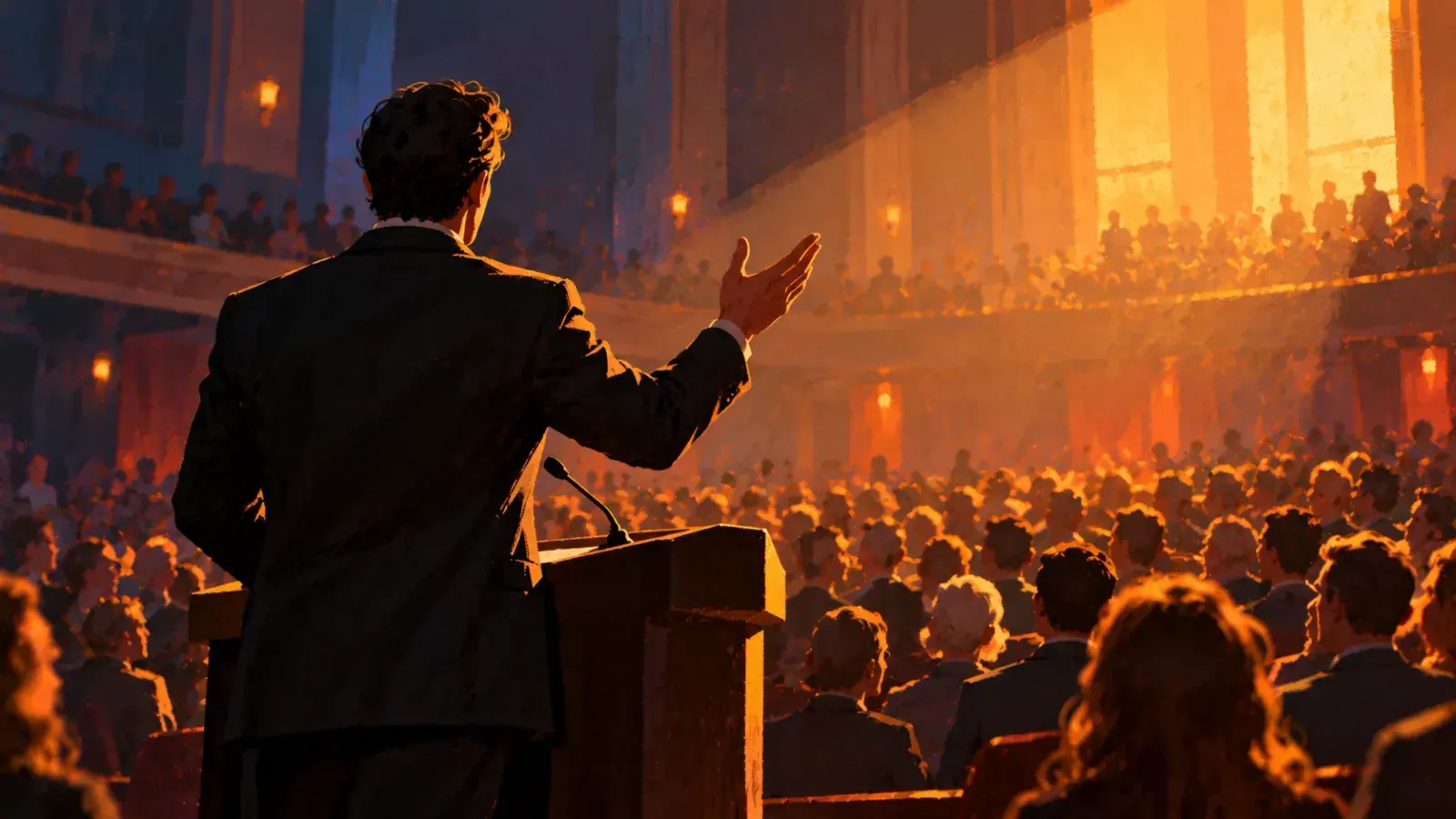
To end a speech well, signal that you are finishing, bring back the one idea you want people to keep, say it in a final line built to be remembered, then pause before you thank anyone. The strongest closings do one of a few things: call back to the opening, ask for a specific action, finish a story, or compress the whole talk into a sentence. Keep the close to about 5 to 10 percent of the speech, and add nothing new in it.
Why the ending matters most
People judge a speech the way they judge most experiences: by its strongest moment and by how it ends. Psychologists call this the peak-end rule. In a 1996 study by Donald Redelmeier and Daniel Kahneman, patients rated a painful medical procedure by its worst moment and its last few minutes, almost regardless of how long it lasted. Your speech will be more pleasant than a colonoscopy, but the principle carries over. The audience decides what the talk meant while you are finishing it.
An ending has three jobs. It tells the room you are wrapping up, which brings back the people who drifted during the middle. It lands the one idea you want them to take home. And it releases them: a clear final line followed by a pause tells everyone it is time to clap. An ending that trails off leaves people unsure whether you are done, and the applause arrives late and thin. In a persuasive speech the close is also where you lean hardest on pathos, because the argument has already been made.
The four beats of a closing
Most good closings, short or long, move through the same four beats. In a five-minute speech each beat is a sentence or two. In a keynote, only the middle two grow.
| Beat | What it does | Sounds like |
|---|---|---|
| BeatSignal | What it doesTells the room you are finishing | Sounds like“Here’s what I’m asking.” |
| BeatReturn | What it doesBrings back the opening or the core idea | Sounds like“Walt made his call again last Saturday.” |
| BeatLand | What it doesOne line they could repeat to a friend | Sounds like“Keep the library open on Saturdays.” |
| BeatRelease | What it doesA pause, then thanks or a toast | Sounds likeTwo seconds of silence. “Thank you.” |
Nine ways to end a speech, with examples
So you can hear the differences, every example below closes the same speech: a five-minute talk at a neighborhood meeting asking residents to help keep the Harbor Street library open on Saturdays before the city council votes on its budget. The talk opens with Walt, a retired machinist who learned to video-call his granddaughter on a library computer one Saturday morning.
| Ending | Best for | Watch out for |
|---|---|---|
| EndingCallback | Best forAlmost any speech | Watch out forAn opening too vague to return to |
| EndingCall to action | Best forPersuasive talks, pitches | Watch out forAsking for five things at once |
| EndingFinished story | Best forPersonal and occasion speeches | Watch out forA story that takes over the close |
| EndingOne-sentence takeaway | Best forInformative talks, lessons | Watch out forTurning it into a full recap |
| EndingPicture of the future | Best forFundraising, campaigns, keynotes | Watch out forAbstractions instead of scenes |
| EndingRhythm close | Best forRallies, ceremonies, big rooms | Watch out forSounding grand in a small room |
| EndingQuotation | Best forTalks with a fitting source | Watch out forLines everyone has heard |
| EndingQuestion | Best forReflective and teaching talks | Watch out forQuestions with an obvious answer |
| EndingPledge | Best forLeaders and organizers | Watch out forPromises you can’t keep |
1. Call back to your opening
A callback returns to the story, image, phrase or question you opened with, now loaded with everything the audience heard in between. It is the most dependable ending there is, because the audience recognizes the shape before you reach the last word. Novelists use the same move in a frame story. The work happens at the start: plant something specific enough to come back to (a name, a time of day, an object), then change what it means at the end.
John F. Kennedy’s 1963 speech in West Berlin sets the ancient boast “civis Romanus sum” against “Ich bin ein Berliner” near the start, then closes by claiming the second phrase for every free person: “as a free man, I take pride in the words ‘Ich bin ein Berliner.’”
Walt made his call again last Saturday. His granddaughter showed him her science project, a volcano that erupted a day early. If the library closes on Saturdays, Walt waits until Monday, and on Monday she’s at school. So keep the doors open on Saturday. Walt has a call to make.
2. Ask for one specific action
A call to action is the right close for any speech meant to change what people do. Most fail by being vague: “get involved,” “spread the word,” “think about it.” A good one asks for a single action, says when and where, and makes the first step smaller than the audience expected. Franklin D. Roosevelt’s address to Congress on December 8, 1941, is short and ends with exactly one request: “I ask that the Congress declare” a state of war. Nobody left the chamber unsure what was wanted.
A call to action people act on
- One action, named plainly
- A date or a deadline
- The first step happens in the room
- Small enough to do tonight
A call to action people nod at
- “Get involved” or “make a difference”
- No date, so it can always wait
- Five requests in one breath
- A step that needs a meeting to plan
The council votes on March 12. Before then, I need one thing from you. By the door there’s a stack of cards with every council member’s email address. Take one on your way out. Tonight, write two sentences about what Saturday at the library means to you, and send them. Two sentences, by March 12. That’s how we keep the doors open.
3. Finish the story you started
Open with a story and stop it at its most uncertain moment. The audience holds the question for the whole talk. Finish it at the end, and the resolution carries your argument for you. This is the natural close for wedding speeches, eulogies and personal talks, where a moral stated outright would sound like a sermon.
I promised I’d tell you how Walt’s first call went. For four minutes the camera pointed at the ceiling. His granddaughter laughed so hard she had to put the phone down. Then Dana, the Saturday librarian, turned the tablet the right way up, and Walt saw her face for the first time since Christmas. That happened on a Saturday. Let’s keep the Saturdays.
4. Compress the talk into one sentence
Skip the recap of every point. Say the whole speech in one sentence the audience could repeat to someone who wasn’t there, and put its key word last. If you must list your points, use no more than three, keep them parallel, and say each in a few words. This is the best ending for informative speeches and class presentations, where the listener’s main question is “what do I need to remember?”
If you remember one thing from tonight, make it this. The library is open on Saturdays because Saturday is the only day many of the people who need it can come. Close it then, and we’ve closed it to them.
5. Show them the future
Describe what will be true if the audience does what you ask, in pictures rather than abstractions. “A stronger community” is a poster. A chess club in the corner of the reading room is a scene, and people remember scenes. Keep it short and specific, then tie it back to the decision in front of them.
Picture a Saturday next October. It’s raining, and the reading room is full: the chess club in the corner, two people at the computers finishing job applications, Walt at the back table holding the tablet too close to his face. That’s what this budget line buys. Vote to keep it.
6. End on a rhythm
Repetition and parallel structure, two of the oldest rhetorical devices, give an ending momentum the audience can feel coming. The Gettysburg Address ends on three parallel phrases, “of the people, by the people, for the people,” and then lands on a final word with weight: “shall not perish from the earth.” Use this close in big rooms and on ceremonial occasions. In a meeting of twelve people it can sound like a campaign rally.
On Saturday, the library is where Walt calls his granddaughter. On Saturday, it’s where Maria studies for her citizenship test. On Saturday, it’s where a room of twelve-year-olds learns that chess is a contact sport. Keep Saturday.
7. Close with a quotation
A quote works when it says your point better than you can and the audience hasn’t heard it a hundred times. Name the source first and quote second, so the quote is the last thing they hear. Steve Jobs closed his 2005 Stanford commencement speech with a farewell line from the back cover of the final Whole Earth Catalog, “Stay Hungry. Stay Foolish,” and repeated it as his own wish for the graduates. The best quotations often come from someone inside your story rather than a famous name.
Dana has worked the Saturday desk for nineteen years. When I asked her why Saturdays matter, she didn’t mention the budget. She said, “On Saturdays, we’re the only door in town that’s open, warm and free.”
8. Leave them with a question
A closing question works when listeners can answer it privately and the honest answer points to your conclusion. Avoid questions with an obvious answer, which sound like a lecture, and questions that sound like a quiz. Ask it, then stop talking. Don’t answer it for them.
Before the vote, I’d ask you to think about one thing. Where else in this town can you spend a whole Saturday without being asked to spend any money?
9. Make a pledge
Tell the audience what you will do. A pledge puts your own effort on the line and makes the request feel shared rather than handed down. It suits leaders, organizers and anyone asking others to commit first. Keep every promise small enough to keep.
Here’s what I’ll do. I’ll be at the council meeting on March 12. I’ll read every note you send into the record, by name. And if Saturdays survive, I’ll work the front desk with Dana on the first Saturday in April. Come and say hello.
Match the ending to the occasion
The occasion sets the tone of voice and usually narrows the choice. A wedding toast ends with a raised glass, and a eulogy rarely ends with a call to action. Use this as a starting point.
| Speech | Best ending | The last line might be |
|---|---|---|
| SpeechPersuasive speech or pitch | Best endingCall to action, then a callback | The last line might be“Two sentences, by March 12.” |
| SpeechInformative or class talk | Best endingOne-sentence takeaway | The last line might be“Back up the file, not the folder.” |
| SpeechWork presentation | Best endingDecision and next step, after Q&A | The last line might be“If we approve this today, hiring starts Monday.” |
| SpeechWedding toast | Best endingRaise a glass | The last line might be“Please stand and raise a glass to Sam and Priya.” |
| SpeechEulogy | Best endingSpeak to the person, or a final image | The last line might be“Thank you, Dad. We’ll take it from here.” |
| SpeechGraduation | Best endingA send-off wish | The last line might be“Go find the problem nobody assigned you.” |
| SpeechRetirement or farewell | Best endingA handoff | The last line might be“The coffee machine is yours now. Be kind to it.” |
For the occasions with their own conventions, see the guides to the best man speech and to writing a eulogy, which cover how those speeches close in more detail.
How to write your closing
- Write the last line before the rest
Finish this sentence: “When they leave, they will ___.” Then write the line you would want someone to quote on the way to the parking lot. Draft the body afterward, as the route to that line. The full process is in the guide to writing a speech.
- Pick the type from your goal
Persuading: a call to action. Informing: a one-line takeaway. Moving people: a callback, a story or a picture of the future. Celebrating: a toast. Two types combine well, such as a call to action followed by a one-line callback.
- Plant the callback in your opening
Once you know the ending, go back to your first minute and put its seed there: the name, the object, the unanswered question. The guide on how to start a speech covers openings that set up a return.
- Put the strongest word last
Spoken English tends to put its main stress near the end of a sentence, so move the word that matters there and cut what trails after it. “Saturdays matter to a lot of people here, I think” becomes “This town needs its Saturdays.” End on a concrete noun or a verb, never on a hedge.
- Signal without saying “in conclusion”
Use a sentence that signals and does work at once: “Here’s what I’m asking.” “I’ll leave you with Walt.” “One more Saturday.” The audience hears the turn and starts listening again.
- Time it, read it aloud, memorize it
Aim for 5 to 10 percent of the talk: 15 to 30 seconds in a five-minute speech, one to two minutes in a twenty-minute one. Read it aloud until it sounds like you, then learn the last two sentences word for word. The methods in how to memorize a speech work best on exactly these lines.
Delivering the last thirty seconds
Nervous speakers speed up when they see the finish. Do the opposite: slow down and drop your volume slightly for the final line. Look up from your notes, which is why the last two sentences should be memorized, and say the line to one person rather than to the room.
Then stand still. Hold the silence for two or three seconds before you say thank you, gather your notes or step away. That pause is how the audience knows the speech is over, and it gives the last line a moment to land. Walking off while you are still talking undoes both.
Mistakes that flatten an ending
- Adding something new. A fresh statistic or argument in the last minute reopens the case you are trying to close.
- The false ending. “One last thing” said twice teaches the audience to stop believing you.
- Apologizing. “I’m almost out of time, so” and “sorry, that ran long” spend the most valuable seconds on an excuse.
- Recapping every point. If the summary takes as long as the body did, it is a second speech.
- Trailing off. “So, yeah, that’s about it” tells the room you ran out, not that you finished.
- The quote everyone knows. If the audience can finish it for you, it carries no weight.
- Reading the last line. Eyes on the page at the moment that matters most costs you the room.
- Letting “thank you” replace the close. Thanks is the release, not the landing.
Drafting closings in Strokes
Endings improve when you write several and choose. In Strokes, keep the speech in one document and draft three closings below it. Open the AI Assistant beside the document and ask which closing lands hardest, which one ends on a weak word, or whether the ending answers the question the opening raised. Select a line and press ⌘K to tighten it in place. Version history keeps earlier drafts, so the ending you cut on Tuesday is still there on Thursday. When it is final, export the speech to PDF or Word to print your reading copy. If you prefer to start from a structure, the speech outline template has a slot for the closing line.
Frequently asked questions
How long should the conclusion of a speech be?
About 5 to 10 percent of the speech, though some public speaking courses allow up to 15. That is 15 to 30 seconds in a five-minute speech and one to two minutes in a twenty-minute talk. If a teacher or an event gives you a number, use theirs.
Should I say thank you at the end of a speech?
Yes, if it comes after your last line rather than in place of it. Deliver the closing line, hold the silence for two or three seconds, then say thank you. Some speakers skip it and let the pause cue the applause. Both work.
Is it OK to say “in conclusion”?
In a class speech graded on structure it is fine. Elsewhere it tends to make people reach for their bags. A line that signals and does work at once, such as “Here’s what I’m asking,” tells the room the end is near without draining its attention.
How do I end a speech if I run out of time?
Jump to your prepared closing. Cut the remaining body points, not the ending, and don’t announce the cut. Say your last two sentences exactly as rehearsed. Nobody will miss what they never heard.
What is a good closing line for a short speech?
One that only you could say: a callback to your first sentence, a specific request, or a toast. In a two-minute speech the whole closing is one or two sentences, so make the last word the one that matters.