When to use it
- Revising a finished first draft of a novel or memoir before beta readers see it
- Editing a thesis chapter, dissertation or long report before it goes to a supervisor or client
- A last check on a long feature, white paper or grant application before submission
- Fixing what you can yourself before paying for a developmental, line or copy edit
- Keeping a series or a long multi-part project consistent across rounds of revision
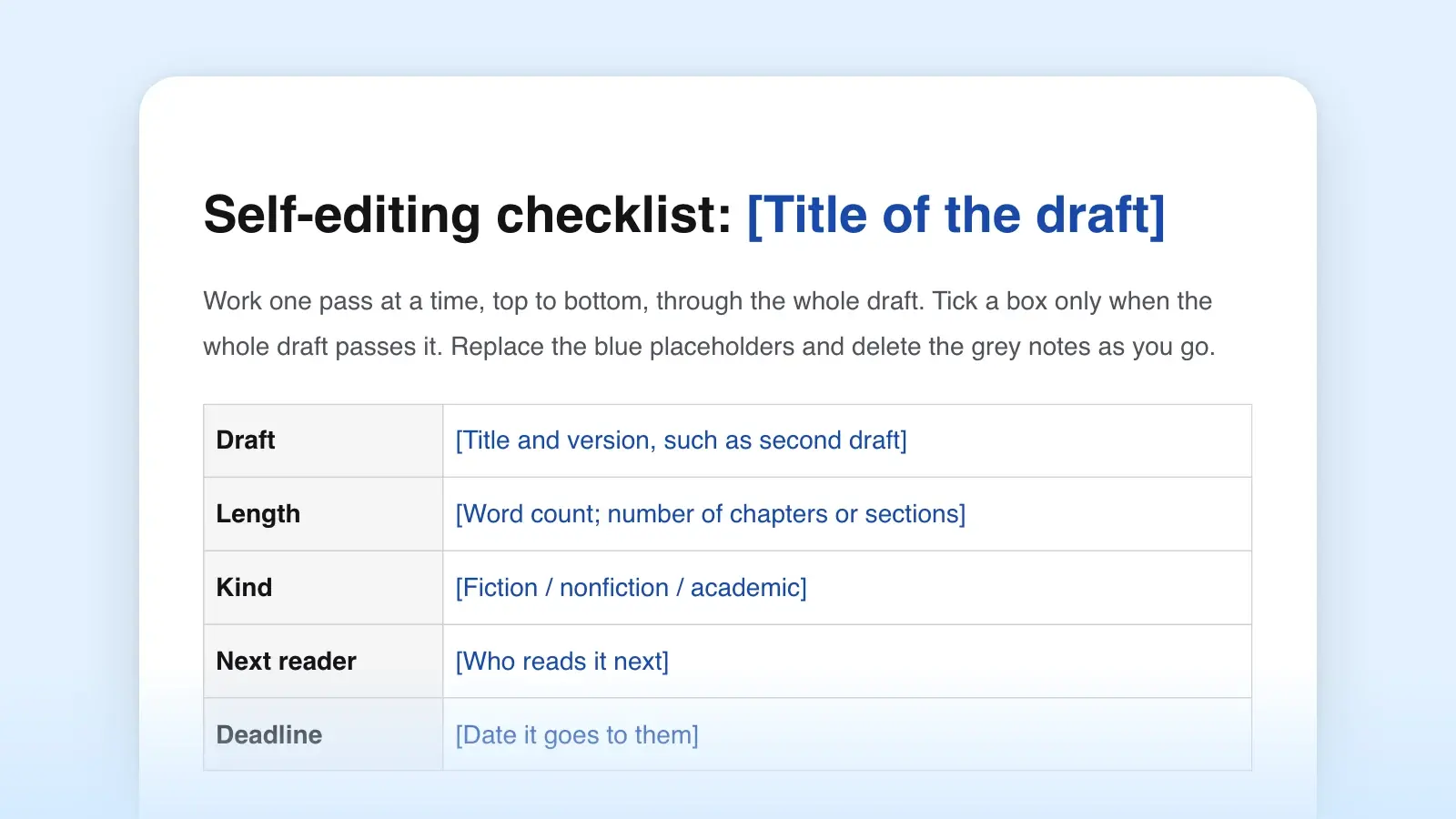
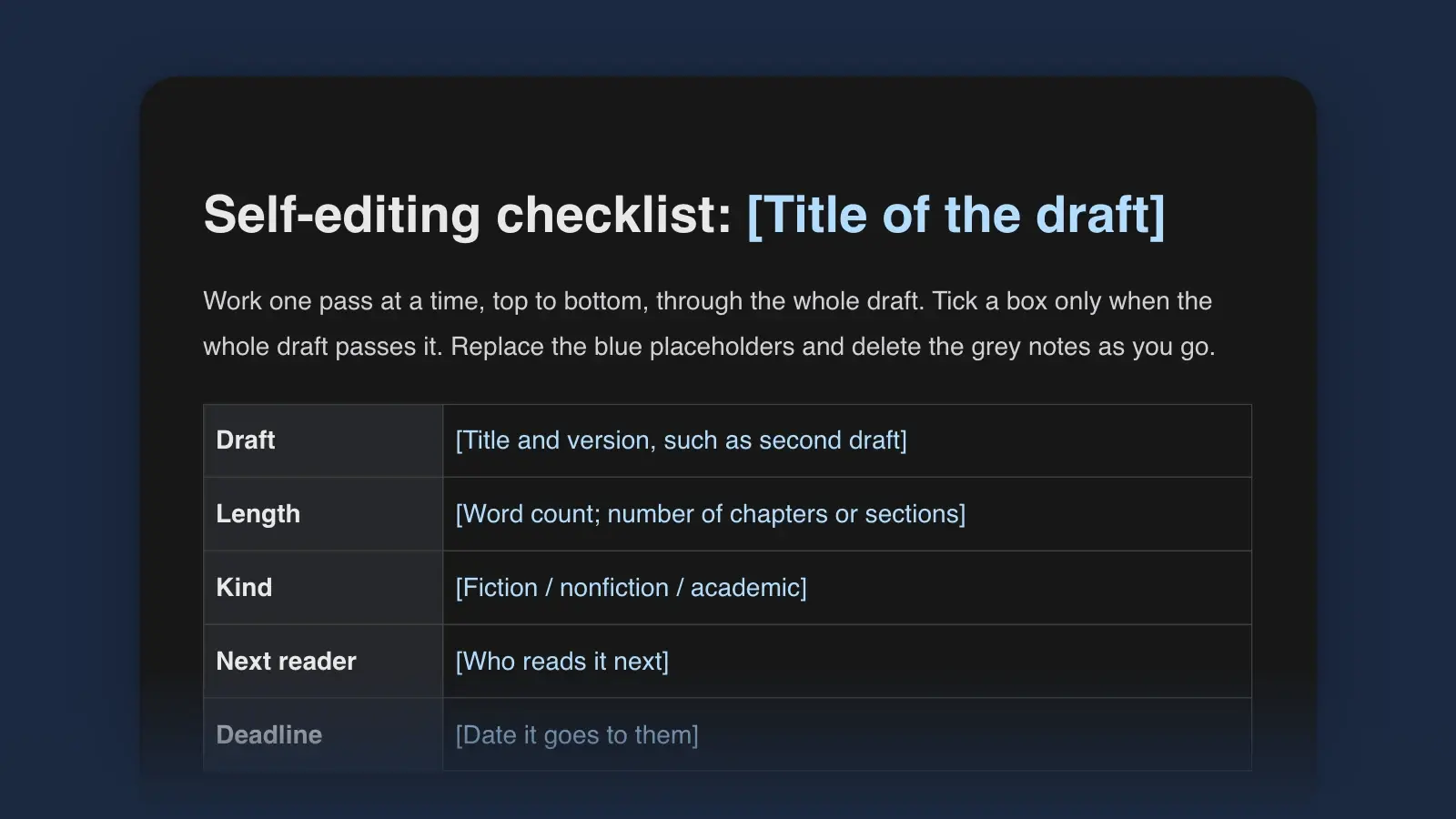
A writing checklist for self-editing lists what to check in a finished draft, and in what order. This one works in six passes, from the structure of the whole draft down to proofreading, so you're less likely to polish a paragraph you later cut. Read the whole draft once per pass, tick the boxes, and add the fiction or nonfiction items only if your draft needs them.
It's built for long work: a novel, a memoir, a thesis chapter, a report or a long feature, where one read-through can't catch everything. The passes follow roughly the order professional editing works in, from a developmental edit through line editing and copy editing to the proof.
The six passes at a glance
| Pass | The question | Works on | Professional equivalent |
|---|---|---|---|
| Pass1. Structure | The questionIs this the right story or argument, in the right order? | Works onThe whole draft, chapter by chapter | Professional equivalentDevelopmental edit |
| Pass2. Scenes and paragraphs | The questionDoes every scene or section do one job, and does each paragraph lead to the next? | Works onScenes, sections, paragraphs | Professional equivalentDevelopmental and line edit |
| Pass3. Sentences | The questionIs every sentence clear, and the right length for its job? | Works onSentences and dialogue | Professional equivalentLine edit |
| Pass4. Words | The questionIs every word the right one, and does it need to be there? | Works onWords and phrases | Professional equivalentLine edit |
| Pass5. Consistency | The questionIs everything the same everywhere it appears? | Works onNames, facts, timeline, style choices | Professional equivalentCopy edit |
| Pass6. Proofread | The questionIs anything wrong on the page? | Works onTypos, punctuation, layout | Professional equivalentProofreading |
A filled-in example
Here is the pass log, part of the pass 2 notes and three style sheet entries for an invented mystery novel, partway through its second draft.
Draft. Slack Water, second draft, 88,400 words in 31 chapters. Next readers: two beta readers, on March 1.
Pass log. Pass 1 (structure), January 6–12: cut chapters 4 and 19; moved the boatyard fire from chapter 22 to chapter 15. Pass 2 (scenes and paragraphs), started January 14: chapters 1–6 done.
Pass 2 notes, chapter 7. Scene 1, the boatyard: opens with Nell parking and saying hello to Abel. Start at the hull with the hole in it and cut the first 300 words. Scene 2 opens with “Later.” Later when? Anchor it: “By six the tide had turned, and Abel still hadn't called.” The paragraph on the 2005 flood (410 words) is backstory nobody has asked for yet. Keep two sentences, move the rest to chapter 9, where Abel tells it himself.
Style sheet. Marigold: Abel's boat, italic, first in chapter 2. Kessling Quay: two words, capital Q. Nell: 34 in chapter 1, born 1992, so 13 in the 2005 flood (chapter 3 says 15; fix in pass 5).
Every note says what to change and where, so the next session starts without rereading. Look at Nell's age. The mismatch turned up during pass 2, but ages belong to the consistency pass, so it went on the style sheet marked “fix in pass 5” instead of being fixed in the middle of a scene edit. And the log records what has already moved, which matters when chapter 14 still foreshadows a fire that now happens in chapter 15.
How to use this template
- Finish the draft, then let it rest
Self-editing works best once you can read the draft as a stranger would. Put it away for as long as the deadline allows, and make a copy before the first cut.
- Read it through once and outline it
Before you change anything, read the whole draft and fill in the reverse outline under pass 1: one line per chapter or section, what happens or what it argues, and what changes. That table is the map for the structure pass.
- Work one pass at a time
Each pass asks one question. Read the whole draft for that question only, and write anything else in the pass log for later. A pass that tries to fix structure and commas at once usually does neither well.
- Keep the style sheet as you go
Every time you make a choice (a name's spelling, OK or okay, numerals or words), add it to the style sheet at the end of pass 5. The consistency pass checks the whole draft against it.
- Change how the draft looks for the late passes
Familiar pages hide errors. For the word and proofreading passes, change the font and size, print the draft or read it on another device.
- Stop when the passes find only taste
When a pass turns up changes you could argue either way, or starts undoing the last pass, the draft is ready for beta readers or an editor.
What to check in each pass
These are the items in the template, pass by pass. The template adds a pass log at the top, a reverse outline table in pass 1, a list for your crutch words in pass 4 and a style sheet in pass 5. Each pass ends with a decision you can write in the pass log.
Pass 1: Structure
Read fast, make notes and change nothing on the first read.
Ends with: keep, cut, merge or move against every row of the reverse outline, and the cuts and moves made before pass 2 starts.
Pass 2: Scenes and paragraphs
One unit at a time: the scene in fiction, the section and paragraph in nonfiction. The paragraph starters and transition sentences help with the last three items.
Ends with: every scene or section kept, cut, merged or given a new start and end, and any problem for a later pass written in the log.
Pass 3: Sentences
Read aloud, mark every sentence you stumble over, then fix the marks. Keep a passive only where the doer is unknown or unimportant; the active vs passive voice guide shows how to tell.
Ends with: every marked sentence rewritten, or kept on purpose.
Pass 4: Words
Search before you read: crutch words are easier to find with a search than by eye. Start with the overused words and filler words lists, then add your own.
Ends with: a found count and a kept count beside each crutch word in the table.
Pass 5: Consistency
Check the draft against the style sheet, and add to the sheet as you go.
Ends with: every mismatch fixed in the draft, and every choice recorded on the style sheet.
Pass 6: Proofread
Last, slowly, on a fresh copy. If you mark up paper, the standard proofreading marks save time.
Ends with: a yes or a no. Either the draft goes to the next reader, or you list what still stops it.
Novel editing checklist: fiction additions
Optional: add these to the passes only if the draft is a novel, a story collection or a memoir told in scenes.
The viewpoint items catch head-hopping and filter words, two common slips that break a close point of view. The planted-detail item is Chekhov's gun run in both directions. For the physical details, keep a story bible beside the manuscript and check pass 5 against it.
Nonfiction and academic checklist
Optional: add these for a thesis, a report, a nonfiction book or a long article. A memoir may need items from both lists, and a draft that fits neither can skip both.
Tips for editing your own writing
- Note, don't fix, out of turn. When you spot a typo during the structure pass, write it in the log and keep reading. Switching levels is how passes stop being passes.
- Read pass 3 aloud. The ear often catches clumsy rhythm and missing words that the eye glides over.
- Keep a cuts file. Paste deleted scenes and paragraphs into a separate document. Cutting is easier when nothing is lost.
- Treat the word pass as more than polish. In an 1888 letter to George Bainton, Mark Twain called the gap between the almost right word and the right one “the difference between the lightning bug and the lightning.”
- Cut for force, not for length. Strunk's rule in The Elements of Style (1920 edition) is “Omit needless words,” and he was careful to add that this “requires not that the writer make all his sentences short” but “that every word tell.”
- Schedule the passes. A pass through a 90,000-word novel usually takes days, not an evening. Put each one on the calendar, and the deadline for the next reader after the last.
Frequently asked questions
How many times should you edit your own writing?
There is no fixed number. With this checklist a long draft gets at least one read per pass, so six reads, and the structure pass often needs two. Stop when a pass finds only changes of taste, or starts undoing the changes from the last one. At that point the draft needs another reader more than another pass.
What is the difference between revising and editing?
Revising changes what the draft says: its structure, scenes, arguments and characters. Editing changes how it says it: sentences, words and consistency. Proofreading, last, catches errors on the page. In this checklist, passes 1 and 2 are revision, passes 3 to 5 are editing and pass 6 is the proofread.
Should you edit while you write?
Small fixes as you go do no harm, but save structural decisions and line editing for a finished draft. Polishing a chapter you may later cut wastes time, and stopping to edit can break the momentum a first draft needs. A common compromise is to reread and tidy the last page you wrote before starting each session.
Can self-editing replace a professional editor?
It can take a draft a long way, and an editor's time goes further when the obvious problems are already fixed. What it can't supply is a reader who doesn't know what you meant. For a book going to agents or readers, use beta readers after your passes, and consider a developmental, line or copy edit for the stage your draft is at.