Filler words are words and phrases that add length without doing a job in the sentence. In writing they're mostly intensifiers and hedges (very, really, just, actually, sort of) and padded phrases (in order to, due to the fact that). In speech they're the sounds and phrases people use while they think: um, uh, like, you know, I mean. Linguists call the sounds filled pauses. In conversation they're normal; they become a habit worth breaking in talks, interviews and scripts.
The same word can be filler in one sentence and necessary in the next, so test it where it stands. Delete it and reread: if nothing is lost, it was filler. If the sentence now claims more than you know, it was an honest hedge, so put it back. If it was doing a social or spoken job (courtesy in an email, a character's voice, a speaker's pause), decide whether this reader needs that job done.
The 118 below are grouped by where they turn up, from essays and emails to fiction and talks, and each comes with how to cut it or when to keep it. After the list: four edits before and after, when filler belongs in dialogue, and how to say um less when you speak.
| Where it turns up | Look under | Fillers |
|---|---|---|
| Where it turns upAny prose: very, really, so | Look underIntensifiers | Fillers1–15 |
| Where it turns upAny prose: just, sort of, I think | Look underHedges and softeners | Fillers16–33 |
| Where it turns upAny prose: actually, basically, thing | Look underEmpty words | Fillers34–50 |
| Where it turns upEssays, reports, legal and business writing | Look underPadded phrases | Fillers51–75 |
| Where it turns upThe first sentence of anything | Look underThroat-clearing openers | Fillers76–87 |
| Where it turns upNovels and short stories | Look underFiller in fiction | Fillers88–99 |
| Where it turns upEmail and office messages | Look underEmail filler | Fillers100–107 |
| Where it turns upTalks, interviews, meetings | Look underFiller in speech | Fillers108–118 |
Intensifier filler words
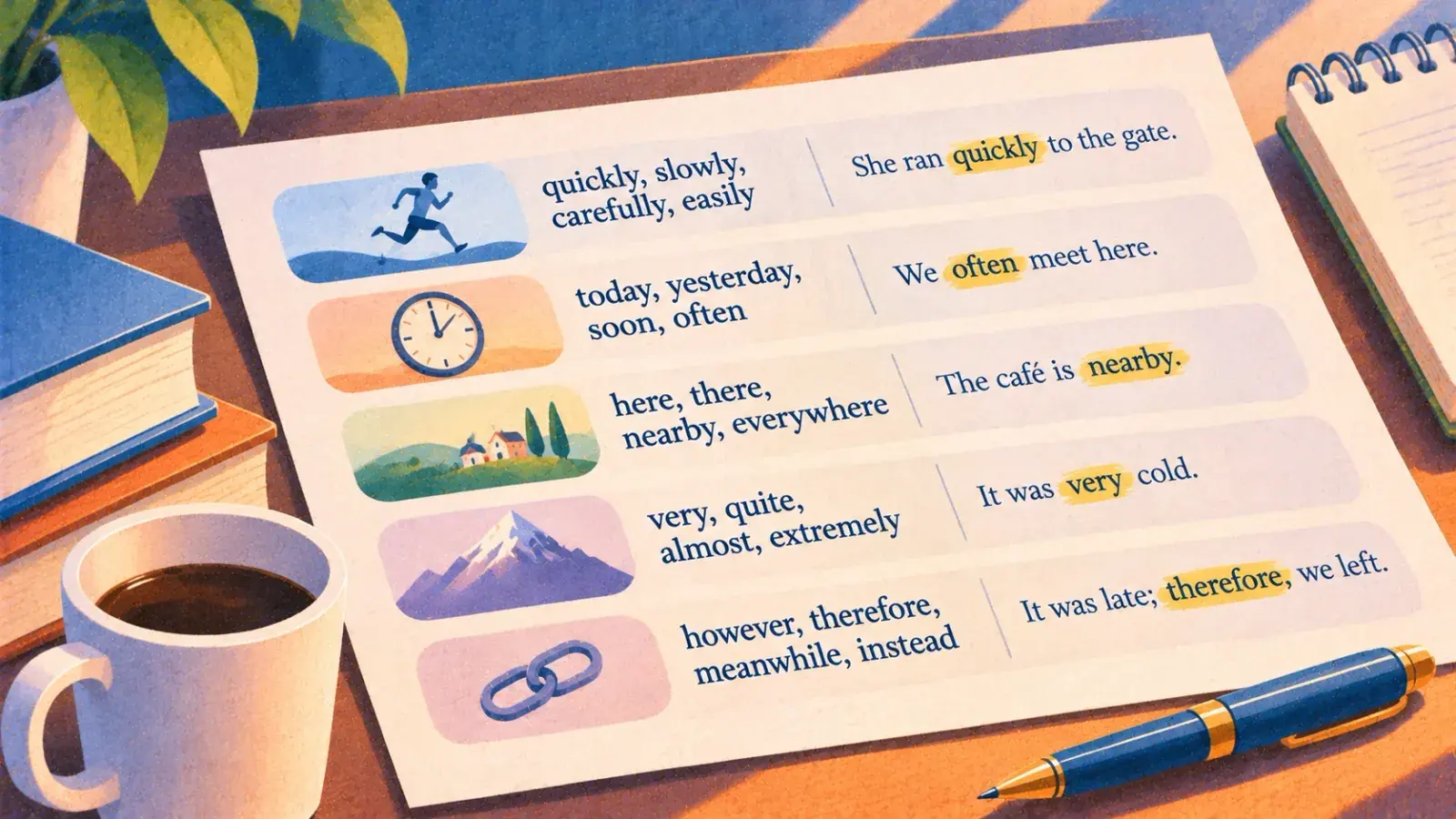
Intensifiers try to make a word stronger and usually make it weaker, because they admit the word wasn't enough. Most are adverbs of degree, sorted by type in the adverbs list.
- very — Delete it, or swap the pair for one exact word: very tired → exhausted, very big → huge.
- really — Delete it: “I really appreciate it” → “I appreciate it.” If the stress matters, say why it matters.
- so — As an intensifier, cut it or give the result: “so tired” → “too tired to drive.”
- extremely — Cut it, or give the measure: “extremely cold” → “twenty below.”
- incredibly — Cut it: “incredibly helpful” → “helpful,” or say what the help was.
- totally — Cut it: “I totally agree” → “I agree.”
- completely — Cut it before words that are already complete: “completely finished” → “finished.”
- absolutely — Cut it in prose: “absolutely essential” → “essential.” Keep it as a one-word answer in dialogue.
- truly — Cut it: “truly grateful” → “grateful.”
- highly — Cut it before vague adjectives, then say how: “highly effective” → “cut wait times by half.”
- quite — Before most adjectives it leans toward “very” in American English and “fairly” in British English, so readers can take it either way. Pick the one you mean, or cut it. Keep it where it means completely: “quite right,” “not quite finished.”
- super — Informal; in formal writing cut it or be specific: “super easy” → “takes five minutes.”
- deeply — Keep it where the feeling is deep (“deeply moved”); cut it from routine thanks and apologies.
- seriously — Cut it as an intensifier: “seriously good coffee” → “good coffee,” or why it's good.
- literally — Keep it only when the words are literal. “I literally died” isn't.
Hedges and softening words
Hedges protect the writer from being wrong. One honest hedge is accuracy; three in a sentence is fog. Keep the ones you can defend and delete the ones that are only nerves.
- just — Delete it in most places: “I just wanted to check” → “I wanted to check.” Keep it for time (“just arrived”) and to mean only (“just two left”).
- sort of — Cut it, or find the exact word: “sort of blue” → “gray-blue.”
- kind of — Same fix: “kind of annoyed” → “annoyed,” or “irritated.”
- a bit — Cut it: “a bit concerned” → “concerned.” Keep it for real small amounts.
- a little — Cut it, or quantify: “a little late” → “ten minutes late.”
- somewhat — Cut it, or give the number: “somewhat higher” → “4 percent higher.”
- rather — Cut it: “rather difficult” → “difficult.”
- fairly — Cut it, or say how sure you are and why: “fairly sure” → “sure.”
- pretty — An informal hedge: “pretty good” → “good,” or what made it good.
- slightly — Keep it for small differences that matter; cut it as a softener: “slightly disappointed” → “disappointed.”
- maybe, perhaps — Keep one where the doubt is real; never stack them: “maybe possibly” → “possibly.”
- probably — Keep it if you'd bet on the claim but can't prove it. Cut it if you know.
- I think — Cut it in opinion writing, where the reader knows it's what you think: “I think the plan fails” → “The plan fails.”
- I feel — Cut it, and don't use it for claims: “I feel that the data show…” → “The data show…”
- I believe — Cut it, or keep it once to separate a belief from a fact you can prove.
- in my opinion — Cut it from a signed opinion piece, where your name already says so. In a report that mixes findings with judgment, a short “in my view” marks which is which.
- it seems that — Cut it unless appearance and reality differ: “It seems that the report is late” → “The report is late.”
- more or less, to some extent — Cut them, or name the extent: “more or less finished” → “finished except the index.”
Empty words and nouns
These sound like they mean something and don't. The adverbs can usually go; the nouns need replacing with the thing you meant.
- actually — Delete it unless you're correcting something: “Actually, it was Tuesday.”
- basically — Delete it. If you're simplifying, say so: “In short,…”
- essentially — Delete it, or give the essence it promises.
- honestly — Delete it; it hints that the rest wasn't.
- definitely — Delete it: “I'll definitely be there” → “I'll be there.”
- certainly — Cut it from claims; a claim you're sure of doesn't need the label.
- obviously, clearly — Cut them. If it's obvious, the reader didn't need telling; if it isn't, you've told them they're slow.
- simply — Cut it from instructions. “Simply restart the server” is simple for everyone except the person who's stuck.
- overall — Cut it from the start of summaries: “Overall, the results were positive” → “The results were positive.”
- various — Count instead: “various issues” → “three issues.”
- certain — Name them: “certain factors” → “cost and staffing.”
- thing — Name the thing: “the main thing is the deadline” → “the deadline matters most.”
- stuff — Name the stuff, or cut “and stuff” from the end of a list.
- aspect, factor, element — Replace with the specific one: “the financial aspect” → “the cost.”
- situation — Cut it: “a crisis situation” → “a crisis.”
- nature, type — Cut them: “problems of a technical nature” → “technical problems.”
- that — Cut it after said, thought and knew when the sentence stays clear: “He said that he was tired” → “He said he was tired.” See the note below for when to keep it.
Padded phrases to shorten
Most of these have a one-word version. The US government's plain-language guide on digital.gov lists several, such as in the event of (if) and in the amount of (for), and the GOV.UK style guide is blunter about in order to: usually not needed, so don't use it.
- in order to — to
- due to the fact that — because
- owing to the fact that — since, because
- in spite of the fact that — though, although
- I was unaware of the fact that — I didn't know that
- the fact that he had not succeeded — his failure
- at this point in time — now
- at the present time — now, currently
- in the event of, in the event that — if
- in the amount of — for
- for the purpose of — to, for
- with regard to, in regard to — about
- in terms of — cut it, or use in, for or about: “strong in terms of sales” → “sales were strong”
- a number of — some, several, or the number
- a majority of — most
- in close proximity to — near
- has the ability to, is able to — can
- prior to — before
- subsequent to — after
- until such time as — until
- each and every — each, or every
- first and foremost — first
- the reason why is because — because
- on a daily basis — daily
- there are many people who — many people: “There are many writers who never outline” → “Many writers never outline.”
Four of those come from William Strunk Jr., who singled out one phrase in The Elements of Style (1918): “In especial the expression the fact that should be revised out of every sentence in which it occurs.”
Throat-clearing openers to delete
Phrases that warm up before the point. They cluster in first sentences, of paragraphs, emails and essays alike. Delete them and start with what came after.
- It is important to note that — Cut it and state the point. If the reader really must not miss it, put it first or label it (“Note:”).
- It should be noted that — Cut it.
- It goes without saying that — Then don't say it, or just say it.
- Needless to say — Same fix.
- As a matter of fact — Cut it, or use “In fact” when you're correcting a claim.
- The thing is — Cut it and start with the thing.
- What I mean is — Cut it and say what you mean.
- As you know, as we all know — Cut the phrase and keep the reminder if they need it: “The deadline moved to Friday.” If they didn't know, the phrase makes them feel left out.
- In today's world — Cut it. Every essay is written in today's world.
- At the end of the day — Cut it, or use “finally” or “in the end.”
- All things considered — Cut it; the paragraph should be the considering.
- Last but not least — “Finally,” or nothing.
Filler words in fiction
Fiction has its own filler: words that delay the action they describe. Several are filter words, which put a character between the reader and the event.
- started to, began to — Cut them unless the action is interrupted: “She started to run” → “She ran.”
- managed to — Cut it unless the action was hard: “He managed to open the door” → “He opened the door.”
- decided to — Cut it when the decision isn't the drama: “She decided to call him” → “She called him.”
- seemed to — Cut it unless appearance and fact really differ.
- suddenly — Cut it and let the sentence be sudden: short, with the event first.
- then — Cut most of them. Sentences already happen in order.
- found herself — Cut it: “She found herself crying” → “She was crying.”
- saw, heard, felt, noticed, realized, could see — Cut the filter unless the noticing matters: “She heard the door slam” → “The door slammed,” “She could see the lake below” → “The lake lay below.”
- nodded his head, shrugged her shoulders — “nodded,” “shrugged.” There's nothing else to nod or shrug.
- for a moment, for a second — Cut them unless the shortness matters.
- almost, nearly — Cut them when the action happened: “She almost smiled” is right only if she didn't.
- stood up, sat down — Usually fine, but in a tight sentence “stood” and “sat” are enough.
Email and office filler
Email filler is mostly politeness that delays the request. Courtesy still matters, especially with someone you don't know well, but it reads better after the ask than before it: lead with the request, give the date, and let a plain “Thanks” close it.
- I hope this email finds you well — Cut it, or replace it with something specific to the reader.
- Just checking in, just following up — Say what you need: “Can you send the contract by Friday?”
- I wanted to reach out about — “I'm writing about,” or ask the question.
- Please do not hesitate to contact me — “Questions? Reply here,” or give the number.
- Please find attached — “I've attached,” or “The contract is attached.”
- Quick question — Ask it.
- Sorry to bother you — Cut it unless you really are interrupting.
- At your earliest convenience — Give a date: “by Thursday noon.”
Filler words in speech
Spoken filler is normal, and in conversation hardly anyone notices it. Other languages have their own: euh in French, äh in German, este in Latin American Spanish, ano and ēto in Japanese, nàge in Mandarin. Fillers become a problem in talks and interviews, where they tend to bunch up at the start of answers and between sections. The empty words above (basically, actually, literally) turn up here too.
- um — In a prepared talk, pause instead. A silent pause tends to sound deliberate; a string of filled ones can sound unsure.
- uh, er, ah — Same fix. In the account of the psycholinguists Herbert Clark and Jean Fox Tree, uh announces a short delay and um a longer one.
- like — As a filler (“it was, like, huge”), drop it. As a quote marker (“she was like, no”), use said in a formal talk.
- you know — Cut it, or ask the audience a real question.
- I mean — Cut it unless you're correcting yourself.
- so — Cut it from the start of answers and start with the answer.
- well — Fine to open a reply now and then; cut it when it opens every one.
- right? okay? — Cut tag questions at the end of sentences and pause instead.
- and, and, and — End the sentence. Pause. Start a new one.
- I guess — Cut it, or say how sure you are.
- or whatever, and stuff, or something — Finish the list or stop before it.
Four filler edits, before and after
Vigorous writing is concise. A sentence should contain no unnecessary words, a paragraph no unnecessary sentences, for the same reason that a drawing should have no unnecessary lines and a machine no unnecessary parts.
Before: Hi Dana, I hope this email finds you well! I just wanted to quickly reach out and check in to see if you'd maybe had a chance to look at the contract I sent over last week. Please don't hesitate to let me know if you have any questions at all. Thanks in advance!
After: Hi Dana, could you send your comments on the contract by Thursday? The printer needs the final version on Friday, probably by noon. Thanks, Sam
Fifty-four words became twenty-five, and the short version contains three things the long one never got to: a clear request, a deadline and the reason for it. The softeners that went (just, quickly, maybe, at all) were nerves. They protected Sam from sounding pushy, not from being wrong. The hedge that stayed, probably, marks a real limit: the printer said Friday but not what time. Filler doesn't only take up space; it takes the place of information.
Before: It is important to note that, in terms of attendance, the program was actually quite successful. Basically, due to the fact that the buses ran on time, a majority of students were able to arrive before the first bell, which in my opinion is a very significant result.
After: Attendance rose because the buses ran on time: 71 percent of students arrived before the first bell, up from 48 percent the year before.
Ten fillers came out, from “It is important to note that” to “very.” Cutting them exposed the real gap: the paragraph claimed a “very significant result” without a number. The revision needed the figures the filler was covering for.
Before: She started to walk toward the door, and then suddenly she heard a noise. She just stood there for a moment, and she realized that her hands were actually shaking a little bit.
After: She was halfway to the door when the floorboard in the hall creaked. She stopped. Her hands were shaking.
Started to, then, suddenly, heard, just, for a moment, realized that, actually, a little bit: nine fillers, and every one of them stood between the reader and the fear. The revision also does what the filler couldn't, which is to name the noise.
Transcript: So, um, basically what we did was, like, we looked at the, uh, the numbers, right? And, you know, they were kind of, I mean, they were really bad.
Script: We looked at the numbers. They were bad.
On stage, the pause between those two sentences does what all the filler was trying to do: it gives the room a second to brace.
How to cut filler in revision
Filler is a first-draft habit, and a useful one: it keeps you writing while you work out what you mean. Take it out afterward, in a pass of its own.
- Finish the draft first
Cutting filler mid-sentence breaks your train of thought. It's a sentence-level job, the kind of thing line editing covers, so save it until the structure is settled.
- Search for your top ten
Everyone has favorites. Start with just, really, very, actually, that, so, quite, basically, in order to and it is important to. Search for each and look at where they cluster.
In Strokes, you can ask the Strokes Assistant to count them in a chapter and point to the paragraphs where they bunch up. A tally that reads “just: 41” is more persuasive than any rule.
- Delete, then reread
If the sentence means the same without the word, it stays deleted. If it means less, the filler was propping up a vague word. Replace that word instead: very tired becomes exhausted, and made a decision becomes decided (more of those in the strong verbs list).
- Keep the hedges you can defend
“The results suggest” is honest when the results only suggest. Ask of each hedge whether you'd keep it if a skeptical reader asked why it was there.
- Read it aloud
Your ear catches what your eye skips, especially the throat- clearing at the start of paragraphs. If a sentence sounds like you're stalling, you probably were.
When filler belongs in dialogue
Real speech is full of filler, and a transcript of real speech is nearly unreadable. Dialogue is a cleaned-up version that keeps just enough filler to signal who the speaker is: nervous, evasive, young, tired, or someone who can't stop talking. Jane Austen built a whole character out of it.
Yes, Friday or Saturday; she cannot say which, because Colonel Campbell will be wanting the carriage himself one of those days. So very good of them to send her the whole way! But they always do, you know. Oh yes, Friday or Saturday next. That is what she writes about.
So very, you know, oh yes, and Friday or Saturday said twice: the filler is the character. Miss Bates is kind, anxious and unable to stop, and her rhythm alone would tell you so. Shakespeare built a joke on the same habit, with a counselor who announces his brevity at length:
POLONIUS: Therefore, since brevity is the soul of wit, / And tediousness the limbs and outward flourishes, / I will be brief. Your noble son is mad. / Mad call I it; for to define true madness, / What is't but to be nothing else but mad? / But let that go.
QUEEN: More matter, with less art.
The rules for your own dialogue follow from both. Give filler to the characters who'd use it, and give different characters different fillers: one says like, another says you see. Use a fraction of what people really say, often one um in a speech rather than one per line. Let it do a job, such as showing a lie, a nerve or a change of mind. And punctuate it so it reads: a comma after um or well, a dash for a line cut off, an ellipsis for one that trails away. The guide to writing dialogue covers the rest of making speech sound real on the page.
Transcript: “Um, so, I was, like, I was by the window, right, and I sort of, I mean, I didn't really see his face or anything, but, um, he was, you know, tall?”
Dialogue: “I was by the window. I didn't see his face, not really. He was—tall?”
The dialogue keeps three signals of nerves (the hedge “not really,” the broken-off dash, the question mark on a statement) and drops the rest. The reader still hears an unsure witness, and can read her in two seconds.
How to stop saying um
Filled pauses aren't a flaw. They tell the listener you're thinking and haven't finished, and they can even help: in a 2001 study by Jean Fox Tree, hearing uh helped listeners recognize the word that came next, while um made no difference either way. A few don't hurt a talk. A habit does, when every sentence starts with one or every transition fills up with them.
- Record yourself and count
Talk for five minutes on a topic you know, play it back and tally each filler. You'll probably find one or two favorites, and knowing yours is half the fix.
- Practice the pause
Replace the sound with silence. A pause that feels long to you often sounds normal to the audience. Rehearse pausing at the ends of sentences until it stops feeling like a mistake.
- Know your first line and your transitions
Fillers cluster where you're deciding what comes next. If you know your opening sentence and the first words of each section cold, the gaps they used to fill go away.
- Slow down and shorten sentences
Long, winding sentences need more thinking mid-flight, and the thinking comes out as um. Short sentences give you a natural place to breathe.
- Get someone to count for you
Toastmasters clubs give one member this job, the Ah-Counter, who notes the overused words and filler sounds each speaker leans on (and, well, but, so and you know; ah, um and er) and reports them in the evaluation part of the meeting. A friend with a tally sheet works too. For practice material, try the impromptu speech topics.
Frequently asked questions
Why do people say um and uh?
Um and uh tell the listener that the speaker is pausing to plan and hasn't finished, which helps them keep their turn in a conversation. The psycholinguists Herbert Clark and Jean Fox Tree argued in 2002 that uh announces a short delay and um a longer one. Other languages have their own versions, such as euh in French and äh in German.
Is that a filler word?
Sometimes. After verbs like said, thought and knew, that can often go: he said he was tired. Keep it when cutting it would let the reader misread the sentence, as in she claimed on Tuesday the invoice was paid, and after verbs like argue and propose when a long clause follows. Read the sentence both ways and keep the clearer one.
Are filler words bad?
Not always. In conversation they're normal and help speakers hold their turn. In dialogue they make characters sound real. In writing, an honest hedge such as probably is accuracy, not filler. They're a problem when they pile up: when every sentence has a very or a just, or every answer in an interview opens with so, um.