Overused words are words used so often, or so loosely, that readers stop registering them: suddenly and gaze in fiction, leverage and synergy in business, crucial and delve in academic writing. Most are fine once. The trouble is repetition, and use in place of a fact: if “innovative” could describe every product on the page, replace it with what yours actually does. The fix is rarely a synonym, as this pitch shows.
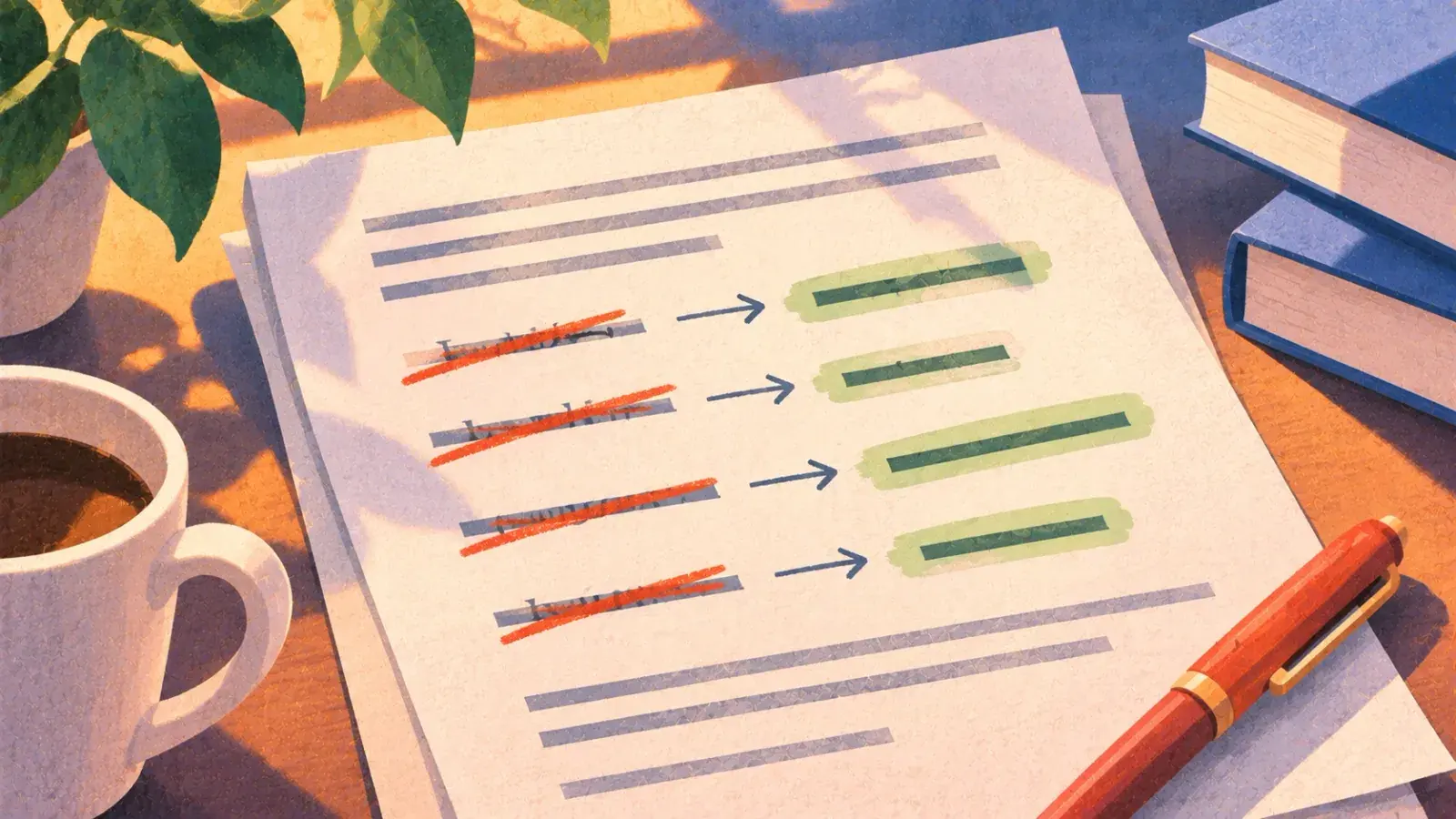
Before: Going forward, our innovative, scalable solution will empower stakeholders to leverage key insights and drive impactful, seamless outcomes across the entire ecosystem.
Synonyms swapped: Moving ahead, our groundbreaking, expandable platform will enable partners to harness core insights and power meaningful, frictionless results across the wider network.
Facts supplied: From January, store managers will see each day's sales by 9 a.m. instead of the following Monday, so they can reorder stock before it runs out.
The synonym version changes every tired word and still says nothing. The fact version answers the questions the overused words were dodging: when (from January, not going forward), who (store managers, not stakeholders), what (each day's sales by 9 a.m., not key insights) and what changes as a result (stock reordered before it runs out, not impactful outcomes). A listed word can stay when it carries a fact. If the system really does handle 40 stores at once, “scales to 40 stores” is information, and scalable has earned its place.
The 148 below are grouped by where they turn up, each with what to use instead. After the list: how to find your own crutch words, and how to replace an overused word without swapping in another one. For very, really, just and the other intensifiers and hedges, see the filler words list.
| If you're writing… | Look under | Words |
|---|---|---|
| If you're writing…Anything | Look underEveryday prose | Words1–24 |
| If you're writing…A novel or story: the narration | Look underFiction narration | Words25–48 |
| If you're writing…A novel or story: what characters do | Look underBody language | Words49–63 |
| If you're writing…A pitch, a report, a website | Look underBusiness and marketing | Words64–98 |
| If you're writing…Email and meetings | Look underOffice jargon | Words99–113 |
| If you're writing…A paper, thesis or grant | Look underAcademic writing | Words114–138 |
| If you're writing…Any of the above | Look underStock phrases | Words139–148 |
Overused words in everyday prose
Words of praise and blame that report a reaction without its cause. Lake Superior State University in Michigan has published a tongue-in-cheek Banished Words List each New Year since 1976; its 50th, the 2026 list, included massive and perfect.
- amazing — Say what amazed you: “an amazing view” → “a view across three counties.”
- awesome — Give the fact behind it: “an awesome team” → “a team that shipped in six weeks.”
- incredible — Something can usually be believed. Give it.
- nice — Name the quality: kind, tidy, warm, comfortable, well made.
- good — Say good at what: reliable, cheap, fast, moving, accurate.
- great — Usually means “I liked it.” Say what you liked.
- bad — Say how: broken, late, rude, unsafe, dull.
- interesting — Show the interesting part instead of announcing it.
- beautiful — Name what made it beautiful; the descriptive words list has hundreds of places to start.
- unique — It means one of a kind. If that isn't true, use unusual or rare, or say what's different.
- iconic — Use famous, or say what it's known for.
- epic — Say what was big about it.
- perfect — Say what fit, and how.
- massive — Give the size: “a massive turnout” → “4,000 people.”
- stunning — Describe what stopped you.
- a lot, lots — Give the number, or use many or much.
- get, got — Use the exact verb: received, became, arrived, understood, bought.
- journey — For careers, projects and products, use career, process, course, or the steps themselves.
- passionate — Show it: what you do that nobody pays you to do.
- curated — Unless you run a museum, chosen or selected.
- elevated — In food and design writing, say what changed: better ingredients, a higher price, a cleaner line.
- obsessed — “I'm obsessed with this” → “I've worn it every day for a month.”
- vibe — Name the mood: tense, relaxed, festive, cold.
- impactful — Say what changed and by how much.
Overused words in fiction narration
Every genre has its stock phrases, and readers of the genre spot them at once. Most are shortcuts to an emotion: the writer names a familiar signal instead of finding the one this character would give.
- suddenly, all of a sudden — When every surprise comes labeled, readers stop feeling the jolt. Drop the label and put the event first, in a short sentence.
- gaze, gazed — Use looked, or the exact look: glanced, stared, studied.
- orbs — Eyes.
- tresses, locks — Hair.
- eyes that do everything — “Her eyes followed him out” → “She watched him go.” Let the person act, not the eyeballs.
- a beat — In narration, show the pause with a paragraph break or an action.
- heart pounded — Find this character's tell instead: cold hands, a joke at the wrong moment.
- let out a breath she didn't know she was holding — Cut it. Readers know it on sight.
- stomach dropped — Same as heart pounded: one specific reaction beats the stock one.
- blood ran cold — Show what she did next.
- a wave of (relief, nausea, grief) — Cut the wave and show the reaction.
- electricity — “Electricity shot through her at his touch” → show the touch and what she did about it.
- ministrations — Name what the hands actually did.
- padded — Fine once for bare feet; overused for every quiet walk.
- somehow — Explain how, or cut it.
- in that moment — Cut it. The sentence is already in that moment.
- little did she know — Cut it unless your narrator really talks like that.
- the silence was deafening — Describe this silence: the fridge hum, the clock, nobody looking up.
- time stood still — Slow the prose down instead: shorter sentences, more detail.
- crimson — Red, or a comparison only this scene could give.
- chiseled — Pick one feature that isn't on a statue.
- something shifted — Show what changed between them.
- a mixture of (fear and excitement) — Pick the stronger feeling and show it.
- the world fell away — Keep the world in the scene and show what she stopped noticing.
Overused body language in fiction
Gestures are the commonest crutch in a novel draft, because each one is invisible on its own. Count them per chapter. Give each character one or two signature moves and cut most of the rest, or replace them with an action that changes something in the scene. Gestures that replace dialogue tags are covered in words to use instead of said.
- nodded — Often the line already says yes. Cut the nod.
- shrugged — Let the reply be the shrug: “Whatever you think.”
- smiled — Say what kind, or what it was for, or cut it.
- grinned — As smiled; one grin per chapter goes a long way.
- smirked — Usually the narrator judging the character. Show the smugness in what they say.
- sighed — Fine once in a scene; three sighs read as the author's.
- frowned — Show the thought that caused it.
- rolled her eyes — Give the scorn a line of dialogue instead.
- raised an eyebrow — A stock way to show skepticism. Find one this character owns.
- bit her lip — A stock sign of nerves. Find a tell that belongs to her.
- clenched his jaw — Anger has more outlets than the jaw.
- ran a hand through his hair — Cut it, or give the hand something to do with the plot.
- swallowed hard — Cut it; show what made the throat tight.
- pinched the bridge of his nose — Shorthand for exasperation. Show the cause.
- turned — “She turned to him” is often unnecessary. Characters can face each other without turning.
Overused business and marketing words
The closest thing to an official blacklist comes from government. The GOV.UK style guide, which sets the rules for writing on GOV.UK, says plain English is mandatory there and lists words to avoid. Fifteen of the words below are on it, with its suggested replacements; the rest are the usual suspects of pitch decks and product pages.
- leverage — Unless you mean finance, use “use” or “influence” (GOV.UK).
- impact — Unless it's a collision, “have an effect on” or “influence” (GOV.UK), or say what changed.
- deliver — For abstract things, use make, create or provide. GOV.UK's reasoning: pizzas, post and services are delivered, improvements aren't.
- drive — Create, cause or encourage. GOV.UK points out that you can only drive vehicles, not schemes or people.
- key — Usually not needed; if it is, important or significant (GOV.UK).
- robust — Unless it's a sturdy object, well thought out or comprehensive (GOV.UK), or say what it withstands.
- streamline — Simplify, or say what you removed (GOV.UK).
- empower — Allow, or give permission (GOV.UK).
- facilitate — Say how you're helping, as in run a workshop (GOV.UK).
- foster — Unless it's children, encourage or help (GOV.UK).
- tackle — Stop, solve or deal with (GOV.UK).
- transform — Describe what you're changing, and how (GOV.UK).
- initiate — Start, begin (GOV.UK).
- incentivize — Encourage or motivate (GOV.UK). It also made the 2026 Banished Words List.
- going forward — From now on, or in the future (GOV.UK). Moving forward, too.
- synergy — Cooperation, or the specific saving: “one warehouse instead of two.”
- scalable — Say to what size: “handles 10,000 orders a day.”
- innovative — Say what's new about it.
- cutting-edge — New, or give the date it came out.
- world-class, best-in-class — Compared with whom? Give the ranking or the award.
- game-changer — Say what changed for the customer.
- disruptive — Say what it replaces.
- seamless — Say what the user doesn't have to do: “no second login.”
- solution — Say what it is: software, a service, a pump.
- ecosystem — Products, partners, or a list of them.
- holistic — Complete, or what it includes.
- optimize — Improve, speed up, cut the cost of; say which.
- actionable — Practical, or name the action.
- bandwidth — Time. (Keep it for networks.)
- stakeholders — Name them: customers, staff, investors, the council.
- value-add — Say what the value is.
- best practices — Describe the practices.
- thought leader — Show the thinking; let others give you the title.
- mission-critical — Essential, or say what fails without it.
- paradigm shift — A change: say from what to what.
Overused office jargon
Meeting language that leaks into email. Each phrase has a plain verb inside it.
- reach out — Contact, write, call. Another 2026 Banished Words List pick.
- circle back — Return to it, or follow up on Friday.
- touch base — Talk, meet, call.
- loop in — Copy, include, tell.
- deep dive — A close look, a review, an analysis.
- low-hanging fruit — Easy wins; better, name them.
- move the needle — Make a difference; say how big.
- on my radar — “I know about it,” or “I'll look at it Monday.”
- take this offline — Discuss it later, separately.
- ping — Message, email, call.
- align — Agree, or decide together.
- unpack — Explain.
- learnings — Lessons, or what we learned.
- ask (as a noun) — Request.
- per my last email — Restate the point politely, or pick up the phone.
Overused words in academic writing
Academic prose has its own inflation, and lately a new layer. A study by Dmitry Kobak and colleagues, first posted in 2024, tracked vocabulary in more than 15 million biomedical abstracts indexed by PubMed from 2010 to 2024. Some style words jumped in 2024: delves, underscores and showcasing among the rarer ones, potential, findings and crucial among the common ones. The authors estimated that at least 13.5 percent of 2024 abstracts had been processed with large language models. Many readers now notice these words, and a paper full of them can read as unrevised, whoever wrote the draft.
- crucial — Important, or say why it matters.
- delve into — Examine, explore, look at.
- underscore — Show, stress, or cut: “The results underscore the need for…” → “The results show that…”
- showcase — Show, present.
- pivotal — Central, decisive, or say what turned on it.
- significant — In quantitative work, keep it for statistical significance; elsewhere use large, important or notable.
- utilize — Use. The US plain-language guide on digital.gov and the GOV.UK style guide both say so.
- novel — New, or what's new about it.
- comprehensive — Complete, or what it covers.
- landscape — The field, the market, or its actual features.
- realm — Field, area.
- tapestry — Name the threads.
- intricate — Complex or detailed, or show the detail.
- multifaceted — Complex; better, list the facets.
- myriad — Many, or the number.
- plethora — Many. Strictly, a plethora is too many.
- shed light on — Explain, show, clarify.
- a growing body of literature — Say who and when: “Studies since 2015 (Ito, 2017; Ruiz, 2021)…”
- aforementioned — This, that, the.
- methodology — Method, when you mean the method itself rather than the study of methods.
- problematic — Say what the problem is.
- potential — Keep it for real possibilities: “has the potential to reduce” → “could reduce.”
- nuanced — Show the nuance.
- furthermore, moreover — Also, or nothing. If several sentences in a row open with them, cut most; the sentence starters list plainer options.
- it is interesting to note that — Cut it and show why it's interesting.
Overused stock phrases
Phrases that were vivid once. Each one stands in for a point the writer didn't make.
- think outside the box — Describe the new approach.
- a win-win — Say what each side gets.
- the elephant in the room — Name the problem.
- in a world where — Start with the specific case instead.
- a perfect storm — List the problems that arrived together.
- back to the drawing board — “We're starting again,” and why.
- the tip of the iceberg — Say what's still hidden.
- hit the ground running — Say what the person will do in week one.
- it is what it is — Cut it.
- full stop (as emphasis) — End the sentence. It made the 2026 Banished Words List too.
How to find your crutch words
The words on public lists are other people's habits. Your own crutch words are the ones you repeat without noticing, and rereading won't find them, because you read for meaning. Count instead.
- Count one chapter
Run a chapter or a long section through a word-frequency count and skip the grammar words (the, and, of). Your crutches usually sit near the top: a favorite verb, an adverb, a name you use where “she” would do.
In Strokes, you can ask the Strokes Assistant to list the words and gestures you repeat most in a chapter, with a count for each.
- Look for gestures and openings, not just words
Crutches aren't only single words. Count nods, sighs and turns from the body-language group, and the way your sentences begin (“As she…”, “With a…”). A habit of construction is harder to see than a habit of vocabulary.
- Ask a reader
A critique partner or beta reader notices in an afternoon what you've stopped seeing. Ask them for one thing: the word or gesture they started to dread.
- Keep the list where you edit
Put your crutch words in the style sheet for the project, with a target for each (“suddenly: zero; smiled: five per chapter”), and check against it before every draft goes out. The self-editing checklist has a word-level pass where the list fits.
How to replace an overused word
A thesaurus swap trades one tired word for a fresher one with the same problem: “amazing” becomes “astonishing,” and the reader still doesn't know what happened. The real fix is to ask what the word was standing in for.
Replace with the specific
- An amazing turnout → 4,000 people in a town of 9,000
- We leverage our network → Our clients refer most of our new work
- Her heart pounded → She read the email twice before she could take it in
- These findings underscore the need for → These findings show we need
Swap for a synonym
- An amazing turnout → An astonishing turnout
- We leverage our network → We harness our network
- Her heart pounded → Her heart hammered
- These findings underscore the need for → These findings highlight the need for
Three more rules keep the pass sane. First, a word is only overused when it's overused: one suddenly in a novel is a choice, and a ban on every listed word produces prose as stiff as the clichés. Second, keep a word where it's the precise term in your field, which is why GOV.UK's own list exempts leverage in finance and deploy in software. Third, check the replacement for meaning. Many near-synonyms differ in connotation, and a word that's merely different isn't better.
Behind the whole list is the pattern the pitch at the top shows: an overused word is usually a placeholder for a fact the writer hasn't supplied. An old editor's joke makes the same point about very: write damn every time you're tempted to write very, and your editor will strike every damn, leaving the sentence as it should have been. The joke is usually credited to Mark Twain, but Quote Investigator found no real evidence he said it; the earliest version it located, in a 1935 Seattle newspaper column, credits the Kansas editor William Allen White.
For verbs, the strong verbs list pairs precise verbs with the weak verbs they replace, and the adverbs list shows which adverbs earn their place and which repeat the verb.
Frequently asked questions
What are the most overused words in writing?
It depends on the genre. In everyday writing: amazing, nice, great, interesting and a lot. In fiction: suddenly, gazed, nodded, smiled, shrugged and sighed. In business: leverage, impact, robust, synergy, solution and going forward. In academic writing: crucial, significant, utilize, novel, underscore and delve. Your own most overused words are the ones a frequency count of your draft puts near the top.
What are crutch words?
Crutch words are the words a particular writer or speaker leans on without noticing, such as just, actually, so or a favorite verb or gesture. They differ from person to person, which is why general lists only go so far. The quickest way to find yours is to count word frequency in a chapter or ask a reader which word they started to notice.
What words should you avoid in academic writing?
Avoid vague intensifiers (very, extremely), inflated words with plain equivalents (utilize for use, aforementioned for this), filler openers (it is important to note that) and, used in bulk, words many readers now take as signs of unrevised prose, such as delve, underscore, showcase and crucial. Keep significant for statistical significance in quantitative work. Precise technical terms in your field are fine.
Is utilize wrong?
Not wrong, just almost always replaceable. In most sentences utilize means exactly what use means, with two more syllables. Both the GOV.UK style guide and the US government's plain-language guidance tell writers to use use. Some writers keep utilize for putting something to a use it wasn't designed for, but most readers won't notice the distinction.