A good headline tells the reader the most important thing in the story, with a concrete subject and an active verb, in as few words as that takes. Put the words that matter first. For the web, keep it to about 60 characters, because search results cut longer titles to fit the screen. And make sure the story delivers everything the headline promises. The practical method is to write ten versions and keep the most specific one that is still true.
Types of headlines, with examples
These are the types you will reach for most. Every example here is original, and several follow one fictional story so you can see how the type changes the headline.
| Type | Best for | Example |
|---|---|---|
| TypeStraight news | Best forHard news, search | ExampleMillbrook council approves 120 apartments in old parking garage |
| TypeFeature | Best forProfiles, long reads, print | ExampleThe garage that outlived its cars |
| TypeHow-to | Best forGuides and tutorials | ExampleHow to cut 2,000 words from a novel without losing a scene |
| TypeList | Best forRoundups and collections | Example12 opening lines that make you read the next one |
| TypeExplainer | Best forContext after the news | ExampleWhat the Elm Street vote means for renters |
| TypeQuestion | Best forQuestions the story answers | ExampleDo you need an editor before you query agents? |
| TypeQuote | Best forSpeeches and interviews | ExampleMayor on garage vote: 'We stopped building for cars' |
| TypeCommand | Best forAdvice, newsletters | ExampleBack up your manuscript before you send it anywhere |
| TypeTeaser | Best forSocial posts, sparingly | ExampleThe one paragraph most press releases get wrong |
Straight news headlines carry the facts, so they hold up anywhere. Feature headlines can play with words and set a tone, but they depend on a deck (the line of smaller type underneath, called a standfirst in Britain) to say what the piece is about. Teasers hold back the point to earn a click. Use them rarely: Google's guidance for Discover warns against headlines that withhold the information a reader needs to understand the content.
The story: Millbrook's city council voted 5–2 on Tuesday to turn the Elm Street parking garage into 120 apartments, 30 of them for low-income renters. Construction starts in March.
- Print, front page: Council votes to turn Elm St. garage into homes
- Print deck: 120 apartments, 30 for low-income renters; work starts in March
- Article page: Millbrook council approves 120 apartments in Elm Street parking garage
- Search title: Elm Street garage to become 120 apartments | The Courier
- Weekend feature: The garage that outlived its cars
- Social post: Millbrook's Elm Street garage is becoming 120 apartments, and 30 of them are for low-income renters.
- Newsletter subject: The garage vote, and what it means for your rent
- Too vague to use: Big changes coming to downtown Millbrook
Headline formulas that work
A formula is a starting shape, not a finished headline. Fill the brackets with the most specific words you have: a number instead of "many", a name instead of "officials", the actual result instead of "better". Numerals ("7", not "seven") are easier to spot in a list of results.
| Formula | Example |
|---|---|
| Formula[Who] [does what] [where or to whom] | ExampleMillbrook council approves 120 apartments in Elm Street garage |
| Formula[Who] to [do what] [when] | ExampleLibrary to close on Sundays starting in January |
| FormulaHow to [result] without [cost] | ExampleHow to write a synopsis without retelling every chapter |
| Formula[Number] [things] for [a specific reader] | Example9 revision passes for a finished first draft |
| FormulaWhat [event] means for [reader] | ExampleWhat the new zoning rules mean for home bakers |
| FormulaWhy [surprising fact] | ExampleWhy the garage vote took four years |
| Formula[Topic]: [specific promise] | ExampleComma splices: what they are and three ways to fix them |
| Formula[Do this] before [consequence] | ExampleRead your speech aloud before you print it |
Print, web and search headlines
A printed headline sits under the masthead, beside a photo, above a deck and the first paragraph. All that context lets it be short and playful. Its limit is physical: it has to fit a set number of columns in a set type size, which is where headline shorthand comes from.
Online, the same headline has to work alone: in a search result, on a social card, in an inbox. It needs the words a reader would type and enough of the story to make sense with no picture, which is why many publishers write several headlines for one story.
| Where it appears | What it needs | Length guide |
|---|---|---|
| Where it appearsPrinted page | What it needsFits the space. Wordplay is fine because the photo and deck explain | Length guideSet by column width and type size |
| Where it appearsArticle page (the H1) | What it needsThe full, accurate claim, matching the story | Length guideOne or two lines |
| Where it appearsSearch title (the title tag) | What it needsMain keyword early, site name at the end | Length guideAbout 55–60 characters |
| Where it appearsSocial card | What it needsMakes sense without the image or the deck | Length guideShort, so check the preview |
| Where it appearsNewsletter subject line | What it needsA reason to open it today | Length guideShort enough to read on a phone |
What Google does with your title
Google sets no fixed character limit. It shortens titles to fit the device, and it builds each result's title from several sources: the title tag, the main visible headline, the H1, the social-sharing title and the text of links pointing to the page. If your title is half-empty, out of date, inaccurate or nearly identical to other pages on your site, Google may show different words. Its advice: describe the page specifically, don't repeat keywords, give every page a distinct title, and set the site name apart with a hyphen, colon or pipe.
Headline style: tense, case and punctuation
News headlines follow a compressed grammar, sometimes called headlinese. These conventions are standard in newsrooms. Magazines and blogs often keep the articles because full sentences read more naturally and match how people search.
| Rule | Instead of | Write |
|---|---|---|
| RulePresent tense for past events | Instead ofCouncil approved garage plan | WriteCouncil approves garage plan |
| Rule"To" plus a verb for the future | Instead ofCouncil will vote on garage Tuesday | WriteCouncil to vote on garage Tuesday |
| RuleDrop "a", "the" and "is" | Instead ofThe garage plan is approved | WriteGarage plan approved |
| RuleA comma for "and" | Instead ofMayor and council split on garage | WriteMayor, council split on garage |
| RuleSingle quotes around claims | Instead ofDeveloper says garage is "beyond repair" | WriteDeveloper says garage 'beyond repair' |
| RuleActive voice when the actor matters | Instead ofGarage plan is approved by council in 5–2 vote | WriteCouncil approves garage plan in 5–2 vote |
| RuleNo period at the end | Instead ofCouncil approves garage plan. | WriteCouncil approves garage plan |
Capitalization splits publications. Many US newspapers and British publications such as The Guardian and The Economist use sentence case: capitalize the first word and proper nouns, as in a sentence. Title case, widely used in US publications, capitalizes the major words. Chicago style, for one, capitalizes the first and last words and every major word, and lowercases articles, short prepositions and words like and, but and or. Either is correct. Pick one, write it in your style guide and use it everywhere.
How to write a headline, step by step
- Find the one sentence first
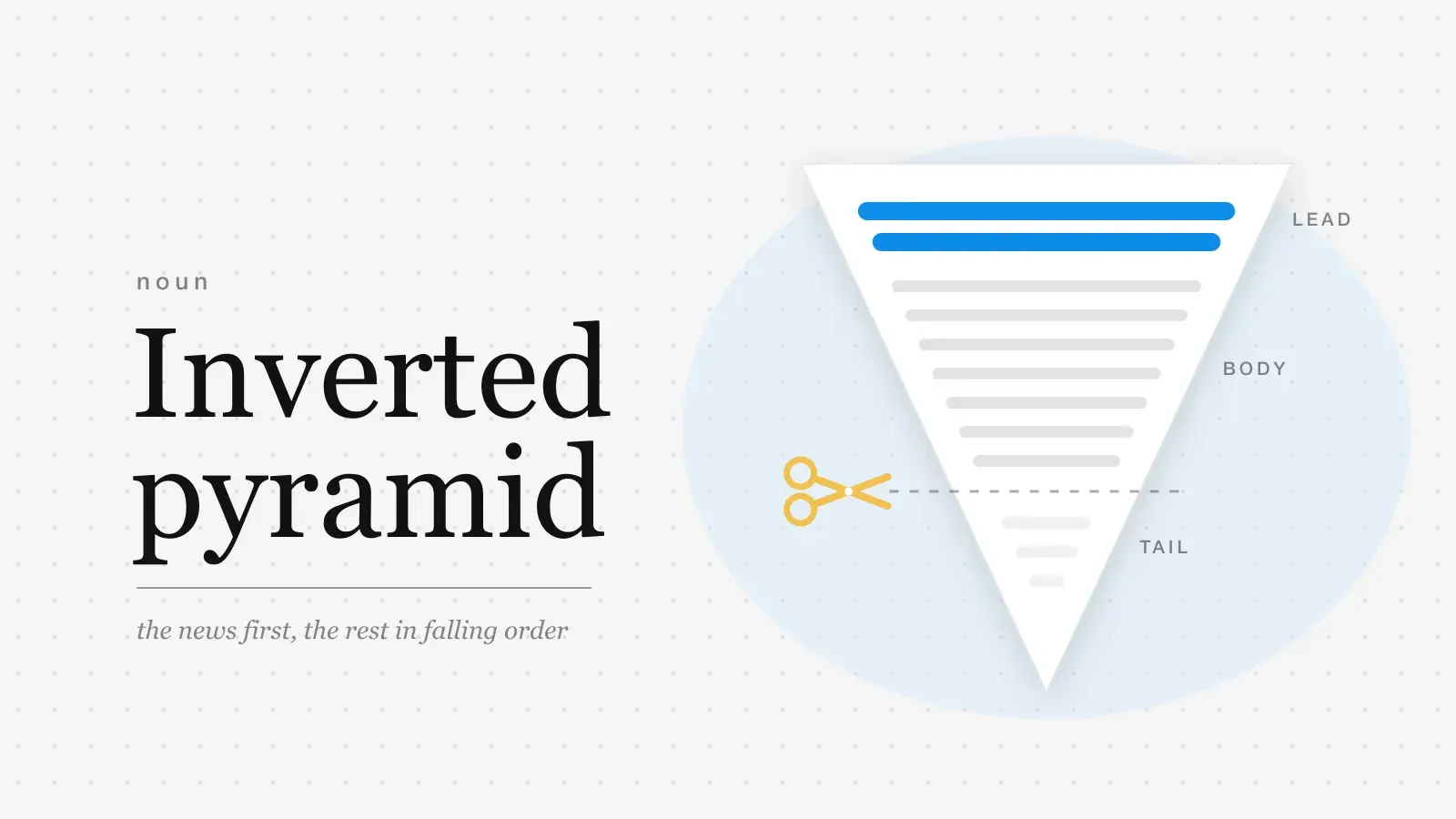
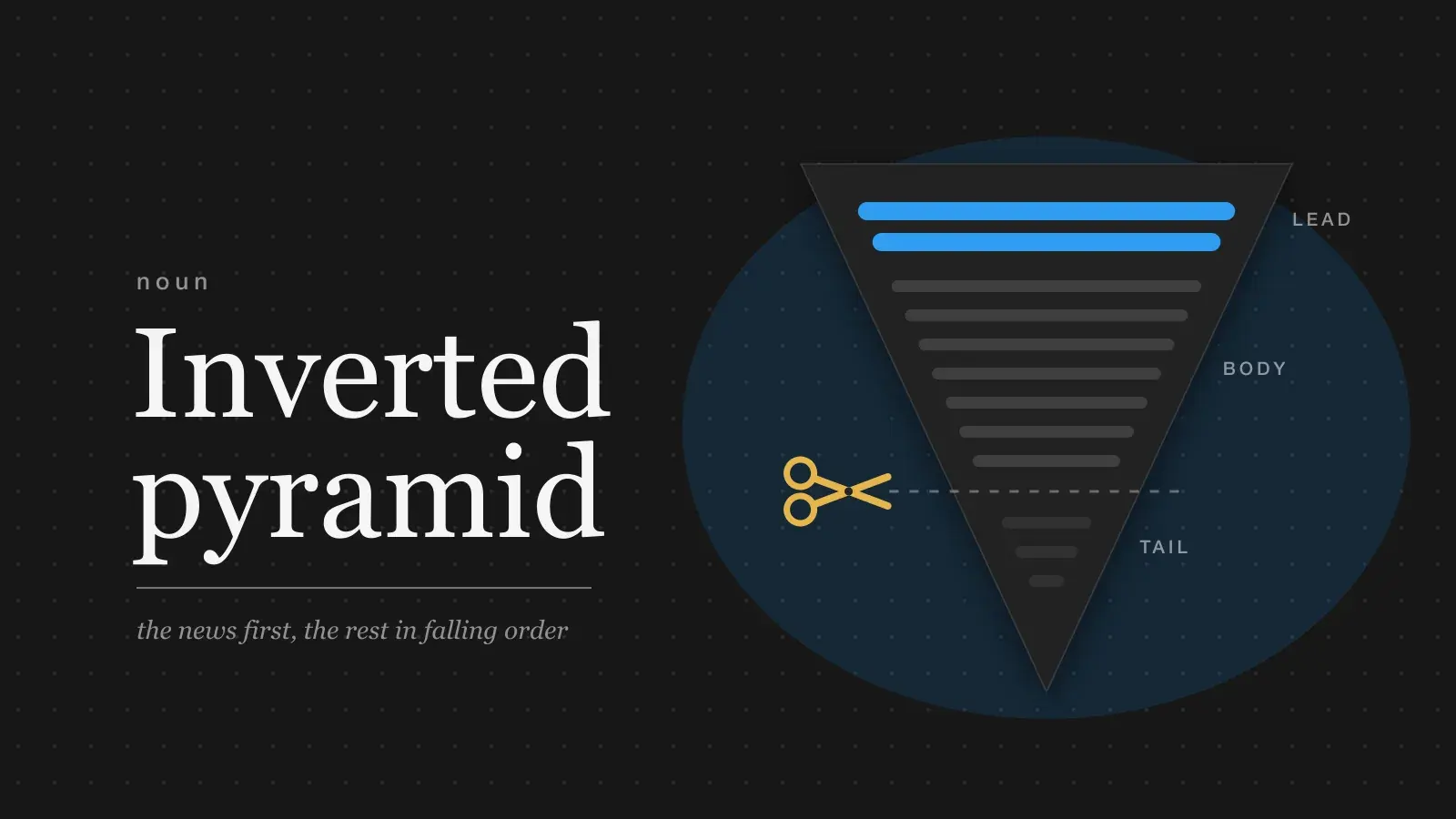
Write one sentence that says what the story is about and why it matters now. In a news story that is close to your first paragraph, which the inverted pyramid puts up front. In a feature it is the nut graf. If you cannot write that sentence, the story needs work before the headline does.
- Write ten versions quickly
Try different types: one straight, one with a number, one question, one quote, one that addresses the reader. Do not judge them yet. The first is usually a label ("Garage vote"). The useful ones come once the obvious words are used up.
- Make every word specific
Replace "changes" with what changed, "experts" with who, "soon" with a date. Look at the verb: "approves", "closes" and "cuts" carry news, while "addresses" and "looks at" do not. Shorthand verbs like slams, eyes and probe save space in print but overstate, and few readers type them into a search box.
- Check it against the story
Every claim in the headline must be in the story with the same certainty. Be careful with questions. Betteridge's law, named for the British technology journalist Ian Betteridge, who wrote about it in 2009, says any headline ending in a question mark can be answered no. It is a joke, but a useful test: if the honest answer to yours is no, rewrite it as the statement the story supports.
- Fit it to each place it appears
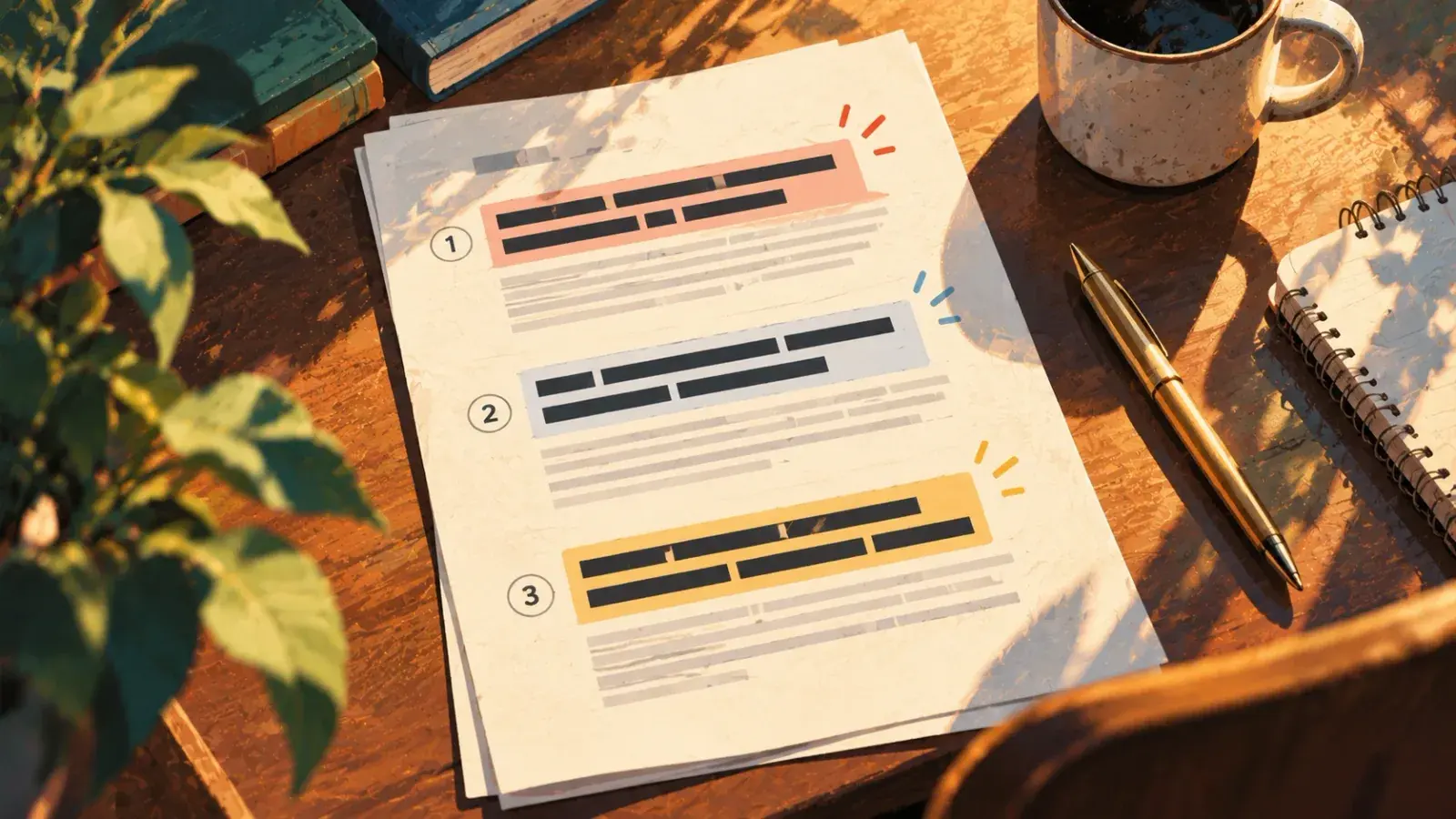
Write the article headline, the deck, the search title and the social line as separate pieces, with the keyword near the start of the search title. With enough traffic, A/B test two versions. Upworthy ran thousands of such tests between 2013 and 2015 and later released them as an open research archive. Without it, read three finalists to someone who has not seen the story and ask what they expect it to say.
Common headline mistakes
Most weak headlines fail in one of a few ways: they label instead of tell, hide the point, or promise more than the story holds. The same fixes apply to a press release headline and to the title of a news article.
| Weak | Better | What changed |
|---|---|---|
| WeakAn update on our downtown project | BetterElm Street garage to become 120 apartments | What changedSays what happened |
| WeakYou won't believe what the council did | BetterCouncil approves 120 apartments in a parking garage | What changedGives the news instead of hiding it |
| WeakLocal author's new book | BetterRetired ER nurse sets her debut thriller on the night shift | What changedA person, a genre and a hook |
| WeakTips for better writing | BetterHow to cut 2,000 words without losing a scene | What changedA concrete result |
| WeakIs this the end of the library? | BetterLibrary to cut Sunday hours in January | What changedAnswers instead of asking |
| WeakCouncil slams developer over garage | BetterCouncil members criticize developer's garage timeline | What changedPlain verb, accurate weight |
Drafting headlines in Strokes
Headlines are easier to judge side by side, so keep the candidates in the story document, under the draft headline. In Strokes, select one and press ⌘K to ask for a change in place: "under 60 characters, keep the number". Or open the AI Assistant beside the document, add the story as context, and ask for fifteen headlines of different types, or for the ones that claim more than the story says. Treat its list as raw material. Checking the facts stays your job. Version history keeps earlier drafts, so the headline you cut on Monday is still there on Wednesday.
Frequently asked questions
How long should a headline be?
There is no single limit. For search, Mozilla's MDN Web Docs notes that search engines typically show about the first 55–60 characters of a page title, and Google says it shortens titles to fit the device. In print, the column width decides. Whatever the length, make the first 60 characters carry the meaning on their own.
Should headlines use title case or sentence case?
Either, as long as you are consistent. Many US newspapers and British publications use sentence case, while title case, following a guide such as Chicago, is widely used in US publications. Record the choice in your style guide.
Are question headlines bad?
Not when the story answers the question and the answer is useful, as in a how-to or an explainer. They mislead when the honest answer is no, or when the question stands in for a claim the reporting cannot support.
What is the difference between a headline, a deck and a title tag?
The headline is the main line above the story. The deck, or standfirst in Britain, is the smaller line under it that adds detail. The title tag is the page title in the HTML, shown in browser tabs and search results, and it can differ from the headline on the page.