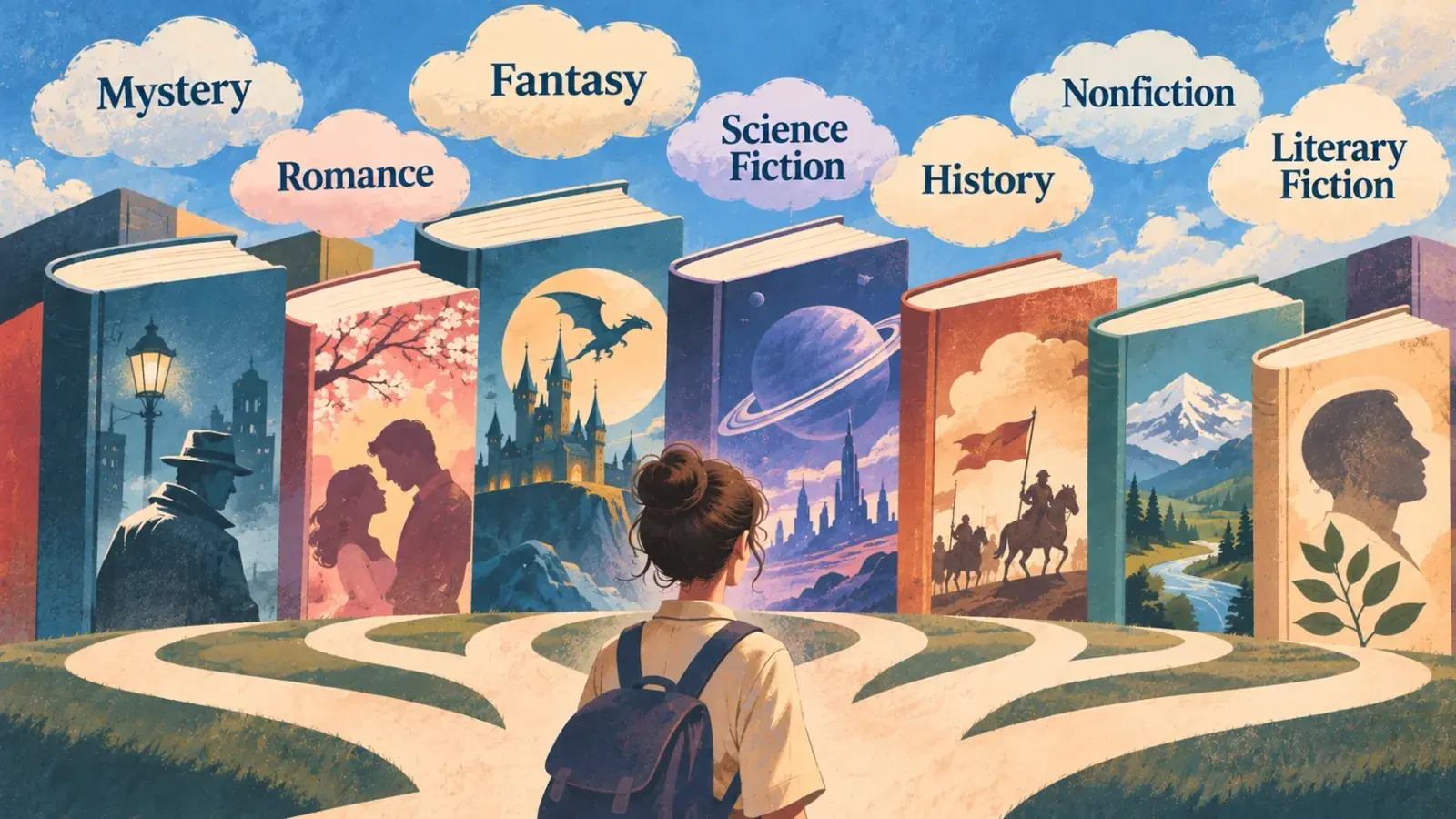
Book genres are the categories books are sorted into by the kind of story they tell and the experience they promise. The main fiction genres are literary fiction, mystery, thriller and suspense, romance, fantasy, science fiction, horror, historical fiction and westerns. Nonfiction divides into memoir and biography, history, true crime, popular science, self-help, business, essays and more. Every genre splits again into subgenres, and the subgenre usually tells a reader more: a cozy mystery and a hardboiled one are very different evenings.
Below is each genre with its main subgenres, what readers expect from it and examples you can look up, classic and modern. After that come the age categories that often get mistaken for genres, how stores classify books, and how to decide where your own book belongs.
Fiction genres at a glance
The ten big fiction shelves are below. Nonfiction has its own table further down, under nonfiction genres.
| Genre | The promise | A classic | A modern example |
|---|---|---|---|
| GenreLiterary fiction | The promiseCharacter, voice and ideas first | A classicMrs. Dalloway | A modern exampleThe Remains of the Day |
| GenreMystery | The promiseA crime and a solution you could have guessed | A classicThe Moonstone | A modern exampleThe Thursday Murder Club |
| GenreThriller | The promiseDanger, a clock, and someone to stop | A classicThe Thirty-Nine Steps | A modern exampleGone Girl |
| GenreRomance | The promiseA love story that ends happily | A classicPride and Prejudice | A modern exampleBeach Read |
| GenreFantasy | The promiseA world where magic is real and has rules | A classicThe Hobbit | A modern exampleJonathan Strange & Mr Norrell |
| GenreScience fiction | The promiseWhat if this changed everything? | A classicThe Time Machine | A modern exampleThe Martian |
| GenreHorror | The promiseDread, fear and the thing in the dark | A classicDracula | A modern exampleMexican Gothic |
| GenreHistorical fiction | The promiseA real past you can live inside | A classicA Tale of Two Cities | A modern exampleWolf Hall |
| GenreWesterns | The promiseThe frontier, its law and its cost | A classicThe Virginian | A modern exampleLonesome Dove |
| GenreAction and adventure | The promiseA journey with real danger | A classicTreasure Island | A modern exampleJurassic Park |
Fiction genres and subgenres
Genres are conventions shared by writers, publishers and readers, not laws. Plenty of great books sit across two of them. But each genre does carry expectations, and readers notice when a book breaks one without meaning to.
Literary fiction
Literary fiction is valued mainly for its prose, its characters and what it has to say. Plot matters, but the book moves at its own pace, and the ending may stay open. Readers expect sentences worth rereading and a change in how they see something.
- Contemporary literary fiction. Lives in the author's own present, examined closely: The Corrections (Jonathan Franzen, 2001), Normal People (Sally Rooney, 2018).
- Modernist and experimental. Form as part of the meaning, from stream of consciousness to fragments: Mrs. Dalloway (Virginia Woolf, 1925).
- Magical realism. The impossible told as everyday fact, without explanation: One Hundred Years of Solitude (Gabriel García Márquez, 1967).
- Autofiction. Novels built openly from the author's own life: Karl Ove Knausgaard's My Struggle series, first published in Norwegian from 2009.
Upmarket and book club fiction
Upmarket fiction sits between literary and commercial fiction: accessible storytelling, polished prose and themes broad enough to argue about over dinner, which is why book clubs pick it. Readers expect a strong emotional arc and a story that moves. Women's fiction is the trade's older label for novels centered on a woman's emotional journey, and some writers and agents now prefer to say upmarket or book club fiction instead.
- Where the Crawdads Sing (Delia Owens, 2018)
- Little Fires Everywhere (Celeste Ng, 2017)
- The Kite Runner (Khaled Hosseini, 2003)
Mystery
Most mysteries open with a crime, usually a murder, and close with its solution. The pleasure is the puzzle: readers expect clues laid out fairly, a detective worth following and an answer that surprises them without cheating. Edgar Allan Poe's "The Murders in the Rue Morgue" (1841) is usually called the first modern detective story.
- Classic detective and whodunit. A brilliant investigator, a closed circle of suspects: The Moonstone (Wilkie Collins, 1868), The Hound of the Baskervilles (Arthur Conan Doyle, 1902).
- Cozy mystery. An amateur sleuth in a small community, violence kept off the page: The Murder at the Vicarage (Agatha Christie, 1930), The Thursday Murder Club (Richard Osman, 2020).
- Hardboiled and noir. A cynical private eye, mean streets and morally gray endings: The Maltese Falcon (Dashiell Hammett, 1930), The Big Sleep (Raymond Chandler, 1939).
- Police procedural. The investigation as police work, with forensics, interviews and paperwork: Cop Hater (Ed McBain, 1956), In the Woods (Tana French, 2007).
- Locked-room mystery. An impossible crime in a sealed space: The Big Bow Mystery (Israel Zangwill, 1892).
- Historical mystery. The puzzle set in a real past: The Name of the Rose (Umberto Eco, 1980).
Two devices belong to this shelf more than any other: the red herring that points the wrong way, and the clue planted so early that nobody notices it.
Thriller and suspense
A mystery asks who did it. A thriller asks whether they will be stopped in time. The danger is usually known early, the stakes keep rising and the clock keeps running. Readers expect pace, reversals and a climax that pays for the tension.
- Psychological thriller. The threat is inside a mind or a marriage: Gone Girl (Gillian Flynn, 2012).
- Domestic suspense. Danger in an ordinary home or street: The Girl on the Train (Paula Hawkins, 2015).
- Spy thriller. Espionage, loyalty and betrayal: The Thirty-Nine Steps (John Buchan, 1915), The Spy Who Came in from the Cold (John le Carré, 1963).
- Legal thriller. The courtroom and the law firm as battleground: The Firm (John Grisham, 1991).
- Techno-thriller. Technology and military detail drive the plot: The Hunt for Red October (Tom Clancy, 1984).
- Action thriller. Chases, fights and a hero on the run: The Bourne Identity (Robert Ludlum, 1980).
- Gothic suspense. An old house, a heroine and a secret: Rebecca (Daphne du Maurier, 1938).
Romance
In a romance the love story is the main plot, not a subplot, and the ending is happy: happily ever after or happy for now. That ending is the genre's one fixed rule. A love story that ends in loss belongs on another shelf. Readers expect both leads to change, and many come for a favorite trope: enemies to lovers, fake dating, second chances.
- Contemporary romance. Present-day settings and lives: The Hating Game (Sally Thorne, 2016).
- Romantic comedy. Banter and set pieces as well as heart: Beach Read (Emily Henry, 2020), The Flatshare (Beth O'Leary, 2019).
- Historical romance. Often Regency England, with its manners and marriage market: The Duke and I (Julia Quinn, 2000). Austen's Pride and Prejudice (1813) is the template the subgenre keeps returning to.
- Romantic suspense. A love story under threat: Nine Coaches Waiting (Mary Stewart, 1958).
- Paranormal romance. Vampires, shifters and ghosts as love interests: Twilight (Stephenie Meyer, 2005).
- Romantasy. A romance and a fantasy at equal weight: A Court of Thorns and Roses (Sarah J. Maas, 2015), Fourth Wing (Rebecca Yarros, 2023).
- Time-travel romance. Outlander (Diana Gabaldon, 1991).
- Category romance. Shorter romances published in numbered lines with set lengths and heat levels, such as Harlequin's.
Fantasy
Fantasy makes magic or the impossible real inside its world. Readers expect the impossible elements to feel coherent within the story, a setting they can believe in and a plot that makes use of both.
- Epic or high fantasy. Invented worlds, large casts, the fate of kingdoms: The Lord of the Rings (J.R.R. Tolkien, 1954–55), A Wizard of Earthsea (Ursula K. Le Guin, 1968).
- Sword and sorcery. Smaller stakes, a hero with a blade, adventures in sequence: Robert E. Howard's Conan stories, from 1932.
- Urban fantasy. Magic in a modern city: Neverwhere (Neil Gaiman, 1996), Storm Front (Jim Butcher, 2000).
- Portal fantasy. A door from our world into another: Alice's Adventures in Wonderland (Lewis Carroll, 1865), The Lion, the Witch and the Wardrobe (C.S. Lewis, 1950).
- Historical fantasy. Magic woven into a real past: Jonathan Strange & Mr Norrell (Susanna Clarke, 2004).
- Grimdark. Violent, morally bleak worlds with no clean heroes: The Blade Itself (Joe Abercrombie, 2006).
- Cozy fantasy. Low stakes, found family, a warm drink: Legends & Lattes (Travis Baldree, 2022).
- Fairy-tale retelling. Old stories made new: Uprooted (Naomi Novik, 2015).
For building one of these worlds, see how to write a fantasy novel.
Science fiction
Science fiction asks what happens if something possible, or nearly possible, changes the world: a technology, a discovery, a contact, a collapse. Readers expect the idea to be followed through to its consequences. Together with fantasy and horror it makes up what the trade calls speculative fiction.
- Hard science fiction. The science is accurate and central: The Martian (Andy Weir, 2011).
- Space opera. Interstellar empires, wars and dynasties: Dune (Frank Herbert, 1965).
- Dystopian. A society gone wrong, usually by design: Brave New World (Aldous Huxley, 1932), Nineteen Eighty-Four (George Orwell, 1949).
- Cyberpunk. Networks, corporations and street-level hackers: Neuromancer (William Gibson, 1984).
- Post-apocalyptic. Life after the collapse: Station Eleven (Emily St. John Mandel, 2014).
- Time travel. The Time Machine (H.G. Wells, 1895).
- First contact and invasion. The War of the Worlds (H.G. Wells, 1898).
- Military science fiction. Starship Troopers (Robert A. Heinlein, 1959).
- Climate fiction. Stories of a warming world: The Ministry for the Future (Kim Stanley Robinson, 2020).
- Alternate history. The past with one thing changed: The Man in the High Castle (Philip K. Dick, 1962).
Horror
Horror is defined by the feeling it is after: dread, fear, revulsion. The monster can be supernatural, human or never seen at all. Readers expect the tension to build and the book to frighten them, not merely describe frightening things.
- Gothic. Decaying houses, family secrets and the past coming back. Horace Walpole's The Castle of Otranto (1764) is usually named the first gothic novel. Later: Dracula (Bram Stoker, 1897), Mexican Gothic (Silvia Moreno-Garcia, 2020).
- Ghost stories and the supernatural. The Turn of the Screw (Henry James, 1898), The Haunting of Hill House (Shirley Jackson, 1959).
- Psychological horror. The terror of a mind coming apart: Charlotte Perkins Gilman's "The Yellow Wallpaper" (1892).
- Cosmic horror. Vast, indifferent forces that make people small: H.P. Lovecraft's "The Call of Cthulhu" (1928).
- Monster horror. Something made, born or woken: Frankenstein (Mary Shelley, 1818), It (Stephen King, 1986).
- Folk horror. Old rites in rural places: Harvest Home (Thomas Tryon, 1973).
More in how to write a horror novel and the horror writing prompts.
Historical fiction
Historical fiction is set in a real past and makes the period more than a backdrop. The Historical Novel Society's working definition is a novel written at least fifty years after the events it describes. Readers expect accuracy, texture and characters who think like people of their time.
- Classic historical novels. A Tale of Two Cities (Charles Dickens, 1859), War and Peace (Leo Tolstoy, 1869).
- Modern historical fiction. The Pillars of the Earth (Ken Follett, 1989), Wolf Hall (Hilary Mantel, 2009).
- Twentieth-century war novels. The Book Thief (Markus Zusak, 2005), All the Light We Cannot See (Anthony Doerr, 2014).
- Dual timeline. A present-day story and a past one, linked by a secret: The Forgotten Garden (Kate Morton, 2008).
Historical mystery and historical romance are shelved with mystery and romance, because the reader's main promise comes from those genres.
Westerns
Westerns are set on the American frontier, usually in the second half of the nineteenth century, and turn on law, land, violence and the price of a code. Readers expect the landscape to matter.
- Classic westerns. The Virginian (Owen Wister, 1902), Riders of the Purple Sage (Zane Grey, 1912).
- Modern and revisionist westerns. True Grit (Charles Portis, 1968), Lonesome Dove (Larry McMurtry, 1985), Blood Meridian (Cormac McCarthy, 1985).
Action and adventure
Adventure stories send characters on a journey with real physical danger, and the journey is the point. Readers expect momentum, set pieces and somewhere they have never been. Treasure Island (Robert Louis Stevenson, 1883), The Count of Monte Cristo (Alexandre Dumas, 1844–46), Around the World in Eighty Days (Jules Verne, 1872), Jurassic Park (Michael Crichton, 1990).
Humor and satire
Comic fiction is shelved by the laugh it promises; satire uses the laugh to attack something real. Gulliver's Travels (Jonathan Swift, 1726), Three Men in a Boat (Jerome K. Jerome, 1889), Catch-22 (Joseph Heller, 1961).
Nonfiction genres
Nonfiction is usually sorted by subject first and by approach second. A book about the Roman Empire is history; told as a gripping true story with scenes and characters, it is also narrative nonfiction.
| Genre | What it is | Examples |
|---|---|---|
| GenreMemoir | What it isOne stretch or theme of the author's life, told as a story | ExamplesAngela's Ashes (Frank McCourt, 1996); Educated (Tara Westover, 2018) |
| GenreAutobiography | What it isThe author's whole life, usually in order | ExamplesNarrative of the Life of Frederick Douglass (1845) |
| GenreBiography | What it isSomeone else's life, researched | ExamplesThe Life of Samuel Johnson (James Boswell, 1791); Steve Jobs (Walter Isaacson, 2011) |
| GenreHistory | What it isWhat happened, and why | ExamplesThe History of the Decline and Fall of the Roman Empire (Edward Gibbon, 1776–89); The Guns of August (Barbara Tuchman, 1962) |
| GenreNarrative nonfiction | What it isA reported true story told with a novelist's tools | ExamplesThe Immortal Life of Henrietta Lacks (Rebecca Skloot, 2010) |
| GenreTrue crime | What it isReal crimes, investigated | ExamplesIn Cold Blood (Truman Capote, 1966); The Devil in the White City (Erik Larson, 2003) |
| GenrePopular science | What it isScience explained for general readers | ExamplesSilent Spring (Rachel Carson, 1962); A Brief History of Time (Stephen Hawking, 1988) |
| GenreSelf-help | What it isAdvice for changing your life or habits | ExamplesHow to Win Friends and Influence People (Dale Carnegie, 1936); Atomic Habits (James Clear, 2018) |
| GenreBusiness | What it isHow companies and careers work | ExamplesGood to Great (Jim Collins, 2001); The Lean Startup (Eric Ries, 2011) |
| GenreEssays | What it isShort nonfiction that thinks on the page | ExamplesNotes of a Native Son (James Baldwin, 1955); Slouching Towards Bethlehem (Joan Didion, 1968) |
| GenreTravel writing | What it isPlaces, and what they do to the traveler | ExamplesThe Innocents Abroad (Mark Twain, 1869); Travels with Charley (John Steinbeck, 1962) |
| GenreNature writing | What it isClose attention to the natural world | ExamplesWalden (Henry David Thoreau, 1854) |
| GenreFood and cooking | What it isRecipes, techniques and food culture | ExamplesMastering the Art of French Cooking (Julia Child, Louisette Bertholle and Simone Beck, 1961) |
| GenreReference and how-to | What it isBooks you consult rather than read through | ExamplesThe Elements of Style (William Strunk Jr., 1918; with E.B. White, 1959) |
If you are writing in the first group, the guide on how to write a memoir covers choosing the slice. Most other nonfiction is sold on a book proposal before it is finished, so the genre goes in the proposal's first lines.
Age categories are not genres
Middle grade, young adult and adult describe the reader's age, and usually the hero's, not the kind of story. Every book in them also has a genre: a middle-grade mystery, a young adult fantasy, an adult romance. The picture book is a format associated with young readers, with pictures carrying much of the story, and it too can be a mystery, a fairy tale or a biography.
| Category | Readers | Main characters | Notes |
|---|---|---|---|
| CategoryPicture book | ReadersAbout 3–8 | Main charactersChildren, animals, anything | NotesA format as much as an age band; usually 32 pages |
| CategoryEarly reader | ReadersAbout 5–7 | Main charactersChildren | NotesShort sentences and simple words for new readers |
| CategoryChapter book | ReadersAbout 6–9 | Main charactersChildren | NotesShort chapters for readers moving on from early readers |
| CategoryMiddle grade | ReadersAbout 8–12 | Main charactersUsually 10–13 | NotesFriendship, family, first independence |
| CategoryYoung adult (YA) | ReadersAbout 12–18 | Main charactersUsually 14–18 | NotesIdentity and firsts, told close to the teenager |
| CategoryNew adult | ReadersAbout 18–25 | Main charactersCollege age and early twenties | NotesA marketing label used mostly for romance |
| CategoryAdult | ReadersGrown-ups | Main charactersAny age | NotesThe default when no category is named |
The word-count ranges agents use for middle grade and YA are in how many words is a novel. Category matters as much as genre in a query: an agent who represents adult fantasy may not take YA fantasy.
How bookstores classify books
In the US book trade, a title's metadata usually carries BISAC subject headings, a standard list maintained by the Book Industry Study Group. The 2025 edition has 53 major sections, from Antiques & Collectibles to Young Adult Nonfiction. Each heading reads like a path, with a code behind it:
| Code | Heading |
|---|---|
| CodeFIC022020 | HeadingFICTION / Mystery & Detective / Police Procedural |
US retailers and libraries use these headings for shelving and search. The codes live in the book's metadata, not on its cover. A publisher assigns them; a self-published author picks them when uploading the book to a distributor. Amazon keeps its own category tree instead, and when you publish through Kindle Direct Publishing, KDP's help page says you can select three categories there.
That is the practical reason to know your subgenre. A heading such as cozy mystery or epic fantasy decides which shelf, physical or online, the book appears on, and therefore which readers meet it.
Blended genres and crossovers
Some of the strongest recent shelves began as blends: romantasy (romance and fantasy at equal weight), cozy fantasy (fantasy with the comfort of a cozy mystery), the literary thriller, historical mystery, horror comedy. Blends are fine. Readers just need to know which promise comes first.
The test is the ending and the main plot. If the love story is the spine of the book and ends happily, it is a romance with fantasy elements, or romantasy. If the love story is one thread in a war for the throne, it is fantasy with a romantic subplot. Name the genre that decides the shelf, then the flavor: "a cozy fantasy with a mystery at its heart", "upmarket historical fiction with a thriller's pace".
How to choose your book's genre
- Find the shelf
Picture a bookstore. Where would a bookseller put your book, and which books would sit on either side of it? That shelf is your genre, whatever you would like it to be.
- Name two or three recent comps
Pick books in your genre published in the last five years or so, ideally debuts, that share your book's tone and readership. These comp titles place your book faster than any label.
- Check the promise against your ending
A romance ends happily; that is the genre's definition. Mystery readers usually expect a solution, and thriller readers a resolution to the main threat, even a costly one. If your ending breaks the expectation on purpose, you may be on a different shelf.
- Check the length
Genres have expected lengths, and a debut far outside them is a harder sell. Compare your draft with the ranges in how many words is a novel.
- Write the genre line
Your query states it in one sentence: title, category and genre, word count, and the comps. The guide on how to write a query letter shows where it goes.
Frequently asked questions
How many book genres are there?
There is no fixed number. The US trade's BISAC list has 53 major sections in its 2025 edition, with far more specific headings beneath them, and readers keep coining labels such as romantasy and cozy fantasy. For a writer, the useful number is small: the one genre your book belongs to and the subgenre that narrows it.
Is young adult a genre?
No. Young adult is an age category. It tells you the reader's age, roughly 12 to 18, and usually the main character's, not what kind of story it is. A YA novel also has a genre, such as YA fantasy or YA contemporary romance. The same goes for middle grade and new adult, while a picture book is a format for young readers.
What is the difference between a genre and a subgenre?
The genre is the shelf and the subgenre is a section of it. Mystery is a genre; cozy, hardboiled and police procedural are subgenres with different sleuths, tones and levels of violence. Agents and readers use subgenres to set expectations, so naming the right one tells them more than the genre alone.
What genre is my book if it mixes two?
Lead with the genre that decides the main plot and the ending, then add the other as a flavor. A fantasy with a romantic subplot is fantasy; a romance set in a fantasy world, where the love story is the main plot and ends happily, is romantasy. Two or three recent comparable titles explain a blend faster than a new label.