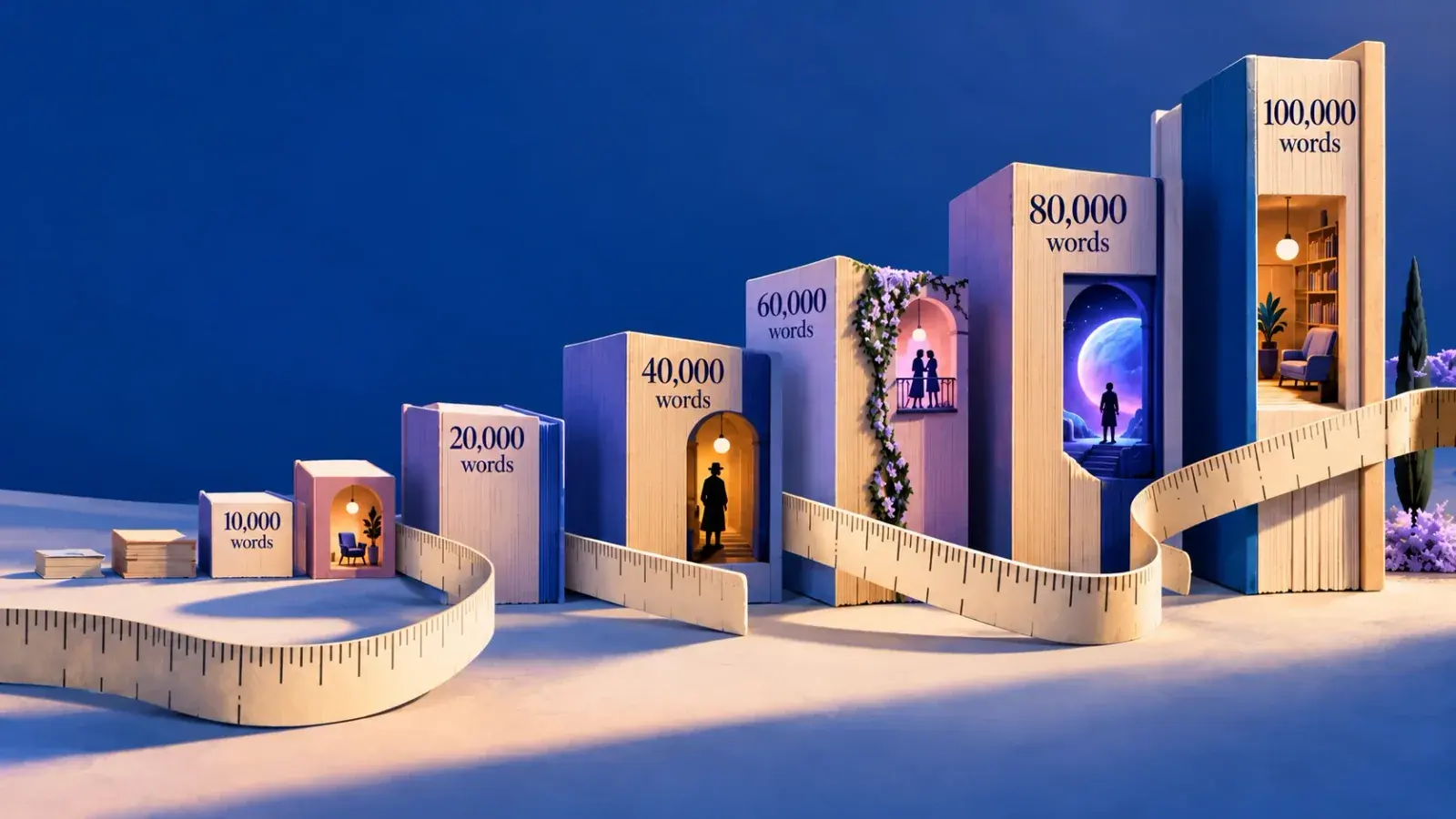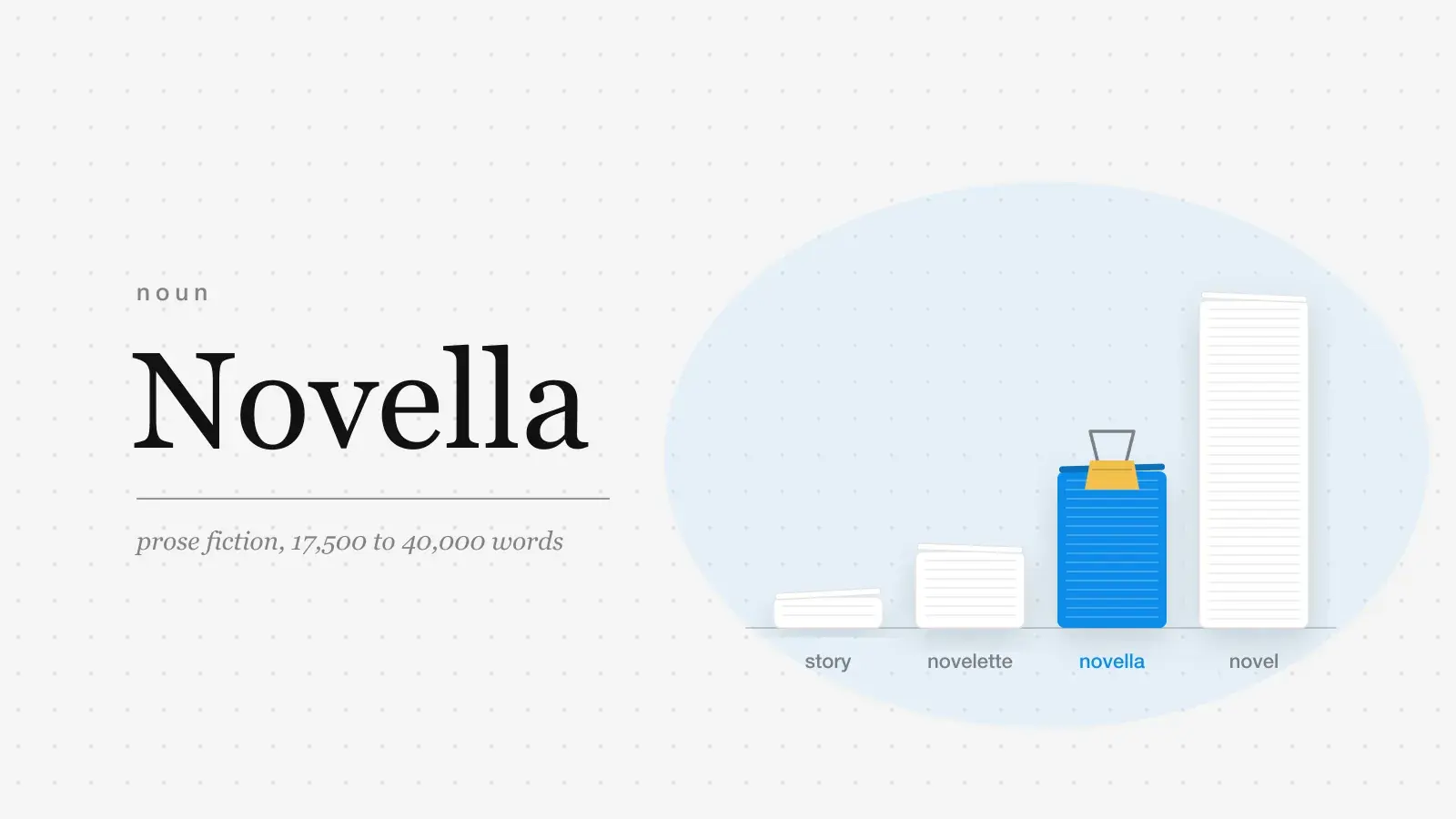
A novella is a work of prose fiction longer than a short story and shorter than a novel. The definition most writers cite, from the Nebula and Hugo awards, puts it at 17,500 to 40,000 words: about 70 to 160 manuscript pages, or a slim book you can finish in an evening or two.
One step down is the novelette, 7,500 to 17,500 words: long for a magazine story, short for a book. You meet the word mostly in science fiction and fantasy, where the awards give it a category of its own. In an older sense it simply means a short novel, hence the mix-ups.
The word is Italian for a new tale, or a piece of news. Boccaccio's fourteenth-century Decameron is a hundred of them. The plural is novellas, or novelle if you want to sound Italian.
How long is a novella?
| Form | Word count | Manuscript pages |
|---|---|---|
| FormShort story | Word countUnder 7,500 | Manuscript pagesUnder 30 |
| FormNovelette | Word count7,500 to 17,499 | Manuscript pages30 to 70 |
| FormNovella | Word count17,500 to 39,999 | Manuscript pages70 to 160 |
| FormNovel | Word count40,000 and up | Manuscript pages160 and up |
The award rules are the clearest definitions in print, so writers in every genre borrow them. The Hugo rules add a gray zone: the Worldcon committee may move a story into the neighboring category if its length is within 20 percent of that category's limits.
A story of 40,000 words or more is a novel, if a short one. The Great Gatsby runs about 47,000 words and is usually called a novel. In print, a novella fills roughly 50 to 160 pages, depending on trim size and type.
Other markets draw other lines
Outside the genre awards, every contest and press sets its own range, and they don't agree.
| Market | What it calls a novella |
|---|---|
| MarketNebula and Hugo awards | What it calls a novella17,500 to 40,000 words |
| MarketWeatherglass Novella Prize (UK) | What it calls a novella20,000 to 40,000 words |
| MarketThe Malahat Review Novella Prize (Canada) | What it calls a novella10,000 to 20,000 words |
A 15,000-word manuscript is a novelette to Hugo voters and a novella to The Malahat Review. In a cover letter, use the word the market uses.
Novella examples
Word counts are approximate and vary a little by edition.
Marley was dead: to begin with.
Five short chapters, which Dickens called staves, and a single night. Every scene serves one question: will Scrooge change? Once he has, Dickens covers the rest of his life in a few paragraphs. A novel would have stayed to watch.
The horror! The horror!
Marlow tells the whole story to four listeners on a yawl anchored in the Thames. Inside that frame story is one journey up one river toward one man. Kurtz stays offstage for most of the book, which is how a novella builds a character it barely shows.
At about 42,700 words it is over the 40,000 line, though inside the Hugo gray zone, and it is almost always called a novella. After a short frame, a governess tells the rest: two children, a country house and two figures only she may be seeing. One house, one narrator and one widening doubt: that is why the label stuck.
In an Irish town in 1985, a coal merchant finds a girl locked in a convent's coal shed in the weeks before Christmas, and the book follows him to one decision. It was shortlisted for the 2022 Booker Prize, a prize for novels. So was Ian McEwan's On Chesil Beach in 2007, a book often described as a novella.
A security robot that has hacked its own governor module would rather watch its shows than guard its clients, until a survey mission goes wrong. It won both the Hugo and the Nebula for best novella, and the Murderbot Diaries ran to four novellas before the first full-length novel.
Novella, novelette or novel?
Length is the first test an editor applies, but the forms also differ in what they can hold.
| Form | What it usually holds |
|---|---|
| FormShort story | What it usually holdsOne scene or a short run of them, and one turn |
| FormNovelette | What it usually holdsSeveral scenes, one line of action, a second character who matters |
| FormNovella | What it usually holdsOne main conflict, a small cast, often one point of view, a change that lasts |
| FormNovel | What it usually holdsSeveral plotlines, subplots, room for more viewpoints |
Nineteenth-century German writers gave the form, the Novelle, rules of its own. In January 1827 Goethe told Eckermann that a novella is nothing but "an unheard-of event that has occurred." In 1871 Paul Heyse added the falcon theory, named for Boccaccio's tale of a ruined nobleman who serves his last possession, a prized falcon, as dinner to the woman he loves: a good novella turns on one concrete thing the reader remembers. Kafka's The Metamorphosis (1915) fits Goethe's test. The impossible event happens in the first sentence, and the rest is consequence.
In your manuscript
A good novella is not a novel with the middle cut out. It has a single line of action that would sag if you stretched it. Signs your draft wants to be one:
- One question carries the whole story. A reader could state it in a sentence, and the ending answers it.
- The cast fits around a kitchen table. Three to six characters who matter, and one point of view, two at most.
- Subplots keep collapsing into the main plot. Every one you try to add turns out to be the same story seen from another side.
- You have a falcon. An object, a place or an image the story keeps returning to.
Two failures are common. A novel squeezed to novella length summarizes: characters arrive with a paragraph of backstory and leave without a scene. A short story padded to novella length repeats the same conflict three times with nothing new at stake. For the first, cut a plotline rather than compressing all of them. For the second, make each repetition cost the character something it didn't before.
Short story, about 5,000 words. A piano tuner is called to a house where nobody plays. The piano is already in tune. The widow who called him admits she only wanted to hear someone touch it. It ends on the first chord.
Novella, about 30,000 words. The same house over one winter. She books him every Thursday, the piano never needs tuning, and her son turns up three times to say the house is being sold. Each visit shifts a little. The last one explains the first.
Novel, about 90,000 words. The son gets his own chapters, the tuner's failing business becomes a second plot, the history of the house a third, and the story covers years.
The novella version keeps one place, one question and one object, and plays the same scene with variations.
Publishing a novella
The length has long been awkward to sell. In Different Seasons (1982), a collection of four novellas, Stephen King wrote that it fit neither magazines nor book publishers. Agents still mostly ask for adult novels of 70,000 words and up (the novel word count guide has the ranges by genre), so a debut novella rarely starts with a query.
Novella contests, run by magazines and small presses, offer publication as the prize. Check the length band and the entry fee first. Some independent presses publish novellas as standalone books, and many series authors self-publish them between full-length books. Once you have readers, three or four novellas make a collection, as Different Seasons did.
When you submit, round the word count to the nearest thousand and format the manuscript as you would a novel. The guide to manuscript formatting covers the page.
Related terms: flash fiction, the shortest complete story, and vignette, a scene with no plot to speak of. For more novellas to read, start with our list of short books to read in a weekend.