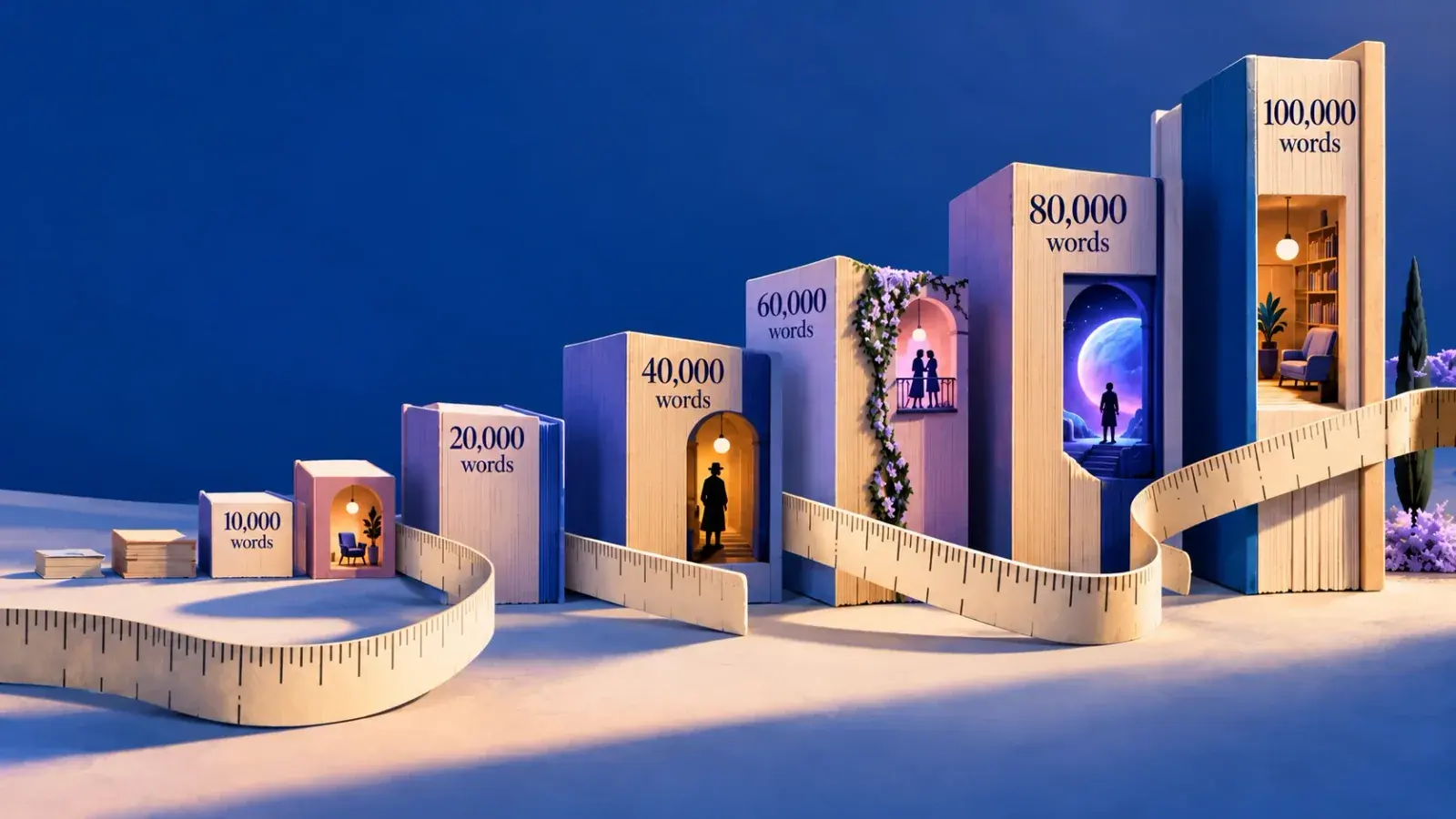
The average adult reads English silently at about 238 words per minute for nonfiction and 260 for fiction. Those are the estimates from a 2019 meta-analysis by Marc Brysbaert, a psychologist at Ghent University, who pooled 190 studies covering 18,573 readers. Most adults fall between 175 and 300 words per minute for nonfiction and between 200 and 320 for fiction. Read aloud, the average drops to 183.
That is slower than the 300 words per minute quoted almost everywhere, and the gap matters when you work out how long your chapter, book or talk will take.
Reading speed at a glance
| Kind of reading | Words per minute | Source |
|---|---|---|
| Kind of readingSilent, nonfiction | Words per minute238 (most adults 175–300) | SourceBrysbaert 2019, 190 studies |
| Kind of readingSilent, fiction | Words per minute260 (most adults 200–320) | SourceBrysbaert 2019 |
| Kind of readingReading aloud | Words per minute183 | SourceBrysbaert 2019, 77 studies |
| Kind of readingEveryday speech | Words per minuteAbout 150 | SourceNational Center for Voice and Speech, US English |
| Kind of readingAudiobook narration | Words per minute140–180 | SourceFigures cited by Brysbaert |
| Kind of readingStudying to remember | Words per minuteAbout 100, often less | SourceBrysbaert 2019 |
| Kind of readingSkimming | Words per minuteAbout 450 | SourceRonald Carver's estimate |
| Kind of readingScanning for a word | Words per minuteAbout 650 | SourceRonald Carver's estimate |
The top rows are averages across many studies, so treat each as the middle of a wide band. Two equally educated readers can differ by a hundred words a minute, and the same reader gets through a thriller faster than a tax guide. The bottom two rows are not reading in the ordinary sense. Brysbaert found clear evidence for only one change of gear, from reading for meaning to scanning for a particular word.
Why you keep seeing 300 wpm
The 300 figure has a long pedigree. In 1901 the psychologist Edmund Huey timed 20 university students reading pages of a novel and recorded normal silent reading at 321 and 355 words a minute. His 1908 book, The Psychology and Pedagogy of Reading, carried those numbers into the field. Later, Ronald Carver built a theory of reading "gears" with ordinary reading set at 300, and Keith Rayner's influential 1978 review illustrated normal reading with a table of ten skilled readers who averaged 308.
The trouble was who got tested and for how long. Samples were small and drawn from university students: Brysbaert argues that Rayner's ten readers most likely came from an earlier study at MIT. Many tests lasted a minute or two, on easy text. Meanwhile the Nelson-Denny Reading Test, used by colleges to screen for reading problems, kept producing norms of around 250.
Brysbaert pooled every usable study he could find from 1901 to 2019. He also ran a small study of his own: 48 regular readers timed themselves reading the next book on their list, start to finish. Their average was 260 words a minute, and only 11 of the 48 beat 300, although all of them had studied at university, 14 held doctorates, and many of the books were page-turners.
Three hundred words a minute is a perfectly good pace. It just isn't the average.
How long it takes to read
Divide the word count by the reading speed. The table uses the two silent-reading averages and, for reading aloud, 150 words a minute, the average rate of speech for American English speakers according to the National Center for Voice and Speech.
| Words | What that is | Nonfiction, 238 wpm | Fiction, 260 wpm | Aloud, 150 wpm |
|---|---|---|---|---|
| Words250 | What that isOne manuscript page | Nonfiction, 238 wpm1 min | Fiction, 260 wpm1 min | Aloud, 150 wpm2 min |
| Words500 | What that isA wedding toast | Nonfiction, 238 wpm2 min | Fiction, 260 wpm2 min | Aloud, 150 wpm3 min |
| Words1,000 | What that isA long blog post | Nonfiction, 238 wpm4 min | Fiction, 260 wpm4 min | Aloud, 150 wpm7 min |
| Words3,000 | What that isA typical chapter | Nonfiction, 238 wpm13 min | Fiction, 260 wpm12 min | Aloud, 150 wpm20 min |
| Words7,500 | What that isLongest short story | Nonfiction, 238 wpm32 min | Fiction, 260 wpm29 min | Aloud, 150 wpm50 min |
| Words20,000 | What that isA short novella | Nonfiction, 238 wpm1 h 24 min | Fiction, 260 wpm1 h 17 min | Aloud, 150 wpm2 h 13 min |
| Words40,000 | What that isWhere a novel starts | Nonfiction, 238 wpm2 h 48 min | Fiction, 260 wpm2 h 34 min | Aloud, 150 wpm4 h 27 min |
| Words80,000 | What that isA typical debut novel | Nonfiction, 238 wpm5 h 36 min | Fiction, 260 wpm5 h 8 min | Aloud, 150 wpm8 h 53 min |
| Words100,000 | What that isA long debut | Nonfiction, 238 wpm7 h | Fiction, 260 wpm6 h 25 min | Aloud, 150 wpm11 h 7 min |
| Words120,000 | What that isLong fantasy | Nonfiction, 238 wpm8 h 24 min | Fiction, 260 wpm7 h 42 min | Aloud, 150 wpm13 h 20 min |
For a page count, convert to words first. A double-spaced manuscript page holds about 250 words. A printed paperback page holds roughly 250 to 350, depending on trim size, font and spacing, so 100 printed pages take somewhere between an hour and a half and two and a quarter hours at fiction pace.
Famous books make the numbers concrete. Public-domain titles below use the word counts published by Standard Ebooks.
| Book | Words | At 260 wpm |
|---|---|---|
| BookA Christmas Carol, Charles Dickens (1843) | Words28,626 | At 260 wpm1 h 50 min |
| BookThe Great Gatsby, F. Scott Fitzgerald (1925) | Words48,465 | At 260 wpm3 h 6 min |
| BookHarry Potter and the Philosopher's Stone, J.K. Rowling (1997) | Words76,944 | At 260 wpm4 h 56 min |
| BookFrankenstein, Mary Shelley (1818) | Words77,898 | At 260 wpm5 h |
| BookPride and Prejudice, Jane Austen (1813) | Words121,970 | At 260 wpm7 h 49 min |
| BookDracula, Bram Stoker (1897) | Words161,105 | At 260 wpm10 h 20 min |
| BookMoby-Dick, Herman Melville (1851) | Words211,202 | At 260 wpm13 h 32 min |
| BookHarry Potter and the Order of the Phoenix, J.K. Rowling (2003) | Words257,045 | At 260 wpm16 h 29 min |
Reading-time labels disagree because every site picks its own divisor. Standard Ebooks lists Pride and Prejudice at 7 hours 24 minutes because its code assumes 275 words a minute. The "min read" label at the top of this page divides by 220, slower than average, to leave time for the tables.
What changes your speed
Word length and difficulty
Much of the gap between fiction and nonfiction comes down to word length. Words in English fiction average 4.2 letters, in nonfiction 4.6. Longer words usually mean harder text, which is also why most readability formulas measure word length, in syllables or letters, alongside sentence length. In one older study Brysbaert cites, readers took easy passages at 262 words a minute and difficult ones at 182.
He offers a formula for adjusting the average to a particular English text: expected speed equals 238 × 4.6 ÷ the text's average word length in letters. Word and Google Docs both report characters without spaces. Divide that by the word count for the average. Punctuation makes the figure a little high, which errs toward a slower, safer estimate.
A 3,000-word thriller chapter has 13,200 characters without spaces: 4.4 per word. 238 × 4.6 ÷ 4.4 = 249 words a minute, so the chapter takes about 12 minutes.
A 3,000-word history chapter with longer words, 5.1 per word: 238 × 4.6 ÷ 5.1 = 215 words a minute, or about 14 minutes. Same length, two extra minutes.
Why you are reading
Reading to remember is slower. When people study a text for a test, Brysbaert puts the pace at about 100 words a minute and often lower, mostly because they go back and reread. Skimming is faster but works differently: it looks like scanning broken up by bursts of real reading. You catch what lands in the parts you read and miss the rest.
Age and language
The averages describe adults of about 18 to 60 reading their first language. Children read more slowly, and their speed climbs through school. In healthy adults, silent reading is not expected to slow before about 60 to 65. A second language costs a lot: Dutch-English bilinguals who read half a novel in Dutch and half in English were 17 percent slower in English, and second-language rates under 100 words a minute are not unusual.
Real life versus the lab
People in studies know they are being timed. At home they drift. In one experiment readers reported unrelated thoughts on 36 percent of sentences in easy texts and 42 percent in difficult ones. In another, students took 34 minutes to read a textbook chapter in the lab and 1 hour 9 minutes at home, with similar quiz scores. The lab figures still hold up for books people want to read. When an e-reader company reported in 2012 that the average reader finished Mockingjay in about seven hours, that came to roughly 241 words a minute for a book of about 101,000 words.
Screens matter less than people expect. In one study undergraduates read Dracula for three one-hour sessions, two on LCD screens and one on paper, and their speed did not differ between them. They averaged 248 words a minute.
Speed reading has a ceiling
Your eyes set a limit. They stop on a word for about a fifth to a quarter of a second, take in seven or eight letters clearly, then jump. The reading scientist Mark Seidenberg's rough arithmetic, quoted in Brysbaert's review: four fixations a second is 240 a minute, times seven letters is 1,680 letters, divided by six for an average word plus its space is 280 words a minute.
A 2016 review led by Keith Rayner in Psychological Science in the Public Interest examined speed-reading courses and apps and found a trade-off between speed and comprehension: readers are unlikely to double or triple their speed and understand as much. Flashing one word at a time does not get around it. In one study, readers shown a novel's first chapter that way, with a pause button, settled at about 200 words a minute and understood less than people who read it as a book. What does make readers faster over the years, the review concludes, is practice and a bigger vocabulary.
Measure your own reading speed
Online tests usually time a passage of a minute or two. A real book gives a truer number.
- Pick a book you would read anyway, of the kind you usually read.
- Count the words in ten full lines, divide by ten, and multiply by the lines on a full page. That is your words per page.
- Read normally for at least ten minutes, ideally twenty or thirty, and stop at the end of a page.
- Multiply pages by words per page and divide by the minutes.
- Check yourself: if you cannot say what happened in those pages, you were skimming, and the number is too high.
Ten full lines hold 104 words, and a page has 31 lines, so a page is about 322 words. You read 14 pages in 17 minutes: 14 × 322 = 4,508 words, divided by 17 is 265 words a minute. That is just above the fiction average.
To see whether your speed changes over months, add a column for pages and minutes to a reading journal. Brysbaert notes that one-minute tests vary far more between studies than long ones, so the longer sessions are the ones to trust.
Reading speed for writers
Words per minute turns length into time, which is how readers feel a book. The 70,000 to 100,000 words that agents expect of most adult debut novels is four and a half to six and a half hours of reading at fiction pace. A 3,000-word chapter is about 12 minutes and a 5,000-word chapter about 19. How long a chapter should be covers the conventions by genre.
Ask your beta readers to note how long each sitting took and where they stopped. A chapter that takes much longer than its word count predicts is often one where they slowed down to reread, which is worth knowing before an editor sees it. If you write in Strokes, export the draft as EPUB so they can read it on an e-reader or phone, the way they read published books.
Out loud the arithmetic changes. Audiobook narration at 140 to 180 words a minute turns an 80,000-word novel into roughly 7.5 to 9.5 hours of audio. For a talk, plan on 130 to 150 words a minute so there is room to pause: the guide to writing a speech shows how to budget the minutes. For a blog post or newsletter, 238 is the honest divisor for nonfiction. A 1,200-word post is a five-minute read, not three.
For typical word counts by genre, read how many words is a novel. For the counts behind famous books, see how many words is Harry Potter, and at the far ends of the shelf, the longest book ever written and short books to read in a weekend.
Frequently asked questions
Is 300 words per minute a good reading speed?
Yes, it is faster than average. Marc Brysbaert's 2019 meta-analysis puts the average adult at about 238 words per minute for nonfiction and 260 for fiction, with most adults between 175 and 320. At 300 you are near the top of the normal range.
How long does it take to read a novel?
About 5 to 6.5 hours for a typical 80,000- to 100,000-word novel at the average fiction speed of 260 words per minute. Divide the word count by your own speed for a personal estimate.
How long does it take to read 100 pages?
About 1.5 to 2.25 hours at 260 words per minute. A printed paperback page holds roughly 250 to 350 words, so 100 pages is 25,000 to 35,000 words. One hundred double-spaced manuscript pages, at about 250 words each, take a little over an hour and a half.
How many words per minute do people speak?
About 150 for American English, according to the National Center for Voice and Speech. Reading aloud averages 183 in studies, and audiobook narration usually runs 140 to 180. For a speech in front of an audience, plan on 130 to 150 so there is room to pause.
Can you learn to speed read?
You can go faster by skimming, but you understand less. A 2016 review led by Keith Rayner found that readers are unlikely to double or triple their speed while understanding as much. Practice and a bigger vocabulary make reading faster over time.